
A complete issue · 16 pages · 1886
Life — April 29, 1886
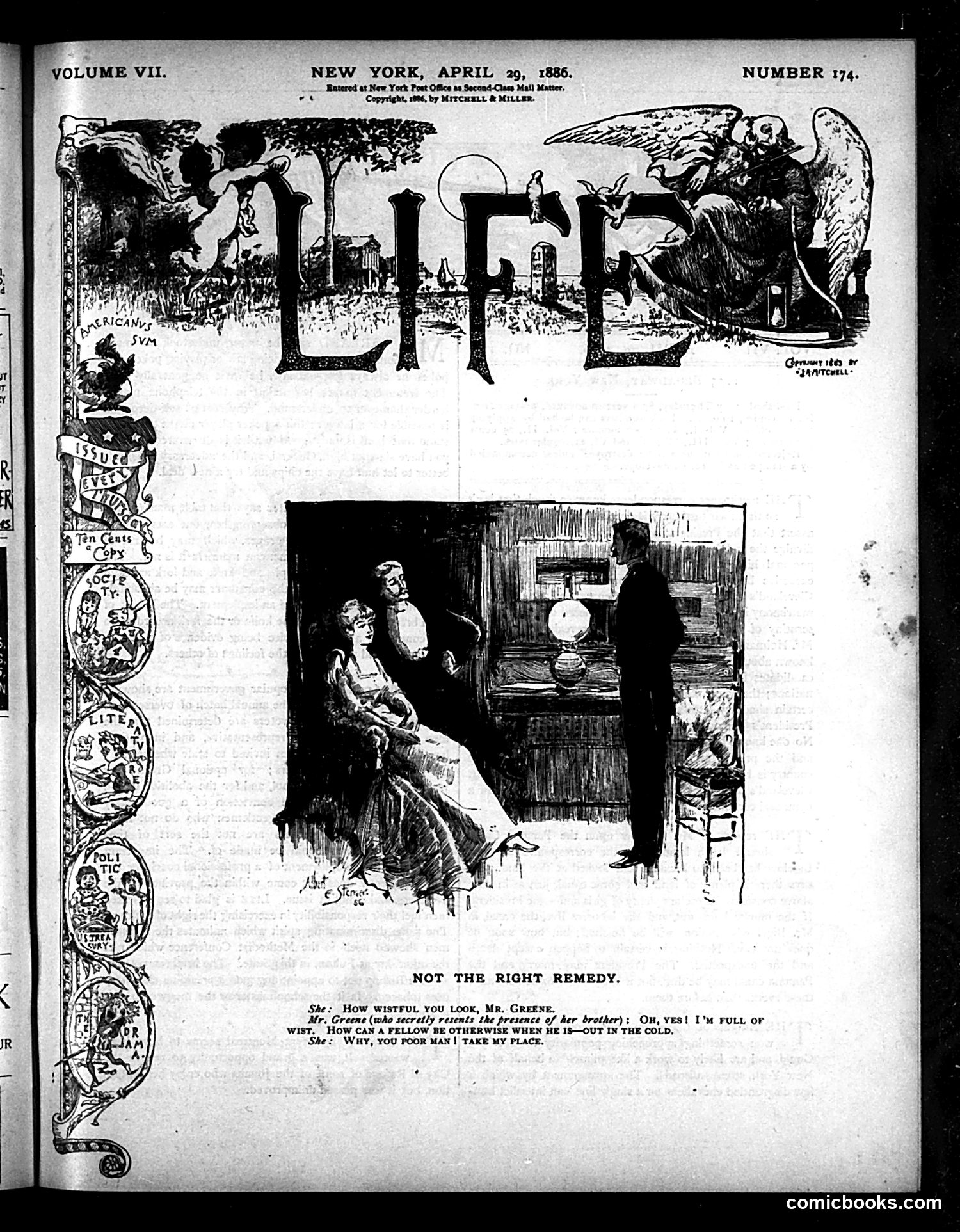
This cartoon satirizes a domestic dispute resolution. A woman sits while a man stands nearby, and another man offers to replace him, saying "Why, you poor man! Take my place." The woman's complaint about her husband (apparently Mr. Greene) is that he's "full of whiskey" and neglectful. The title "Not the Right Remedy" suggests the cartoon mocks the proposed solution—having another man take the husband's place—as absurd and inappropriate for addressing alcoholism and marital problems. The joke likely critiques both the husband's drinking and the ridiculous "remedy" proposed. This reflects 1880s concerns about alcohol's social impact on families and marriages, while satirizing unhelpful or absurd proposed solutions to domestic troubles.
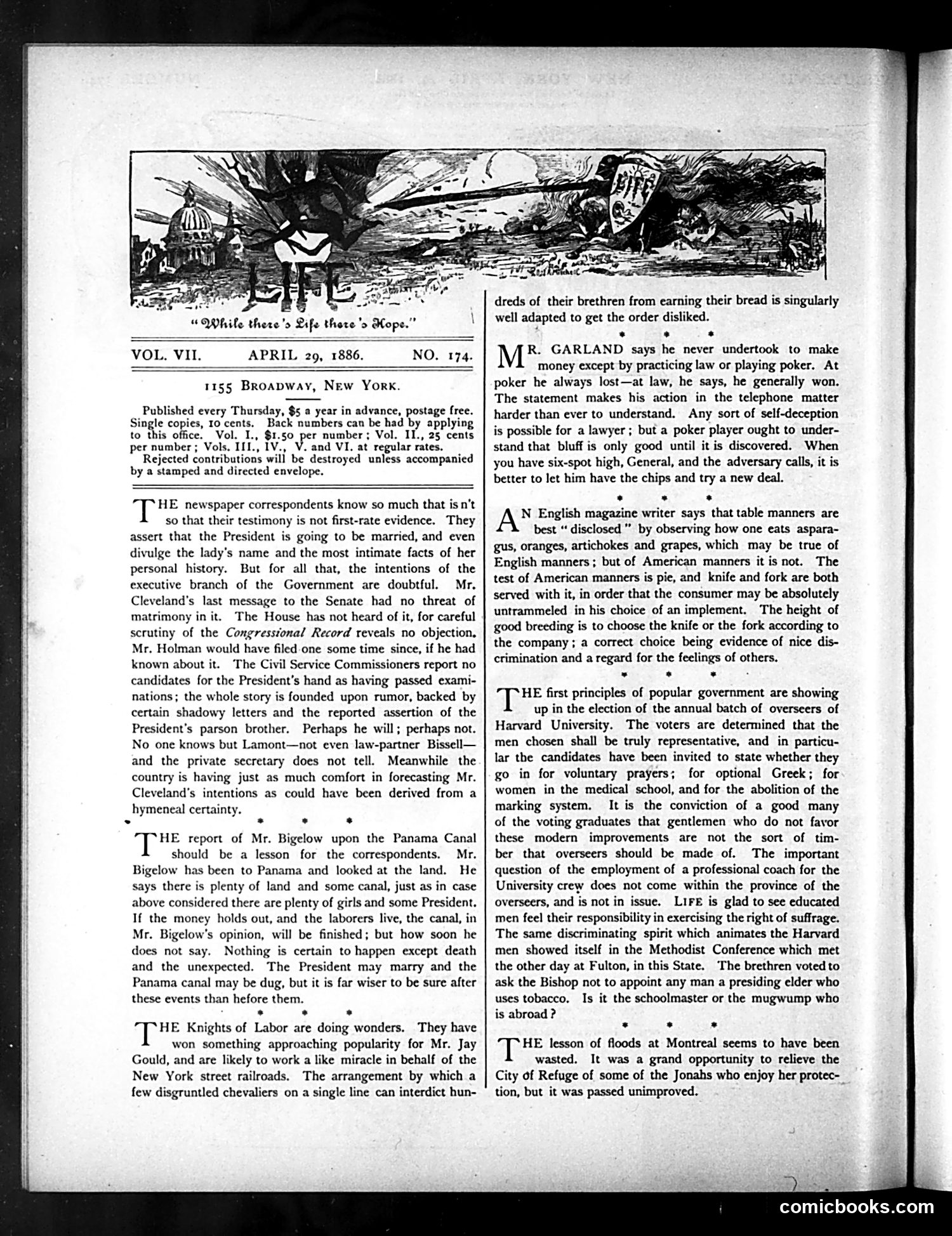
The cartoon at the top, captioned "While there's Life there's Hope," depicts a dark allegorical scene with what appears to be classical or mythological figures amid destruction and chaos. The specific identities of the figures are unclear from the image quality, but the composition suggests commentary on contemporary crisis or social upheaval. The page itself consists primarily of editorial commentary rather than humor. Articles discuss President Cleveland's marriage rumors, the Panama Canal project under Mr. Bigelow, labor activism by the Knights of Labor regarding New York railroads, and Harvard University's governance reforms. The satirical approach is subtle—using ironic observation rather than caricature—typical of Life's editorial style in this era.
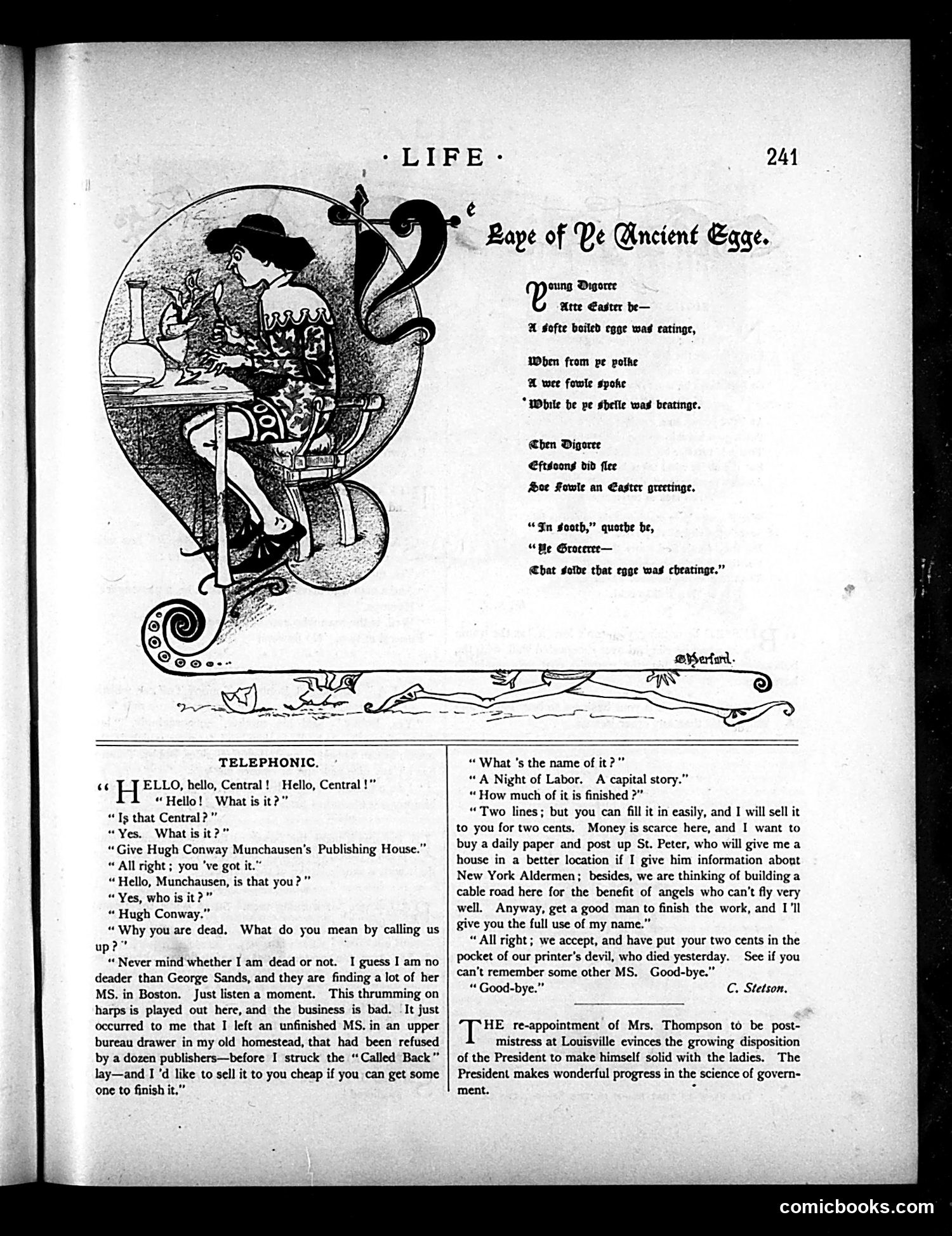
The top illustration is a decorative poem about Easter eggs and their consumption. The ornate medieval-style lettering and illustration suggest mock-archaic language, a common satirical device in *Life* magazine. Below, the "Telephonic" section is a humorous dialogue between someone at "Central" (a telephone operator) and Hugh Conway Munchausen of a publishing house. The joke plays on the name "Munchausen"—famous for tall tales—as the publisher discusses trying to sell an unfinished manuscript for two cents, attempting to find someone to complete it. The satire mocks both publishing industry desperation and the absurdity of the situation itself, treating the ridiculous business proposal as mundane telephone conversation fodder.
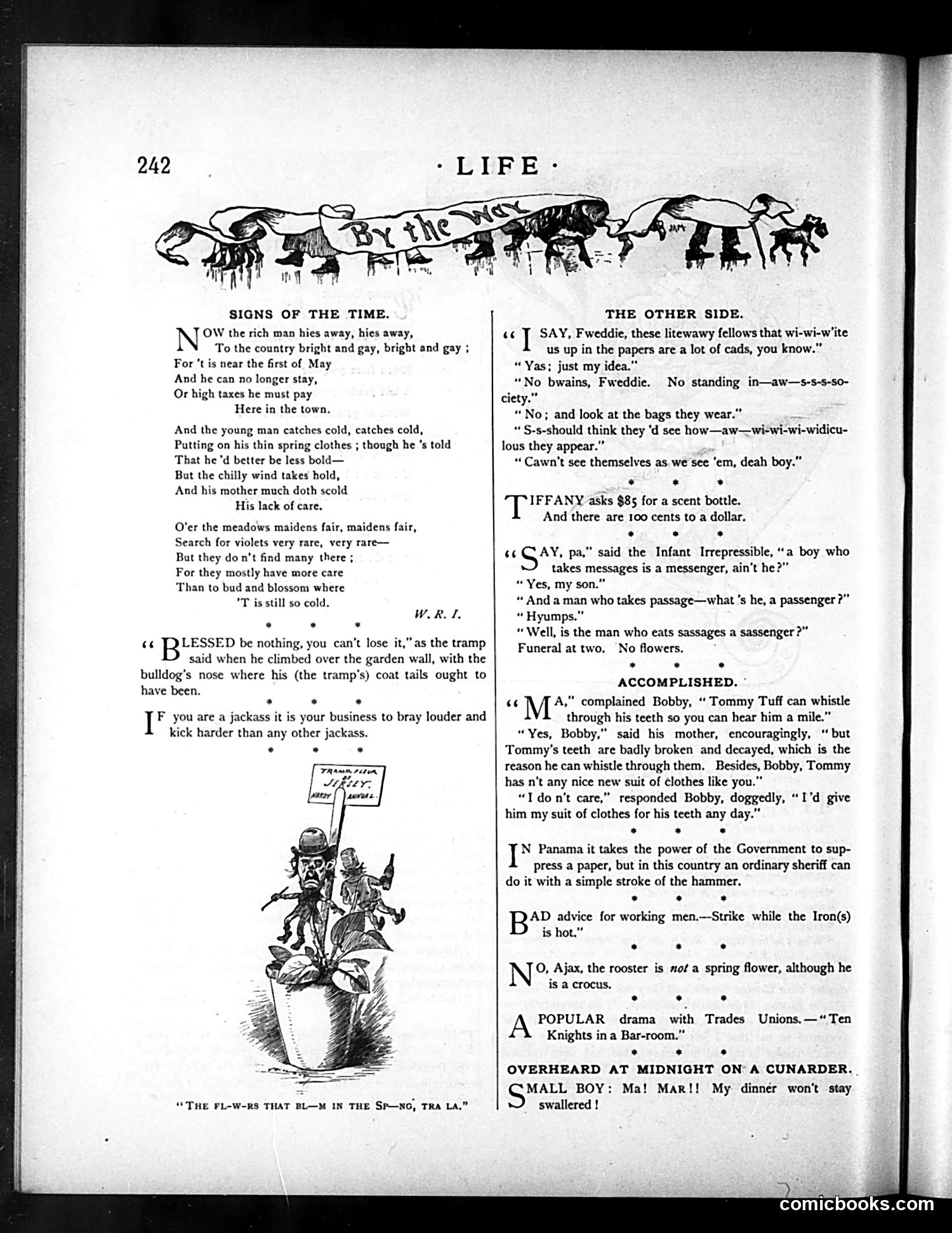
This page contains humorous short pieces and social commentary typical of Life's satirical style, rather than political cartoons requiring historical context. The main cartoon depicts a disheveled figure emerging from a flowerpot, labeled "THE FL-W-RS THAT BL-M IN THE SP-NG, TRA LA" — a play on the nursery rhyme, with vowels removed for comic effect. This appears to mock Victorian sentimentality about spring. The right-side column "THE OTHER SIDE" presents quick jokes about urban life: satirizing bohemian poverty (discussing shabby clothing), mocking high-end luxury goods (Tiffany's scent bottles), and poking fun at various social types and their pretensions. The remaining pieces mock government inefficiency, labor relations, and middle-class aspirations through brief, witty observations—characteristic of Life's general-interest humor rather than commentary on specific contemporary events.
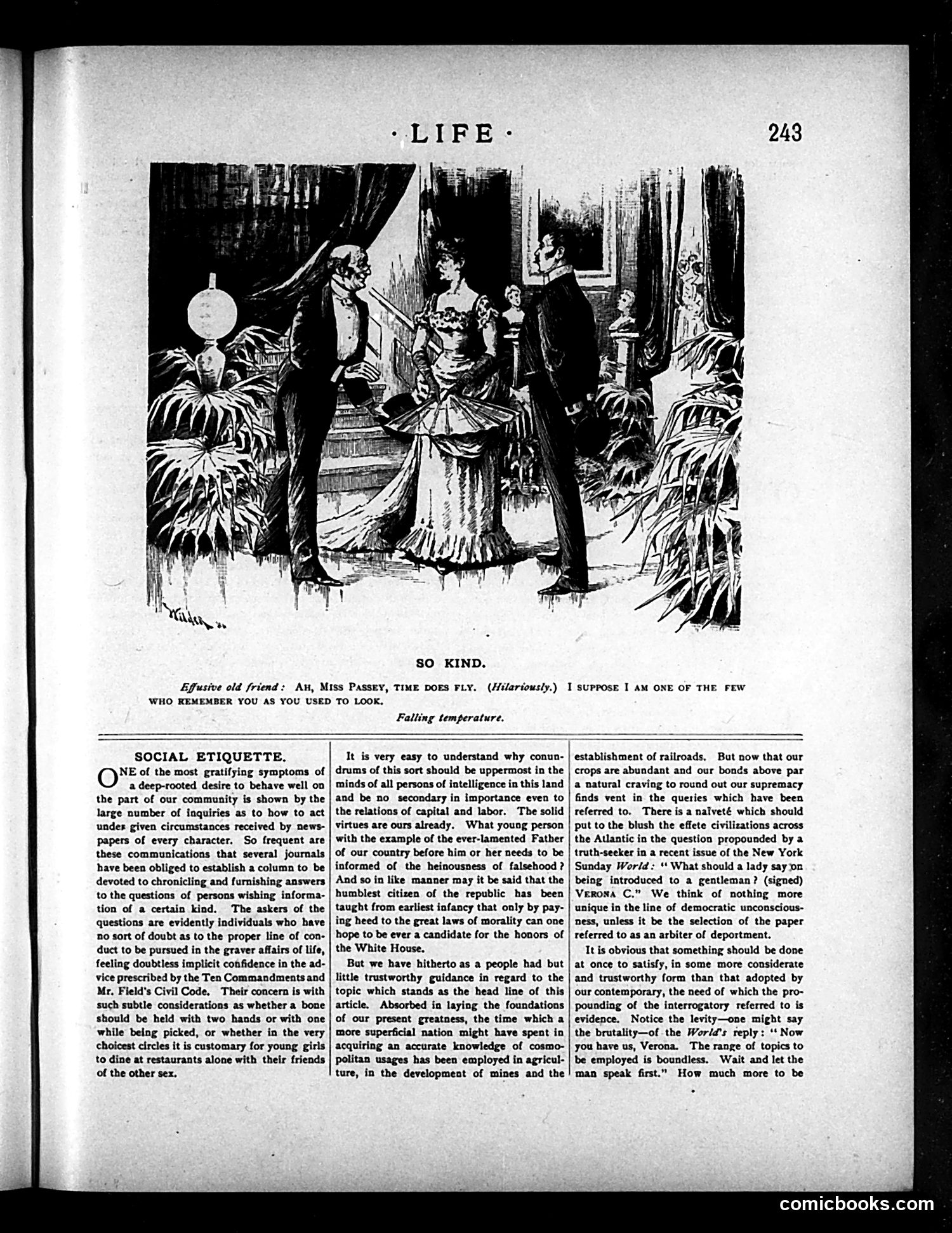
The cartoon depicts an elegant social gathering where a man addresses a woman, remarking on how she's aged ("Time does fly"). The satire targets **social hypocrisy and tactlessness**—the man's comment, framed as polite observation, is actually a cutting insult about her appearance. The accompanying article on "Social Etiquette" discusses proper conduct in society, emphasizing discretion and consideration. The cartoon illustrates the *opposite*: a supposedly refined gentleman making a backhanded compliment that violates basic courtesy. The humor relies on the gap between what passes for politeness in high society and actual kindness. The title "So Kind" is ironic—his remark is anything but kind, exposing how social conventions can mask rudeness.
This page contains **no political cartoons**. Instead, it features literary criticism and book reviews. The main content discusses **Andrew Lang's novel**, praising his ability to blend old-fashioned literary qualities with modern sensationalism. The reviewer compares Lang favorably to Hugh Conway and R.L. Stevenson, noting his satirical treatment of London fashion in a novel called *Maitland*. Below are **book reviews** and advertisements for recent publications, including works on New England history, poetry collections, and social commentary. The page also includes a brief humorous observation about children's unpredictability, unrelated to politics or current events. This is fundamentally a **literary-focused page** rather than satirical commentary on contemporary politics or social issues.
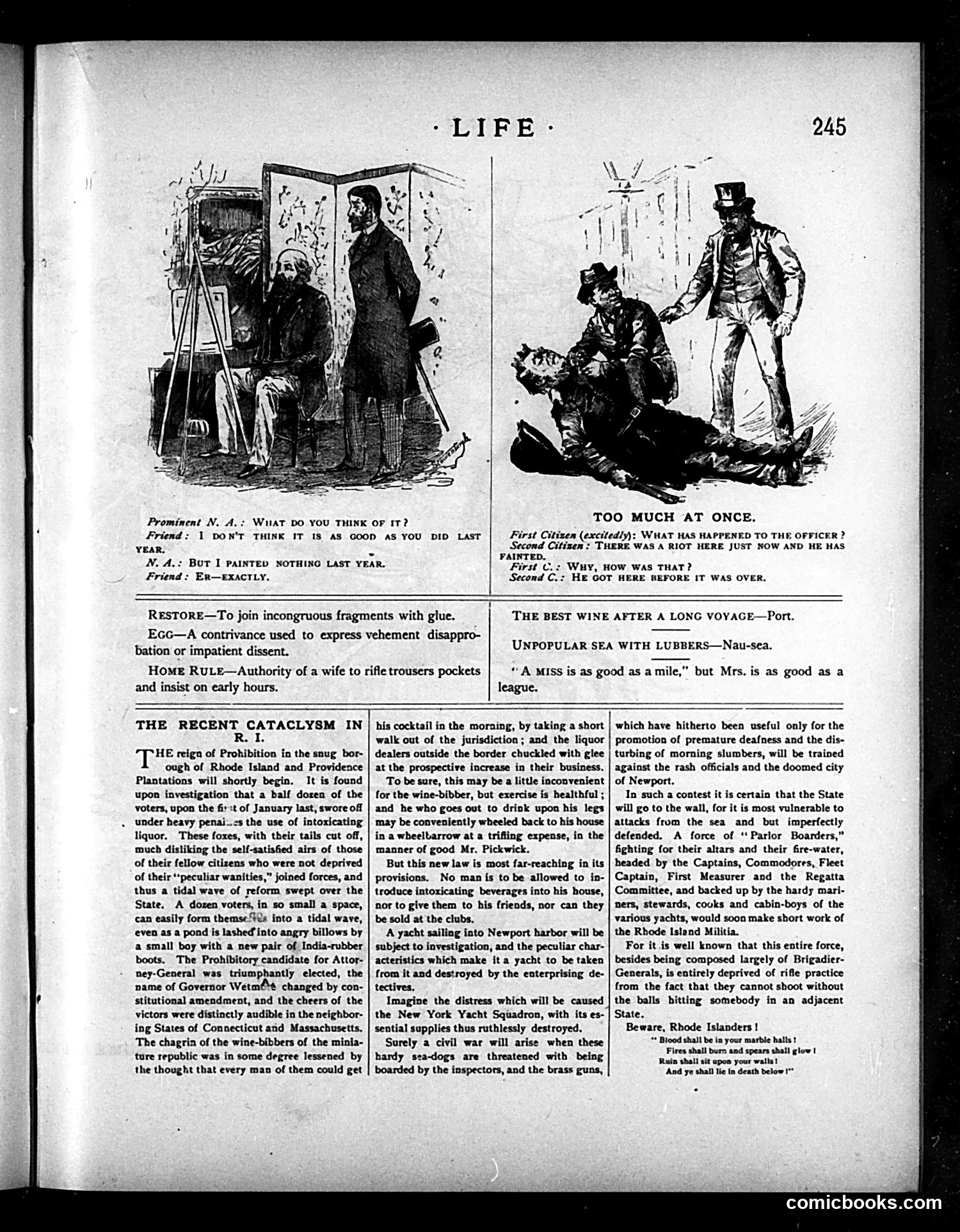
**Left cartoon:** A "Prominent N.A." (North American, likely an artist) shows work to a friend. The artist claims he "painted nothing last year," while the friend notes the current work "is as good as you did last year." The joke satirizes artistic pretension—the artist produces mediocre work consistently while making excuses. **Right cartoon ("Too Much at Once"):** Two well-dressed men discover an apparently injured or unconscious officer. One asks what happened; the other explains the officer "got here before it was over," implying he arrived too late to participate in some event (possibly a brawl or disturbance). The satire mocks the officer's tardiness or ineffectiveness. Both cartoons appear to target social hypocrisy and incompetence among the privileged classes.
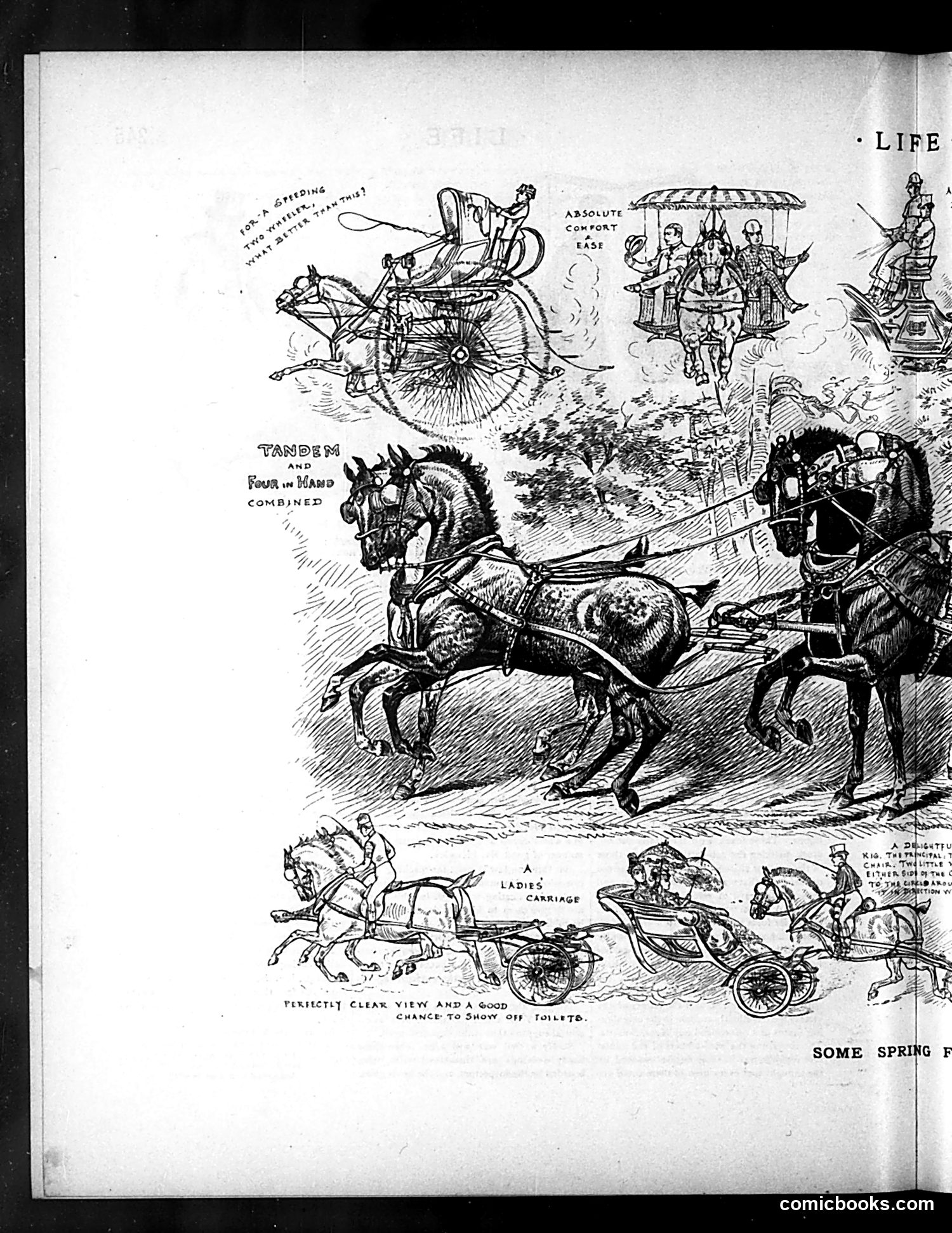
This satirical illustration from *Life* magazine depicts various fashionable horse-drawn carriages and conveyances of the spring season. The cartoons label different vehicle styles with humorous commentary: - "For a Careening" and "Absolute Comfort & Ease" describe elaborate passenger carriages - "Tandem and Four in Hand Combined" shows an ostentatious multi-horse setup - "Ladies' Carriage" depicts a simpler vehicle - "Variety Clear...Chance to Show Off Toilets" (meaning fine clothing) mocks the social function of carriages as displays of wealth and fashion The satire targets the upper class's obsession with conspicuous consumption—using expensive, elaborate carriages primarily to showcase their affluence and fashionable dress to society. The exaggerated, ornate designs emphasize the impracticality and vanity involved.
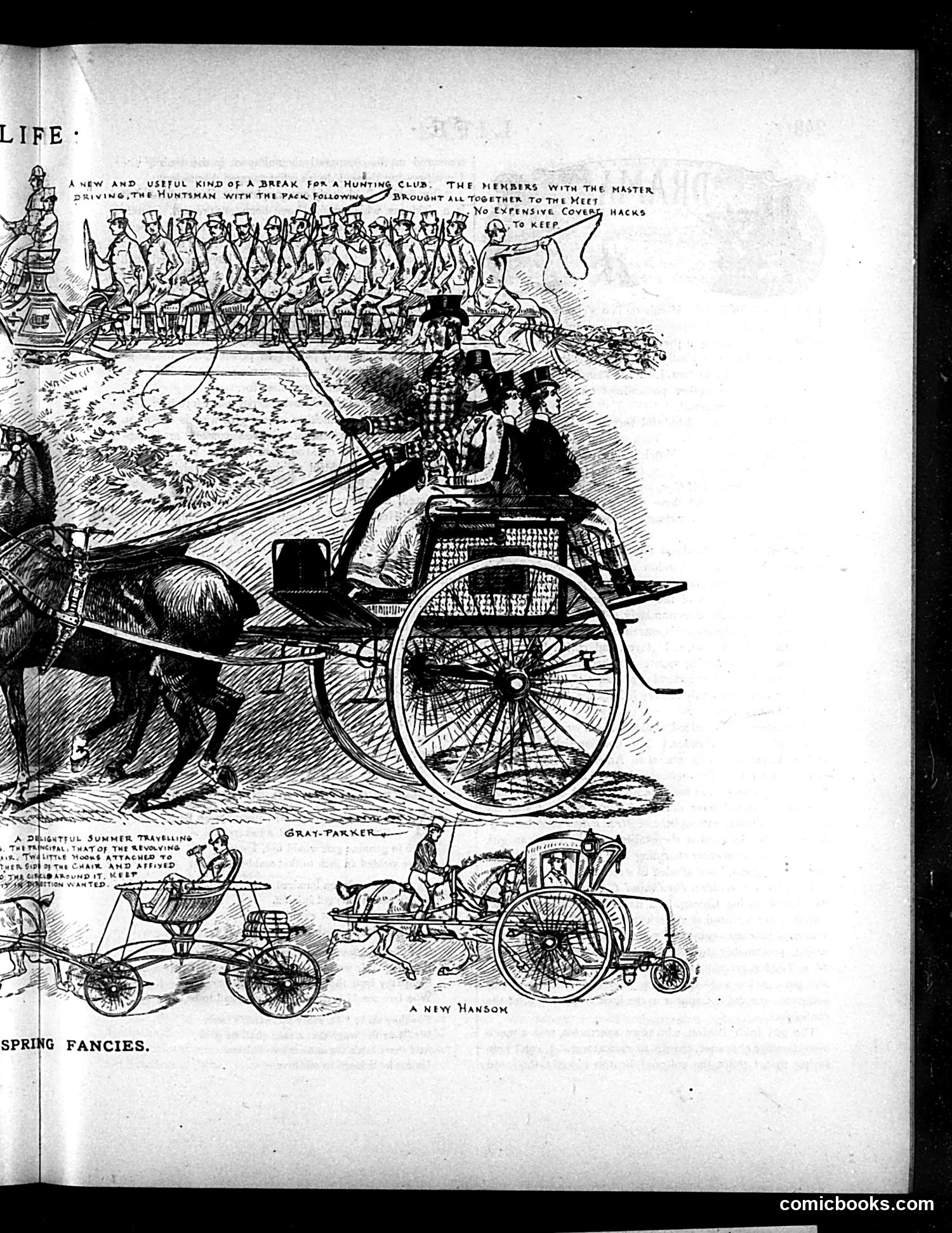
This page depicts "A New and Useful Kind of Break for a Hunting Club," showing an elaborate horse-drawn carriage carrying numerous club members seated along its top, with spectators lined up to watch. The satirical point mocks the pretentious leisure activities of wealthy hunting clubs during the era. Below are additional vehicle designs labeled "Gray-Parker" and "A New Hansom," suggesting humorous alternative transportation concepts for club outings. The overall satire targets upper-class recreational culture and the absurd, overcrowded contraptions devised for social gatherings. The exaggerated size of the vehicle and packed seating poke fun at both the conspicuous consumption and the impracticality of such elite pastimes. The tone is lighthearted social commentary on Gilded Age leisure culture.
This page reviews a play called "Our Society," an Americanized adaptation of a French work, performed at Madison Square Theatre. The reviewer celebrates the novelty of seeing *American* characters on stage—a Senator, a Chicago businessman, a Boston girl—rather than the predictable European aristocrats (lords, countesses in diaphanous gowns) that dominated imported theatrical fare. The satire targets American audiences' snobbish preference for European society dramas. The reviewer notes the irony: viewers found American characters charmingly funny precisely *because* they were unfamiliar—a pork-packer's daughter, a girl saying "I guess," someone mentioning street cars. The piece gently mocks both the provincialism of American theatergoers and their hunger for European sophistication, suggesting Americans found their own society exotic by contrast.
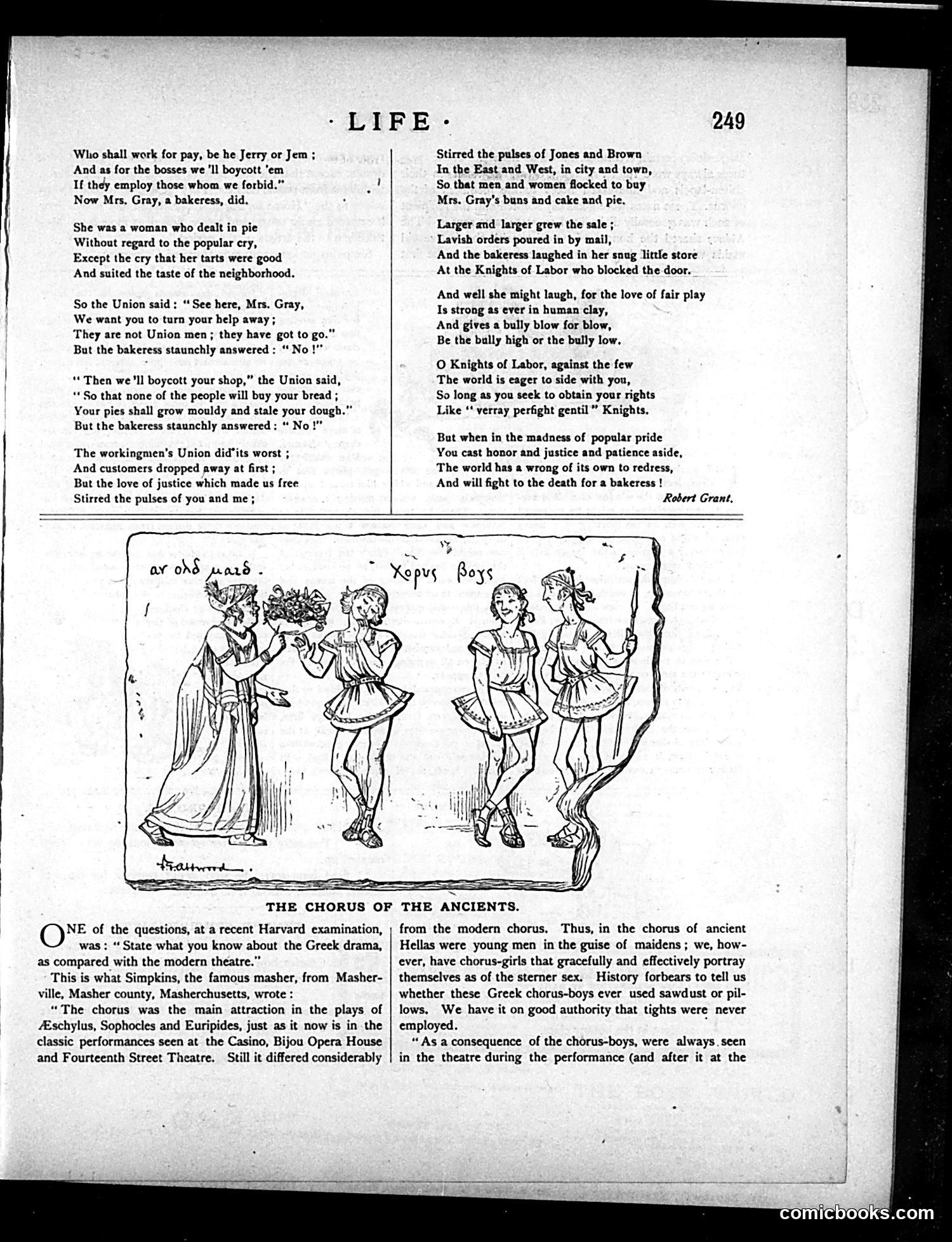
**Main Cartoon/Poem: "Mrs. Gray, the Bakeress"** This satirical poem attacks labor union tactics, specifically the **Knights of Labor** (a major late-19th-century labor organization). The narrative celebrates Mrs. Gray, a baker who refuses union demands to fire non-union workers. When the union boycotts her shop, the public supports her out of principle—customers flock to buy her goods to oppose what the poem frames as union bullying. **The satire's message**: Labor unions, despite claiming to fight for workers' rights ("Knights of Labor"), become tyrannical when they use coercive tactics like boycotts against small business owners. The poem argues that fair-minded people will ultimately reject such "madness of popular pride" and side with honest business owners defending their independence. **Lower Section: "The Chorus of the Ancients"** This is a humorous college exam answer comparing ancient Greek drama choruses to modern theater choruses. The joke relies on crude gender commentary: ancient choruses were men dressed as women; modern choruses are women dressed/acting as men—inverting traditional expectations in ways meant to amuse readers.
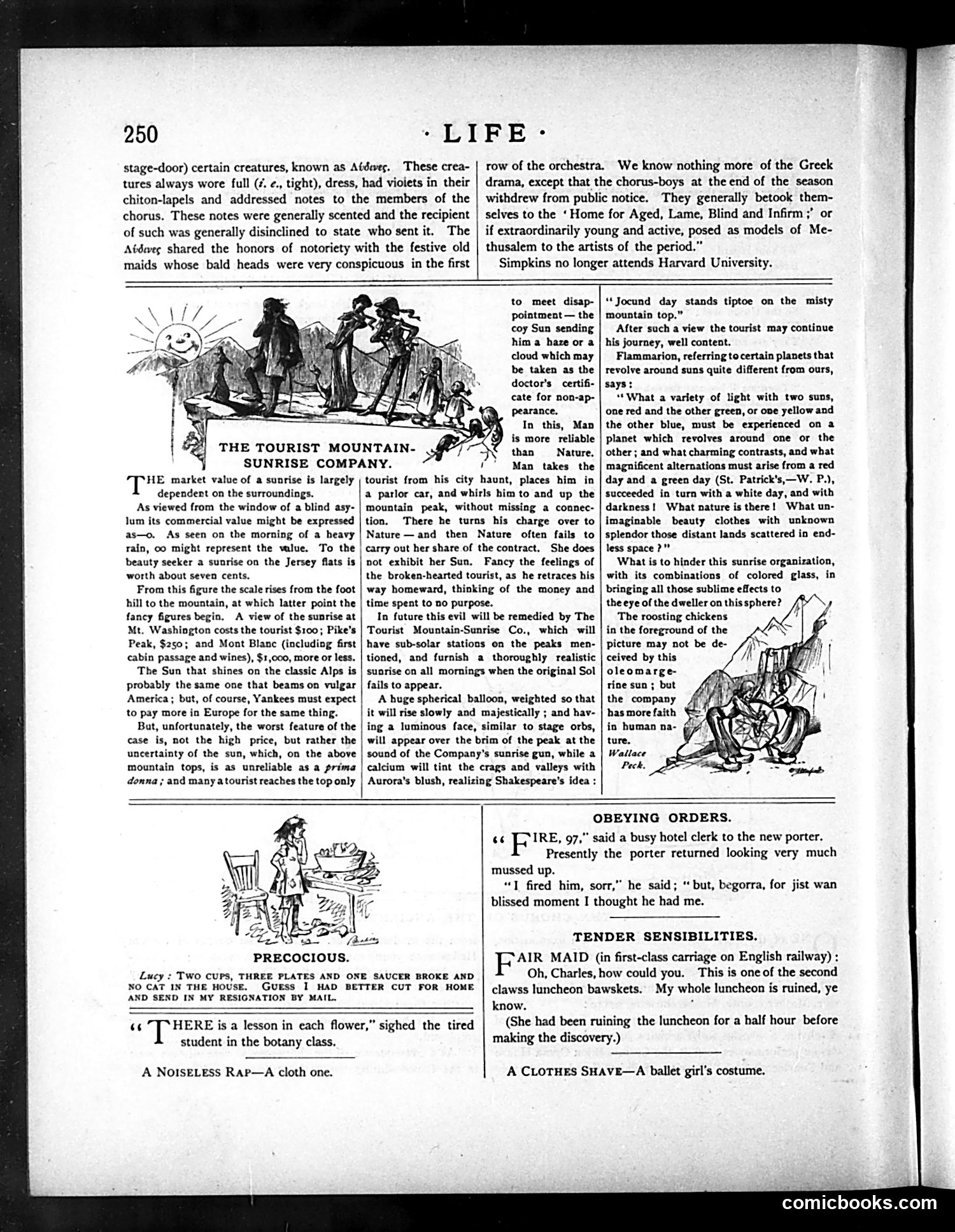
This satirical piece mocks the commercialization of natural beauty and American tourist culture. The cartoon depicts a scheme to guarantee sunrise views on mountain peaks—a response to disappointed tourists who paid premium prices (Pike's Peak costs $250; Mont Blanc $1,000) only to encounter clouds or haze. The satire targets two things: Nature's unreliability compared to human enterprise, and the absurdity of trying to commodify and guarantee aesthetic experiences. The proposed solution—a fake mechanical sunrise using a luminous balloon and calcium lighting—represents the ridiculous extreme of commercialism: literally replacing God's creation with theatrical artifice. The accompanying text about Greek theater's "Aldwes" (stage-door admirers) and the brief jokes about Harvard and hotel porters are unrelated filler content typical of *Life* magazine's miscellaneous humor format.
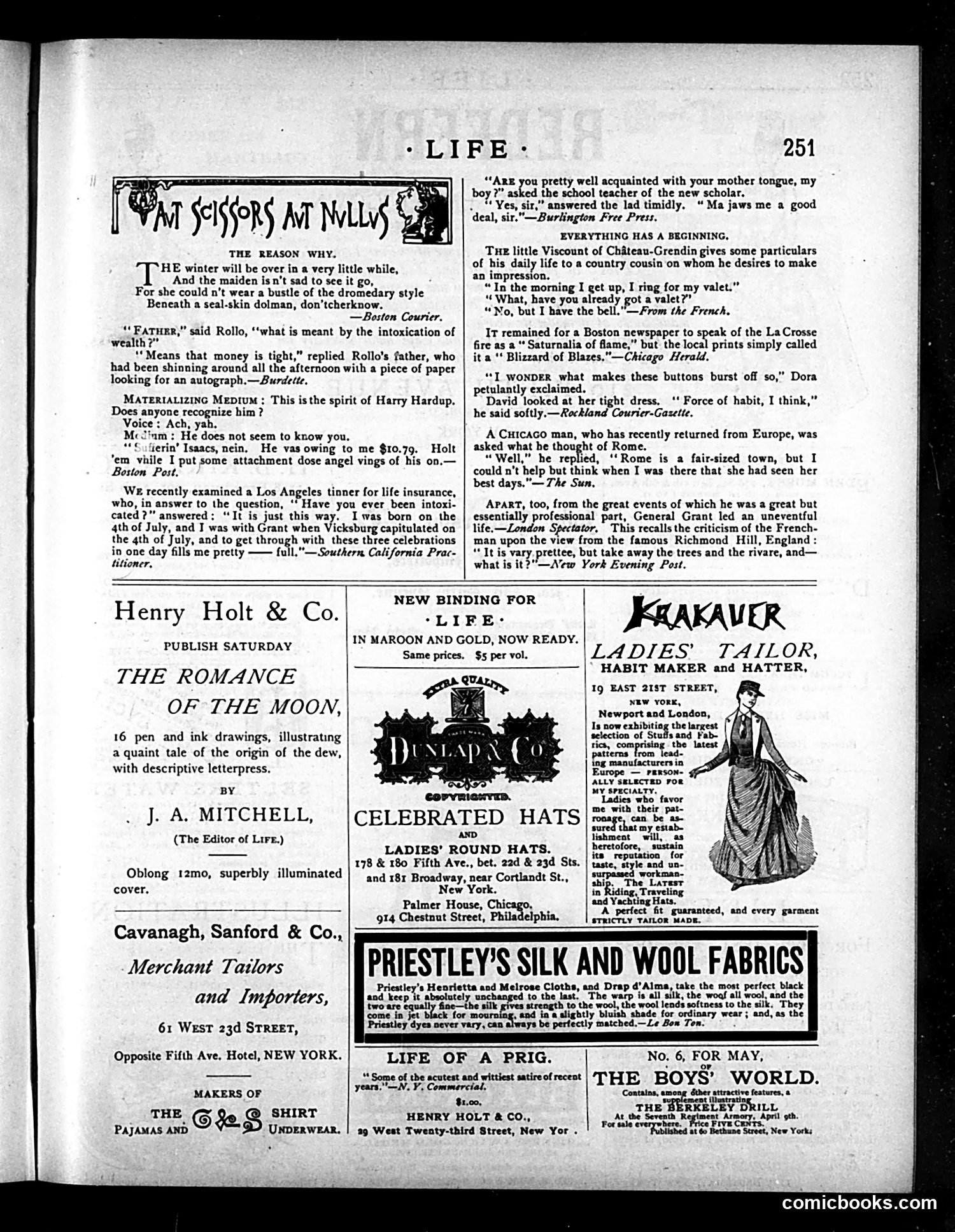
This page is primarily **advertisements and humor columns**, not political cartoons. The content consists of brief comic anecdotes—mostly one-liners and short jokes—typical of *Life* magazine's satirical format. The humor targets: - **Gender roles**: A joke about women's winter fashion (bustles and seal-skin coats) and tight corsets causing buttons to burst - **Class pretension**: A French viscount who owns no valet but has a bell to ring for one - **Wealthy anxieties**: A father frantically seeking an autograph, described as "intoxicated" by wealth - **Touristic ignorance**: A Chicago businessman dismissing Rome as merely "fair-sized" The jokes rely on **observational humor about everyday life**—fashion, class aspiration, parental discipline—rather than partisan politics. The page is dominated by period advertisements for tailors, hat makers, and publishers, with the humor squeezed between ads. No specific political figures or events are referenced.
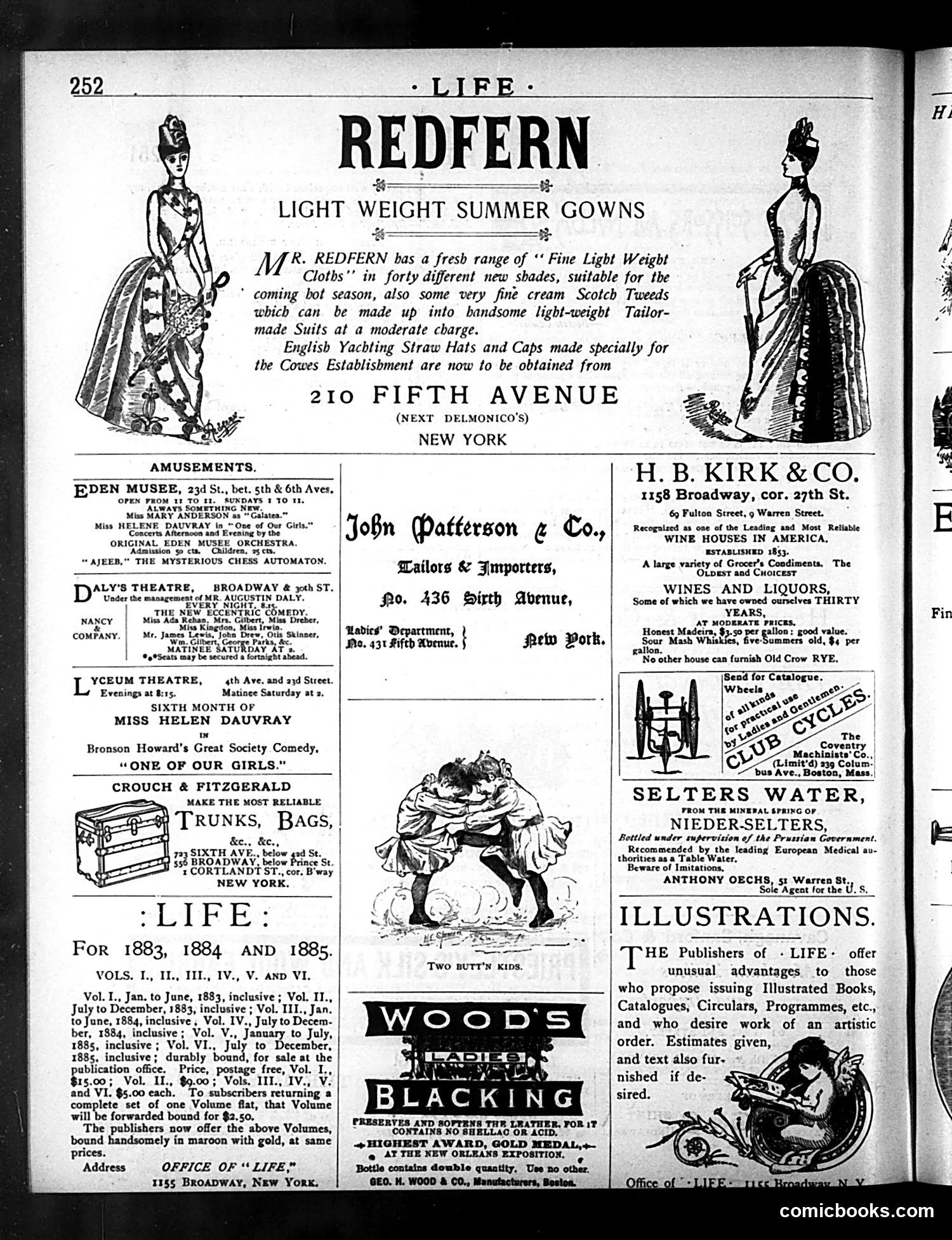
This is primarily an **advertising and announcements page** rather than a satirical cartoon page. The content includes: **Main Features:** - Top: Fashion advertisement for Redfern's lightweight summer gowns and yachting accessories (Fifth Avenue luxury goods) - Center: Single cartoon titled "Two Butt's Kids" showing what appears to be cherubs or putti in a playful scene—likely a humorous domestic or social commentary, though the specific reference is unclear without additional context **Surrounding Content:** Theater listings (Eden Musee, Daly's Theatre, Lyceum Theatre), luggage and tailoring advertisements, wine merchants, and notices about back issues of Life magazine itself. The cartoon's meaning requires knowledge of contemporary social references or individuals named "Butt" that isn't apparent from the image alone. The rest of the page reflects 1880s New York commercial life: theater, fashion, luxury goods, and periodical distribution.
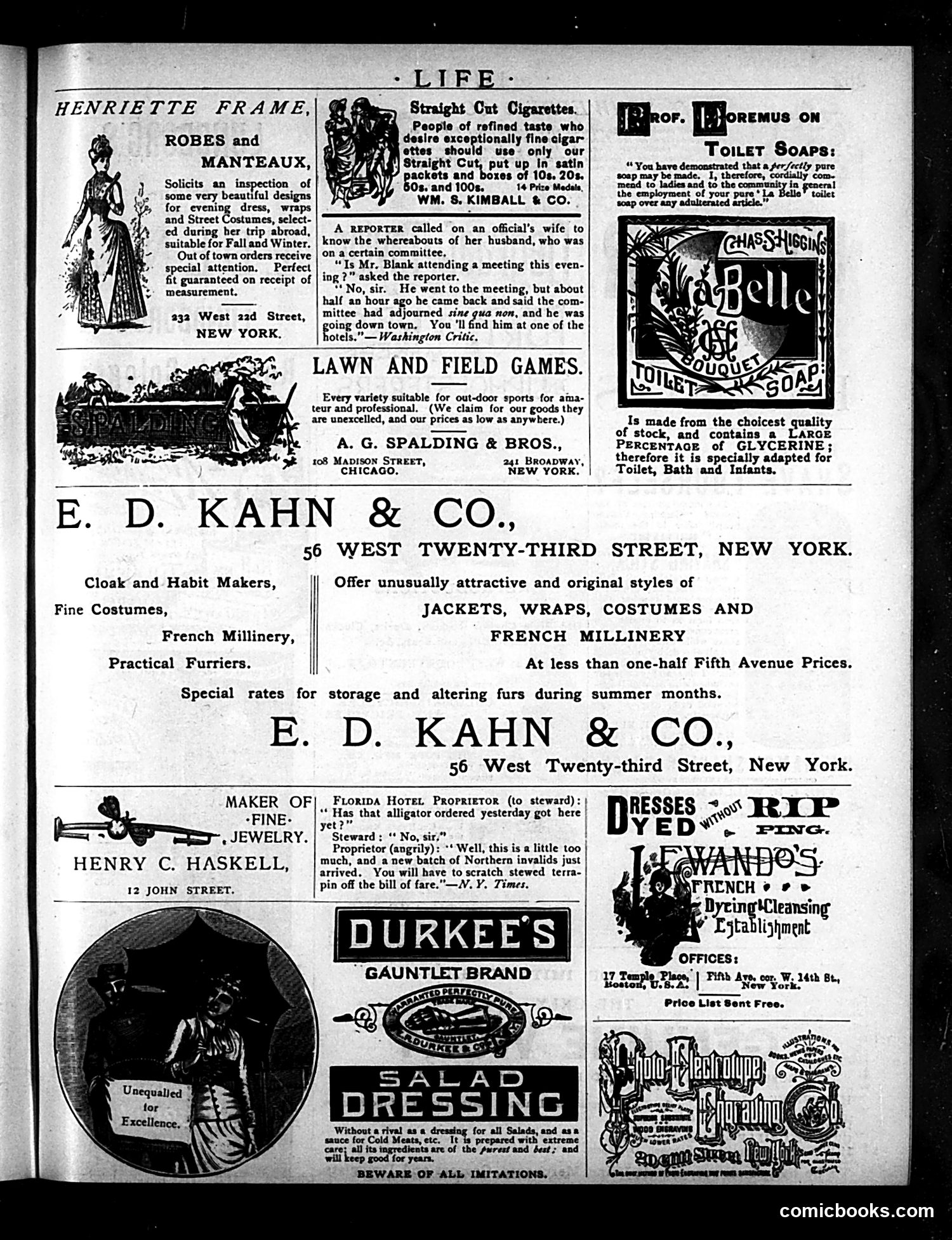
This is primarily an **advertising page** from Life magazine with one embedded joke. The satirical content is minimal: **The Joke:** A brief anecdote from the "Washington Critic" mocks bureaucratic absurdity. A reporter seeks an official's wife, asking if her husband will attend a committee meeting. She replies he attended but left early because the committee had adjourned "*sine qua non*" (a Latin phrase meaning "without which not" — logically nonsensical for ending a meeting). The husband then went to a hotel. The humor lies in the wife's apparent misuse of the Latin phrase, suggesting the official invented an excuse to avoid work, and the wife either doesn't understand or is complicit in the deception. **The Advertisements** include: women's clothing (Henriette Frame robes), cigarettes, lawn games equipment (Spalding), jewelry, soap, dresses, and salad dressing — typical late 19th-century consumer goods marketed to affluent readers. The page reflects Gilded Age commercial culture and gentle satire of political dishonesty.
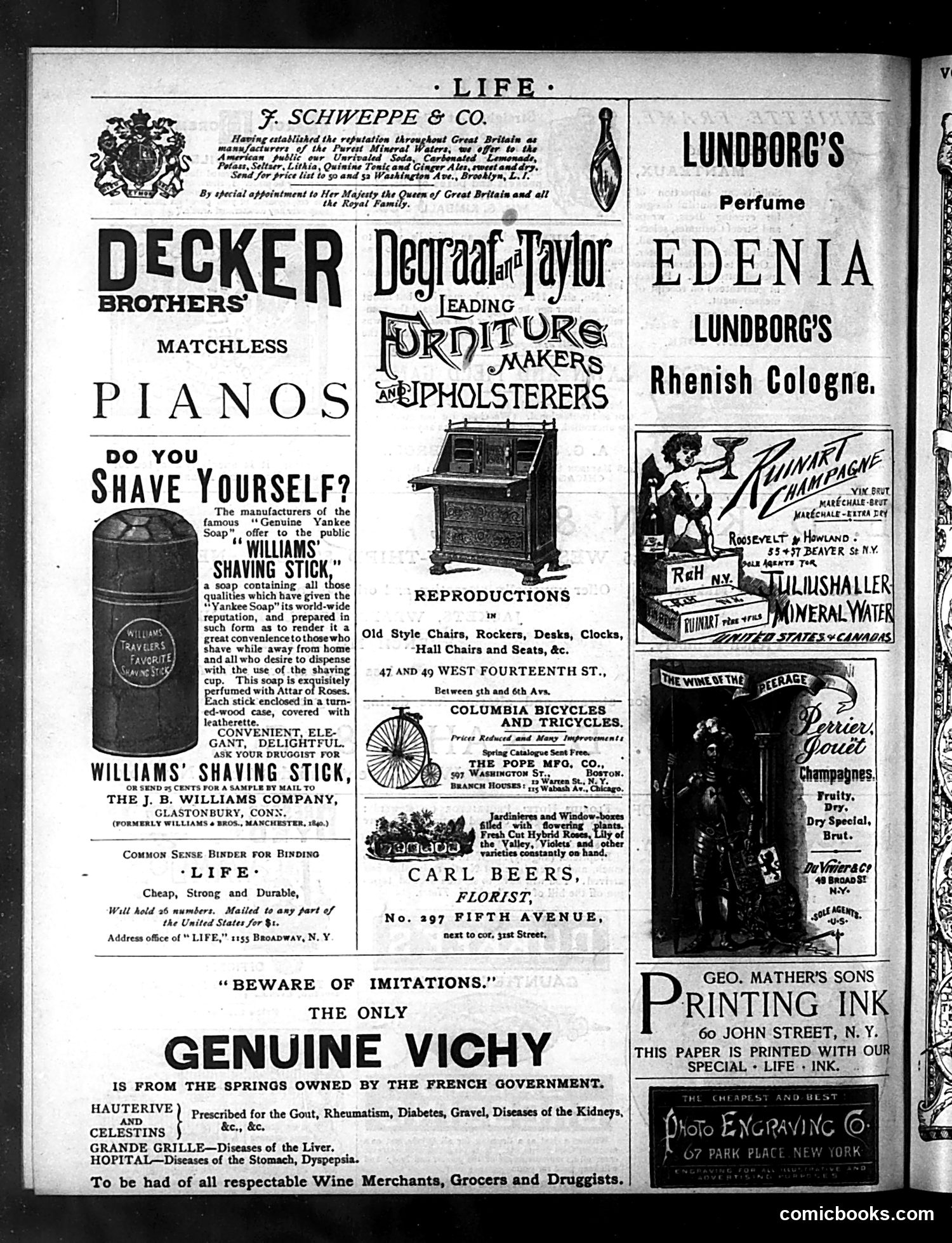
This page is primarily **advertisements**, not editorial content or satire. It's from a late 19th-century issue of *Life* magazine and showcases period consumer goods: pianos, shaving products, bicycles, furniture reproductions, mineral water, perfume, and printing ink. The ads reflect Victorian-era commerce and marketing conventions—claims of superiority ("matchless," "genuine"), royal endorsements, and appeals to convenience and quality. The Vichy water ad warns against counterfeits, a common concern when branded goods were becoming valuable. There is **no political cartoon or satire visible** on this page. It functions as a revenue-generating advertising section typical of 19th-century magazines, offering products to middle and upper-class readers. The only visual element is a furniture manufacturer's image of a desk and some small product illustrations.