
Life, 1886-04-29 · page 6 of 16
Life — April 29, 1886 — page 6: what you’re looking at
What you’re looking at
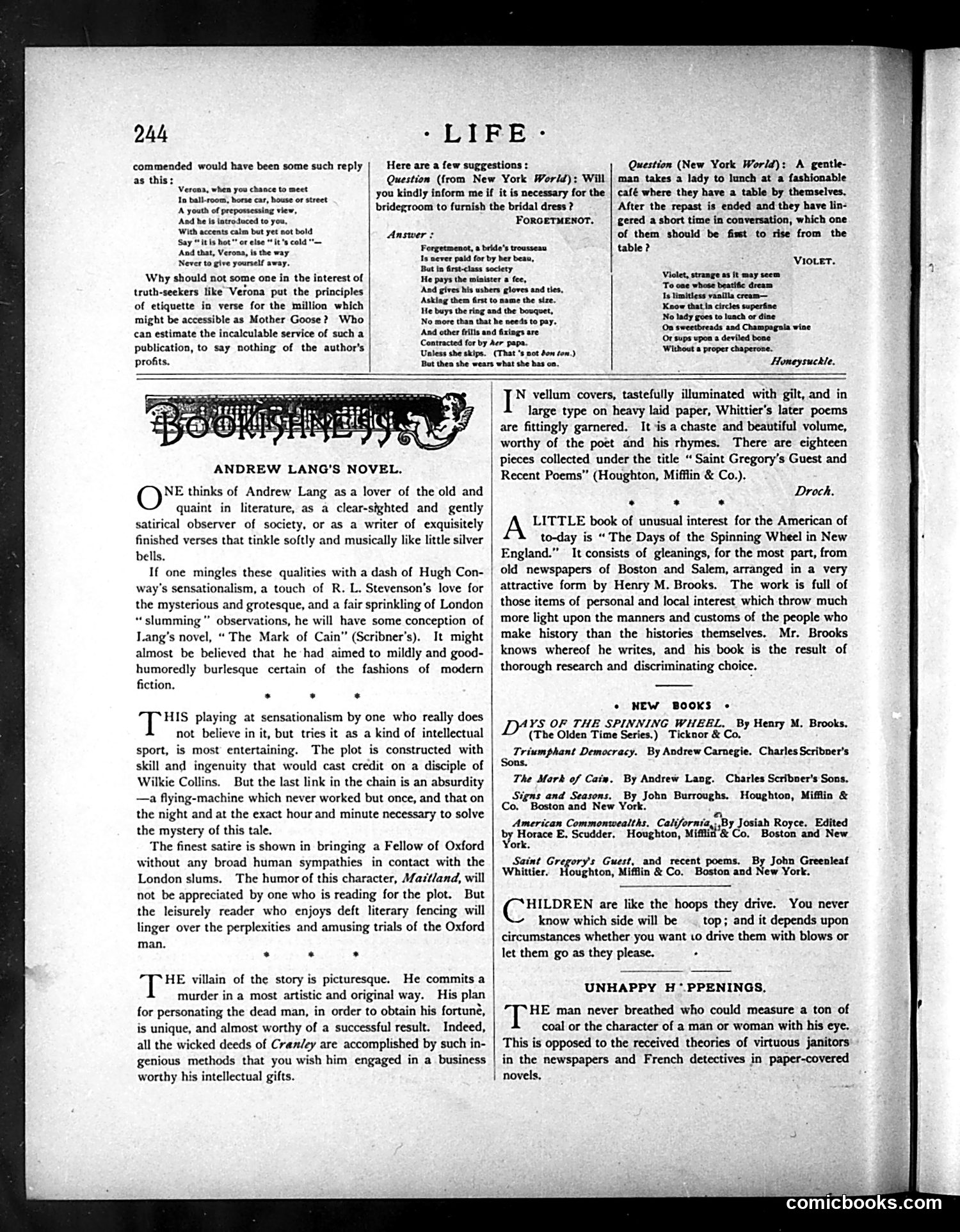
This page contains **no political cartoons**. Instead, it features literary criticism and book reviews. The main content discusses **Andrew Lang's novel**, praising his ability to blend old-fashioned literary qualities with modern sensationalism. The reviewer compares Lang favorably to Hugh Conway and R.L. Stevenson, noting his satirical treatment of London fashion in a novel called *Maitland*. Below are **book reviews** and advertisements for recent publications, including works on New England history, poetry collections, and social commentary. The page also includes a brief humorous observation about children's unpredictability, unrelated to politics or current events. This is fundamentally a **literary-focused page** rather than satirical commentary on contemporary politics or social issues.
📄 Transcribed text from this page (OCR, searchable)
Machine-transcribed from the original scan — historical spelling and the odd misread are preserved.
244 commended would have been some such reply as this: Verona, when you chance to meet In ball-room, horse car, house or street A youth of prepossessing view, Aod he is introduced to you, With accents calm but yet not bold Say “it is hot” or else “it's cold "— ‘And that, Verona, is the wa Never to give yourself away. Why should not some one in the interest of truth-seekers like Verona put the principles of etiquette in verse for the million which might be accessible as Mother Goose? Who can estimate the incalculable service of such a | publication, to say nothing of the author's LIFE Here are a few suggestions : Question (from New York World): Will you kindly inform me if it is necessary for the bridegroom to furnish the bridal dress ? FORGETMENOT. Answer: Forgetmenct, a bride's trousseau Is never paid for by her beau, Bot in first-class society He pays the minister a fee, ‘And gives his ushers gloves and ties, Asking them first to name the size. He buys the ring and the bouquet, No more than that he needs to pay. And other frills and fixings are Contracted for by Aer papa. Unless she skips. (That ‘s not bon fon.) But thea she wears what she bas on. Question (New York World): A gentle- man takes a lady to lunch at a fashionable café where they have a table by themselves. ‘After the repast is ended and they have lin- gered a short time in conversation, which one of them should be fisst to rise from the table? Viotet. Viclet, strange as ft may seem To one whose beatific dream Is Uimitless vanilla cream— Know that la circles superfine No lady goes to laach of dine (On sweetbreads and Champagaia wine Or sups vpon a deviled bone ‘Without a proper chaperone. Honeysuckle, ANDREW LANG'S NOVEL. NE thinks of Andrew Lang asa lover of the old and quaint in literature, as a clear-sighted and gently satirical observer of society, or as a writer of exquisitely finished verses that tinkle softly and musically like little silver bells. If one mingles these qualities with a dash of Hugh Con- way’s sensationalism, a touch of R. L. Stevenson's love for the mysterious and grotesque, and a fair sprinkling of London | observations, he will have some conception of | “slumming” Lang's novel, “ The Mark of Cain” (Scribner's). It might almost be believed that he had aimed to mildly and good- humoredly burlesque certain of the fashions of modern fiction, . . . HIS playing at sensationalism by one who really does not believe in it, but tries it as a kind of intellectual sport, is most entertaining. The plot is constructed with skill and ingenuity that would cast credit on a disciple of Wilkie Collins. But the last link in the chain is an absurdity —a flying-machine which never worked but once, and that on the night and at the exact hour and minute necessary to solve the mystery of this tale, The finest satire is shown in bringing a Fellow of Oxford without any broad human sympathies in contact with the London slums. not be appreciated by one who is reading for the plot. the leisurely reader who enjoys deft literary fencing will linger over the perplexities and amusing trials of the Oxford man. e , HE villain of the story is picturesque. He commits a murder in a most artistic and original way. His plan | for personating the dead man, in order to obtain his fortuné, is unique, and almost worthy of a successful result. Indeed, all the wicked deeds of Cran/ey are accomplished by such in- genious methods that you wish him engaged in a business worthy his intellectual gifts. The humor of this character, Maz¢/and, will | But N vellum covers, tastefully illuminated with gilt, and in large type on heavy laid paper, Whittier’s later poems are fittingly garnered. It is a chaste and beautiful volume, worthy of the poet and his rhymes. There are eighteen pieces collected under the title “ Saint Gregory’s Guest and Recent Poems” (Houghton, Mifflin & Co.). Droch. . . . LITTLE book of unusual interest for the American of to-day is “ The Days of the Spinning Wheel in New England.” It consists of gleanings, for the most part, from | old newspapers of Boston and Salem, arranged in a very | attractive form by Henry M. Brooks. The work is full of those items of personal and local interest which throw much more light upon the manners and customs of the people who make history than the histories themselves. Mr. Brooks | knows whereof he writes, and his book is the result of thorough research and discriminating choice. « NEW BOOKS «+ DAYS OF THE SPINNING WHEEL. By Henry M. Brooks. (The Olden Time Series.) Ticknor & Co, Triumphant Democracy. By Andrew Carnegie. Charles Scribner's ‘Sons. The Mark of Cain. By Andrew Lang. Charles Scribner's Sons. Signs and Seasons, By John Burroughs. Houghton, Miffin & Boston and New York. American Commonwealths. California, Hoesce E. Scudder. Houghton, Miftiy’& on ‘Saint Gregory's Guest and recent poems. By Joba Greenleaf Whittier. Houghton, Mifflin & Co. Boston and New York. Brg jeu Royce, Edited Boston and New HILDREN are like the hoops they drive. You never know which side will be top; and it depends upon circumstances whether you want .o drive them with blows or let them go as they please. . UNHAPPY H °.PPENINGS. HE man never breathed who could measure a ton of coal or the character of a man or woman with his eye. This is opposed to the received theories of virtuous janitors in the newspapers and French detectives in paper-covered | novels, ~ comicbooks.com