
Life, 1886-04-29 · page 11 of 16
Life — April 29, 1886 — page 11: what you’re looking at
What you’re looking at
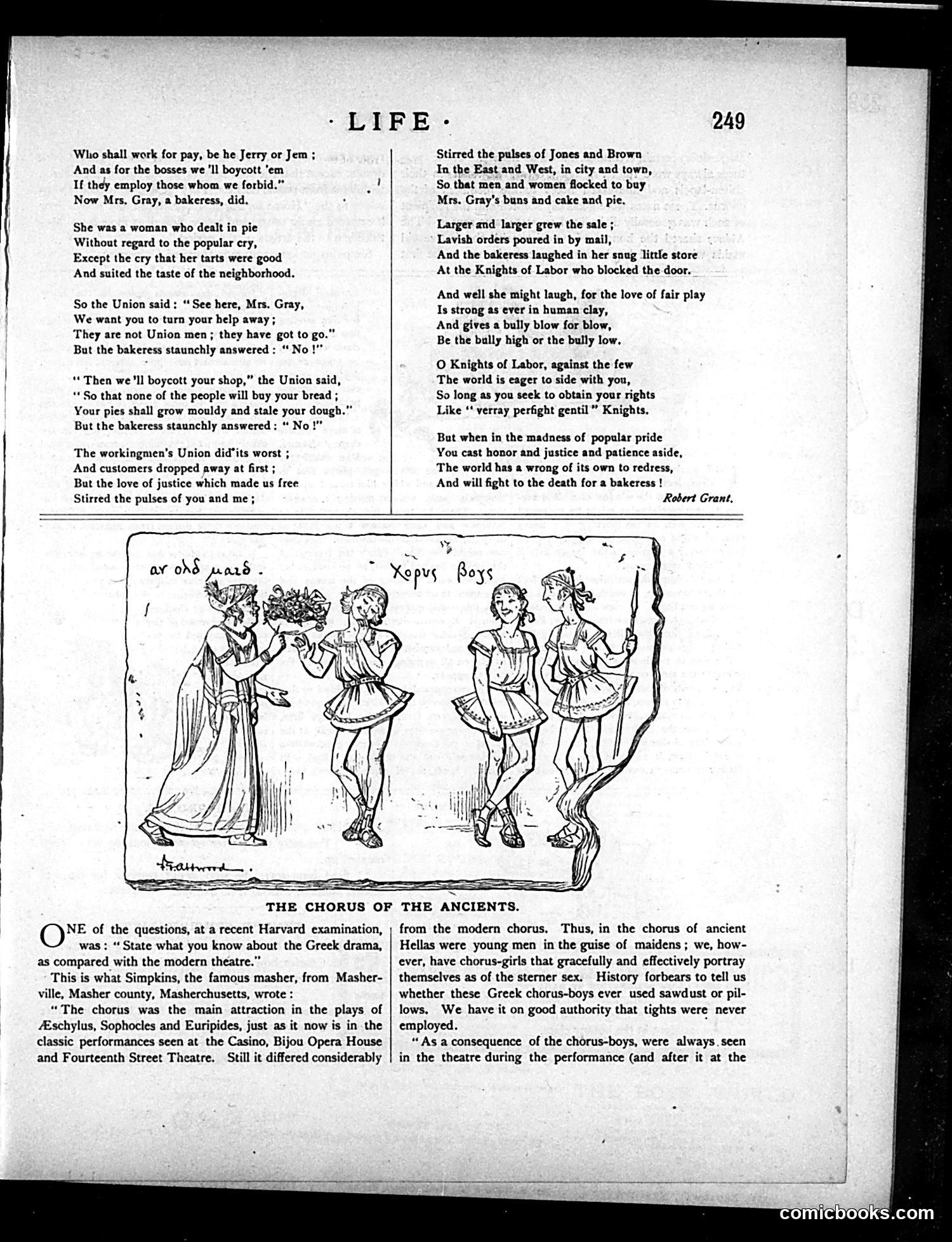
**Main Cartoon/Poem: "Mrs. Gray, the Bakeress"** This satirical poem attacks labor union tactics, specifically the **Knights of Labor** (a major late-19th-century labor organization). The narrative celebrates Mrs. Gray, a baker who refuses union demands to fire non-union workers. When the union boycotts her shop, the public supports her out of principle—customers flock to buy her goods to oppose what the poem frames as union bullying. **The satire's message**: Labor unions, despite claiming to fight for workers' rights ("Knights of Labor"), become tyrannical when they use coercive tactics like boycotts against small business owners. The poem argues that fair-minded people will ultimately reject such "madness of popular pride" and side with honest business owners defending their independence. **Lower Section: "The Chorus of the Ancients"** This is a humorous college exam answer comparing ancient Greek drama choruses to modern theater choruses. The joke relies on crude gender commentary: ancient choruses were men dressed as women; modern choruses are women dressed/acting as men—inverting traditional expectations in ways meant to amuse readers.
📄 Transcribed text from this page (OCR, searchable)
Machine-transcribed from the original scan — historical spelling and the odd misread are preserved.
Who shall work for pay, be he Jerry or Jem ; And as for the bosses we 'Il boycott ‘em If they employ those whom we forbid.” =) Now Mrs. Gray, a bakeress, did. ‘ She was a woman who dealt in pie Without regard to the popular cry, Except the cry that her tarts were good And suited the taste of the neighborhood. So the Union said: “See here, Mrs. Gray, We want you to turn your help away; They are not Union men; they have got to go.” But the bakeress staunchly answered : ‘No !"" “Then we'll boycott your shop,” the Union said, “So that none of the people will buy your bread ; Your pies shall grow mouldy and stale your dough.” But the bakeress staunchly answered : “ No!” The workingmen's Union did’its worst ; And customers dropped away at first ; But the love of justice which made us free Stirred the pulses of you and me ; - LIFE: Stirred the pulses of Jones and Brown In the East and West, in city and town, So that men and women flocked to buy Mrs. Gray's buns and cake and pie. Larger and larger grew the sale ; Lavish orders poured in by mail, And the bakeress laughed in her snug little store At the Knights of Labor who blocked the door, And well she might laugh, for the love of fair play Is strong as ever in human clay, And gives a bully blow for blow, Be the bully high or the bully low. O Knights of Labor, against the few The world is eager to side with you, So long as you seek to obtain your rights Like “* verray perfight gentil” Knights, But when in the madness of popular pride You cast honor and justice and patience aside, The world has a wrong of its own to redress, And will fight to the death for a bakeress ! Robert Grant, Or ond ppord - THE CHORUS OF THE ANCIENTS. NE of the questions, at a recent Harvard examination, was : “‘ State what you know about the Greek drama, as compared with the modern theatre.” This is what Simpkins, the famous masher, from Masher- ville, Masher county, Masherchusetts, wrote : “The chorus was the main attraction in the plays of schylus, Sophocles and Euripides, just as it now is in the classic performances seen at the Casino, Bijou Opera House and Fourteenth Street Theatre. Still it differed considerably from the modern chorus. Thus, in the chorus of ancient Hellas were young men in the guise of maidens ; we, how- ever, have chorus-girls that gracefully and effectively portray themselves as of the sterner sex. History forbears to tell us whether these Greek chorus-boys ever used sawdust or pil- lows, We have it on good authority that tights were never employed. 3 “As a consequence of the chorus-boys, were always.seen in the theatre during the performance (and after it at the