
Life, 1886-04-29 · page 2 of 16
Life — April 29, 1886 — page 2: what you’re looking at
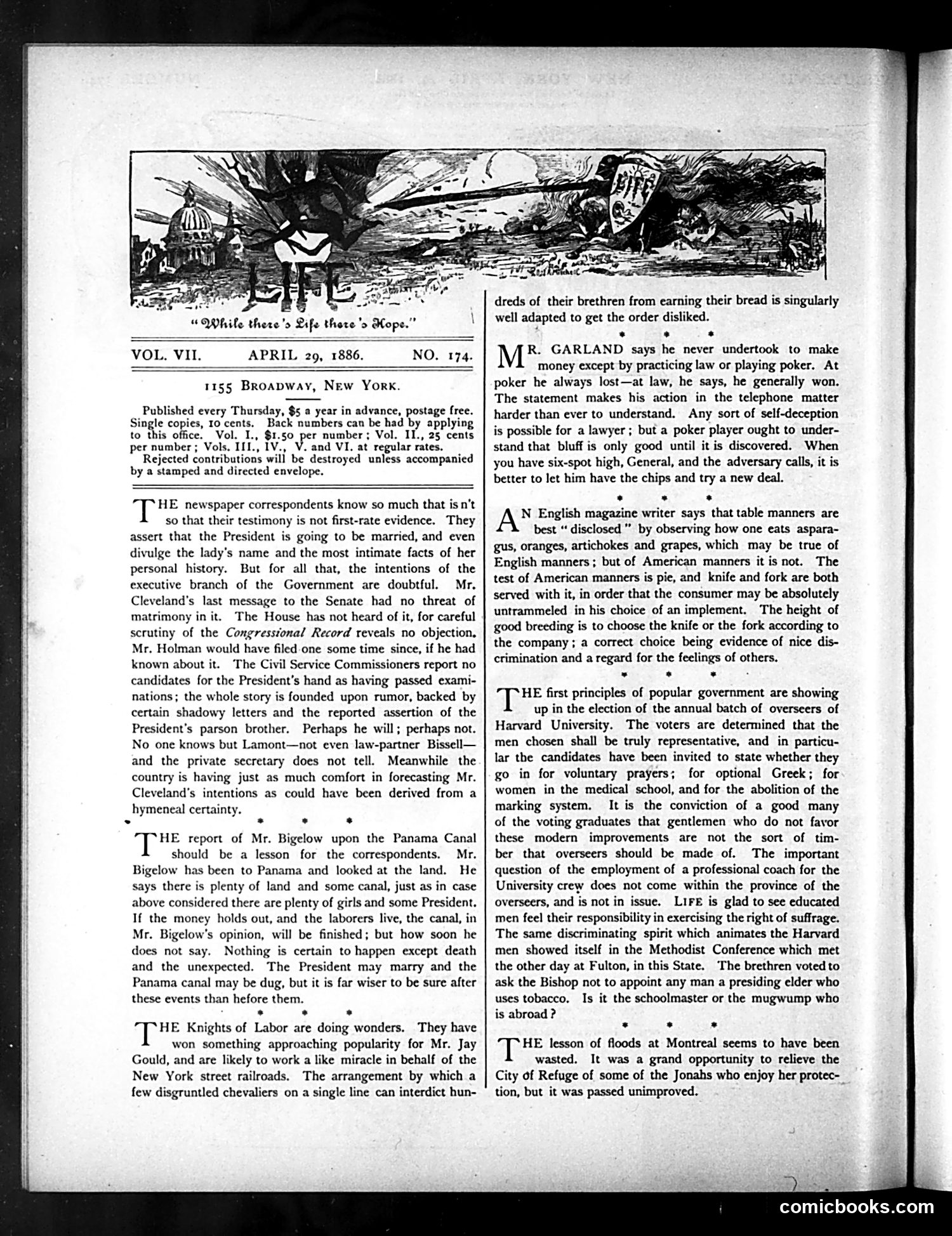
What you’re looking at
The cartoon at the top, captioned "While there's Life there's Hope," depicts a dark allegorical scene with what appears to be classical or mythological figures amid destruction and chaos. The specific identities of the figures are unclear from the image quality, but the composition suggests commentary on contemporary crisis or social upheaval. The page itself consists primarily of editorial commentary rather than humor. Articles discuss President Cleveland's marriage rumors, the Panama Canal project under Mr. Bigelow, labor activism by the Knights of Labor regarding New York railroads, and Harvard University's governance reforms. The satirical approach is subtle—using ironic observation rather than caricature—typical of Life's editorial style in this era.
📄 Transcribed text from this page (OCR, searchable)
Machine-transcribed from the original scan — historical spelling and the odd misread are preserved.
“QWPhile there's Life there 's Hope.” VOL. VII. APRIL 29, 1886. NO. 174. 1155 Broapway, New York. Published every Thursday, $5 a year in advance, postage free. Single copies, 10 cents. Back numbers can be had by applying to this office. Vol. I., $1.50 per number; Vol. IT., 25 cents per number; Vols. III., IV. and VI. at regular rates. Rejected contributions will be destroyed unless accompanied by a stamped and directed envelope. T HE newspaper correspondents know so much that isn’t so that their testimony is not first-rate evidence. They assert that the President is going to be married, and even divulge the lady's name and the most intimate facts of her personal history. But for all that, the intentions of the executive branch of the Government are doubtful. Mr. Cleveland's last message to the Senate had no threat of matrimony in it. The House has not heard of it, for careful scrutiny of the Congressional Record reveals no objection, Mr. Holman would have filed-one some time since, if he had known about it. The Civil Service Commissioners report no candidates for the President's hand as having passed exami- nations; the whole story is founded upon rumor, backed by certain shadowy letters and the reported assertion of the President's parson brother. Perhaps he will; perhaps not. No one knows but Lamont—not even law-partner Bissell— and the private secretary does not tell. Meanwhile the country is having just as much comfort in forecasting Mr. Cleveland's intentions as could have been derived from a hymeneal certainty. - . . * HE report of Mr. Bigelow upon the Panama Canal should be a lesson for the correspondents. Mr. Bigelow has been to Panama and looked at the land. He says there is plenty of land and some canal, just as in case above considered there are plenty of girls and some President. If the money holds out, and the laborers live, the canal, in Mr. Bigelow’s opinion, will be finished; but how soon he does not say. Nothing is certain to happen except death and the unexpected. The President may marry and the Panama canal may be dug, but it is far wiser to be sure after these events than hefore them. * . . HE Knights of Labor are doing wonders. They have won something approaching popularity for Mr. Jay Gould, and are likely to work a like miracle in behalf of the New York street railroads. The arrangement by which a few disgruntled chevaliers on a single line can interdict hun- dreds of their brethren from earning their bread is singularly well adapted to get the order disliked. 5 . * * R. GARLAND says he never undertook to make money except by practicing law or playing poker. At poker he always lost—at law, he says, he generally won. The statement makes his action in the telephone matter harder than ever to understand. Any sort of self-deception is possible for a lawyer ; but a poker player ought to under- stand that bluff is only good until it is discovered. When you have six-spot high, General, and the adversary calls, it is better to let him have the chips and try a new deal. . . . N English magazine writer says that table manners are best “ disclosed " by observing how one eats aspara- gus, oranges, artichokes and grapes, which may be true of English manners ; but of American manners it is not. The test of American manners is pie, and knife and fork are both served with it, in order that the consumer may be absolutely untrammeled in his choice of an implement. The height of good breeding is to choose the knife or the fork according to the company; a correct choice being evidence of nice dis- crimination and a regard for the feelings of others. . . . apg first principles of popular government are showing up in the election of the annual batch of overseers of Harvard University. The voters are determined that the men chosen shall be truly representative, and in particu- lar the candidates have been invited to state whether they go in for voluntary prayers; for optional Greek; for women in the medical school, and for the abolition of the marking system. It is the conviction of a good many of the voting graduates that gentlemen who do not favor these modern improvements are not the sort of tim- ber that overseers should be made of. The important question of the employment of a professional coach for the University crew does not come within the province of the overseers, and is not in issue. LiFe is glad to see educated men feel their responsibility in exercising the right of suffrage. The same discriminating spirit which animates the Harvard men showed itself in the Methodist Conference which met the other day at Fulton, in this State. The brethren voted to ask the Bishop not to appoint any man a presiding elder who uses tobacco. Is it the schoolmaster or the mugwump who is abroad ? . . * HE lesson of floods at Montreal seems to have been wasted. It was a grand opportunity to relieve the City of Refuge of some of the Jonahs who enjoy her protec-_ tion, but it was passed unimproved. comicbooks.com