
Life, 1886-04-29 · page 5 of 16
Life — April 29, 1886 — page 5: what you’re looking at
What you’re looking at
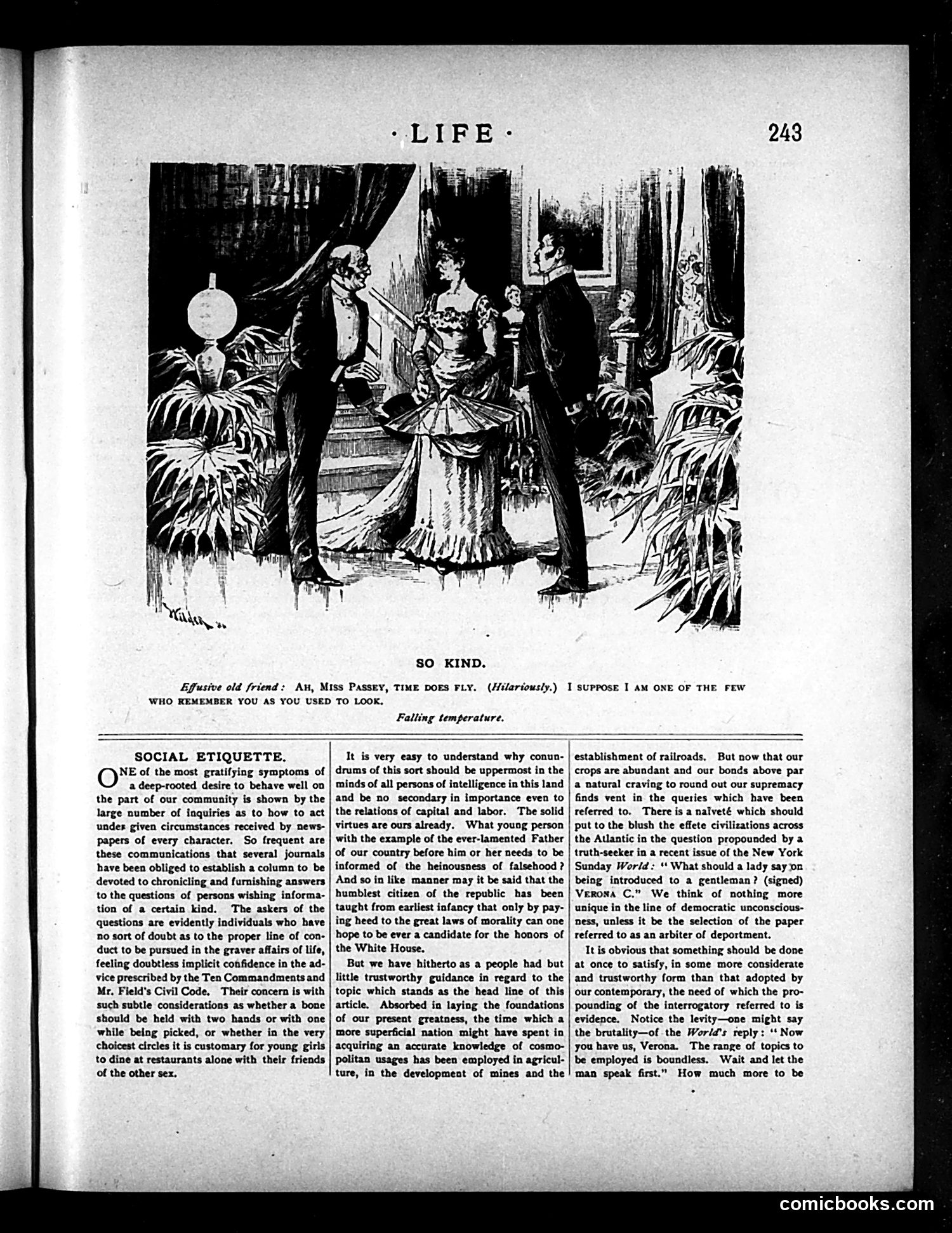
The cartoon depicts an elegant social gathering where a man addresses a woman, remarking on how she's aged ("Time does fly"). The satire targets **social hypocrisy and tactlessness**—the man's comment, framed as polite observation, is actually a cutting insult about her appearance. The accompanying article on "Social Etiquette" discusses proper conduct in society, emphasizing discretion and consideration. The cartoon illustrates the *opposite*: a supposedly refined gentleman making a backhanded compliment that violates basic courtesy. The humor relies on the gap between what passes for politeness in high society and actual kindness. The title "So Kind" is ironic—his remark is anything but kind, exposing how social conventions can mask rudeness.
📄 Transcribed text from this page (OCR, searchable)
Machine-transcribed from the original scan — historical spelling and the odd misread are preserved.
Effusive old friend: Aw, Miss Passey, TIME DOES FLY. | / sO KIND. (Hilariously.) WHO KEMEMBER YOU AS YOU USED TO LOOK, Falling temperature. I SUPPOSE I AM ONE OF THE FEW SOCIAL ETIQUETTE, NE of the most gratifying symptoms of a deep-rooted desire to behave well on the part of our community is shown by the large number of inquiries as to how to act undes given circumstances received by news- papers of every character. So frequent are these communications that several journals have been obliged to establish a column to be devoted to chronicling and furnishing answers to the questions of persons wishing informa- tion of a certain kind. The askers of the questions are evidently individuals who have no sort of doubt as to the proper line of con- duct to be pursued in the graver affairs of life, feeling doubtless implicit confidence in the ad- vice prescribed by the Ten Commandments and Mr. Field's Civil Code, Their concern is with such subtle considerations as whether a bone should be held with two hands or with one while being picked, or whether in the very choicest circles it is customary for young girls to dine at restaurants alone with their friends of the other sex. It is very easy to understand why conun- drums of this sort should be uppermost in the minds of all persons of intelligence in this land and be no secondary in importance even to the relations of capital and labor. The solid virtues are ours already. What young person with the example of the ever-lamented Father of our country before him or her needs to be informed of the heinousness of falsehood ? And so in like manner may it be said that the humblest citizen of the republic has been taught from earliest infancy that only by pay- ing heed to the great laws of morality can one hope to be ever a candidate for the honors of the White House, But we have hitherto as a people had but little trustworthy guidance in regard to the topic which stands as the head line of this article, Absorbed in laying the foundations of our present greatness, the time which a more superficial nation might have spent in acquiring an accurate knowledge of cosmo- politan usages has been employed in agricul- ture, in the development of mines and the establishment of railroads. But now that our crops are abundant and our bonds above par a natural craving to round out our supremacy finds vent in the queries which have been referred to. There is a nalveté which should put to the blush the effete civilizations across the Aulantic in the question propounded by a truth-seeker in a recent issue of the New York Sunday World: ‘* What should a lady say on being introduced to a gentleman? (signed) Verona C.” We think of nothing more unique in the line of democratic unconscious- ness, unless it be the selection of the paper referred to as an arbiter of deportment. It is obvious that something should be done at once to satisfy, in some more considerate and trustworthy form than that adopted by our contemporary, the need of which the pro- pounding of the interrogatory referred to is evidence. Notice the levity—one might say the brutality—of the World's reply: ‘‘Now you have us, Verona. The range of topics to be employed is boundless. Wait and let the man speak first.” How much more to be comicbooks.com