
Life, 1886-04-29 · page 10 of 16
Life — April 29, 1886 — page 10: what you’re looking at
What you’re looking at
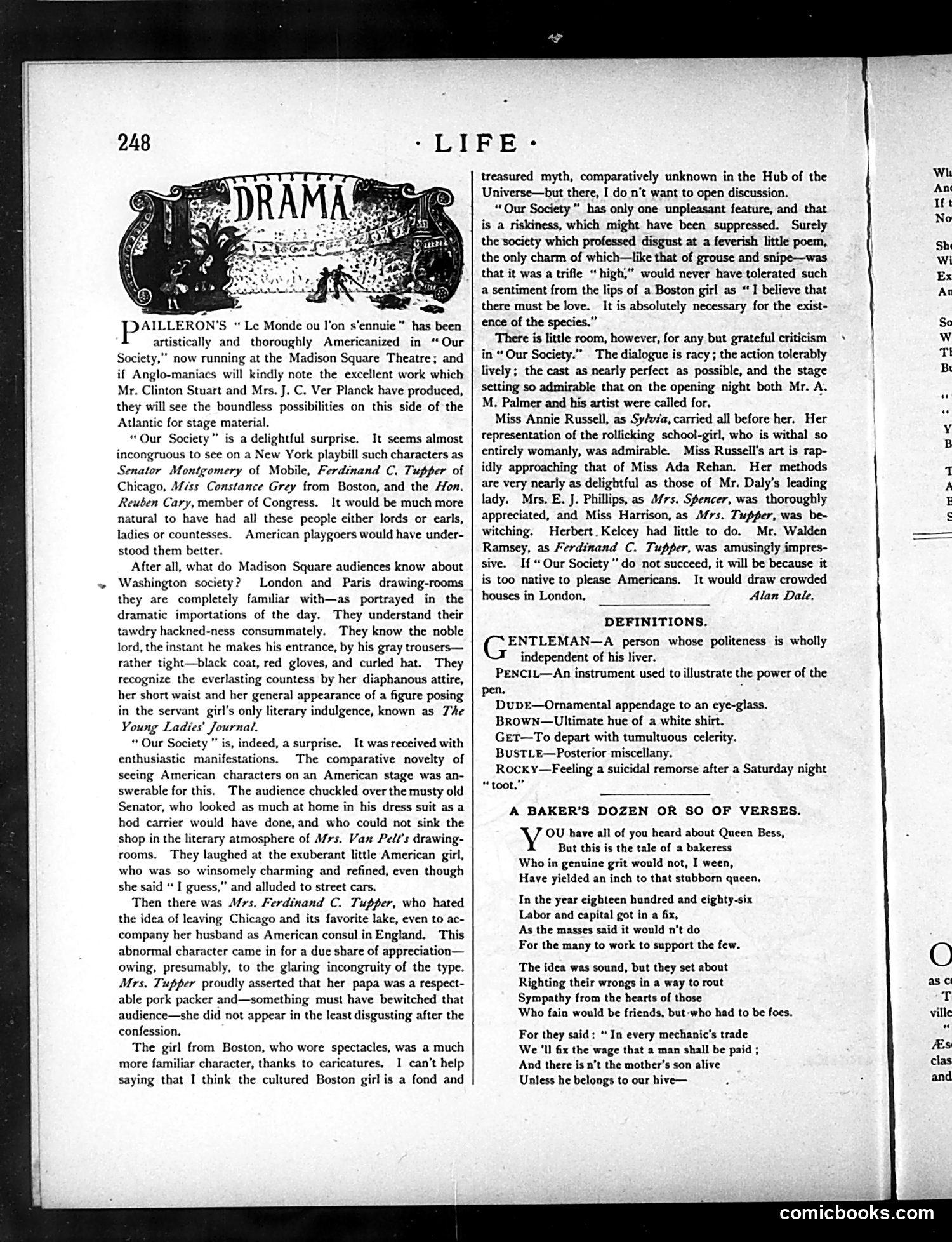
This page reviews a play called "Our Society," an Americanized adaptation of a French work, performed at Madison Square Theatre. The reviewer celebrates the novelty of seeing *American* characters on stage—a Senator, a Chicago businessman, a Boston girl—rather than the predictable European aristocrats (lords, countesses in diaphanous gowns) that dominated imported theatrical fare. The satire targets American audiences' snobbish preference for European society dramas. The reviewer notes the irony: viewers found American characters charmingly funny precisely *because* they were unfamiliar—a pork-packer's daughter, a girl saying "I guess," someone mentioning street cars. The piece gently mocks both the provincialism of American theatergoers and their hunger for European sophistication, suggesting Americans found their own society exotic by contrast.
📄 Transcribed text from this page (OCR, searchable)
Machine-transcribed from the original scan — historical spelling and the odd misread are preserved.
ea) : AILLERON'S “Le Monde ou I’on s’ennuie” has been artistically and thoroughly Americanized in ‘Our Society,” now running at the Madison Square Theatre; and if Anglo-maniacs will kindly note the excellent work which Mr. Clinton Stuart and Mrs. J. C. Ver Planck have produced, they will see the boundless possibilities on this side of the Atlantic for stage material. “Our Society” is a delightful surprise. It seems almost incongruous to see on a New York playbill such characters as Senator Montgomery of Mobile, Ferdinand C. Tupper of Chicago, Mss Constance Grey from Boston, and the Hon. Reuben Cary, member of Congress. It would be much more natural to have had all these people either lords or earls, ladies or countesses. American playgoers would have under- stood them better. After all, what do Madison Square audiences know about ~ Washington society? London and Paris drawing-rooms they are completely familiar with—as portrayed in the dramatic importations of the day. They understand their tawdry hackned-ness consummately. They know the noble lord, the instant he makes his entrance, by his gray trousers— rather tight—black coat, red gloves, and curled hat. They recognize the everlasting countess by her diaphanous attire, her short waist and her general appearance of a figure posing in the servant girl's only literary indulgence, known as The Young Ladies’ Journal. “ Our Society " is, indeed, a surprise. It was received with enthusiastic manifestations. The comparative novelty of seeing American characters on an American stage was an- swerable for this. The audience chuckled over the musty old Senator, who looked as much at home in his dress suit as a hod carrier would have done, and who could not sink the shop in the literary atmosphere of Afrs. Van Pelt’s drawing- rooms, They laughed at the exuberant little American girl, who was so winsomely charming and refined, even though she said “I guess,” and alluded to street cars. Then there was Mrs. Ferdinand C. Tupper, who hated the idea of leaving Chicago and its favorite lake, even to ac- company her husband as American consul in England. This abnormal character came in for a due share of appreciation— owing, presumably, to the glaring incongruity of the type. Mrs. Tupper proudly asserted that her papa was a respect- able pork packer and—something must have bewitched that audience—she did not appear in the least disgusting after the confession, The girl from Boston, who wore spectacles, was a much more familiar character, thanks to caricatures. 1 can’t help saying that I think the cultured Boston girl is a fond and - LIFE: treasured myth, comparatively unknown in the Hub of the Universe—but there, I do n’t want to open discussion. “Our Society” has only one unpleasant feature, and that is a riskiness, which might have been suppressed. Surely the society which professed disgust at a feverish little poem, the only charm of which—like that of grouse and snipe—was that it was a trifle “high,” would never have tolerated such a sentiment from the lips of a Boston girl as “I believe that there must be love. It is absolutely necessary for the exist- ence of the species.” There is little room, however, for any but grateful criticism in “ Our Society.” The dialogue is racy ; the action tolerably lively ; the cast as nearly perfect as possible, and the stage setting so admirable that on the opening night both Mr. A. M. Palmer and his artist were called for. Miss Annie Russell, as Sy/v#a, carried all before her. Her representation of the rollicking school-girl, who is withal so entirely womanly, was admirable. Miss Russell's art is rap- idly approaching that of Miss Ada Rehan. Her methods are very nearly as delightful as those of Mr. Daly’s leading lady. Mrs. E. J. Phillips, as 4/rs. Spencer, was thoroughly appreciated, and Miss Harrison, as Mrs. Tupper, was be- witching. Herbert. Kelcey had little to do. Mr. Walden Ramsey, as Ferdinand C. Tupper, was amusingly impres- sive. If “ Our Society "do not succeed, it will be because it is too native to please Americans. It would draw crowded houses in London, Alan Date, DEFINITIONS. (Gee person whose politeness is wholly independent of his liver. PENCIL—An instrument used to illustrate the power of the pen. DupE—Ornamental appendage to an eye-glass. BROWN—Ultimate hue of a white shirt. GeEtT—To depart with tumultuous celerity. BusTLE—Posterior miscellany. Rocky—Feeling a suicidal remorse after a Saturday night “toot.” A BAKER'S DOZEN OR SO OF VERSES. OU have all of you heard about Queen Bess, But this is the tale of a bakeress Who in genuine grit would not, I ween, Have yielded an inch to that stubborn queen, In the year eighteen hundred and eighty-six Labor and capital got in a fix, As the masses said it would n't do For the many to work to support the few. The idea was sound, but they set about Righting their wrongs in a way to rout Sympathy from the hearts of those Who fain would be friends, but-who had to be foes. For they said: “In every mechanic’s trade We 'll fix the wage that a man shall be paid ; And there is n’t the mother’s son alive Unless he belongs to our hive— l comicbooks.com