
A complete issue · 16 pages · 1886
Life — March 18, 1886
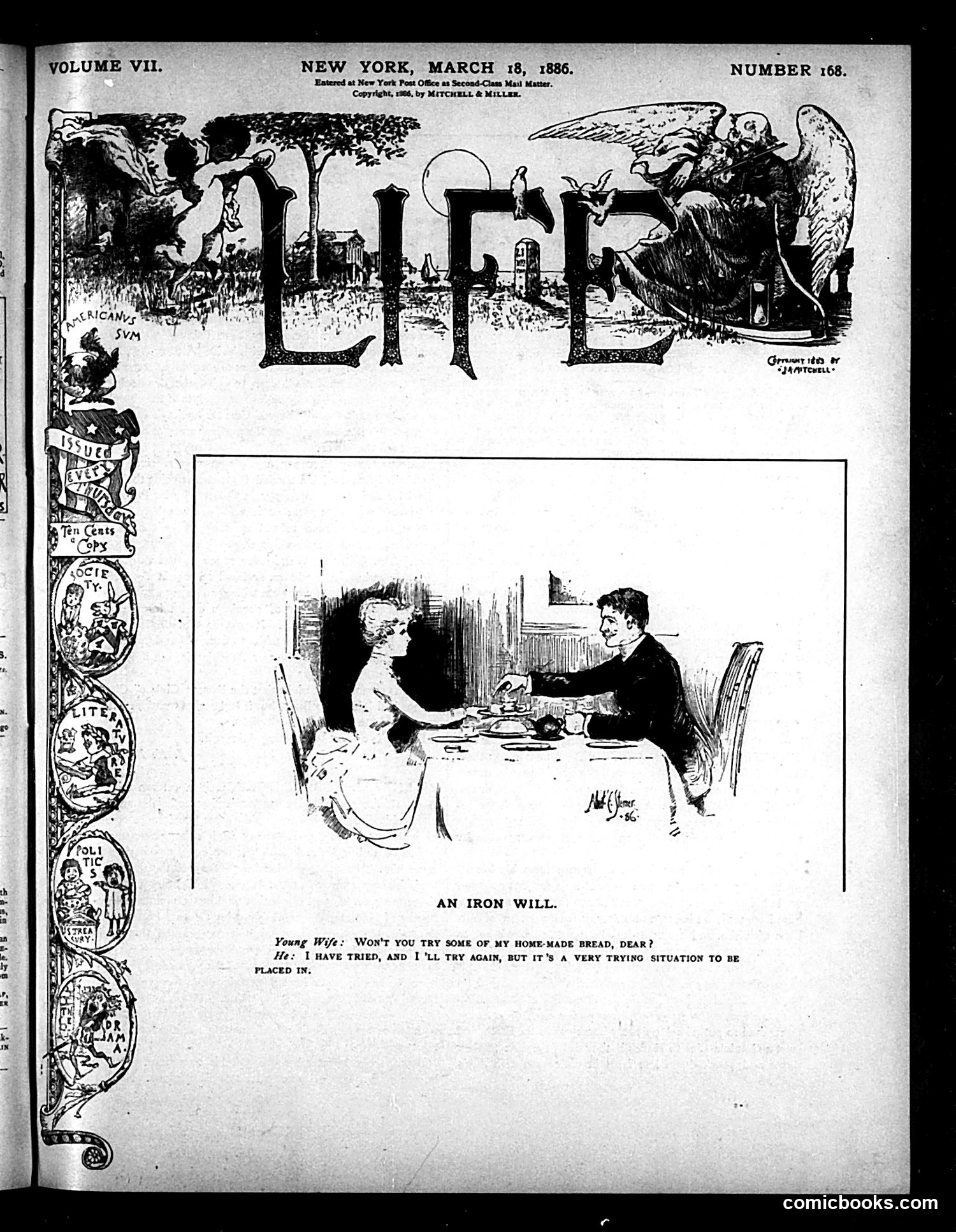
This cartoon satirizes marital conflict through a domestic dinner scene. The title "An Iron Will" plays on the husband's stubbornness—he refuses his wife's homemade bread despite her efforts. The husband's dismissive response—"I have tried, and I'll try again, but it's a very trying situation to be placed in"—mocks the tension between marital duty and personal preference. The joke relies on the double meaning of "trying" (difficult/attempting). This reflects 1880s attitudes about domestic life: wives were expected to master homemaking, particularly cooking. The cartoon humorously presents the husband's resistance to his wife's failed bread-making as evidence of his inflexible character, while implicitly critiquing her domestic inadequacy. The satire targets both spouses' roles in Victorian marriage expectations.
The masthead cartoon depicts a skeletal Death figure straddling a landscape, with the caption "Divide there's Life there's Hope." The cartoon comments on labor disputes of the era. The accompanying text discusses the "Amalgamated Knights of Labor" strike and references a confrontation between millionaires and workers over wages and working conditions. There's mention of Grand High Millionaire Astorgould and disputes over bread-and-butter issues affecting employees. The satire appears to mock both wealthy industrialists resisting wage increases and labor organizations demanding them—suggesting that amid this conflict between capital and labor, only death remains certain. The skeleton likely represents the grim consequences of industrial labor disputes and class conflict during the Gilded Age.
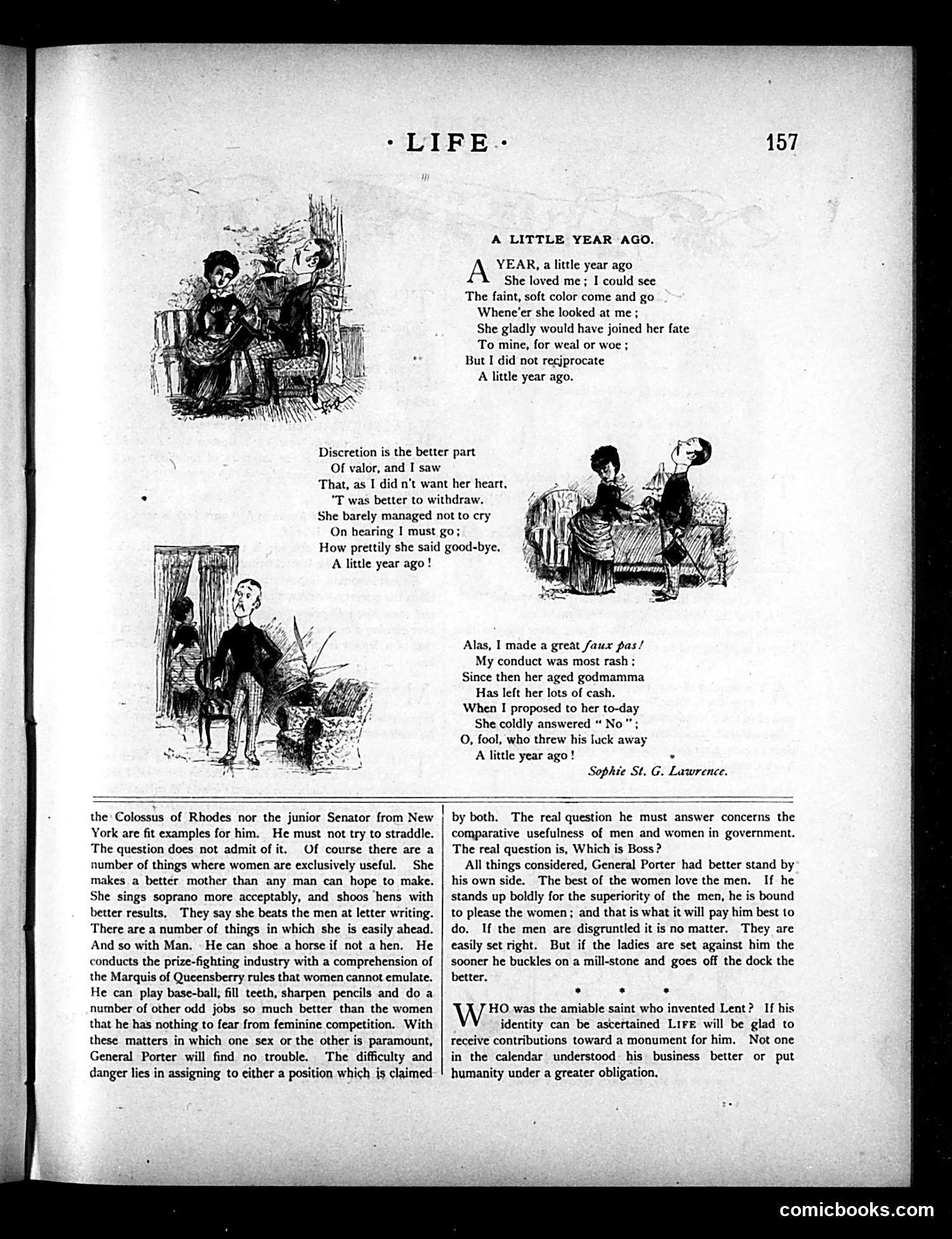
This page contains a poem titled "A Little Year Ago" by Sophie St. G. Lawrence, accompanied by three sketches depicting a romantic narrative. The poem recounts a failed courtship from a year prior, where the speaker chose not to pursue a woman's affections out of discretion, believing she deserved better. The sketches illustrate key moments: the couple together, their parting, and the speaker's subsequent regret when learning the woman has married someone wealthier. The satirical point targets male romantic hesitation and poor judgment—the speaker's "discretion" backfired, costing him the relationship. The accompanying prose below discusses women's capabilities and their role in governance, suggesting this reflects broader Victorian-era debates about gender competence. The humor derives from the protagonist's self-inflicted romantic failure through overthinking.
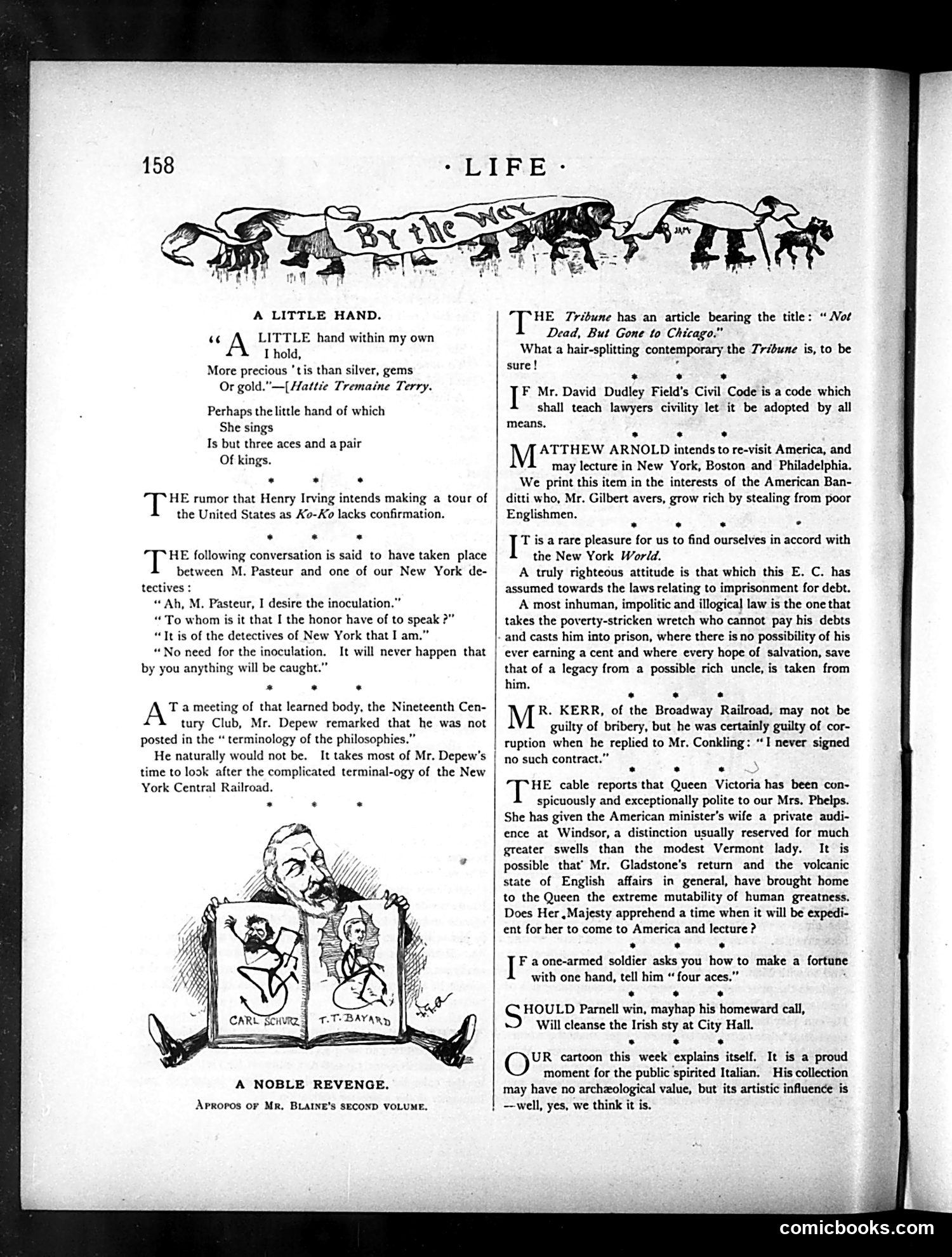
The page contains primarily brief satirical commentary and gossip items rather than political cartoons. The main illustration titled "A Noble Revenge" shows a caricatured figure (labeled as relating to "Mr. Blaine's second volume") holding what appears to be a book or document featuring two smaller figures labeled "Carl Schurz" and "T.T. Bayard." The text items mock contemporary figures including Henry Irving, Matthew Arnold, David Dudley Field, and others. One note satirizes Mr. Kerr of the Broadway Railroad regarding corruption and bribery. Another comments on Queen Victoria's politeness toward American visitors. The overall tone is gossipy and mocking of public figures' pretensions and behaviors. Without clearer context about specific dates and events, precise identification of the revenge reference remains unclear, though it appears related to late 19th-century political or literary feuds.
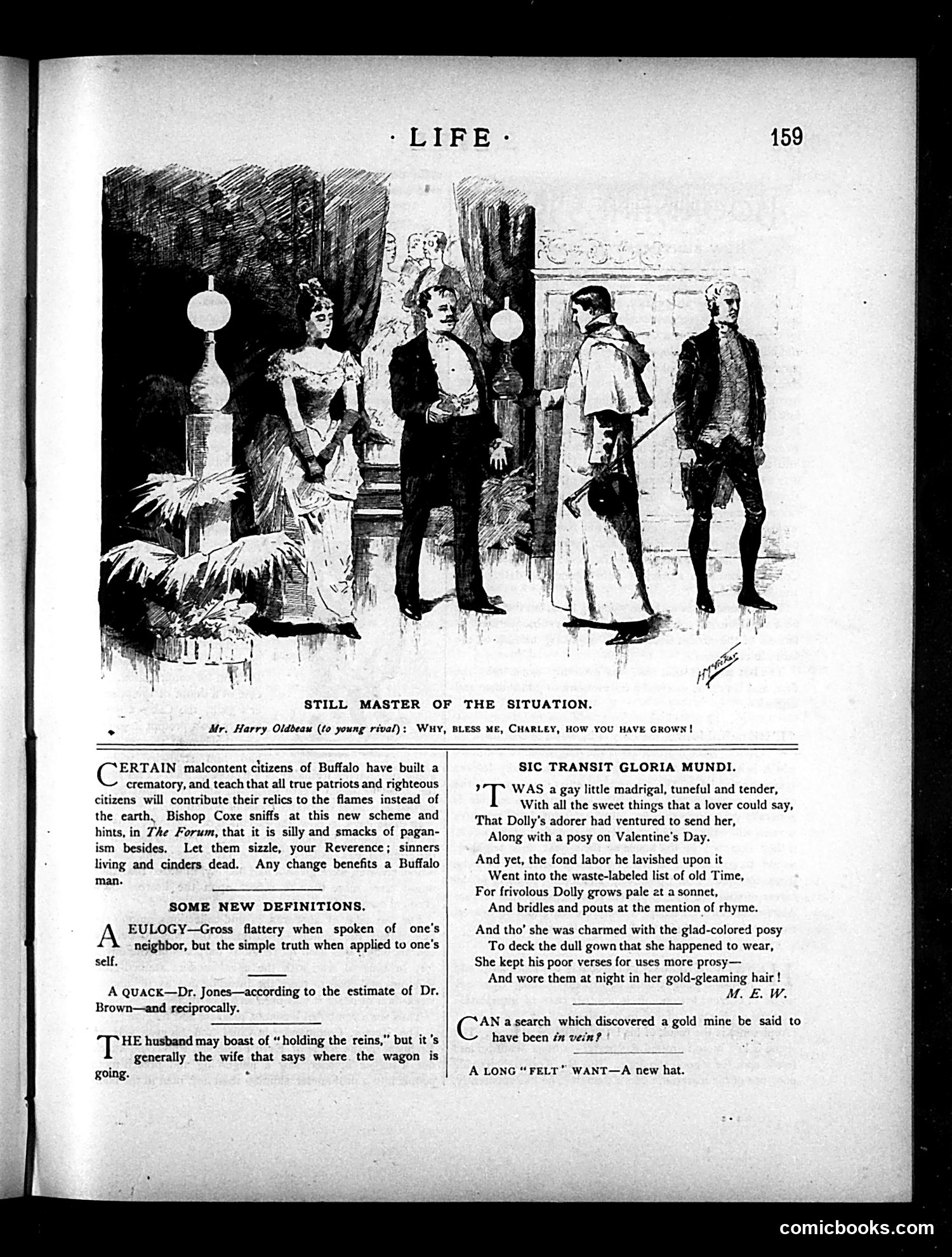
The main cartoon depicts a social scene where a man (Mr. Harry Oldean, identified in the caption) greets a young rival with the line "Why, bless me, Charley, how you have grown!" The satire appears to mock a man's attempt to maintain social composure and authority in an awkward encounter—perhaps with a younger competitor or someone he once had power over. His patronizing tone suggests he's trying to assert dominance through casual, superior familiarity, hence the title "Still Master of the Situation." The joke implies his forced cheerfulness masks anxiety about his actual standing. The page also contains humor definitions ("Some New Definitions") and a sentimental poem about a madrigal, typical of Life magazine's mixed satirical and literary content.
This page contains **literary criticism and book reviews**, not political cartoons. The main content critiques contemporary novels, particularly criticizing how authors waste sentiment on crime and melodrama. The reviewer argues that refined writers shouldn't depict crude social conflicts in domestic settings. The small illustration accompanying "Old New York" shows a **colonial-era figure**, supporting the article's discussion of a history book about Manhattan Island spanning Dutch, English, American, and Restoration periods through 1880. The page primarily functions as **cultural commentary** rather than political satire—attacking overly sentimental Victorian literature as artistically inferior. No specific political figures or current events appear to be referenced. This represents Life magazine's role as a literary and cultural critic for educated readers.
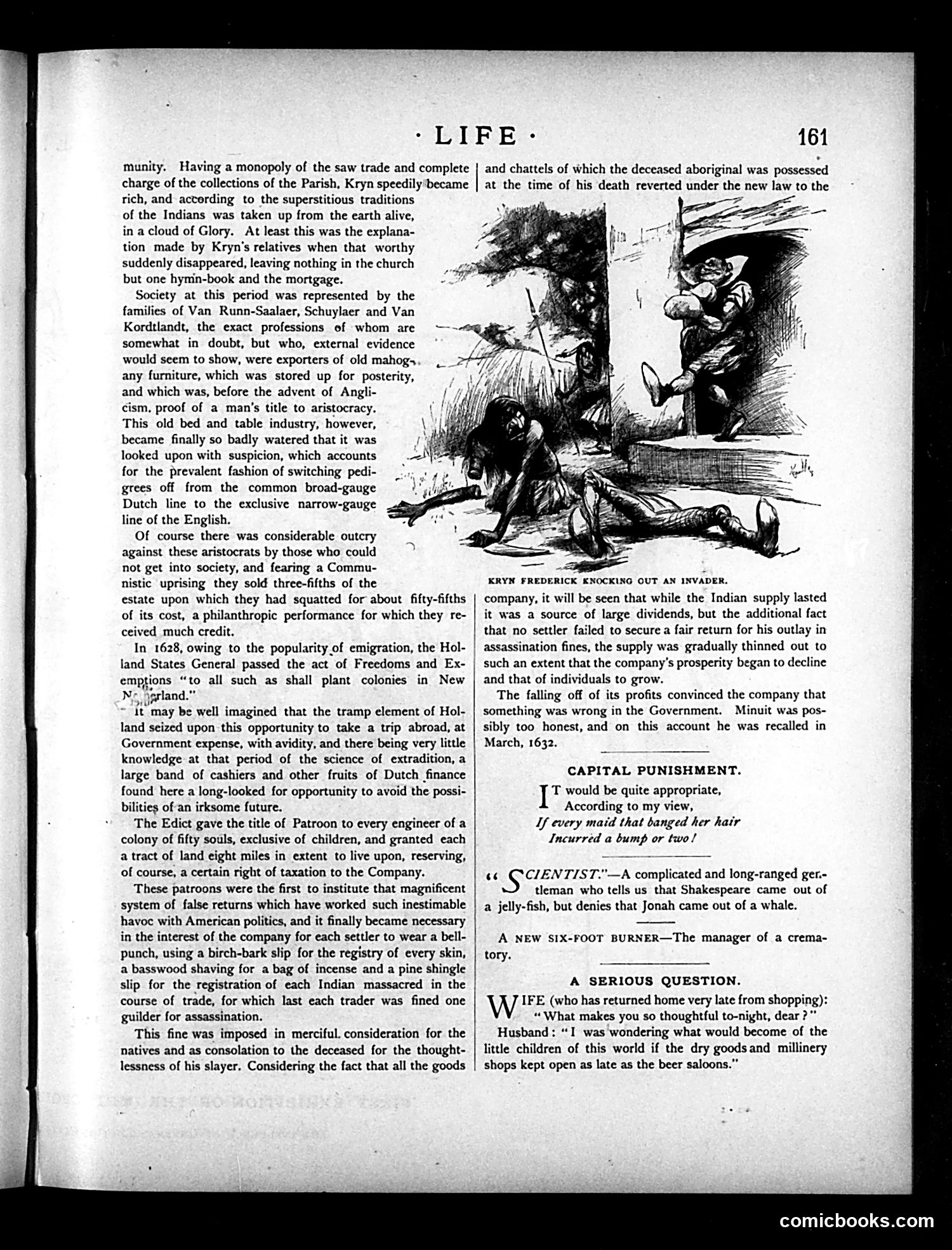
The main illustration, titled "KRYN FREDERICK KNOCKING OUT AN INVADER," depicts a figure striking down what appears to be a Native American or colonial-era combatant. Based on the surrounding text discussing Dutch colonial history, the image likely illustrates a historical episode involving early American settlement and indigenous conflict. The page's body text discusses Dutch colonial ventures, the Dutch East India Company's monopolies, and early settlement patterns in New Amsterdam (later New York). The satirical sections below—"CAPITAL PUNISHMENT," "A NEW SIX-FOOT BURNER," and "A SERIOUS QUESTION"—are brief comedic quips unrelated to the main historical narrative. The cartoon appears to commemorate or satirize a specific colonial-era incident, though without additional historical documentation, the exact identity of "Kryn Frederick" and the specific conflict depicted remains unclear from the image alone.
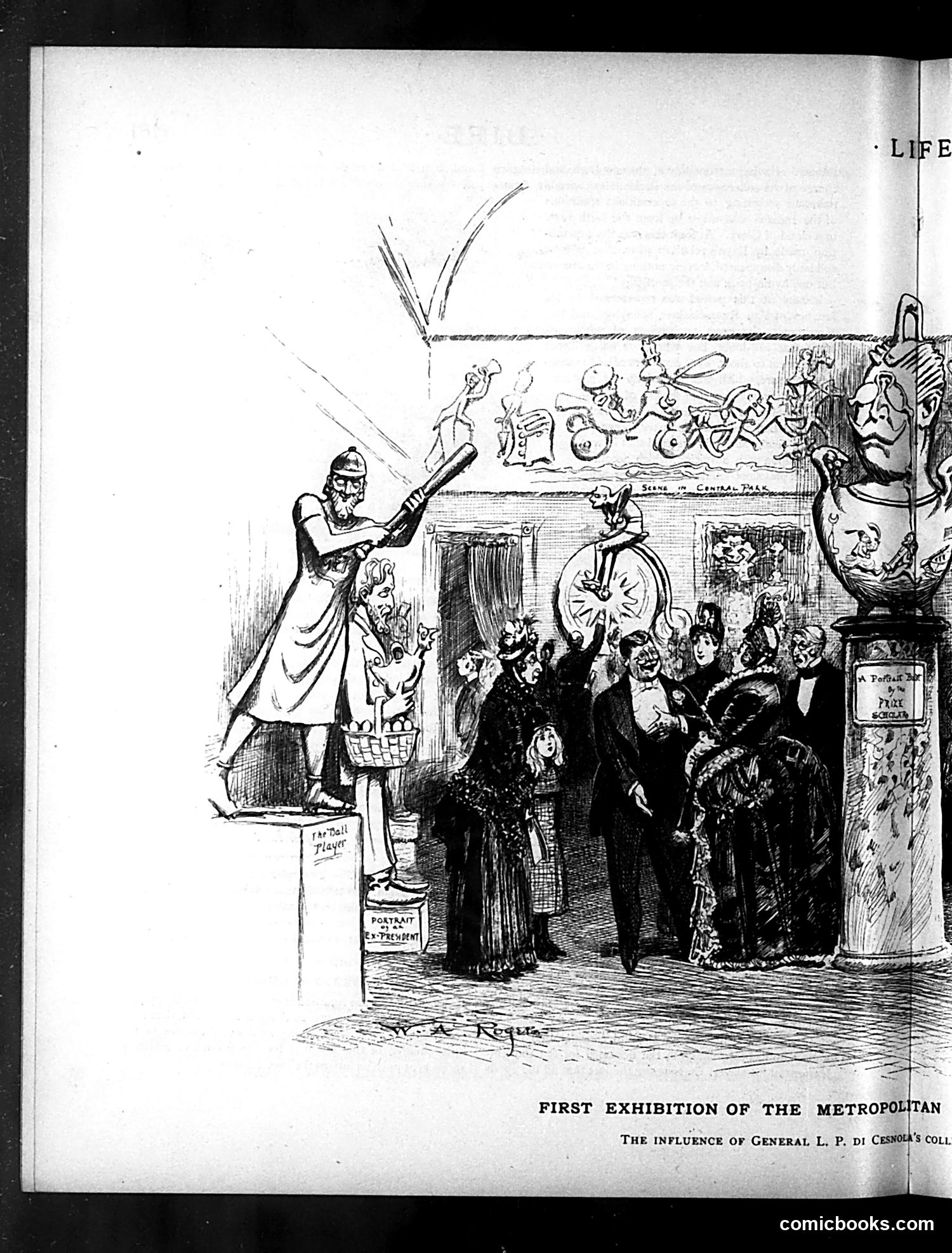
This satirical cartoon depicts the opening of the Metropolitan Museum of Art's first exhibition. The central figure on the elevated platform appears to be a military or authority figure (labeled as relating to "General L. P. di Cesnola's" influence, visible in the caption), directing proceedings with a baton like a conductor. The sketch mocks the pretentious, chaotic nature of the museum's inaugural exhibition. Well-dressed visitors below seem bewildered or dismissive, while various artworks and classical statuary are displayed haphazardly on the walls and pedestal. The satire suggests the exhibition was poorly organized or that Cesnola's leadership resulted in an absurd, unimpressive debut—poking fun at both the institution's ambitions and high-society attendees.
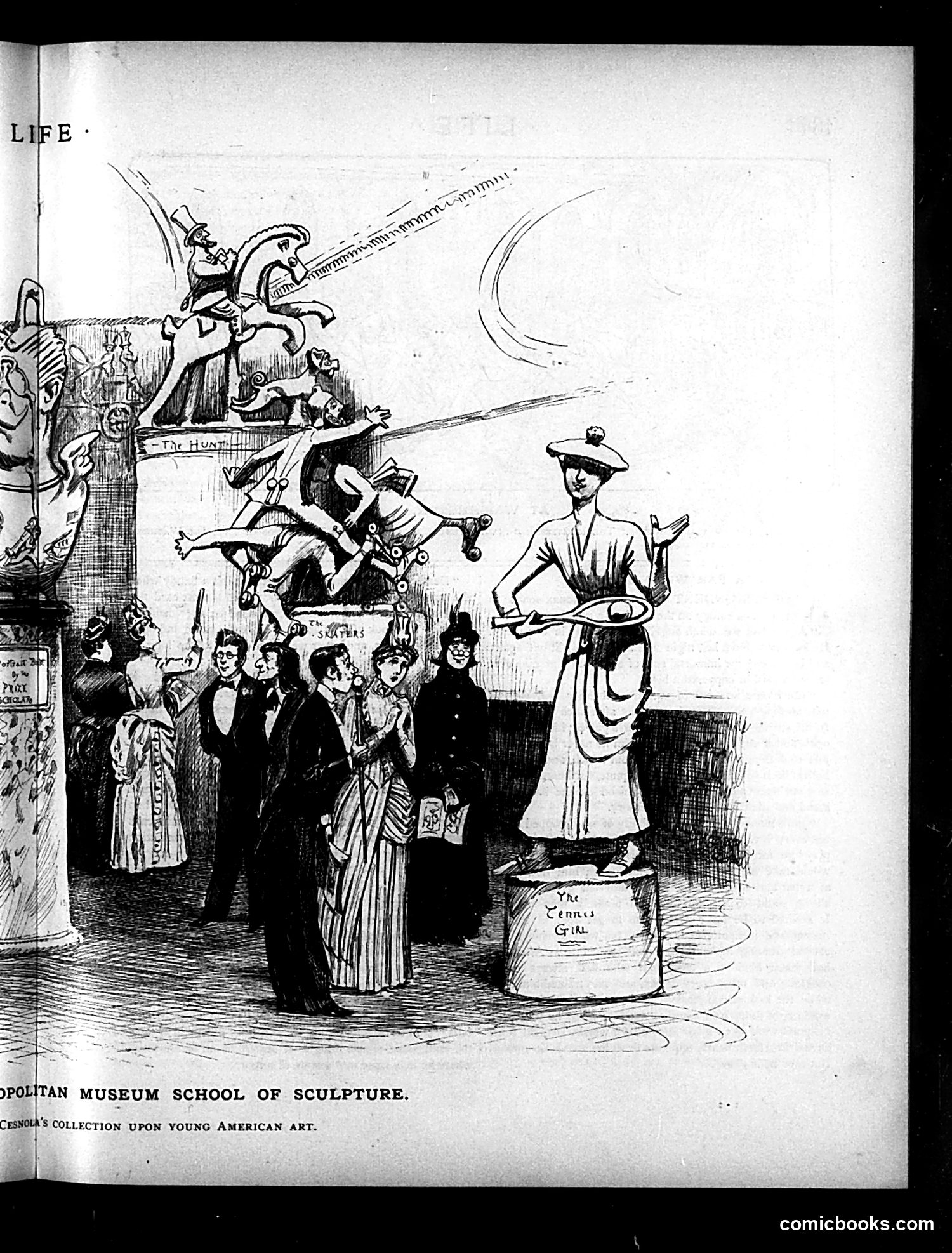
This satirical cartoon mocks the Metropolitan Museum's influence on American art. On the right stands "The Venus Girl"—a young woman posed as a classical sculpture on a pedestal. On the left, wealthy patrons in formal dress gaze upward at an elaborate, chaotic sculptural monument featuring mythological figures and ornate details. The satire appears to critique how the Metropolitan Museum's collection and classical aesthetic shaped American taste and art education, turning living subjects into imitations of European masterworks. The exaggerated, busy monument suggests pretension—that American artists and collectors blindly copied classical styles rather than developing original work. The caption indicates this represents Census's influence on American art, though the specific artist or collector referenced is unclear from visible text.
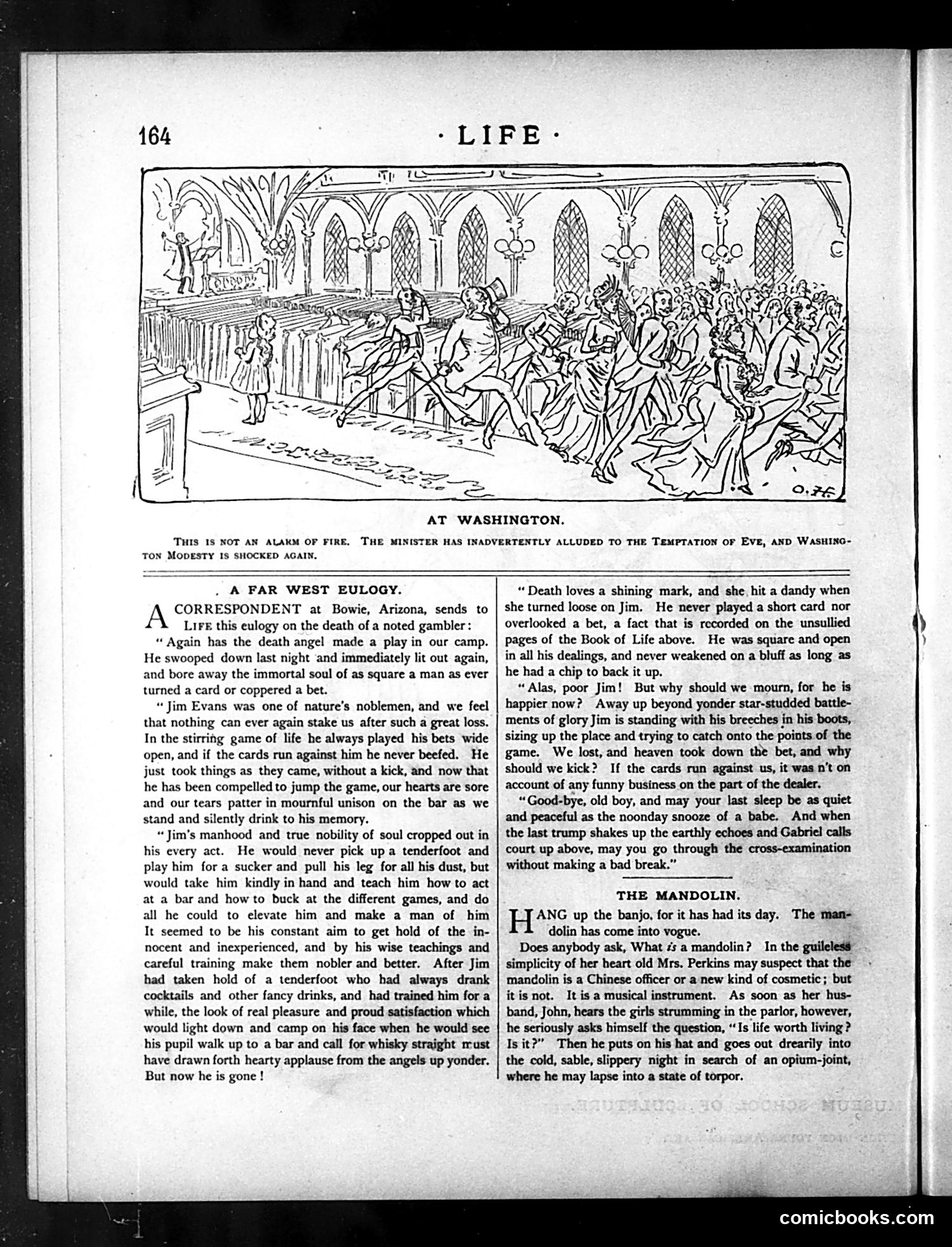
The top cartoon satirizes Washington society's prudishness. A minister accidentally references the "Temptation of Eve" (the biblical Adam and Eve story) during a church service, causing shocked reactions among the congregation—the joke being that Washington elites are so easily scandalized by even innocent allusions to sin. Below, "A Far West Eulogy" mockingly celebrates a dead gambler by describing his morally dubious practices—teaching inexperienced men to gamble and drink—as noble character-building, using flowery language to ironically elevate criminal behavior. "The Mandolin" jokes about the musical instrument's sudden popularity. It humorously suggests that when wives and daughters begin playing mandolins in parlors, their husbands find the sound so unbearable they escape to opium dens—a dark comedic exaggeration of male domestic discontent.
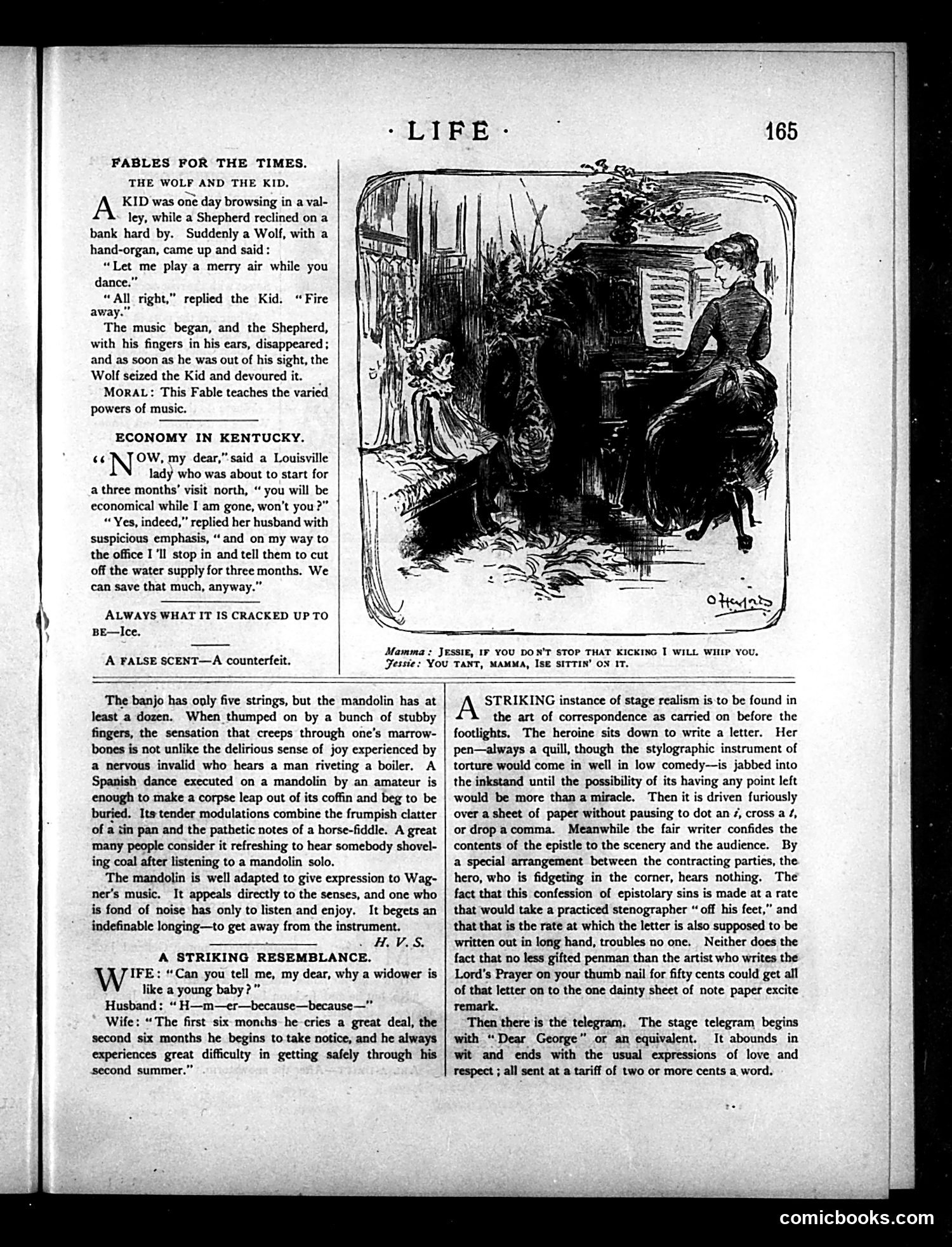
This page contains several short satirical pieces typical of *Life* magazine's humor: **"The Wolf and the Kid"** is a fable mocking how people are distracted by entertainment (the hand-organ music) from real dangers—the wolf devours the kid while the shepherd flees. The moral satirizes music's power to distract. **"Economy in Kentucky"** jokes about a husband's absurd "economy" suggestion: cutting off the water supply entirely while his wife visits, rather than genuinely economizing. **"A Striking Resemblance"** contains a husband-wife joke comparing widowers to babies: both cry for six months, then take notice, then have difficulty with their "second summer"—a crude reference to remarriage challenges. The larger articles critique stage conventions (artificial letter-writing scenes, implausible telegrams) with theatrical exaggeration. The cartoon illustration shows a domestic scene with a mother threatening her child. These pieces reflect *Life's* satirical approach to everyday absurdities and social pretension.
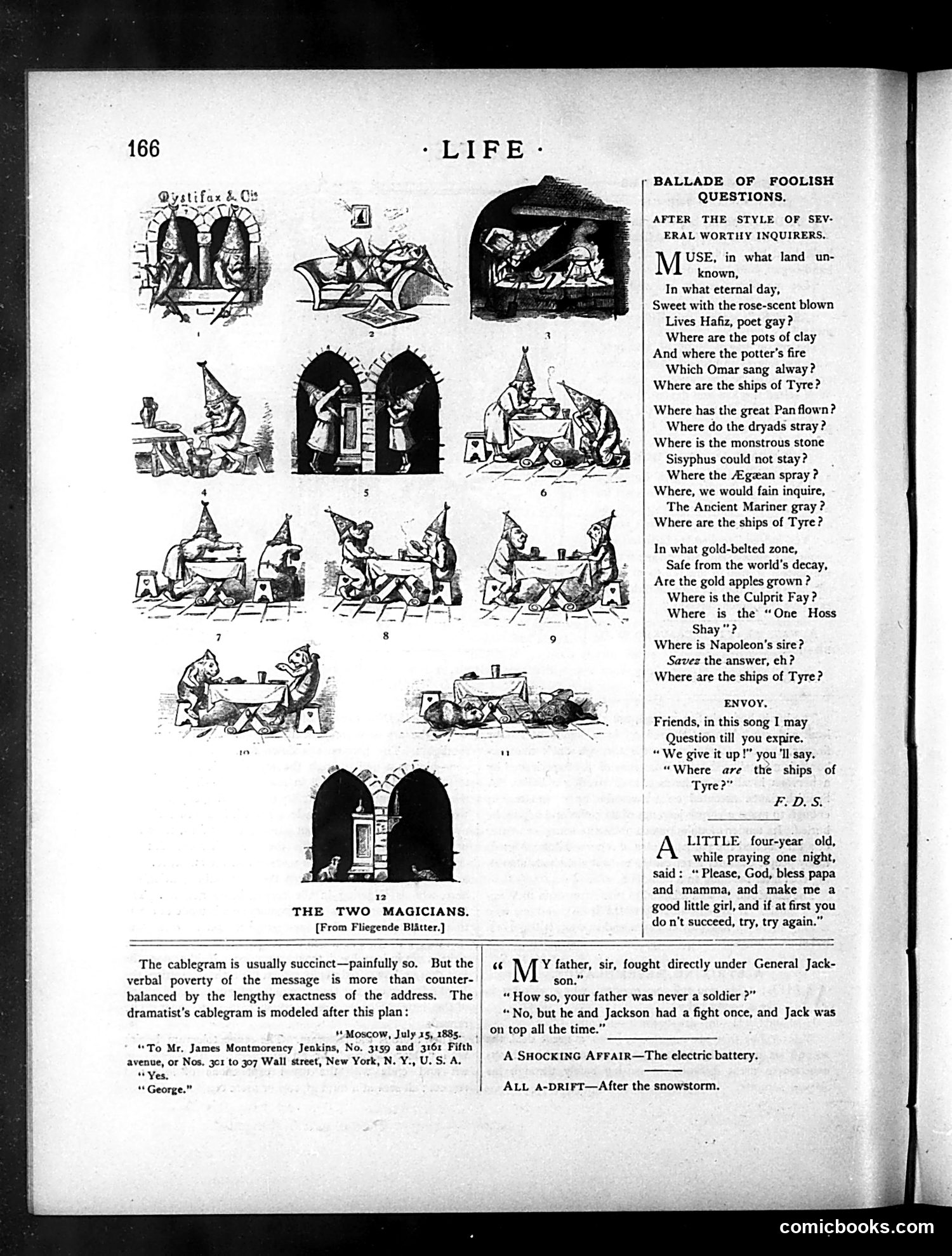
This page contains three distinct satirical pieces from *Life* magazine: **"The Two Magicians"** (illustrated top-left): A cartoon from a German publication showing two figures performing tricks—likely social or political commentary, though the specific reference is unclear without more context. **"Ballade of Foolish Questions"**: A poem mocking the tendency of certain writers to pose unanswerable, overly romantic questions about literary and mythological figures (Hafiz, Omar, the ships of Tyre, Napoleon). The refrain "Where are the ships of Tyre?" emphasizes the absurdity—these are unknowable or nonsensical queries. It's satire of pretentious, affected writing styles popular in the era. **Brief humorous items**: Including a child's prayer mixing religious devotion with "try, try again" (self-help clichés), and wordplay jokes about telegraph addresses and mishearing ("Jackson had a fight"). The page satirizes affectation, pompous writing, and linguistic confusion—typical *Life* magazine fare targeting educated readers familiar with classical literature and contemporary literary pretension.
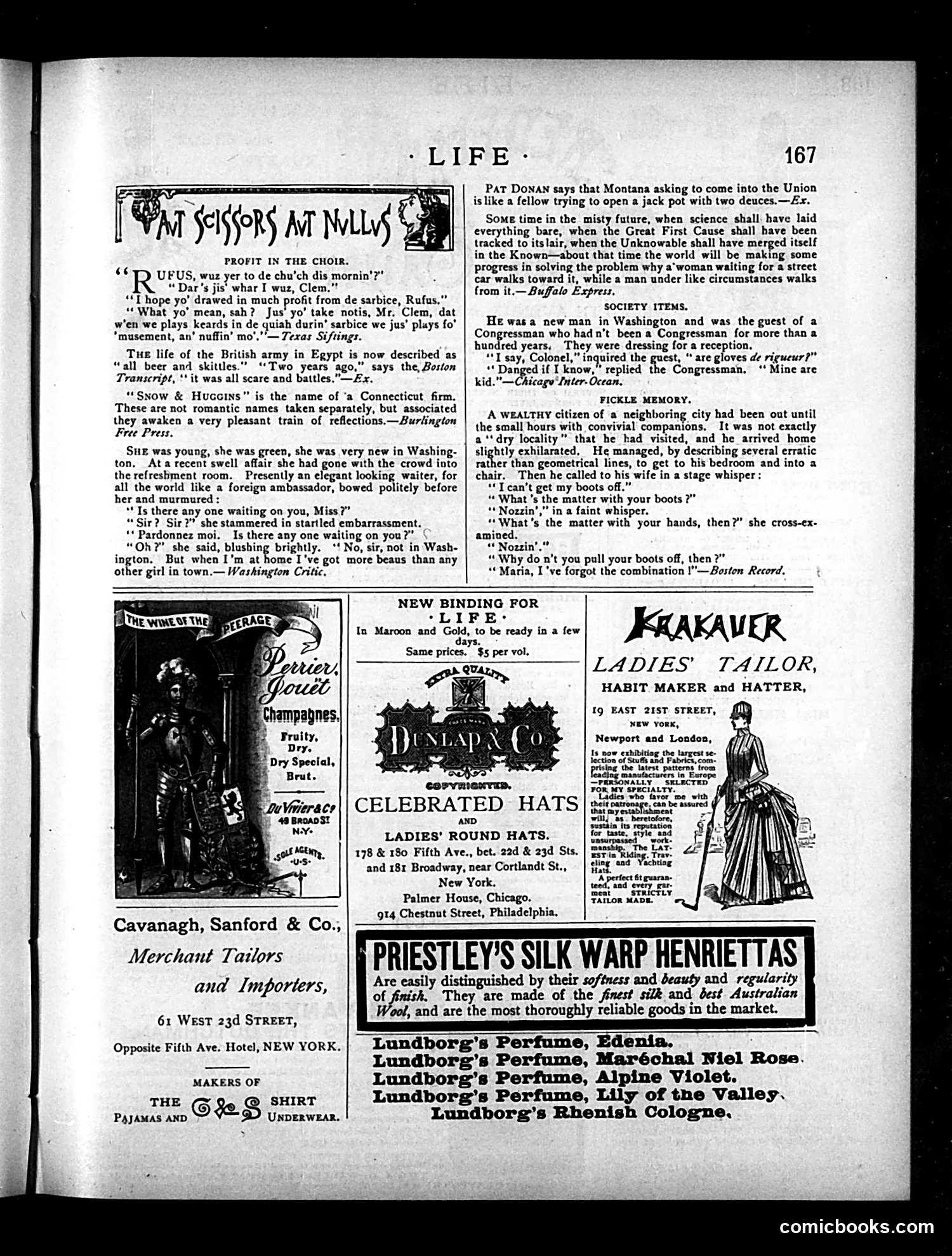
This page is primarily **advertising and humorous filler content** rather than political satire. The visible elements include: **Humorous Short Items:** The page contains several brief comedic anecdotes targeting specific social groups: - A dialect joke about African Americans ("Rufus" and "Clem") discussing card-playing in church - A joke about a naive young woman in Washington confusing a waiter's question about service - Observational humor about a drunk man unable to remove his boots, claiming he's "forgot the combination" **Political/Social References:** - Montana's potential statehood (compared to a weak poker hand) - General observations about human behavior **Format:** The majority of the page consists of period advertisements for tailors, hatmakers, perfumes, and book bindings—typical of *Life* magazine's revenue model. This appears to be a standard issue page mixing light humor with commercial content rather than focused political commentary.
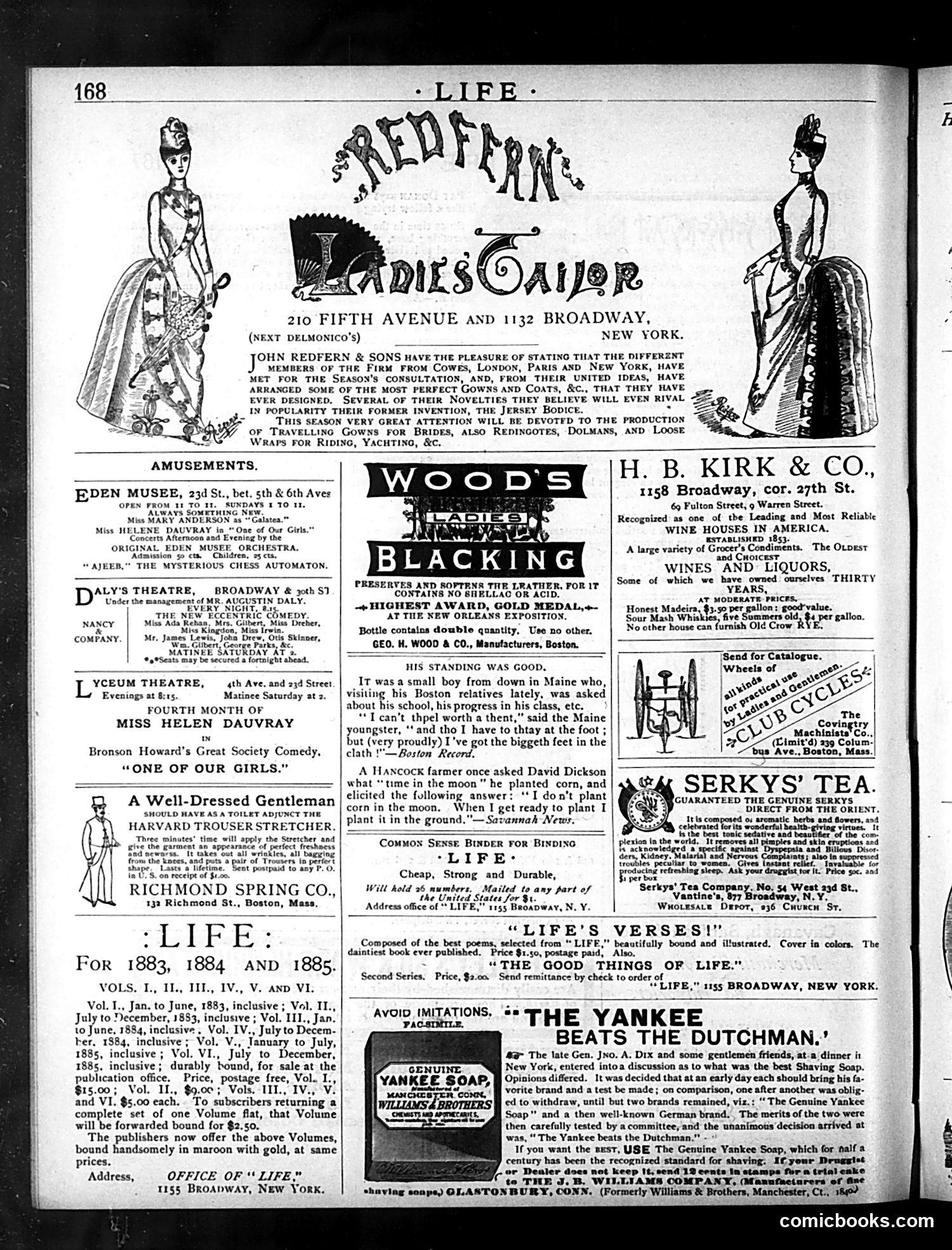
This page is primarily a **fashion advertisement**, not political satire. The large illustration shows two elegantly dressed women modeling gowns from **Redfern & Sons**, a prestigious tailoring firm with locations in Cowes, London, Paris, and New York. The text announces that Redfern designers have gathered internationally to create the season's fashions, highlighting their innovations in traveling gowns for brides, redingotes, dolmans, and riding wear. They claim their designs rival previous successes like the "Jersey Bodice." The remainder of the page contains typical period **advertising**: theater listings, patent products (trouser stretchers, shaving soap), and consumer goods (wines, tea). The anecdotes about the Maine boy and farmer are filler humor common to *Life* magazine. There is **no political cartoon or satire** visible here—this is a commercial page showcasing 1880s high fashion and consumer culture.
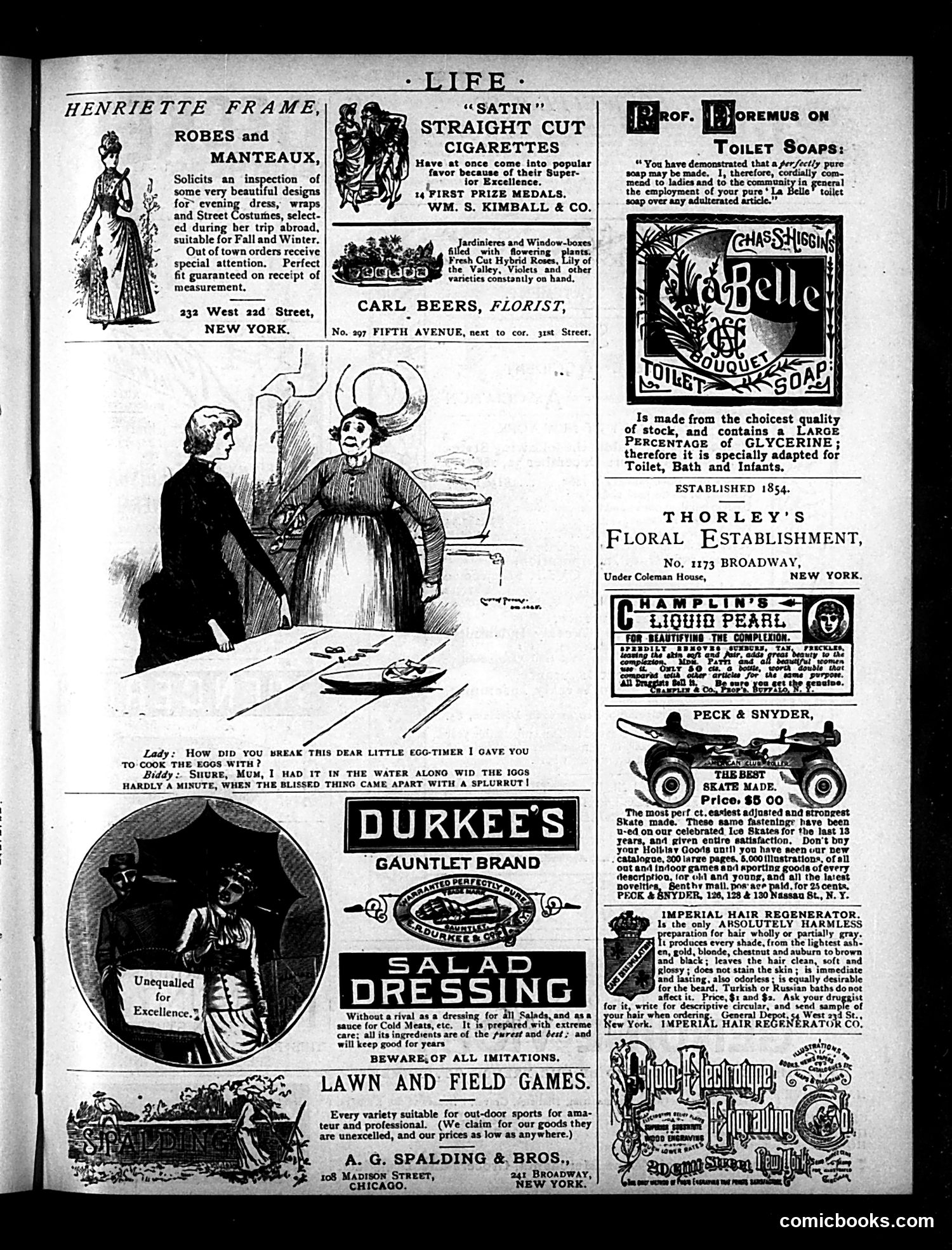
This page is primarily **advertisements with one central cartoon**. The main satirical illustration depicts an Irish domestic servant ("Biddy") explaining to her employer how she broke an egg-timer by placing it in boiling water with eggs—treating the delicate timing device as if it were cookware. The joke targets **Irish immigrant domestic workers** of the era, portraying them as comically ignorant and unable to understand how to use modern household items. The servant's heavy accent ("Sure, Mum," "blissed thing," "splurrut!") reinforces ethnic stereotyping common in late 19th-century American humor. The surrounding advertisements—for women's fashion, flowers, salad dressing, and sporting goods—reflect the magazine's upper-class readership. The cartoon mocks the working-class help these readers employed, a form of casual prejudice typical of period comedy aimed at genteel audiences.
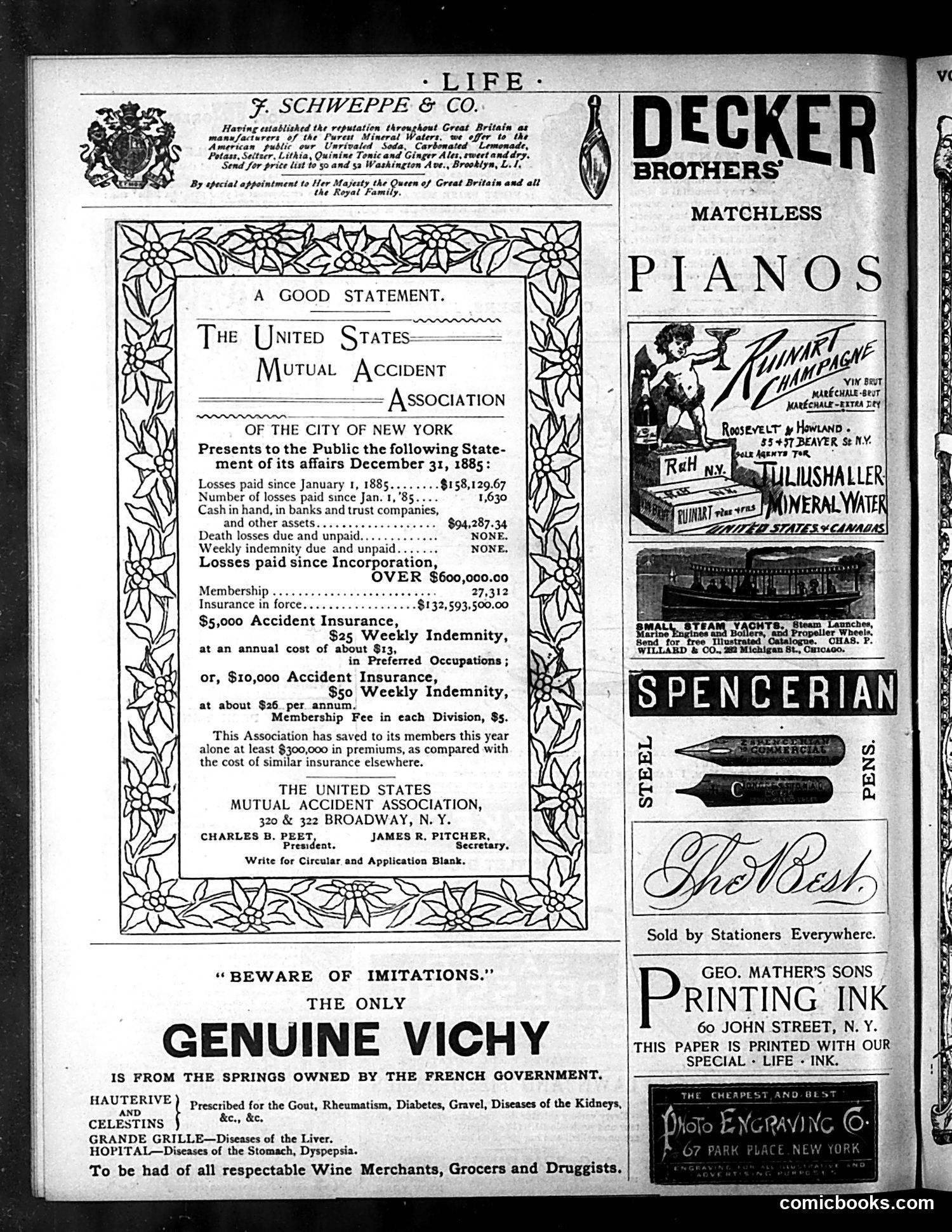
This page is **primarily advertisements**, not satirical content. The main editorial element is a financial statement from the United States Mutual Accident Association of New York, presented as "A Good Statement." It reports the association's insurance operations—losses paid, membership numbers, and premium costs—to demonstrate the organization's financial soundness and value to potential customers. The surrounding advertisements promote various products: Schweppes mineral waters and sodas (with royal warrant), Decker Brothers pianos, Spencerian pens, small steam yachts, printing ink, and Vichy mineral water (a French spring water marketed for treating gout, rheumatism, and digestive ailments). **No political cartoons or satirical commentary appear on this page.** The "Life" branding suggests this is from the satirical magazine, but this particular page functions as a commercial vehicle rather than humor publication.