
Life, 1886-03-18 · page 6 of 16
Life — March 18, 1886 — page 6: what you’re looking at
What you’re looking at
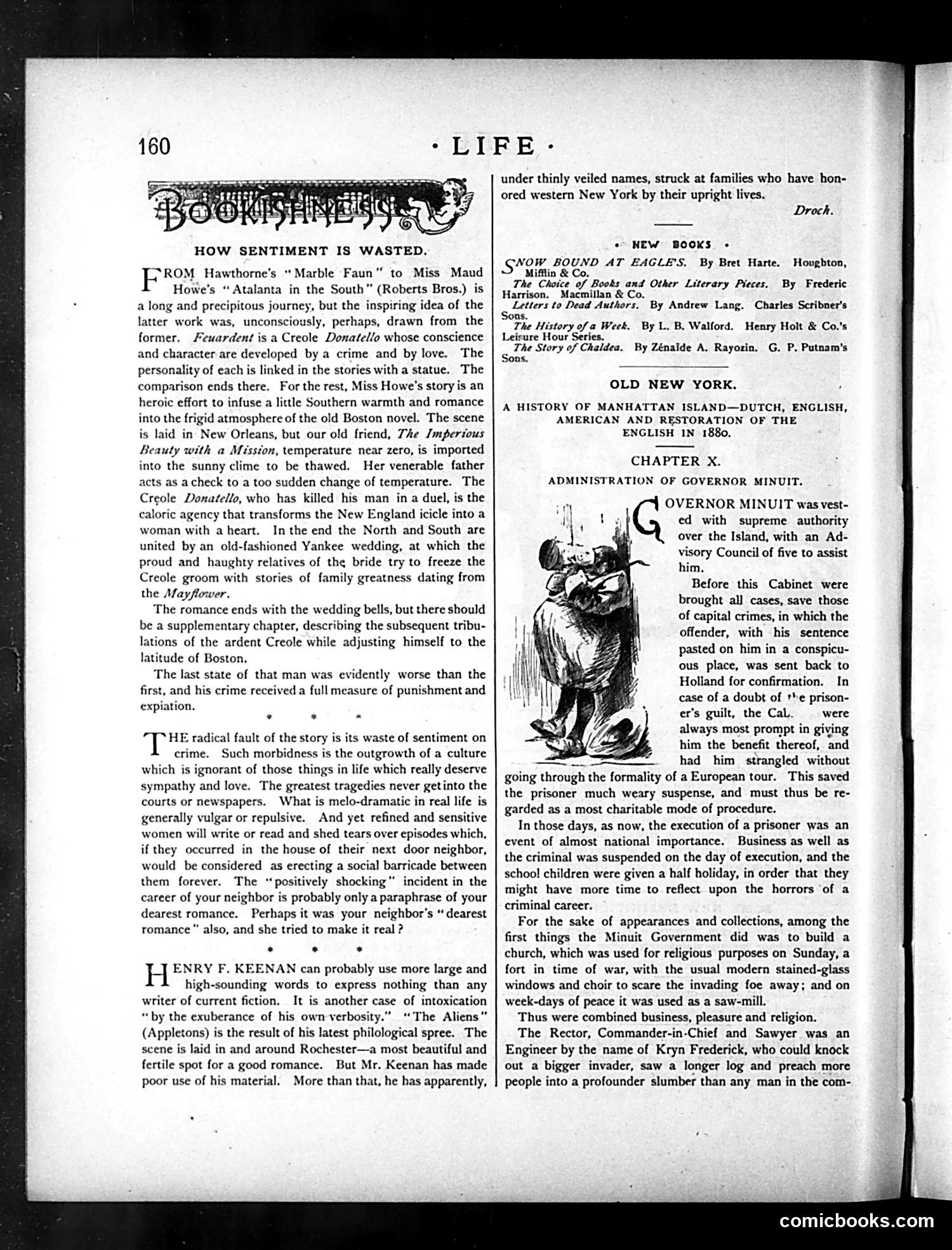
This page contains **literary criticism and book reviews**, not political cartoons. The main content critiques contemporary novels, particularly criticizing how authors waste sentiment on crime and melodrama. The reviewer argues that refined writers shouldn't depict crude social conflicts in domestic settings. The small illustration accompanying "Old New York" shows a **colonial-era figure**, supporting the article's discussion of a history book about Manhattan Island spanning Dutch, English, American, and Restoration periods through 1880. The page primarily functions as **cultural commentary** rather than political satire—attacking overly sentimental Victorian literature as artistically inferior. No specific political figures or current events appear to be referenced. This represents Life magazine's role as a literary and cultural critic for educated readers.
📄 Transcribed text from this page (OCR, searchable)
Machine-transcribed from the original scan — historical spelling and the odd misread are preserved.
LIFE HOW SENTIMENT IS WASTED. FR Hawthorne's “Marble Faun” to Miss Maud Howe's “Atalanta in the South” (Roberts Bros.) is a long and precipitous journey, but the inspiring idea of the latter work was, unconsciously, perhaps, drawn from the former. Feuardent is a Creole Donatello whose conscience and character are developed by a crime and by love. The personality of each is linked in the stories with a statue. The comparison ends there. For the rest, Miss Howe's story is an heroic effort to infuse a little Southern warmth and romance into the frigid atmosphere of the old Boston novel. The scene is laid in New Orleans, but our old friend, The /mperious Beauty with a Misston, temperature near zero, is imported into the sunny clime to be thawed. Her venerable father acts as a check to a too sudden change of temperature. The Creole Donatello, who has killed his man in a duel, is the caloric agency that transforms the New England icicle into a woman with a heart. In the end the North and South are united by an old-fashioned Yankee wedding, at which the proud and haughty relatives of the bride try to freeze the Creole groom with stories of family greatness dating from the Mayflower. The romance ends with the wedding bells, but there should be a supplementary chapter, describing the subsequent tribu- lations of the ardent Creole while adjusting himself to the latitude of Boston, The last state of that man was evidently worse than the first, and his crime received a full measure of punishment and expiation. . * “ HE radical fault of the story is its waste of sentiment on crime. Such morbidness is the outgrowth of a culture which is ignorant of those things in life which really deserve sympathy and love. The greatest tragedies never getinto the courts or newspapers. What is melo-dramatic in real life is generally vulgar or repulsive. And yet refined and sensitive women will write or read and shed tears over episodes which, if they occurred in the house of their next door neighbor, would be considered as erecting a social barricade between them forever. The ‘positively shocking" incident in the career of your neighbor is probably only a paraphrase of your dearest romance. Perhaps it was your neighbor's “dearest romance” also, and she tried to make it real ? . . * ENRY F, KEENAN can probably use more large and high-sounding words to express nothing than any writer of current fiction. It is another case of intoxication “by the exuberance of his own verbosity.” “The Aliens” (Appletons) is the result of his latest philological spree. The scene is laid in and around Rochester—a most beautiful and fertile spot for a good romance. But Mr. Keenan has made poor use of his material. More than that, he has apparently, under thinly veiled names, struck at families who have hon- ored western New York by their upright lives. Droch. « NEW BOOKS - SNOW BOUND AT EAGLES. By Bret Harte. iffin & The Choice SF Books and Other Literary Pieces. Harrison. Macmillan & Co. Letters to Dead Authors, Houghton, By Frederic By Andrew Lang. Charles Scribner's Mica History of a Week. By LB. Walford. Henry Holt & Co.'s The Story of Chaldea. Sons. By Zénalde A. Rayozin. G. P, Putnam's OLD NEW YORK. i A HISTORY OF MANHATTAN ISLAND—DUTCH, ENGLISH, AMERICAN AND RESTORATION OF THE ENGLISH IN 1880. CHAPTER X. ADMINISTRATION OF GOVERNOR MINUIT. OVERNOR MINUIT was vest- ed with supreme authority over the Island, with an Ad- visory Council of five to assist him. Before this Cabinet were brought all cases, save those of capital crimes, in which the offender, with his sentence pasted on him in a conspicu- ous place, was sent back to Holland for confirmation. In case of a doubt of the prison- er's guilt, the CaL. were always most prompt in giving him the benefit thereof, and had him strangled without going through the formality of a European tour. This saved the prisoner much weary suspense, and must thus be re- garded as a most charitable mode of procedure. In those days, as now, the execution of a prisoner was an event of almost national importance. Business as well as the criminal was suspended on the day of execution, and the school children were given a half holiday, in order that they might have more time to reflect upon the horrors ‘of a criminal career. For the sake of appearances and collections, among the first things the Minuit Government did was to build a church, which was used for religious purposes on Sunday, a fort in time of war, with the usual modern stained-glass windows and choir to scare the invading foe away; and on week-days of peace it was used as a saw-mill. Thus were combined business, pleasure and religion. The Rector, Commander-in-Chief and Sawyer was an Engineer by the name of Kryn Frederick, who could knock out a bigger invader, saw a longer log and preach more people into a profounder slumber than any man in the com- comicbooks.com