
Life, 1886-03-18 · page 7 of 16
Life — March 18, 1886 — page 7: what you’re looking at
What you’re looking at
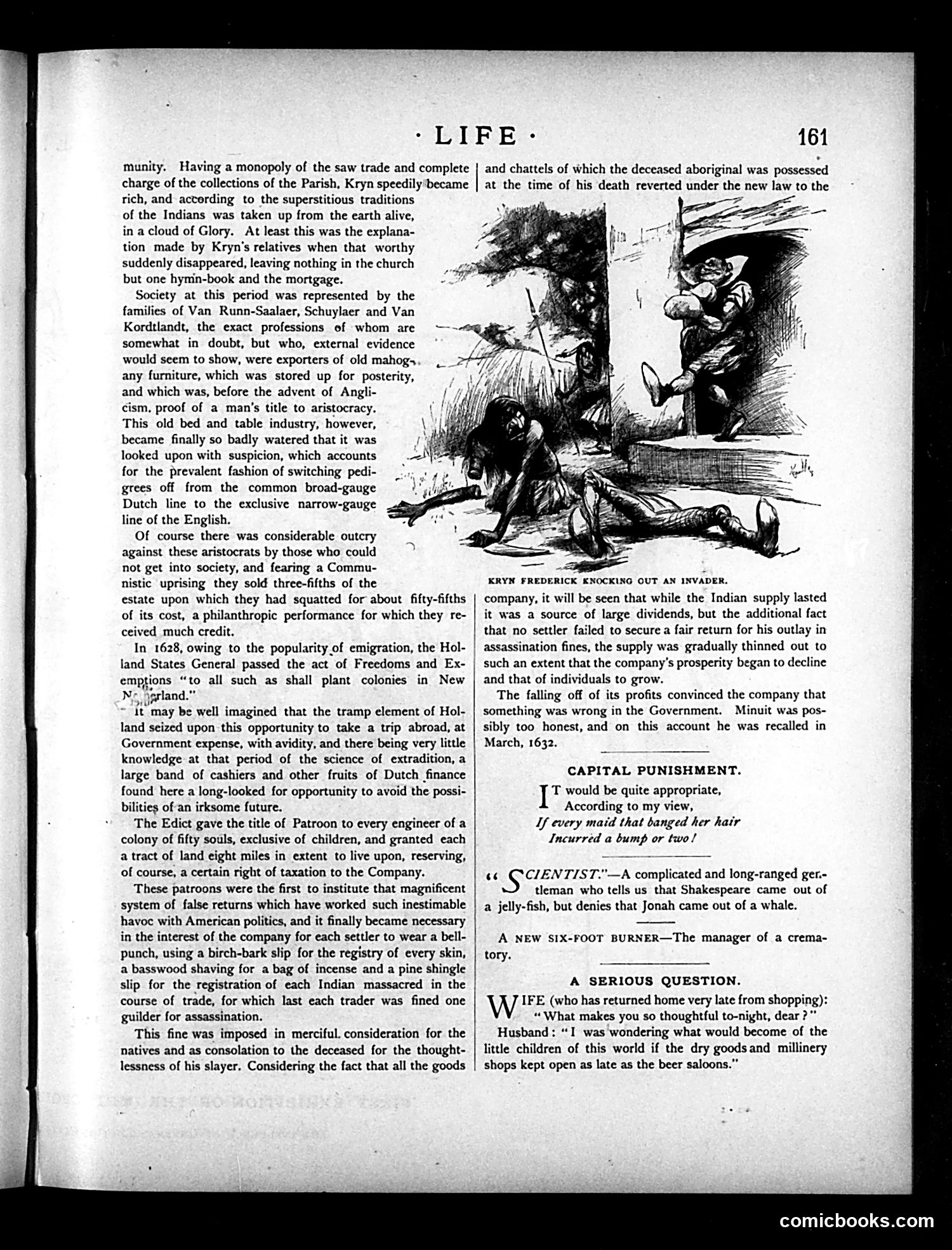
The main illustration, titled "KRYN FREDERICK KNOCKING OUT AN INVADER," depicts a figure striking down what appears to be a Native American or colonial-era combatant. Based on the surrounding text discussing Dutch colonial history, the image likely illustrates a historical episode involving early American settlement and indigenous conflict. The page's body text discusses Dutch colonial ventures, the Dutch East India Company's monopolies, and early settlement patterns in New Amsterdam (later New York). The satirical sections below—"CAPITAL PUNISHMENT," "A NEW SIX-FOOT BURNER," and "A SERIOUS QUESTION"—are brief comedic quips unrelated to the main historical narrative. The cartoon appears to commemorate or satirize a specific colonial-era incident, though without additional historical documentation, the exact identity of "Kryn Frederick" and the specific conflict depicted remains unclear from the image alone.
📄 Transcribed text from this page (OCR, searchable)
Machine-transcribed from the original scan — historical spelling and the odd misread are preserved.
- LIFE: munity. Having a monopoly of the saw trade and complete charge of the collections of the Parish, Kryn speedily‘became rich, and acterding to the superstitious traditions of the Indians was taken up from the earth alive, in a cloud of Glory. At least this was the explana- tion made by Kryn’s relatives when that worthy suddenly disappeared, leaving nothing in the church but one hymin-book and the mortgage. Society at this period was represented by the families of Van Runn-Saalaer, Schuylaer and Van Kordtlandt, the exact professions of whom are somewhat in doubt, but who, external evidence would seem to show, were exporters of old mahog any furniture, which was stored up for posterity, and which was, before the advent of Angli- cism, proof of a man’s title to aristocracy. This old bed and table industry, however, became finally so badly watered that it was looked upon with suspicion, which accounts for the prevalent fashion of switching pedi- grees off from the common broad-gauge Dutch line to the exclusive narrow-gauge line of the English. Of course there was considerable outcry against these aristocrats by those who could not get into society, and fearing a Commu- nistic uprising they sold three-fifths of the estate upon which they had squatted for about fifty-fifths of its cost, a philanthropic performance for which they re- ceived much credit. In 1628, owing to the popularity of emigration, the Hol- land States General passed the act of Freedoms and Ex- | emptions “to all such as shall plant colonies in New No, jpfland.” it may be well imagined that the tramp element of Hol- land seized upon this opportunity to take a trip abroad, at Government expense, with avidity, and there being very little | knowledge at that period of the science of extradition, a large band of cashiers and other fruits of Dutch finance found here a long-looked for opportunity to avoid the possi- bilities of-an irksome future. The Edict gave the title of Patroon to every engineer of a colony of fifty souls, exclusive of children, and granted each a tract of land eight miles in extent to live upon, reserving, of course, a certain right of taxation to the Company. These patroons were the first to institute that magnificent | system of false returns which have worked such inestimable havoc with American politics, and it finally became necessary in the interest of the company for each settler to wear a bell- punch, using a birch-bark slip for the registry of every skin, a basswood shaving for a bag of incense and a pine shingle slip for the registration of each Indian massacred in the course of trade, for which last each trader was fined one guilder for assassination. This fine was imposed in merciful. consideration for the natives and as consolation to the deceased for the thought- lessness of his slayer. Considering the fact that all the goods 161 and chattels of which the deceased aboriginal was possessed at the time of his death reverted under the new law to the ns KRYN FREDERICK KNOCKING OUT AN INVADER. company, it will be seen that while the Indian supply lasted it was a source of large dividends, but the additional fact that no settler failed to secure a fair return for his outlay in assassination fines, the supply was gradually thinned out to such an extent that the company’s prosperity began to decline and that of individuals to grow. The falling off of its profits convinced the company that something was wrong in the Government. Minuit was pos- sibly too honest, and on this account he was recalled in March, 1632. CAPITAL PUNISHMENT. T would be quite appropriate, According to my view, If every maid that banged her hair Incurred a bump or two! “cc CIENTIST."—A complicated and long-ranged ger.- tleman who tells us that Shakespeare came out of a jelly-fish, but denies that Jonah came out of a whale. A NEW SIX-FOOT BURNER—The manager of a crema- tory. A SERIOUS QUESTION. IFE (who has returned home very late from shopping): “What makes you so thoughtful to-night, dear?” Husband: “I was wondering what would become of the little children of this world if the dry goods and millinery shops kept open as late as the beer saloons.” comicbooks.com