
Life, 1886-03-18 · page 11 of 16
Life — March 18, 1886 — page 11: what you’re looking at
What you’re looking at
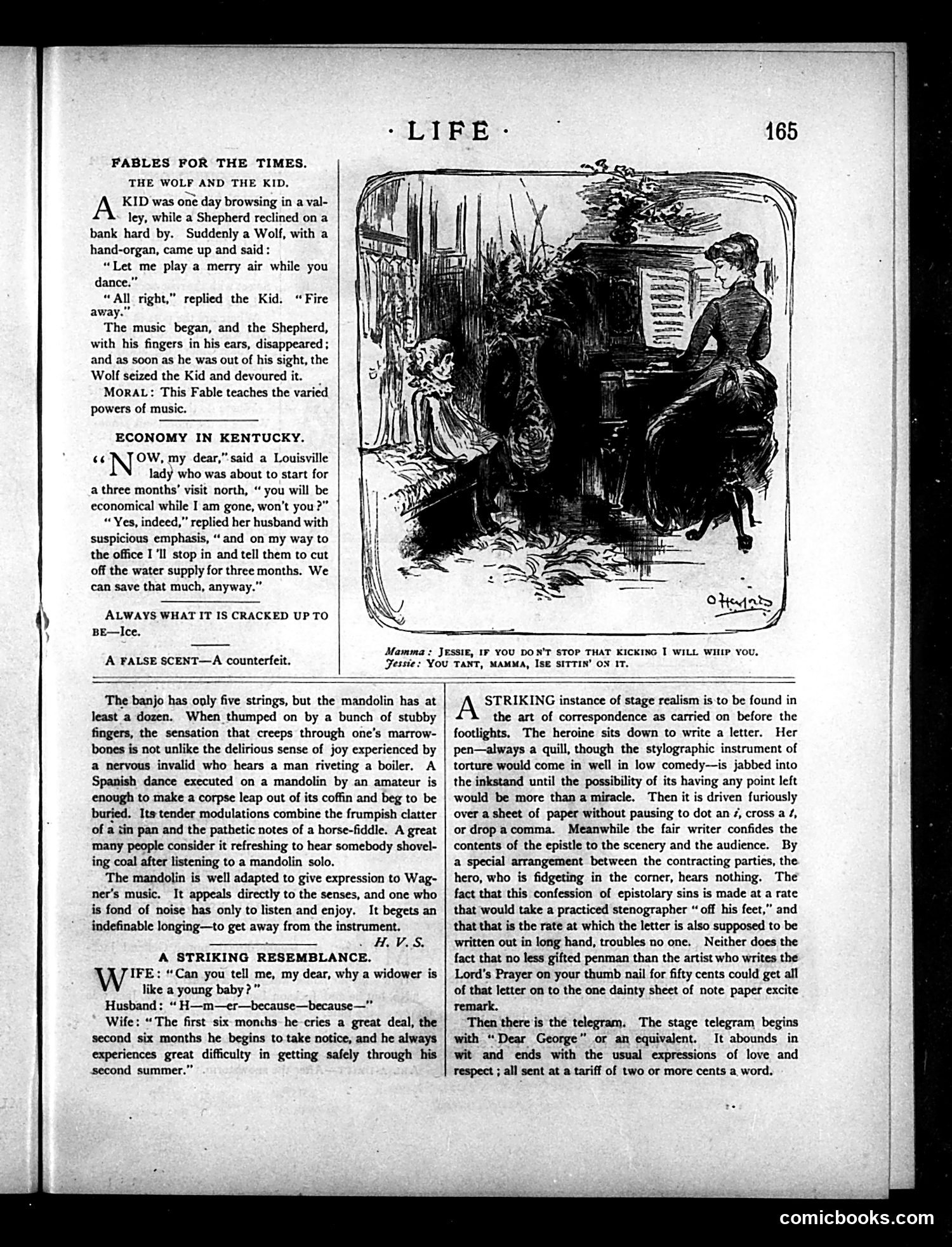
This page contains several short satirical pieces typical of *Life* magazine's humor: **"The Wolf and the Kid"** is a fable mocking how people are distracted by entertainment (the hand-organ music) from real dangers—the wolf devours the kid while the shepherd flees. The moral satirizes music's power to distract. **"Economy in Kentucky"** jokes about a husband's absurd "economy" suggestion: cutting off the water supply entirely while his wife visits, rather than genuinely economizing. **"A Striking Resemblance"** contains a husband-wife joke comparing widowers to babies: both cry for six months, then take notice, then have difficulty with their "second summer"—a crude reference to remarriage challenges. The larger articles critique stage conventions (artificial letter-writing scenes, implausible telegrams) with theatrical exaggeration. The cartoon illustration shows a domestic scene with a mother threatening her child. These pieces reflect *Life's* satirical approach to everyday absurdities and social pretension.
📄 Transcribed text from this page (OCR, searchable)
Machine-transcribed from the original scan — historical spelling and the odd misread are preserved.
FABLES FOR THE TIMES. THE WOLF AND THE KID. KID was one day browsing in a val- ley, while a Shepherd reclined on a bank hard by. Suddenly a Wolf, with a hand-organ, came up and said: “Let me play a merry air while you dance.” “All right,” replied the Kid. “Fire away.’ The music began, and the Shepherd, with his fingers in his ears, disappeared; and as soon as he was out of his sight, the Wolf seized the Kid and devoured it. | MORAL: This Fable teaches the varied powers of music. ECONOMY IN KENTUCKY. 6 OW, my dear,” said a Louisville lady who was about to start for a three months’ visit north, “ you will be economical while I am gone, won't you?” “Yes, indeed,” replied her husband with | suspicious emphasis, “and on my way to the office I'll stop in and tell them to cut off the water supply for three months. We can save that much, anyway.” ALWAYS WHAT IT IS CRACKED UP TO BE—Ice. A FALSE SCENT—A counterfeit. Mamma : JEsSi£, 1F YOU DON’T STOP THAT KICKING I WILL WHIP YoU. Jessie: YOU TANT, MAMMA, Ise SITTIN’ ON IT. The banjo has oply five strings, but the mandolin has at least a dozen. When thumped on by a bunch of stubby fingers, the sensation that creeps through one’s marrow- bones is not unlike the delirious sense of joy experienced by a nervous invalid who hears a man riveting a boiler. A Spanish dance executed on a mandolin by an amateur is enough to make a corpse leap out of its coffin and beg to be buried. Its tender modulations combine the frumpish clatter of a tin pan and the pathetic notes of a horse-fiddle. A great many people consider it refreshing to hear somebody shovel- ing coal after listening to a mandolin solo. The mandolin is well adapted to give expression to Wag- ner’s music. It appeals directly to the senses, and one who is fond of noise has only to listen and enjoy. It begets an indefinable longing—to get away from the instrument. one, _ AVS. A STRIKING RESEMBLANCE. IFE: Can you tell me, my dear, why a widower is like a young baby?” Husband: “ H—m—er—because—because—” Wife: “The first six-moncths he-cries a great deal, the second six months he begins to take notice, and he always experiences great difficulty in getting safely through his second summer.” STRIKING instance of stage realism isto be found in the art of correspondence as carried on before the footlights. The heroine sits down to write a letter. Her pen—always a quill, though the stylographic instrument of torture would come in well in low comedy—is jabbed into the inkstand until the possibility of its having any point left would be more than a miracle. Then it is driven furiously over a sheet of paper without pausing to dot an /, cross a /, or drop acomma. Meanwhile the fair writer confides the contents of the epistle to the scenery and the audience. By a special arrangement between the contracting parties, the hero, who is fidgeting in the corner, hears nothing. The fact that this confession of epistolary sins is made at a rate that would take a practiced stenographer “ off his feet,” and that that is the rate at which the letter is also supposed to be written out in long hand, troubles no one. Neither does the fact that no less gifted penman than the artist who writes the Lord’s Prayer on your thumb nail for fifty cents could get all of that letter on to the one dainty sheet of note paper excite remark. Then there is the telegram. The stage telegram begins with “Dear George” or an equivalent. It abounds in wit and ends with the usual expressions of love and Fespect ; all sent at a tariff of two or more cents a word, comicbooks.com