
Life, 1886-03-18 · page 3 of 16
Life — March 18, 1886 — page 3: what you’re looking at
What you’re looking at
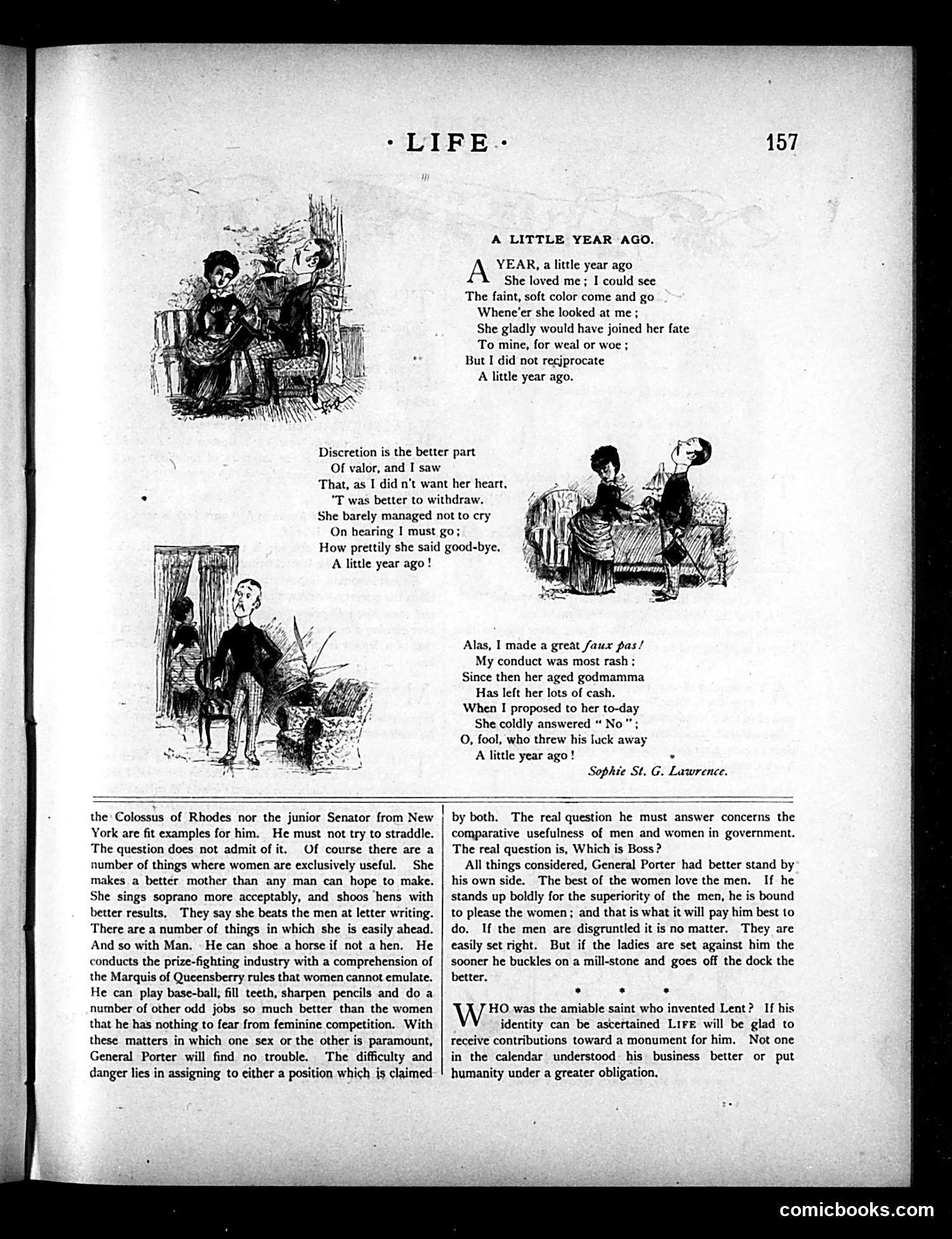
This page contains a poem titled "A Little Year Ago" by Sophie St. G. Lawrence, accompanied by three sketches depicting a romantic narrative. The poem recounts a failed courtship from a year prior, where the speaker chose not to pursue a woman's affections out of discretion, believing she deserved better. The sketches illustrate key moments: the couple together, their parting, and the speaker's subsequent regret when learning the woman has married someone wealthier. The satirical point targets male romantic hesitation and poor judgment—the speaker's "discretion" backfired, costing him the relationship. The accompanying prose below discusses women's capabilities and their role in governance, suggesting this reflects broader Victorian-era debates about gender competence. The humor derives from the protagonist's self-inflicted romantic failure through overthinking.
📄 Transcribed text from this page (OCR, searchable)
Machine-transcribed from the original scan — historical spelling and the odd misread are preserved.
A LITTLE YEAR AGO. YEAR, a little year ago She loved me; I could see The faint, soft color come and go Whene'er she looked at me ; She gladly would have joined her fate To mine, for weal or woe ; But I did not recjprocate A little year ago. Discretion is the better part Of valor, and I saw That, as I did n’t want her heart, 'T was better to withdraw. She barely managed not to cry On bearing I must go; How prettily she said good-bye, A little year ago! Alas, I made a great faux pas/ My conduct was most rash ; Since then her aged godmamma Has left her lots of cash. When I proposed to her to-day She coldly answered “ No”; O, fool, who threw his luck away A little year ago! Sophie St. G. Lawrence. the: Colossus of Rhodes nor the junior Senator from New York are fit examples for him. He must not try to straddle. The question does not admit of it. Of course there are a number of things where women are exclusively useful. She makes a better mother than any man can hope to make. She sings soprano more acceptably, and shoos ‘hens with better results, They say she beats the men at letter writing. There are a number of things in which she is easily ahead. And so with Man. . He can shoe a horse if not ahen. He conducts the prize-fighting industry with a comprehension of the Marquis of Queensberry rules that women cannot emulate. He can play base-ball, fill teeth, sharpen pencils and do a number of other odd jobs so much better than the women that he has nothing to fear from feminine competition. With these matters in which one sex or the other is paramount, General Porter will find no trouble. The difficulty and danger lies in assigning to either a position which js claimed | by both. The real question he must answer concerns the comparative usefulness of men and women in government. The real question is, Which is Boss ? All things considered, General Porter had better stand by his own side. The best of the women love the men. If he stands up boldly for the superiority of the men, he is bound to please the women ; and that is what it will pay him best to do. If the men are disgruntled it is no matter. They are easily set right. But if the ladies are set against him the sooner he buckles on a mill-stone and goes off the dock the better. . . . HO was the amiable saint who invented Lent? If his identity can be ascertained LiFe will be glad to receive contributions toward a monument for him. Not one in the calendar understood his business better or put humanity under a greater obligation, comicbooks.com