
A complete issue · 16 pages · 1886
Life — February 25, 1886
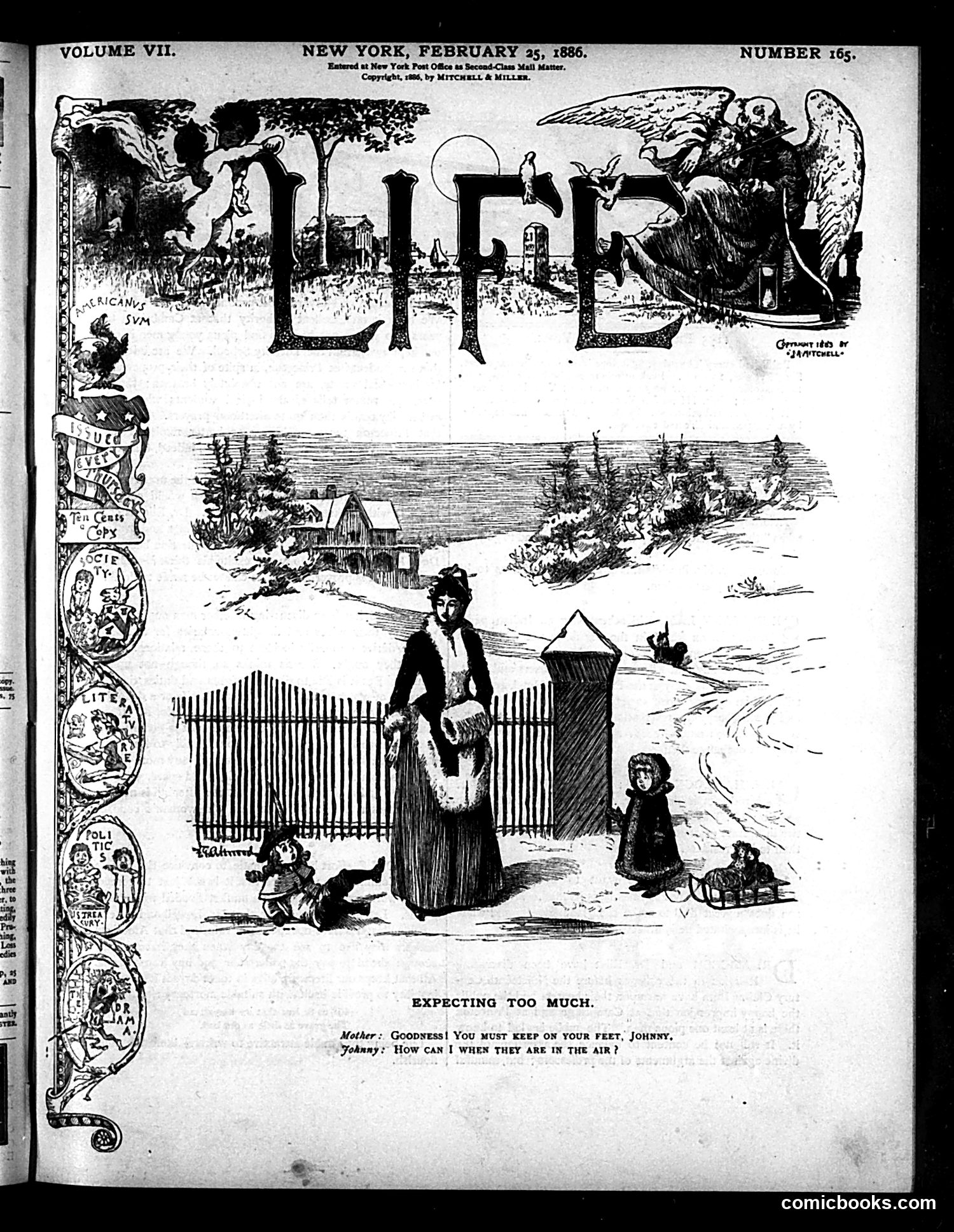
This cartoon satirizes parental expectations during winter. A mother stands in snow with three children, addressing her son Johnny with the caption: "Goodness! You must keep on your feet, Johnny. How can I when they are in the air?" The humor lies in the impossible contradiction: the mother demands Johnny stay upright while he's actively sledding or sliding on ice—feet literally airborne. The cartoon mocks unrealistic parental demands of children during winter play. The snowy landscape with a house and fence in the background establishes the winter setting, while the children's winter clothing suggests this is depicting typical childhood winter activities of the 1880s era.
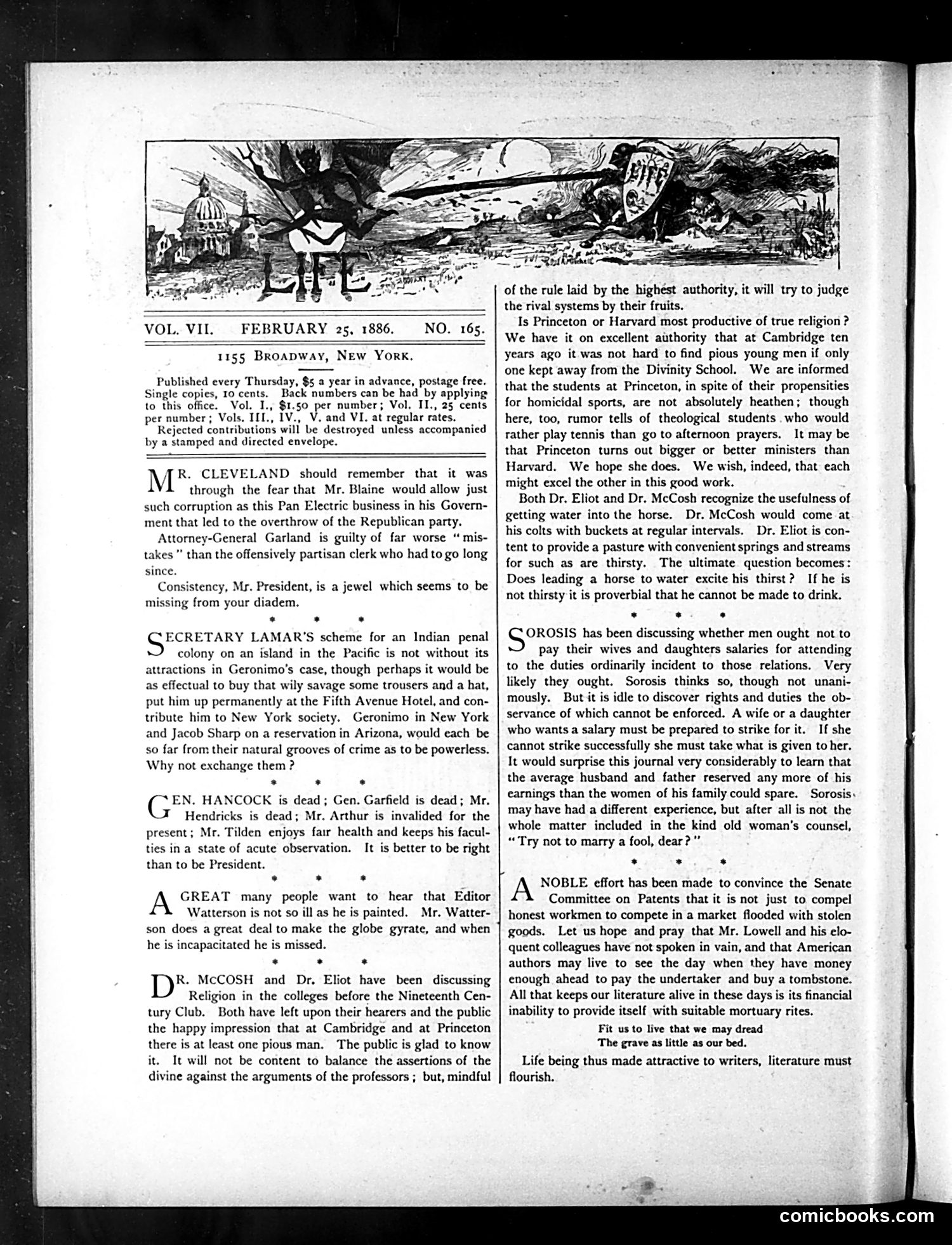
The masthead cartoon depicts a figure labeled "LIFE" emerging from or presiding over a chaotic landscape. The image appears satirical but the specific reference is unclear without additional context. The text consists of brief editorial commentaries on contemporary political and social figures, including mentions of Cleveland, Secretary Lamar's Indian penal colony proposal, and various deceased or incapacitated political figures (Hancock, Garfield, Hendricks, Arthur). Notable satirical points target Cleveland's administration regarding corruption, discuss Princeton versus Harvard's religious education, debate women's salary rights, and comment on patent reform and literary finances. The overall tone is acerbic political commentary typical of 1880s American satirical journalism, criticizing government figures and social institutions of the Gilded Age.
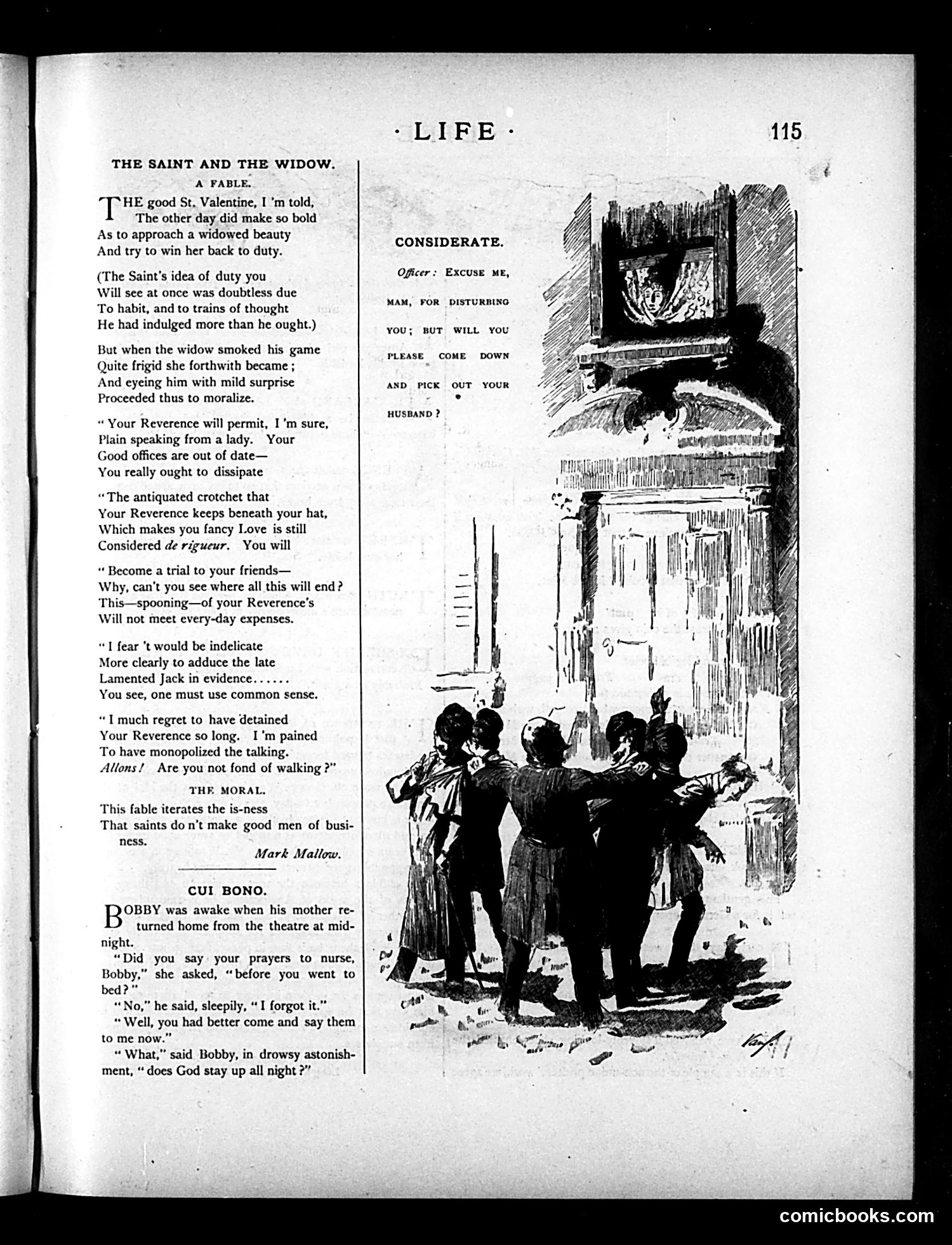
This page contains two separate pieces: **"The Saint and the Widow"** (top): A fable by Mark Mallow satirizing sanctimonious clergy. A widow rebuffs St. Valentine's moral lecturing about duty and propriety. The saint objects to her smoking, her "antique crotchet" (old-fashioned hat), and her independence—yet hypocritically keeps a mistress himself ("Love is still Considered *de rigueur*"). The moral critiques how saints/clergy impose strict rules on others while ignoring their own transgressions. **"Cui Bono"** (bottom): A domestic scene where young Bobby questions his mother about prayers to a nurse before sleep. When told "God stay up all night?" it's a child's innocent challenge to religious assumptions—likely satirizing unthinking faith transmission between generations. Both pieces critique hypocrisy in religious and social institutions.
This page contains multiple satirical brief items typical of Life's format. Key references include: **"The Wily Alderman"** - A poem mocking a local politician seeking private retreat after questionable conduct, suggesting his "public station" was compromised. **Political commentary** addresses Mr. Garland's resignation (context unclear without additional information), the Earl of Fife and Gladstone regarding Irish policy, and currency issues. **"George Washington! Pah!"** - The lengthy closing piece mocks Americans' reverence for Washington, arguing his actual character was flawed—he was "inconsiderate enough to remove what was English"—and that modern children idealize an impossible standard. The page uses satirical wit to critique both local corruption and national mythmaking. Specific figures and dates require additional historical context to fully explain references.
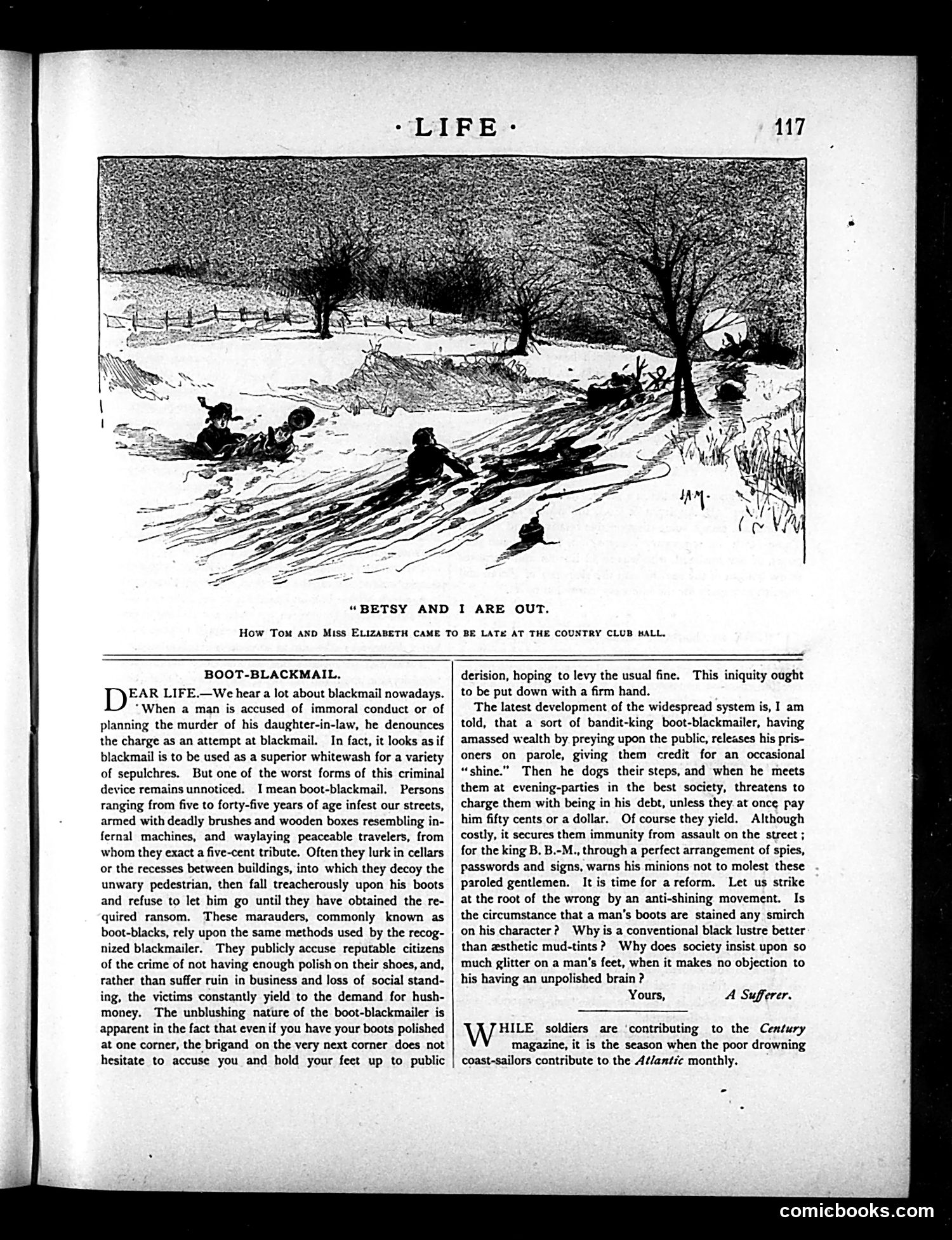
The page features an illustration titled "Betsy and I Are Out," depicting children sledding or playing on a snowy slope near bare trees and a fence—a gentle domestic scene seemingly unrelated to the serious letter below. The main content is "Boot-Blackmail," a reader's complaint about extortion by organized shoe-shiners. The writer describes how blackmailers threaten to publicly damage polished boots unless given money, operating as an unofficial extortion racket. He criticizes this "widespread system" and argues it should be stopped "with a firm hand." The satirical point: Life is using this mundane street-level crime to mock organized fraud and the public's vulnerability to petty criminals exploiting social conventions—in this case, the expectation of well-maintained appearance.
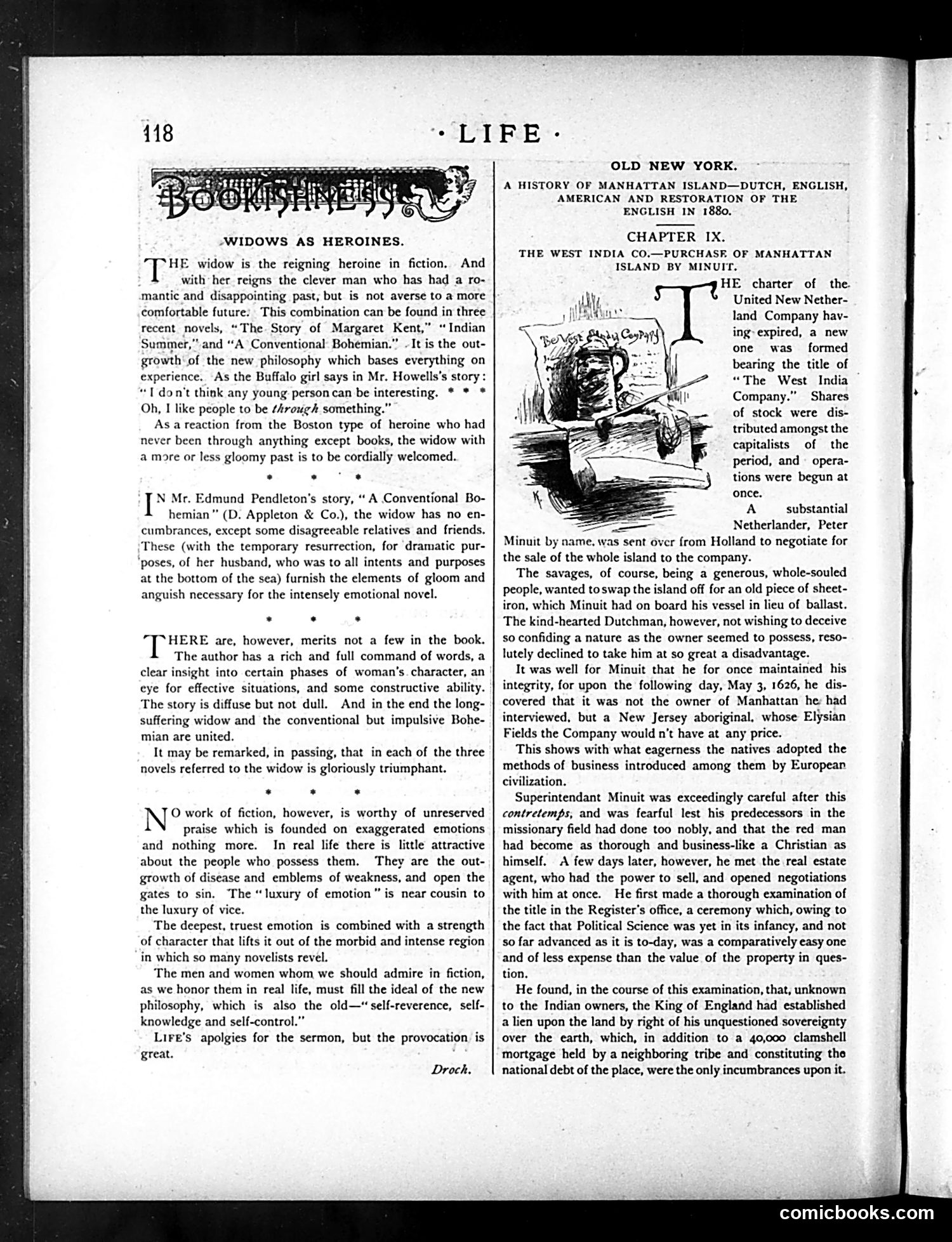
This page contains no political cartoon or satirical visual. Instead, it presents two distinct text sections: **Left side:** A "Book Shelf" column discussing "Widows as Heroines" in fiction, critiquing how literature romanticizes widow characters. The author argues real widows embody weakness and disease rather than the noble heroism fictional works portray. **Right side:** Chapter IX of a historical article about Manhattan's colonial history, specifically discussing the West India Company's 1626 purchase of the island from Native Americans through an agent named Peter Minuit. The text details the company's business practices and property assessments. The small illustration shows a figure reading, likely decorative. The page primarily serves educational/informational purposes rather than satirical commentary.
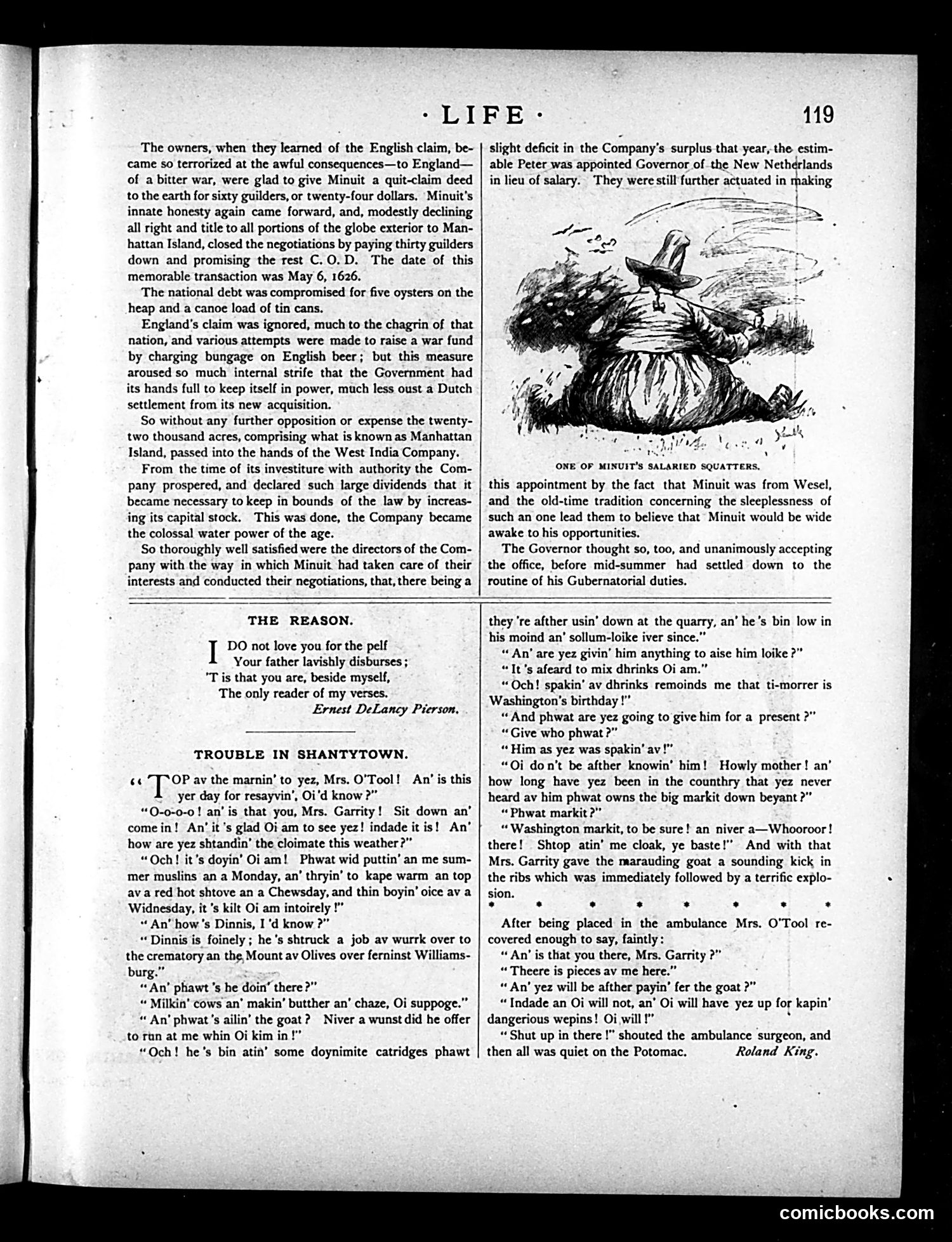
The page contains two distinct sections: **Upper section:** Historical narrative about early Manhattan Island and the Dutch West India Company's colonial dealings, including a small illustration labeled "One of Minuit's Salaried Squatters" (appears to be a Native American figure). **Lower section:** Two pieces of humorous dialect writing: 1. "The Reason" - A brief poem by Ernest DeLancy Pierson 2. "Trouble in Shantytown" - Comic dialogue in Irish-American vernacular, featuring characters Mrs. Garrity and others discussing neighborhood gossip, injuries, and working-class life The shantytown piece uses exaggerated Irish dialect and humor typical of early 20th-century American satire, poking fun at immigrant community life, domestic disputes, and workplace accidents through comedic conversation. The tone is lighthearted social commentary on working-class urban life.
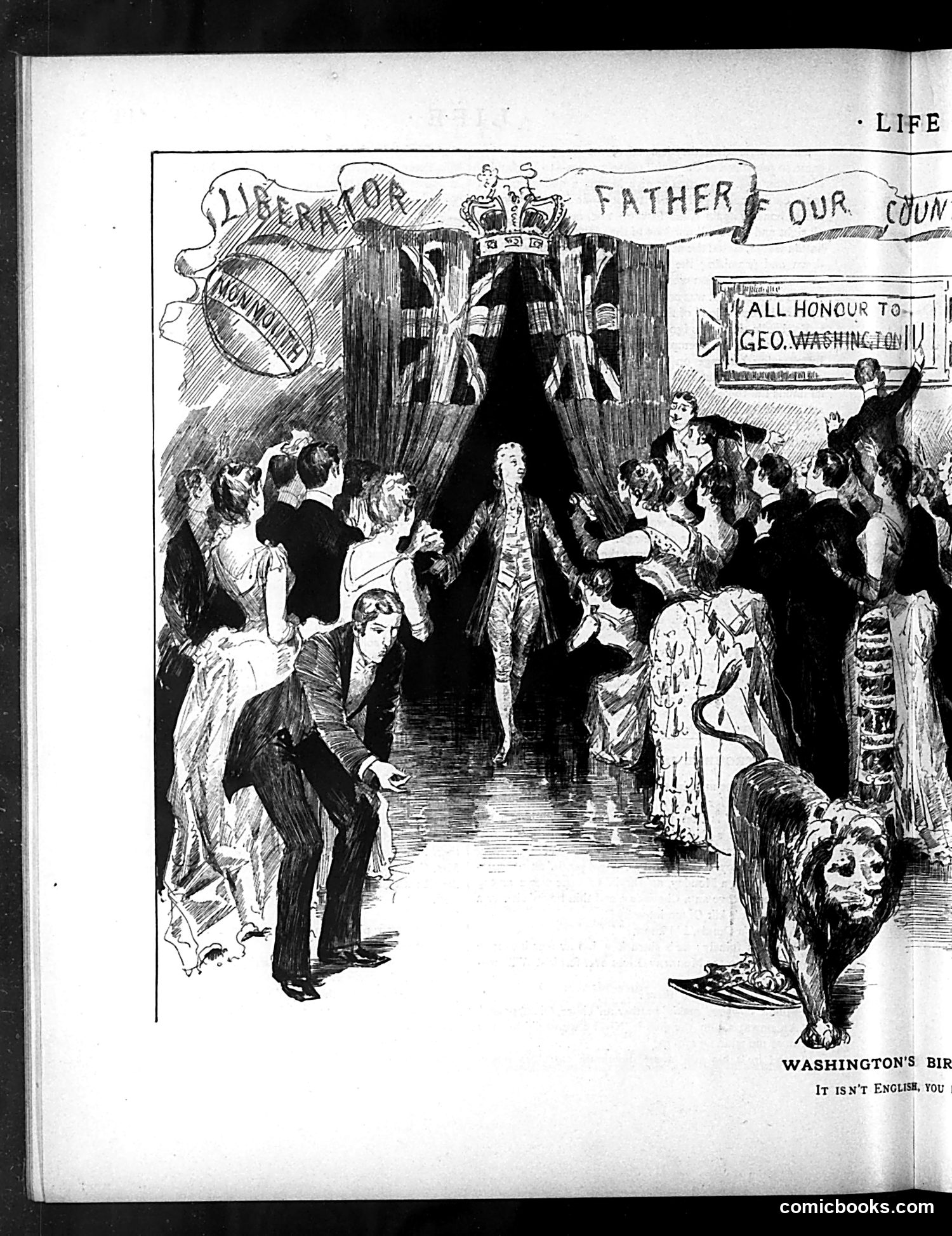
This satirical illustration depicts a formal gathering inside what appears to be a large tree or hollow structure, with "Father of Our Country" inscribed above. The banner reads "All Honour to Geo. Washington." The cartoon appears to be commemorating or mocking a celebration of George Washington. The crowd of well-dressed figures surrounds a central tall figure (likely representing Washington or an idealized version of him). A bear sits prominently in the foreground on the right. The caption at bottom reads "Washington's Bir[thday]" and "It Isn't English, You—" The satire likely critiques either excessive American patriotism around Washington's birthday celebrations, or possibly comments on American pretension to British civility. The bear's presence suggests American "wilderness" or "roughness" contrasted with the formal gathering. The incomplete final caption text prevents full interpretation of the intended joke.
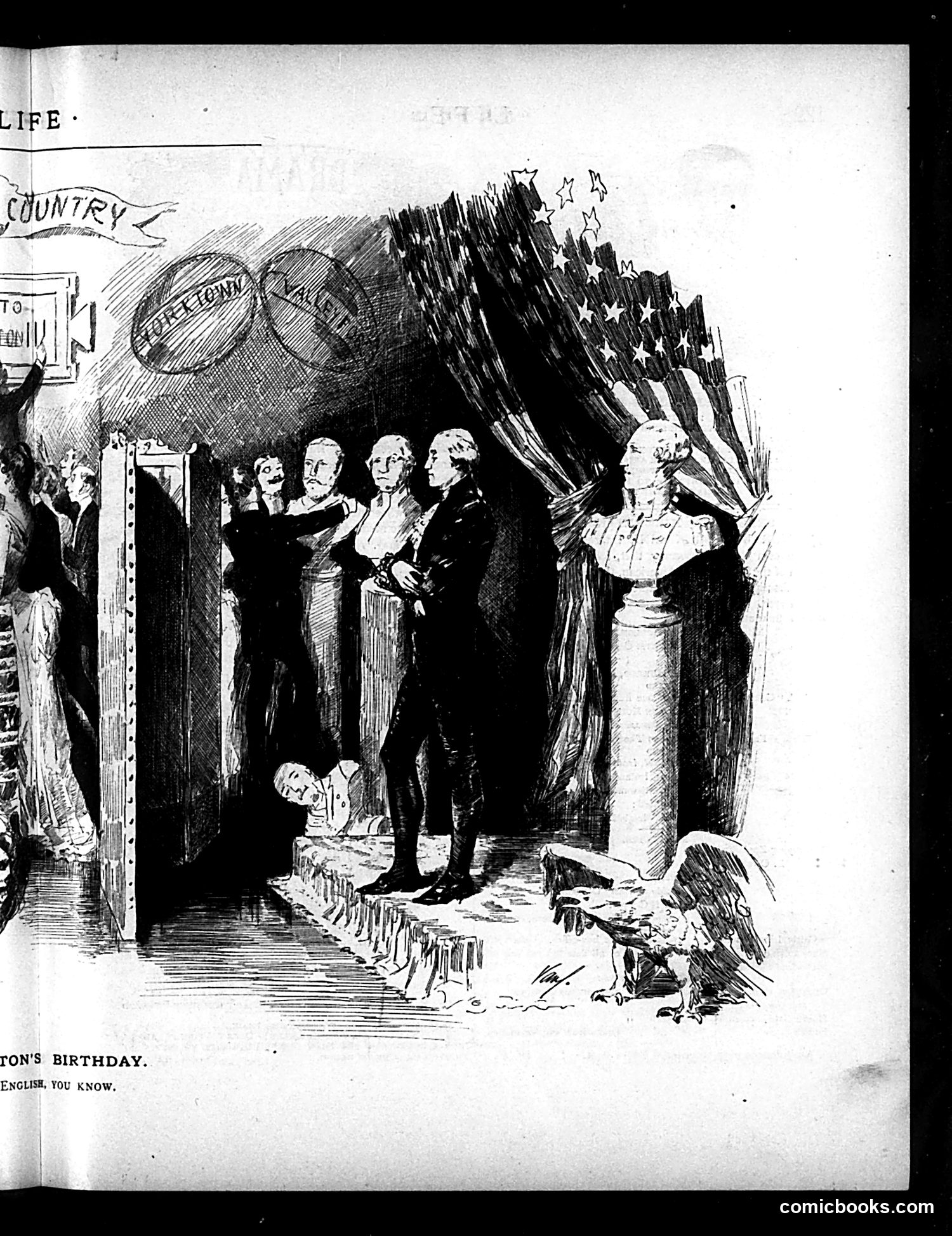
This appears to be a satirical cartoon about American patriotism and national celebration. The scene shows formally dressed gentlemen and a woman entering through a large door, beneath an American flag with stars. A disheveled figure sits outside on the ground, seemingly excluded from the festivities. The satire likely critiques hypocrisy: the well-dressed elite gather to celebrate the nation's birthday behind closed doors while a poor or working-class person remains outside. The contrast between the formal, respectable interior gathering and the excluded figure suggests commentary on social inequality and incomplete national values—questioning whether America's founding ideals of equality apply to all citizens or only the privileged classes. The partial text "NATION'S BIRTHDAY" and "ENGLISH, YOU KNOW" visible at bottom remain unclear in full context.
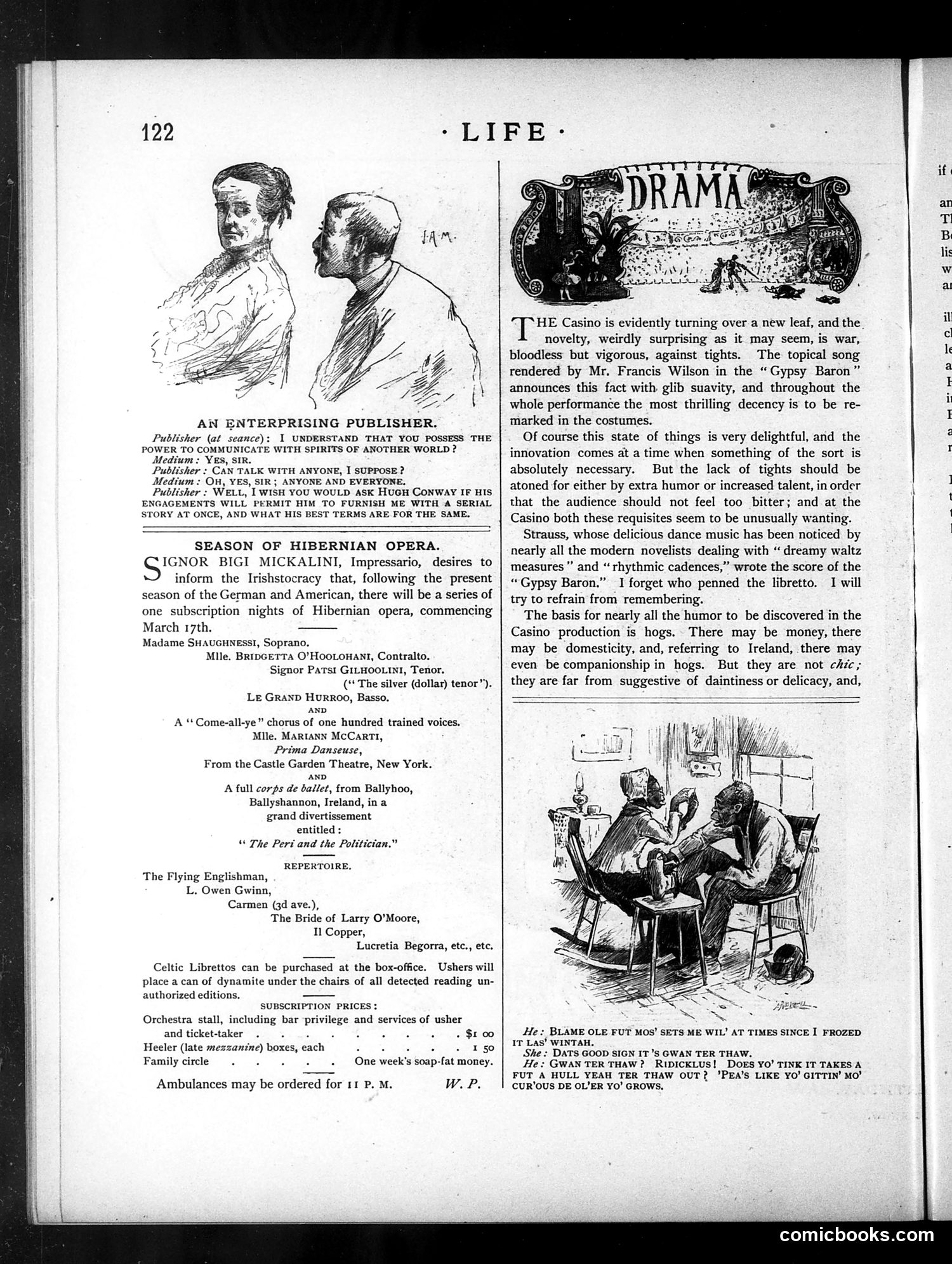
This page contains two satirical cartoons and theatrical advertisements. **"An Enterprising Publisher"** depicts a publisher at a séance asking a medium to contact the deceased author Hugh Conway to commission a serial story. The joke mocks both spiritualism craze and aggressive publishing practices—the publisher's opportunism is so extreme he'll literally contact the dead for content. **"Season of Hibernian Opera"** is ethnic satire mocking Irish immigrants through absurdist opera parodies with names like "Shaughnessi" and "O'Hoolohani." References to "dynamite under chairs" allude to Fenian violence associations. The mock-Irish dialogue in the bottom cartoon ("BLAME OLE FUT MOS") uses exaggerated dialect humor common to the era, depicting working-class Irish characters discussing frozen feet. The satire reflects late-19th-century American attitudes: skepticism toward spiritualism, contempt for Irish immigrants portrayed as violent/crude, and mockery of theatrical pretension. The humor relies on ethnic stereotypes now considered offensive.
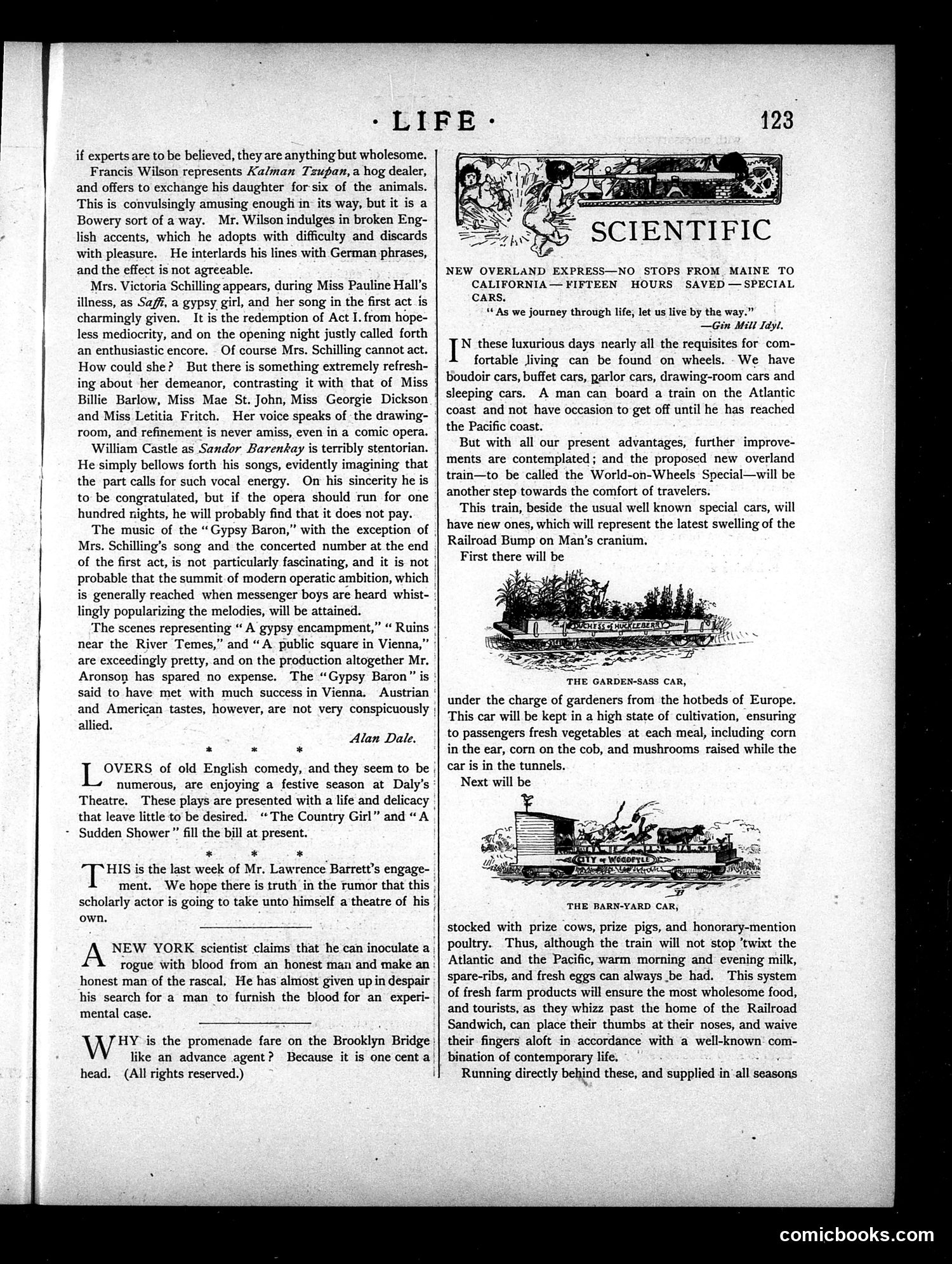
This page from Life magazine contains theater reviews and satirical commentary typical of the publication's focus on entertainment and social observation. The left column reviews "The Gypsy Baron" opera, critiquing performances by Francis Wilson (playing a hog dealer with exaggerated German-accented English), Victoria Schilling (a soprano with refined demeanor), and William Castle (criticized for bellowing rather than singing artfully). The reviewer suggests the music lacks memorability—a dig at operatic ambition measured by whether "messenger boys" whistle the tunes. The right side's "Scientific" section satirizes a New York scientist's claimed ability to reform criminals by transfusing blood from honest men. The joke's cynicism: he's "almost given up in despair his search for a man to furnish the blood"—implying honest men are so rare he cannot find one for the experiment. This reflects Gilded Age skepticism about both scientific claims and human virtue. A separate joke mocks Brooklyn Bridge toll rates, comparing the one-cent pedestrian fee to theatrical "advance agents."
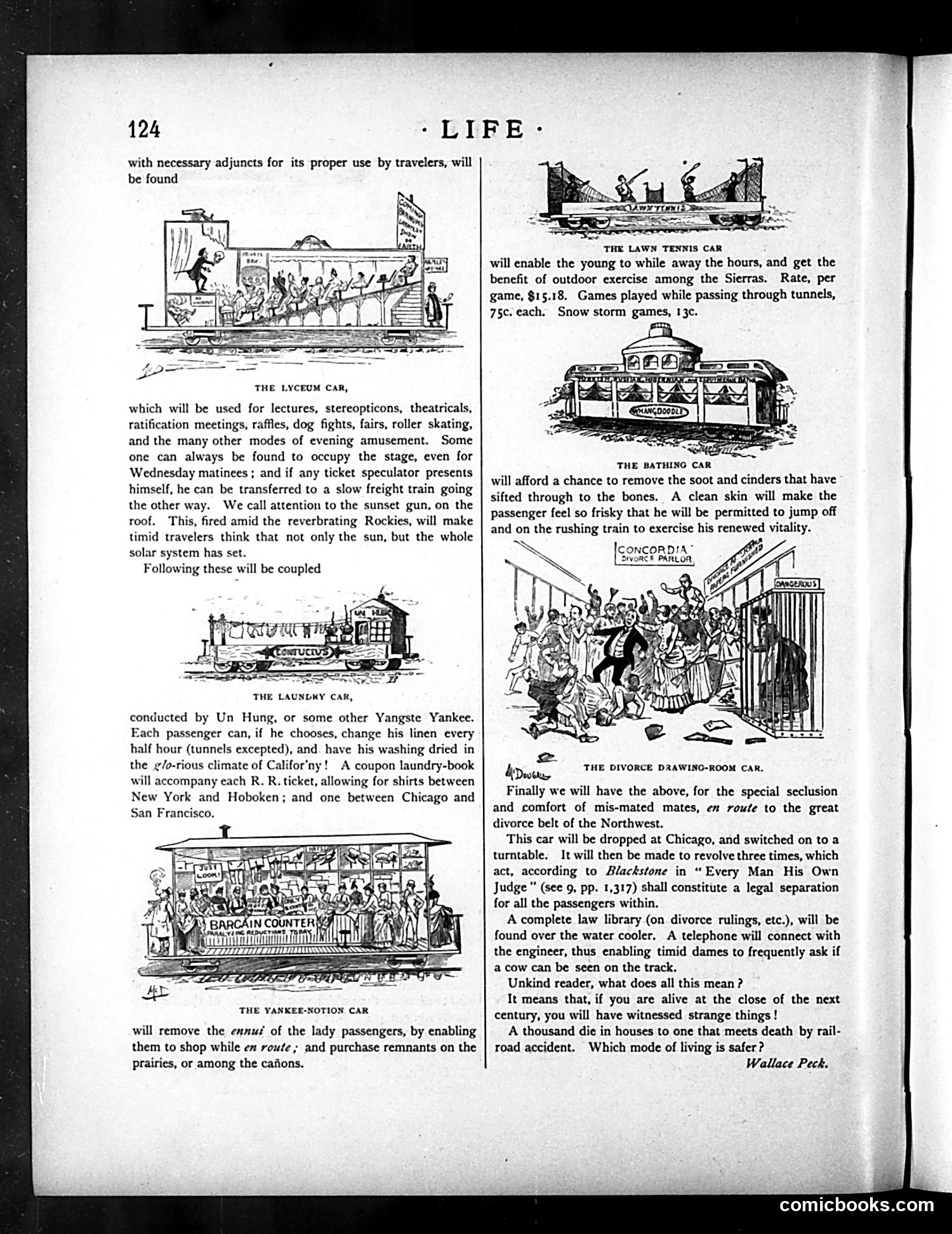
This satirical piece imagines absurd specialized railroad cars for future transcontinental travel. The humor targets both emerging technology and contemporary social anxieties. The "Lyceum Car" mocks earnest self-improvement culture by mixing lectures with frivolous entertainment (dog fights, roller skating). The "Laundry Car" references anti-Chinese sentiment—"Un Hung" is a racial caricature of Chinese laborers—while joking about the desert heat drying clothes instantly. The "Yankee-Notion Car" plays on American entrepreneurship and women's shopping habits. The "Divorce Drawing-Room Car" satirizes the growing "divorce belt" (permissive western states like Nevada and Dakota), suggesting the train itself becomes a legal mechanism for dissolution. The closing argument—that rail travel is statistically safer than houses—suggests this piece defends railroad expansion against public fear of accidents, a major concern of the era. Bylined Wallace Peck; author/publication date unclear from image alone.
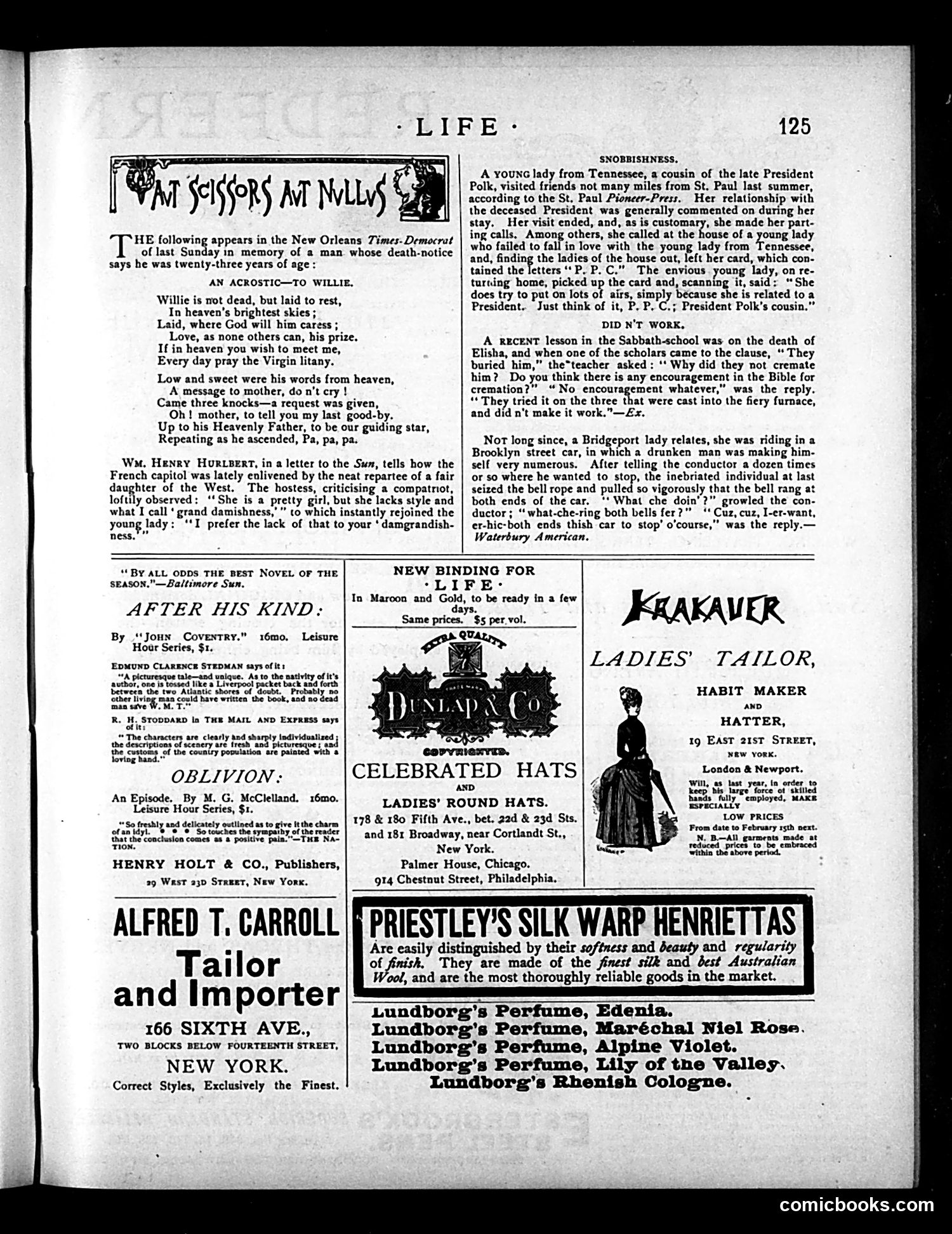
This page contains several brief humorous anecdotes satirizing social pretension and snobbishness among Americans. The opening story mocks a Tennessee woman who claims kinship to the late President Polk. When she leaves her calling card marked "P.P.C." (President Polk's Cousin), the locals see through her snobbery. The joke: her attempt to elevate her status by association backfires—the envious hosts dismiss her pretension. A second anecdote ridicules a drunken man in a Brooklyn streetcar pulling both bell ropes simultaneously, justifying himself with slurred logic ("I-er-want...both ends thish car to stop"). The satire targets working-class intoxication and incoherence. Another item mocks a society hostess criticizing another woman's lack of "grand damishness," only to be shut down by a witty young woman preferring authenticity to affected grandeur. Throughout, *Life* skewers American social climbers and their transparent pretensions—whether aristocratic affectation or drunken buffoonery—suggesting that genuine character beats performative status-seeking.
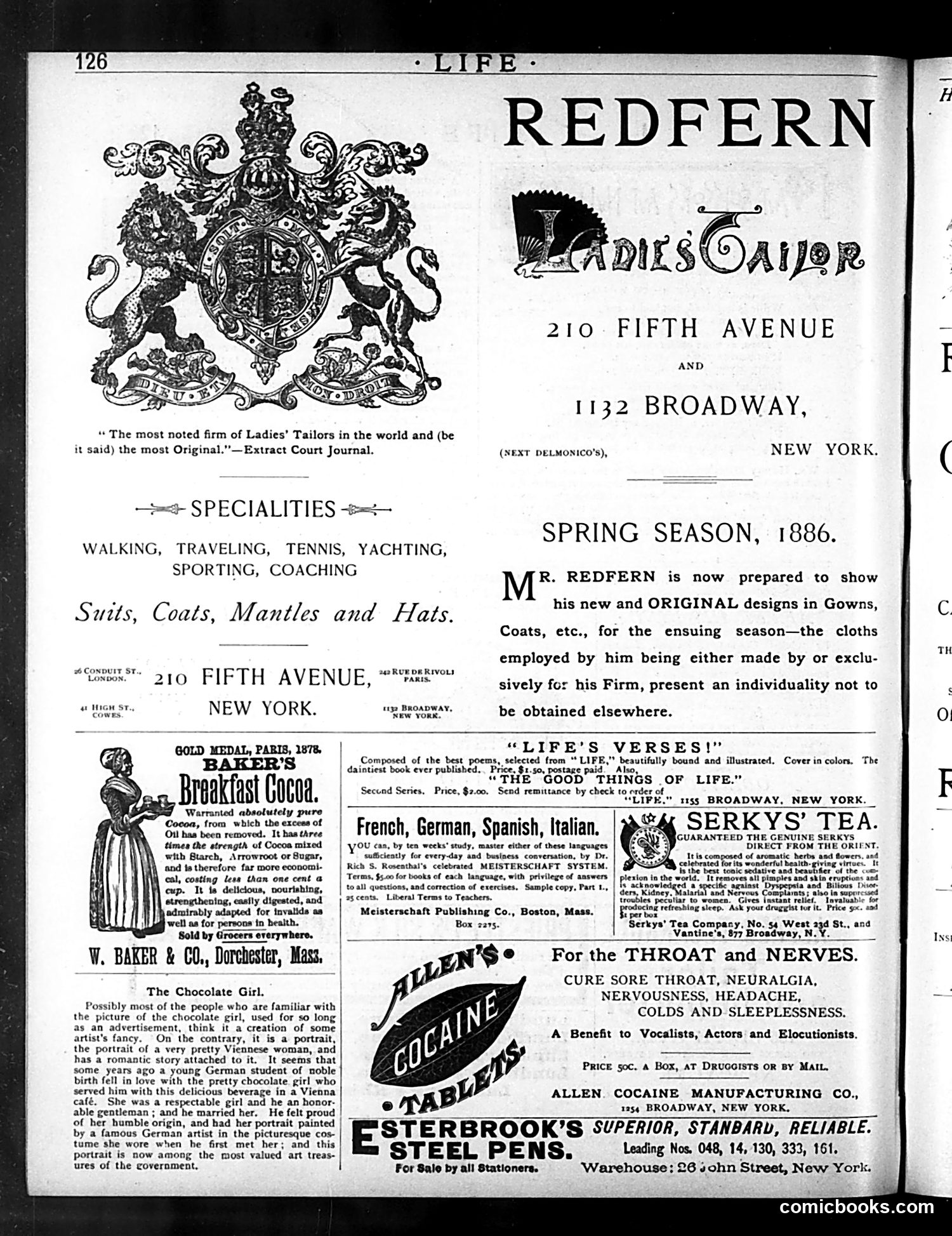
This page is primarily **advertising**, not satire or political commentary. It's from Life's Spring 1886 issue and features luxury goods marketed to wealthy Americans. The main advertisement is for **Redfern**, a prestigious ladies' tailor with locations on Fifth Avenue and Broadway in New York. The ornate coat-of-arms suggests European prestige; Redfern specializes in custom clothing for activities like tennis, yachting, and coaching—markers of upper-class leisure. Other advertisements include Baker's Cocoa, language instruction, and notably **Allen's Cocaine Tablets**—sold over-the-counter for throat and nerve ailments. This reflects 1880s medical practice when cocaine was legal and marketed as therapeutic. The brief story about "The Chocolate Girl" describes a portrait of a Viennese café worker who married a nobleman—romanticizing working-class femininity for wealthy readers. The page reflects Gilded Age consumer culture: luxury imported goods, leisure activities, and early pharmaceutical marketing to affluent audiences.
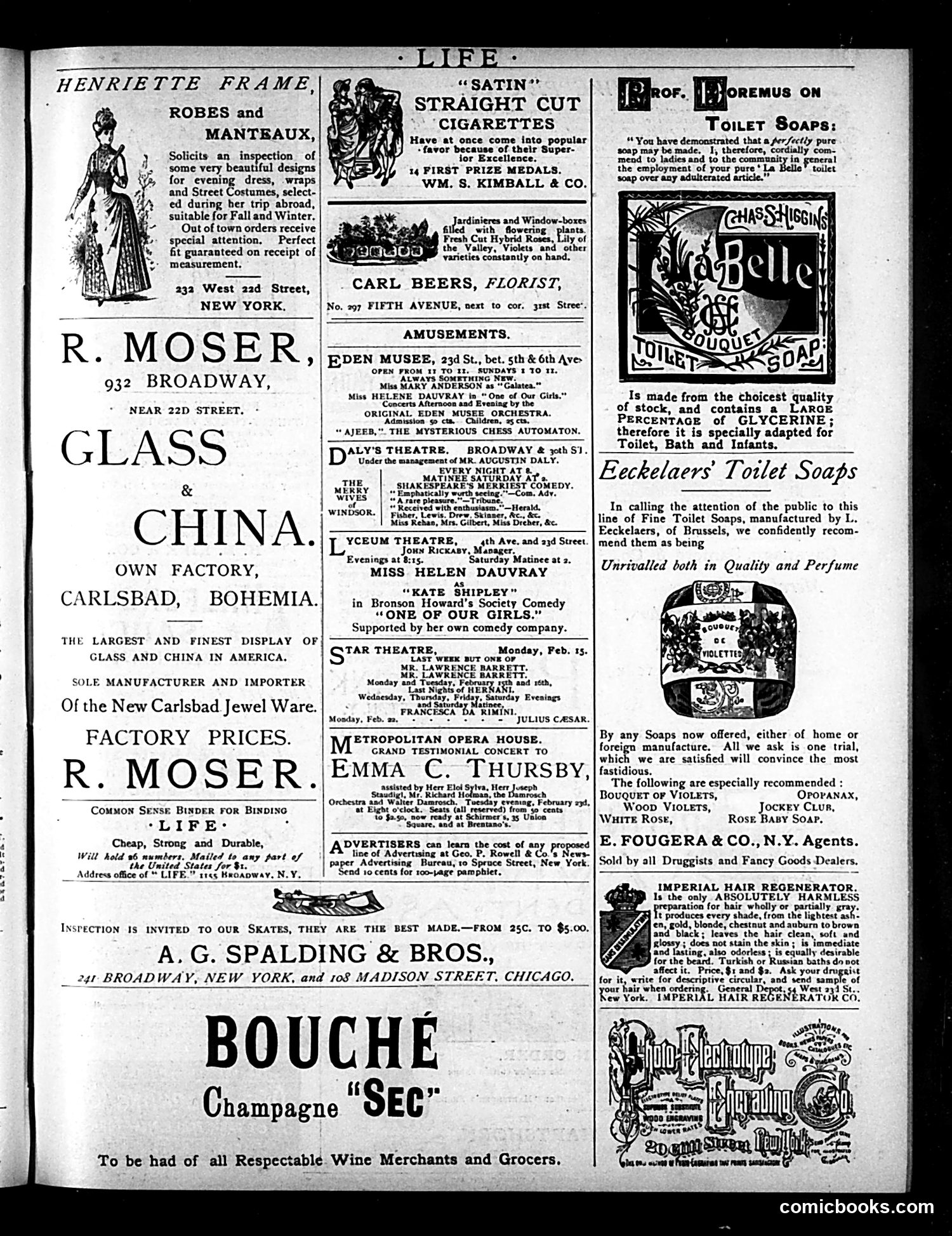
This is primarily an **advertising page** from Life magazine, likely from the 1880s-1890s based on the references and design styles. Rather than political satire, it features commercial advertisements for luxury goods and services targeting wealthy New York audiences. The ads showcase period consumer products: women's clothing and robes (Henriette Frame), flowers and plants (Carl Beers), fine glassware and china from Bohemia (R. Moser), cigarettes, and toilet soaps. Theater announcements promote contemporary plays and performances. The page's implicit satire is subtle and structural rather than explicit: it presents an aspirational lifestyle of refined consumption—imported goods, theater attendance, fine imported champagne—reflecting Gilded Age commercialism and consumerism. The dense advertising itself satirizes the magazine's role in promoting consumer culture to the wealthy. No identifiable political figures or specific current events are referenced on this page.
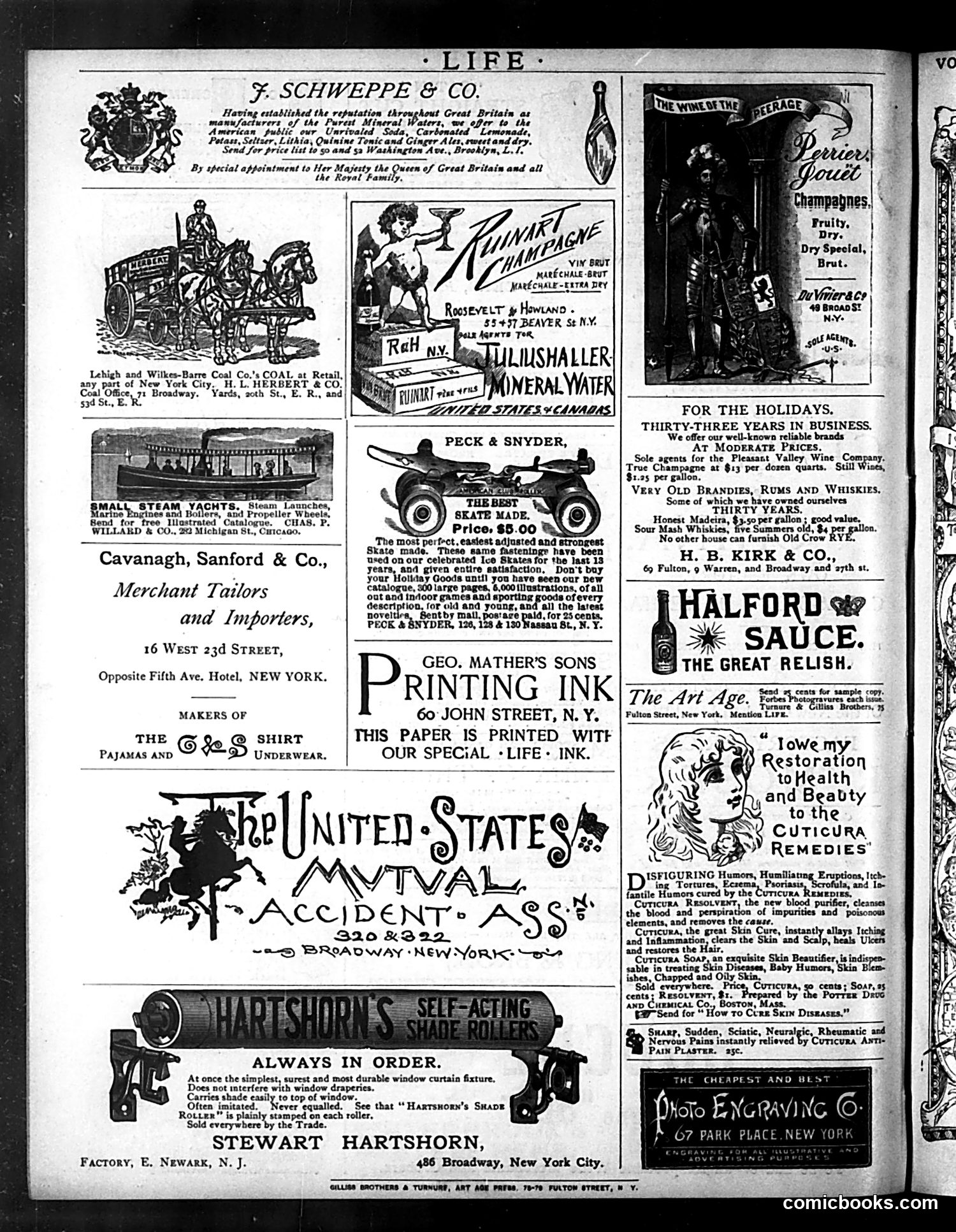
This page is **primarily advertising**, not political satire or comics. It's a collection of commercial advertisements typical of early Life magazine, which subsidized its satirical content through paid ads. The page features various product advertisements: mineral waters (Schweppe & Co.), champagne (Runart), coal delivery, steam yachts, merchant tailoring, ice skates, printing ink, window shade rollers (Hartshorn), and medicinal products (Cuticura remedies for skin conditions). The only potentially noteworthy element is a small **United States Mutual Accident Association** advertisement at bottom-left, promoting accident insurance—a routine commercial pitch with no satirical intent. There are **no identifiable political cartoons or caricatures** on this page. The ornamental illustrations (horses pulling wagons, cherubs advertising champagne) are standard commercial artwork, not satire. This appears to be a typical revenue-generating page from the magazine's interior.