
Life, 1886-02-25 · page 11 of 16
Life — February 25, 1886 — page 11: what you’re looking at
What you’re looking at
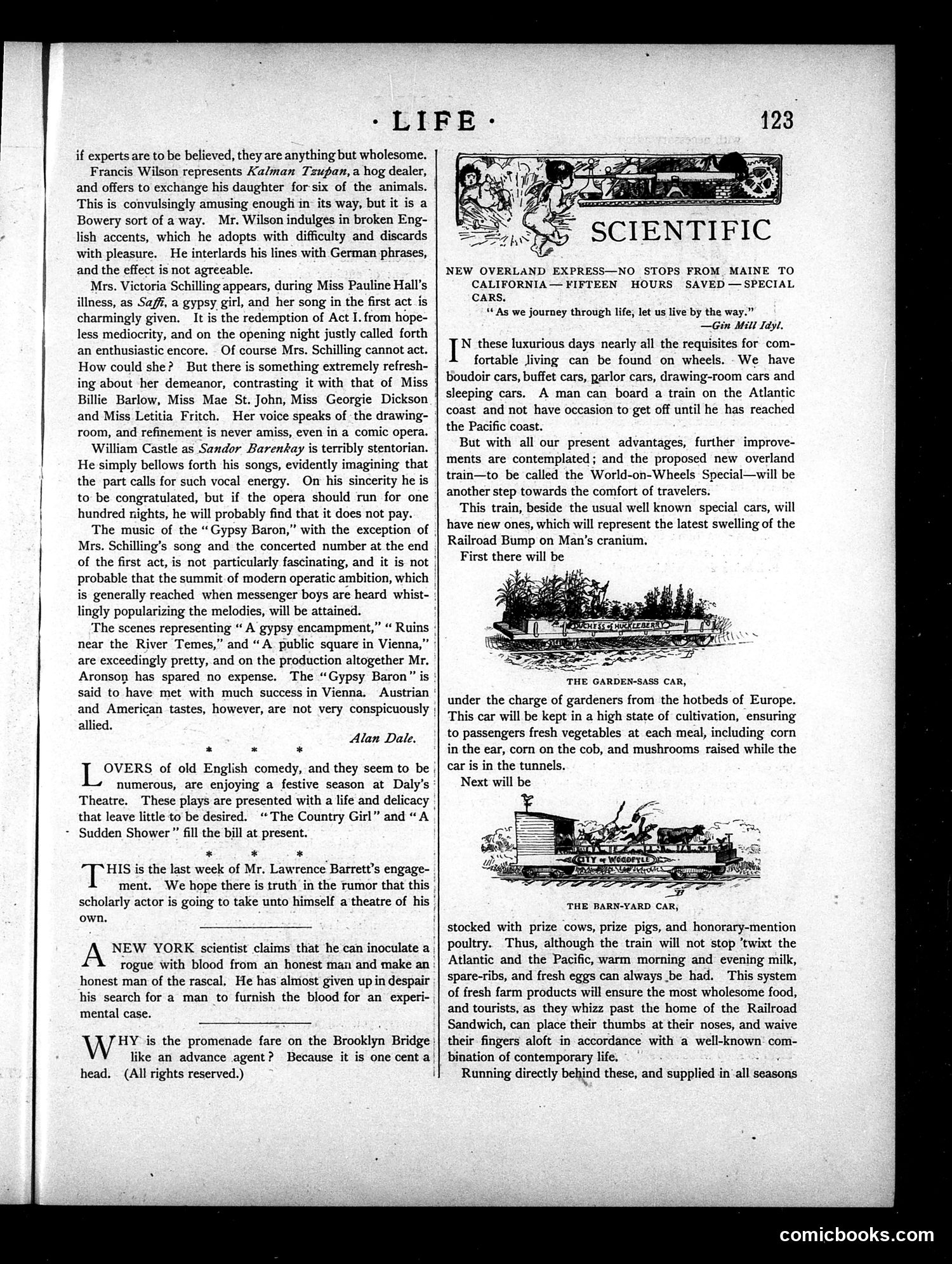
This page from Life magazine contains theater reviews and satirical commentary typical of the publication's focus on entertainment and social observation. The left column reviews "The Gypsy Baron" opera, critiquing performances by Francis Wilson (playing a hog dealer with exaggerated German-accented English), Victoria Schilling (a soprano with refined demeanor), and William Castle (criticized for bellowing rather than singing artfully). The reviewer suggests the music lacks memorability—a dig at operatic ambition measured by whether "messenger boys" whistle the tunes. The right side's "Scientific" section satirizes a New York scientist's claimed ability to reform criminals by transfusing blood from honest men. The joke's cynicism: he's "almost given up in despair his search for a man to furnish the blood"—implying honest men are so rare he cannot find one for the experiment. This reflects Gilded Age skepticism about both scientific claims and human virtue. A separate joke mocks Brooklyn Bridge toll rates, comparing the one-cent pedestrian fee to theatrical "advance agents."
📄 Transcribed text from this page (OCR, searchable)
Machine-transcribed from the original scan — historical spelling and the odd misread are preserved.
if experts are to be believed, they are anything but wholesome. Francis Wilson represents Kalman Tzupan, a hog dealer, and offers to exchange his daughter for-six of the animals. This is convulsingly amusing enough in: its way, but it is a Bowery sort of away. Mr. Wilson indulges in broken Eng- lish accents, which he adopts. with difficulty and discards with pleasure. He interlards his lines with German phrases, and the effect is not agreeable. Mrs. Victoria Schilling appears, during Miss Pauline Hall’s illness, as Saf?, a gypsy girl, and her song in the first act is charmingly given. It is the redemption of Act I. from hope- less mediocrity, and on the opening night justly called forth an enthusiastic encore. Of course Mrs. Schilling cannot act. How could she? But there is something extremely refresh- ing about her demeanor, contrasting it with that of Miss | Billie Barlow, Miss Mae St. John, Miss Georgie Dickson and Miss Letitia Fritch. Her voice speaks of the drawing- room, and refinement is never amiss, even in a comic opera. William Castle as Sandor Barenkay is terribly stentorian. He simply bellows forth his songs, evidently imagining that the part calls for such vocal energy. On his sincerity he is to be congratulated, but if the opera should run for one hundred nights, he will probably find that it does not pay. The music of the “Gypsy Baron,” with the exception of Mrs. Schilling’s song and the concerted number at the end of the first act, is not particularly fascinating, and it is not | probable that the summit of modern operatic ambition, which is generally reached when messenger boys are heard whist- lingly popularizing the melodies, will be attained. The scenes representing “A gypsy encampment,” “ Ruins near the River Temes,” and “A public square in Vienna,” are exceedingly pretty, and on the production altogether Mr. Aronson has spared no expense. The “Gypsy Baron” is said to have met with much success in Vienna. Austrian ‘ and American tastes, however, are not very conspicuously ; allied. Alan Dale. * * * OVERS of old English comedy, and they seem to be ; numerous, are enjoying a festive season at Daly's Theatre. These plays are presented with a life and delicacy that leave little to be desired. “The Country Girl” and “A, - Sudden Shower” fill the bill at present. * * * HIS is the last week of Mr. Lawrence Barrett’s engage- ment. We hope there is truth in the rumor that this scholarly actor is going to take unto himself a'theatre of his © own. NEW YORK scientist claims that he can inoculate a rogue with blood from an honest man and make an ; honest man of the rascal, He has almost given up in despair his search for a man to furnish the blood for an experi- mental case. HY jis the promenade fare on the Brooklyn Bridge} like an advance agent? Because it is one cent a) head. (All rights reserved.) i -LIFE- NEW OVERLAND EXPRESS—NO STOPS FROM MAINE TO CALIFORNIA— FIFTEEN HOURS SAVED — SPECIAL CARS. ‘As we journey through life; let us live by the way.” —Gin Mill Idyl. N these luxurious days nearly all the requisites for com- fortable Jiving can be found on wheels. -We have boudoir cars, buffet cars, parlor cars, drawing-room cars and sleeping cars. A man can board a train on the Atlantic coast and not have occasion to get off until he has reached the Pacific coast. But with all our present advantages, further improve- ments are contemplated; and the proposed new overland train—to be called the World-on-Wheels Special—will be another step towards the comfort of travelers. This train, beside the usual well known special cars, will have new ones, which will represent the latest swelling of the Railroad Bump on Man’s cranium. First there will be THE GARDEN-SASS CAR, under the charge of gardeners from the hotbeds of Europe. This car will be kept in a high state of cultivation, ensuring to passengers fresh vegetables at each meal, including corn in the ear, corn on the cob, and mushrooms raised while the car is in the tunnels. Next will be THE BARN-YARD CAR, stocked with prize cows, prize pigs, and honorary-mention poultry. Thus, although the train will not stop ’twixt the Atlantic and the Pacific, warm morning and evening milk, spare-ribs, and fresh eggs can always be had. This system of fresh farm products will ensure the most wholesome food, and tourists, as they whizz past the home of the Railroad Sandwich, can place their thumbs at their noses, and waive their fingers aloft in accordance with a well-known: com- bination of contemporary life, Running directly behind these, and supplied in ‘all seasoi comicbooks.com