
Life, 1886-02-25 · page 6 of 16
Life — February 25, 1886 — page 6: what you’re looking at
What you’re looking at
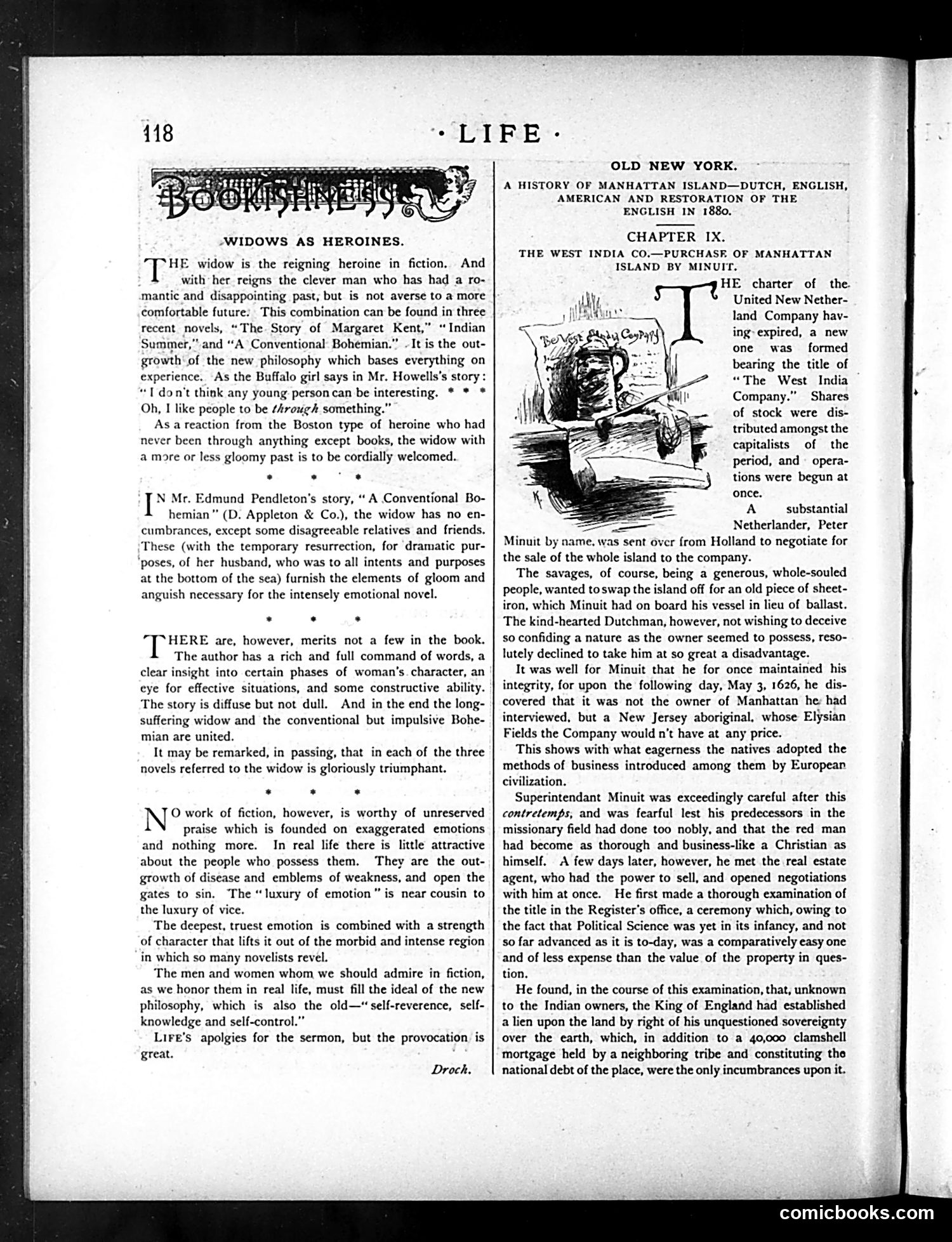
This page contains no political cartoon or satirical visual. Instead, it presents two distinct text sections: **Left side:** A "Book Shelf" column discussing "Widows as Heroines" in fiction, critiquing how literature romanticizes widow characters. The author argues real widows embody weakness and disease rather than the noble heroism fictional works portray. **Right side:** Chapter IX of a historical article about Manhattan's colonial history, specifically discussing the West India Company's 1626 purchase of the island from Native Americans through an agent named Peter Minuit. The text details the company's business practices and property assessments. The small illustration shows a figure reading, likely decorative. The page primarily serves educational/informational purposes rather than satirical commentary.
📄 Transcribed text from this page (OCR, searchable)
Machine-transcribed from the original scan — historical spelling and the odd misread are preserved.
“WIDOWS AS HEROINES. HE widow is the reigning heroine in fiction. And with her reigns the clever man who has had a ro- mantic and disappointing past, but is not averse to a more comfortable future: This combination can be found in three recent novels, “The Story of Margaret Kent,” “Indian Summer,” and “A Conventional: Bohemian.” - It is the out- growth of the new philosophy which bases everything on experience. As the Buffalo girl says in Mr. Howells’s story : “T don't think any young personcan be interesting. * * * Oh, I like people to be ¢hrough something.” As a reaction from the Boston type of heroine who had never been through anything except books, the widow with a more or less gloomy past is to be cordially welcomed. . . e N Mr. Edmund Pendleton’s story, “A Conventional Bo- hemian" (D. Appleton & Co.), the widow has no en- cumbrances, except some disagreeable relatives and friends. ‘These (with the temporary resurrection, for dramatic pur- ‘poses, of her husband, who was to all intents and purposes at the bottom of the sea) furnish the elements of gloom and anguish necessary for the intensely emotional novel. * . . HERE are, however, merits not a few in the book. The author has a rich and full command of words, a clear insight into certain phases of woman's. character, an eye for effective situations, and some constructive ability. The story is diffuse but not dull. And in the end the long- suffering widow and the conventional but impulsive Bohe- mian are united. It may be remarked, in passing, that in each of the three novels referred to the widow is gloriously triumphant. * * * O work of fiction, however, is worthy of unreserved praise which is founded on exaggerated emotions and nothing more. In real life there is little attractive about the people who possess them. They are the out- growth of disease and emblems of weakness, and open the gates to sin. The “luxury of emotion” is near cousin to the luxury of vice. The deepest, truest emotion is combined with a strength of character that lifts it out of the morbid and intense region in which so many novelists revel. The men and women whom we should admire in fiction, as we honor them in real life, must fill the ideal of the new philosophy, which is also the old—“ self-reverence, self- knowledge and self-control.” Lire's apolgies for the sermon, but the provocation is great. Droch, OLD NEW YORK. A HISTORY OF MANHATTAN ISLAND—DUTCH, ENGLISH, AMERICAN AND RESTORATION OF THE ENGLISH IN 1880. CHAPTER IX. THE WEST INDIA CO.—PURCHASE OF MANHATTAN ISLAND BY MINUIT. HE charter of the. United New Nether- land Company hav- ing-expired, a new one was formed bearing the title of “The West India Company.” Shares of stock were dis- tributed amongst the capitalists of the period, and © opera- tions were begun at once. A substantial Netherlander, Peter Minuit by name, was sent over from Holland to negotiate for the sale of the whole island to the company. The savages, of course, being a generous, whole-souled people, wanted to swap the island off for an old piece of sheet- iron, which Minuit had on board his vessel in lieu of ballast. The kind-hearted Dutchman, however, not wishing to deceive so confiding a nature as the owner seemed to possess, reso- lutely declined to take him at so great a disadvantage. It was well for Minuit that he for once maintained his integrity, for upon the following day, May 3, 1626, he dis- covered that it was not the owner of Manhattan he had interviewed, but a New Jersey aboriginal, whose Elysian Fields the Company would n't have at any price. This shows with what eagerness the natives adopted the methods of business introduced among them by European civilization. Superintendant Minuit was exceedingly careful after this contretemps, and was fearful lest his predecessors in the missionary field had done too nobly, and that the red man had become as thorough and business-like a Christian as himself. A few days later, however, he met the real estate agent, who had the power to sell, and opened negotiations with him at once. He first made a thorough examination of the title in the Registers office, a ceremony which, owing to the fact that Political Science was yet in its infancy, and not so far advanced as it is to-day, was a comparatively easy one and of less expense than the value of the property in ques- tion. He found, in the course of this examination, that, unknown to the Indian owners, the King of England had established a lien upon the land by right of his unquestioned sovereignty over the earth, which, in addition to a 40,000 clamshell mortgage held by a neighboring tribe and constituting the national debt of the place, were the only incumbrances upon it. comicbooks.com