
Life, 1886-02-25 · page 2 of 16
Life — February 25, 1886 — page 2: what you’re looking at
What you’re looking at
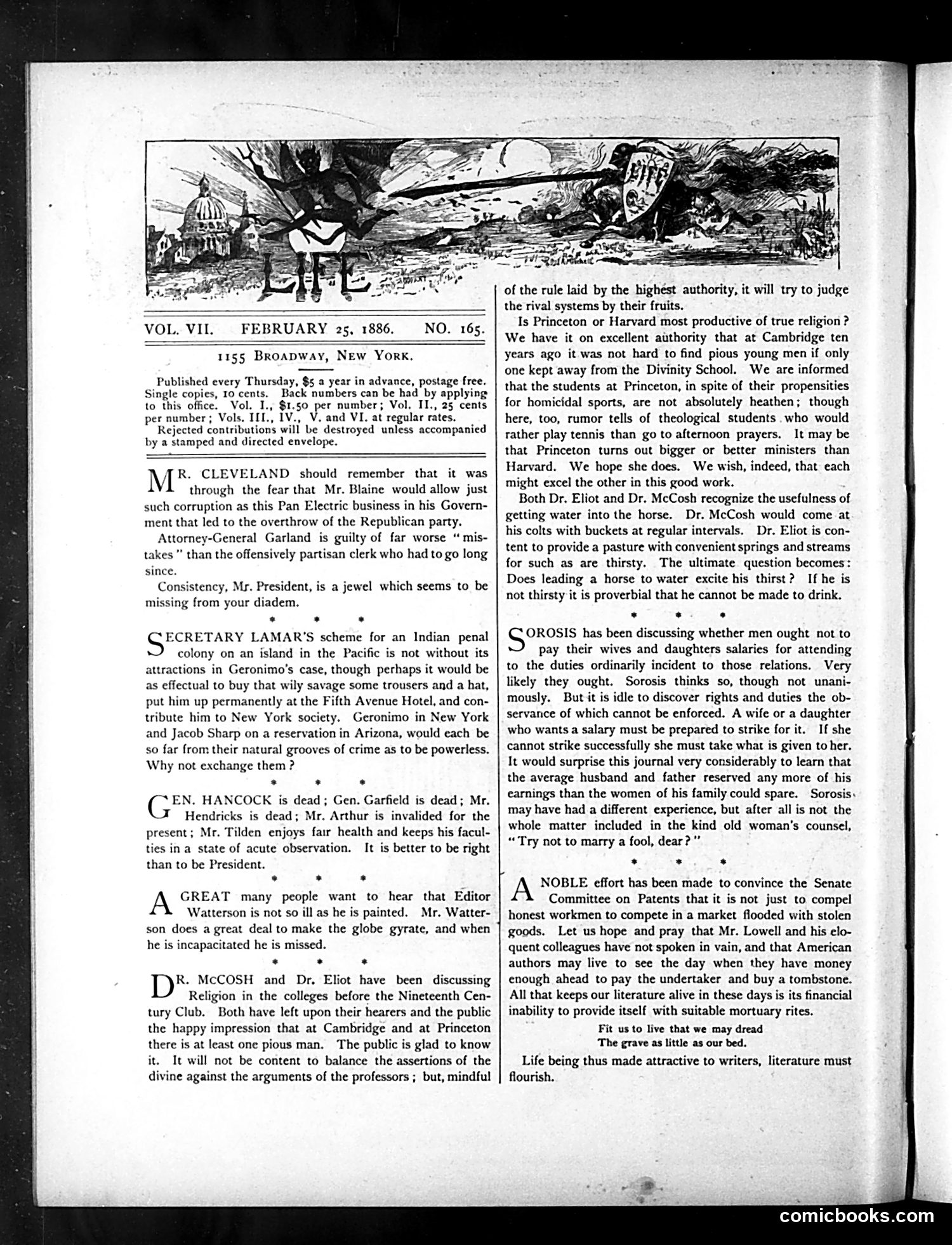
The masthead cartoon depicts a figure labeled "LIFE" emerging from or presiding over a chaotic landscape. The image appears satirical but the specific reference is unclear without additional context. The text consists of brief editorial commentaries on contemporary political and social figures, including mentions of Cleveland, Secretary Lamar's Indian penal colony proposal, and various deceased or incapacitated political figures (Hancock, Garfield, Hendricks, Arthur). Notable satirical points target Cleveland's administration regarding corruption, discuss Princeton versus Harvard's religious education, debate women's salary rights, and comment on patent reform and literary finances. The overall tone is acerbic political commentary typical of 1880s American satirical journalism, criticizing government figures and social institutions of the Gilded Age.
📄 Transcribed text from this page (OCR, searchable)
Machine-transcribed from the original scan — historical spelling and the odd misread are preserved.
VOL. VIL. 1155 Broapway, New York. EBRUARY 25, 1886. NO. 165. Published every Thursday, $5 a year in advance, postage free. Single copies, 10 cents. Back numbers can be had by applying to this office. Vol. I., $1.50 per number; Vol. II., 25 cents per number; Vols. I[I., 1V., V. and VI. at regular rates. Rejected contributions will be destroyed unless accompanied by a stamped and directed envelope. M R. CLEVELAND should remember that it was through the fear that Mr. Blaine would allow just such corruption as this Pan Electric business in his Govern- ment that led to the overthrow of the Republican party. Attorney-General Garland is guilty of far worse “ mis- takes " than the offensively partisan clerk who had to go long since. Consistency, Mr. President, is a jewel which seems to be missing from your diadem. . * . ECRETARY LAMAR'S scheme for an Indian penal colony on an island in the Pacific is not without its attractions in Geronimo’s case, though perhaps it would be as effectual to buy that wily savage some trousers and a hat, put him up permanently at the Fifth Avenue Hotel, and con- tribute him to New York society. Geronimo in New York and Jacob Sharp on a reservation in Arizona, would each be so far from their natural grooves of crime as to be powerless. Why not exchange them ? . . . “EN. HANCOCK is dead; Gen. Garfield is dead; Mr. Hendricks is dead; Mr. Arthur is invalided for the present; Mr. Tilden enjoys fair health and keeps his facul- ties in a state of acute observation. It is better to be right than to be President. . * * GREAT many people want to hear that Editor Watterson is not so ill as he is painted. Mr. Watter- son does a great deal to make the globe gyrate, and when he is incapacitated he is missed. . . . R. McCOSH and Dr. Eliot have been discussing Religion in the colleges before the Nineteenth Cen- tury Club. Both have left upon their hearers and the public the happy impression that at Cambridge and at Princeton there is at least one pious man. The public is glad to know it. It will not be content to balance the assertions of the divine against the arguments of the professors ; but, mindful of the rule laid by the highest authority, it will try to judge the rival systems by their fruits. Is Princeton or Harvard most productive of true religion ? We have it on excellent authority that at Cambridge ten years ago it was not hard to find pious young men if only one kept away from the Divinity School. We are informed that the students at Princeton, in spite of their propensities for homicidal sports, are not absolutely heathen; though here, too, rumor tells of theological students .who would rather play tennis than go to afternoon prayers. It may be that Princeton turns out bigger or better ministers than Harvard. We hope she does. We wish, indeed, that each might excel the other in this good work. Both Dr. Eliot and Dr. McCosh recognize the usefulness of getting water into the horse. Dr. McCosh would come at his colts with buckets at regular intervals. Dr. Eliot is con- tent to provide a pasture with convenient springs and streams for such as are thirsty. The ultimate question becomes: Does leading a horse to water excite his thirst? If he is not thirsty it is proverbial that he cannot be made to drink. . . . OROSIS has been discussing whether men ought not to pay their wives and daughters salaries for attending to the duties ordinarily incident to those relations. Very likely they ought. Sorosis thinks so, though not unani- mously. But it is idle to discover rights and duties the ob- servance of which cannot be enforced. A wife or a daughter who wants a salary must be prepared to strike for it. If she cannot strike successfully she must take what is given to her. It would surprise this journal very considerably to learn that the average husband and father reserved any more of his earnings than the women of his family could spare. Sorosis. may have had a different experience, but after all is not the whole matter included in the kind old woman's counsel, “Try not to marry a fool, dear?” * * * NOBLE effort has been made to convince the Senate Committee on Patents that it is not just to compel honest workmen to compete in a market flooded with stolen goods. Let us hope and pray that Mr. Lowell and his elo- quent colleagues have not spoken in vain, and that American authors may live to see the day when they have money enough ahead to pay the undertaker and buy a tombstone. All that keeps our literature alive in these days is its financial inability to provide itself with suitable mortuary rites. Fit us to live that we may dread The grave as little as our bed. Life being thus made attractive to writers, literature must flourish.