
Life, 1886-02-25 · page 5 of 16
Life — February 25, 1886 — page 5: what you’re looking at
What you’re looking at
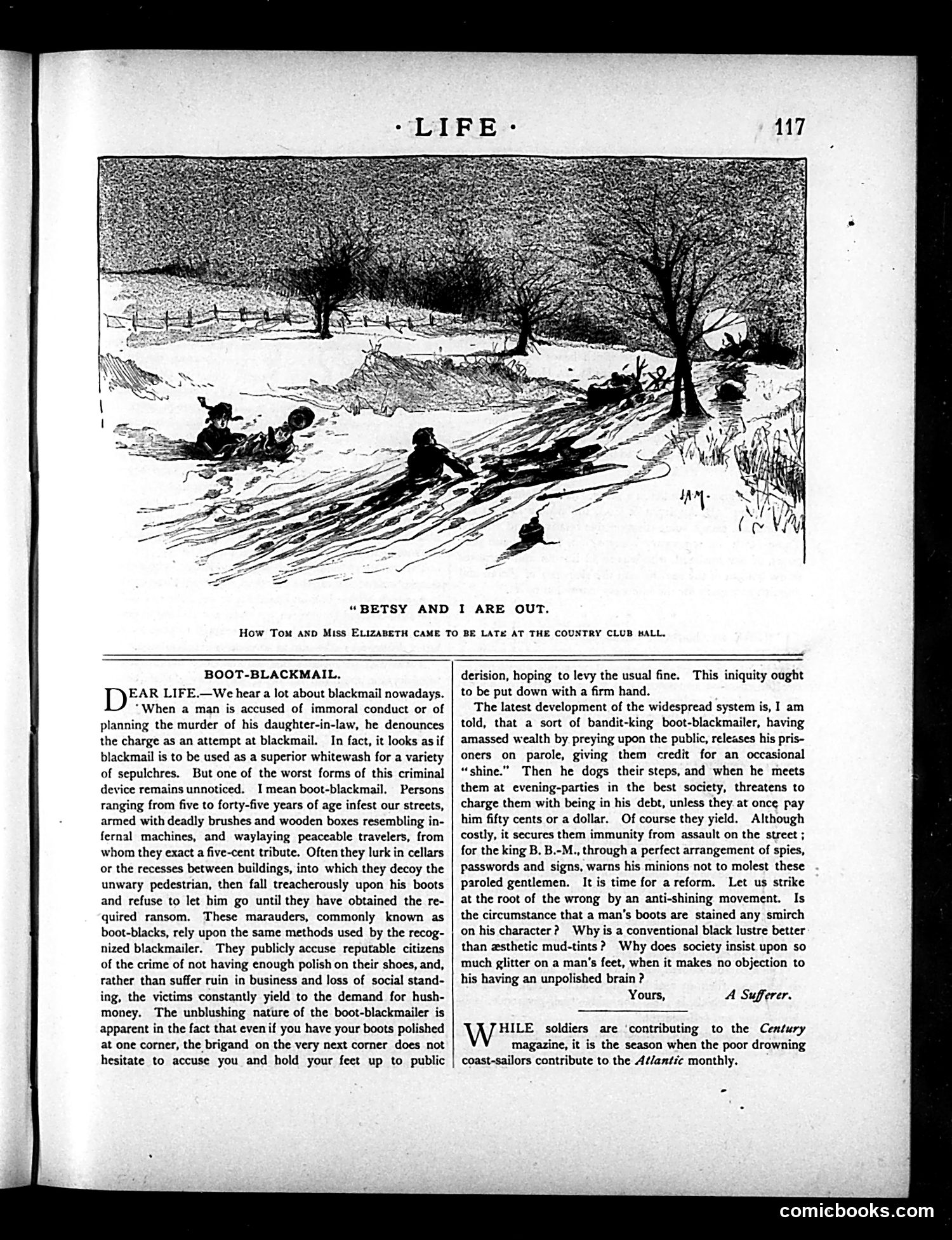
The page features an illustration titled "Betsy and I Are Out," depicting children sledding or playing on a snowy slope near bare trees and a fence—a gentle domestic scene seemingly unrelated to the serious letter below. The main content is "Boot-Blackmail," a reader's complaint about extortion by organized shoe-shiners. The writer describes how blackmailers threaten to publicly damage polished boots unless given money, operating as an unofficial extortion racket. He criticizes this "widespread system" and argues it should be stopped "with a firm hand." The satirical point: Life is using this mundane street-level crime to mock organized fraud and the public's vulnerability to petty criminals exploiting social conventions—in this case, the expectation of well-maintained appearance.
📄 Transcribed text from this page (OCR, searchable)
Machine-transcribed from the original scan — historical spelling and the odd misread are preserved.
“BETSY AND I ARE OUT. How Tom ano Miss ELIZABETH CAME TO BE LATE AT THE COUNTRY CLUB HALL, BOOT-BLACKMAIL, EAR LIFE.—We hear a lot about blackmail nowadays. “When a man is accused of immoral conduct or of planning the murder of his daughter-in-law, he denounces the charge as an attempt at blackmail. In fact, it looks as if blackmail is to be used as a superior whitewash for a variety of sepulchres. But one of the worst forms of this criminal device remains unnoticed. I mean boot-blackmail. Persons ranging from five to forty-five years of age infest our streets, armed with deadly brushes and wooden boxes resembling in- fernal machines, and waylaying peaceable travelers, from whom they exact a five-cent tribute. Often they lurk in cellars or the recesses between buildings, into which they decoy the unwary pedestrian, then fall treacherously upon his boots and refuse to let him go until they have obtained the re- quired ransom. These marauders, commonly known as boot-blacks, rely upon the same methods used by the recog- nized blackmailer. They publicly accuse reputable citizens of the crime of not having enough polish on their shoes, and, rather than suffer ruin in business and loss of social stand- ing, the victims constantly yield to the demand for hush- money. The unblushing nature of the boot-blackmailer is apparent in the fact that evenif you have your boots polished at one corner, the brigand on the very next corner does not hesitate to accuse you and hold your feet up to public derision, hoping to levy the usual fine. to be put down with a firm hand. The latest development of the widespread system is, I am told, that a sort of bandit-king boot-blackmailer, having amassed wealth by preying upon the public, releases his pris- oners on parole, giving them credit for an occasional “shine.” Then he dogs their steps, and when he meets them at evening-parties in the best society, threatens to charge them with being in his debt, unless they at once pay him fifty cents or a dollar. Of course they yield. Although costly, it secures them immunity from assault on the street ; for the king B. B.-M., through a perfect arrangement of spies, passwords and signs, warns his minions not to molest these paroled gentlemen. It is time for areform. Let us strike at the root of the wrong by an anti-shining movement. Is the circumstance that a man’s boots are stained any smirch on his character? Why is a conventional black lustre better than zsthetic mud-tints? Why does society insist upon so much glitter on a man’s feet, when it makes no objection to his having an unpolished brain ? Yours, This iniquity ought A Sufferer. HILE soldiers are ‘contributing to the Century magazine, it is the season when the poor drowning coast-sailors contribute to the Aé/antic monthly. comicbooks.com