
A complete issue · 16 pages · 1886
Life — January 1, 1886
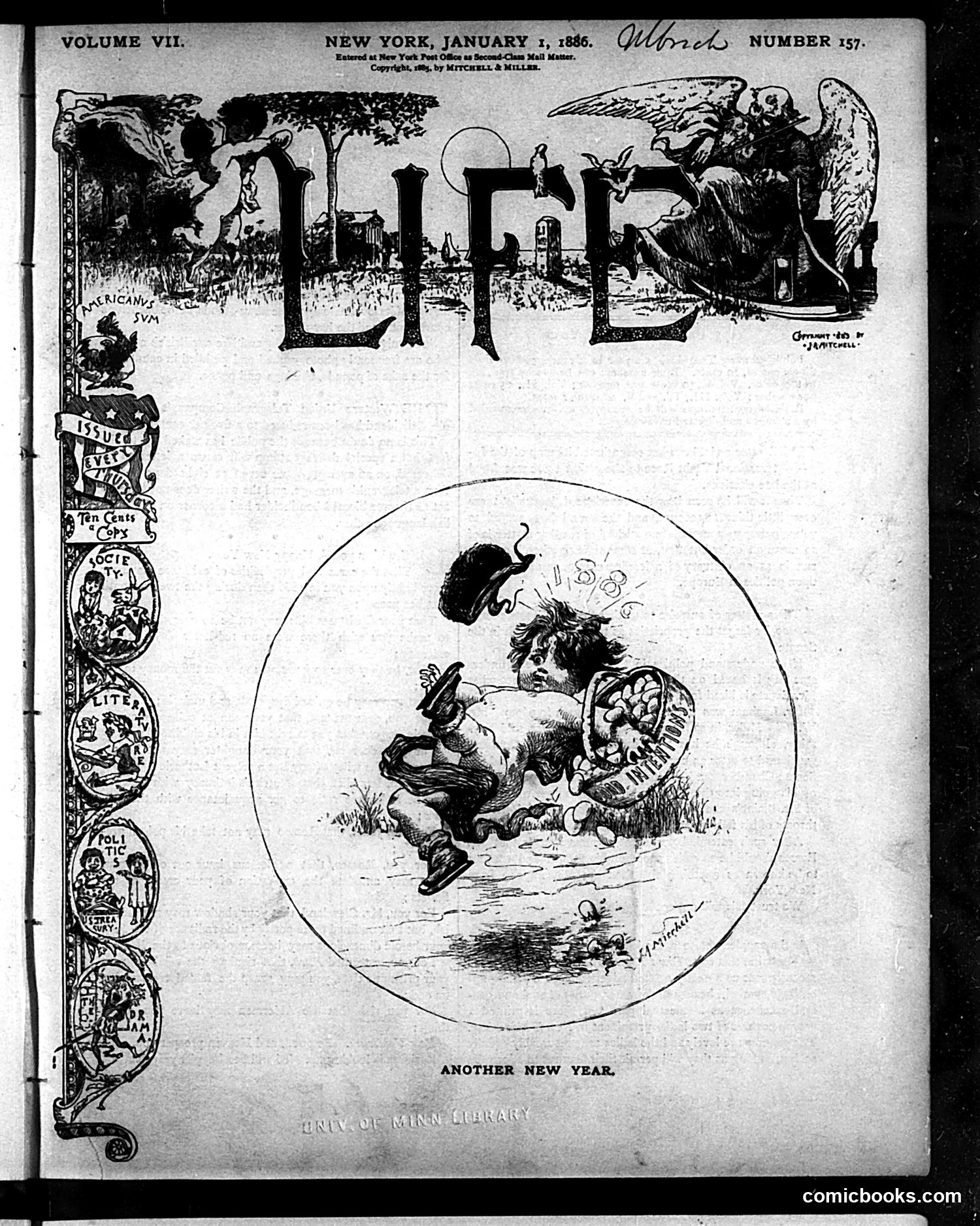
This New Year's cover features a mischievous cherub or putto figure stumbling through mud or water, carrying what appears to be a basket or bundle. The character's disheveled appearance and precarious balance suggest the chaotic, uncertain nature of entering a new year. The title "Another New Year" presents this annual transition with gentle humor rather than optimism. The decorative border on the left contains various small vignettes (typical of Life's design style), though their specific content is difficult to discern clearly in this reproduction. The overall satirical tone suggests mild skepticism about whether the new year will bring genuine improvement or simply repeat the previous year's troubles—a timeless New Year's joke about human hopes versus reality.
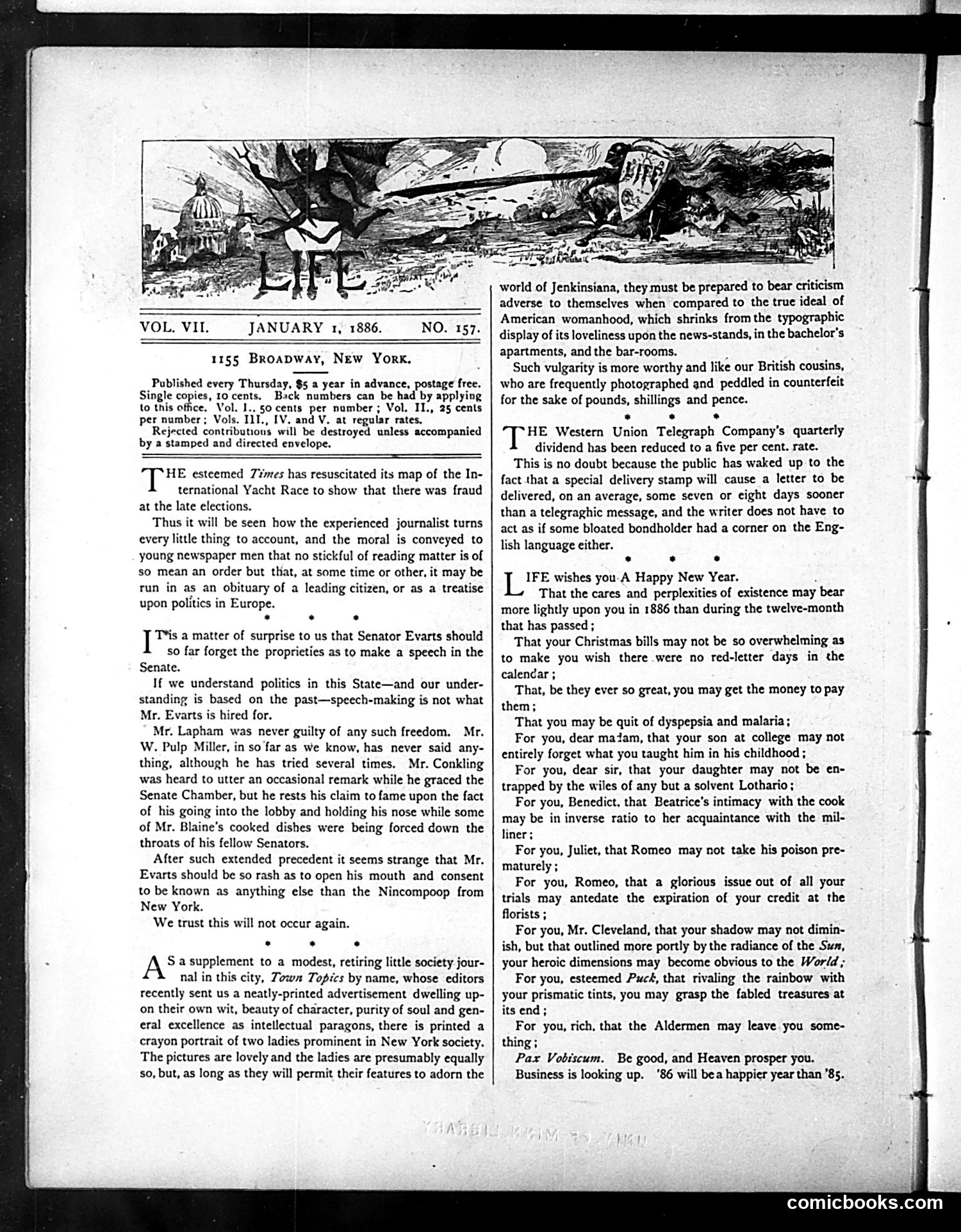
The masthead cartoon depicts a winged allegorical figure (likely "Life" personified) surveying a landscape with a classical building and a sign reading "1886." The text criticizes **Senator Evarts** for making a Senate speech—apparently violating an unwritten rule that experienced politicians shouldn't engage in such displays. The author suggests Evarts, unlike predecessors Lapham, W. Pulp Miller, and Conkling, should have known better than to speak in the Senate chamber, implying speechmaking there was considered undignified or inappropriate. The piece also mocks a New York society journal called *Town Topics* for publishing flattering portraits of prominent women. Overall, this represents Victorian-era political and social satire targeting both legislative decorum and society gossip.
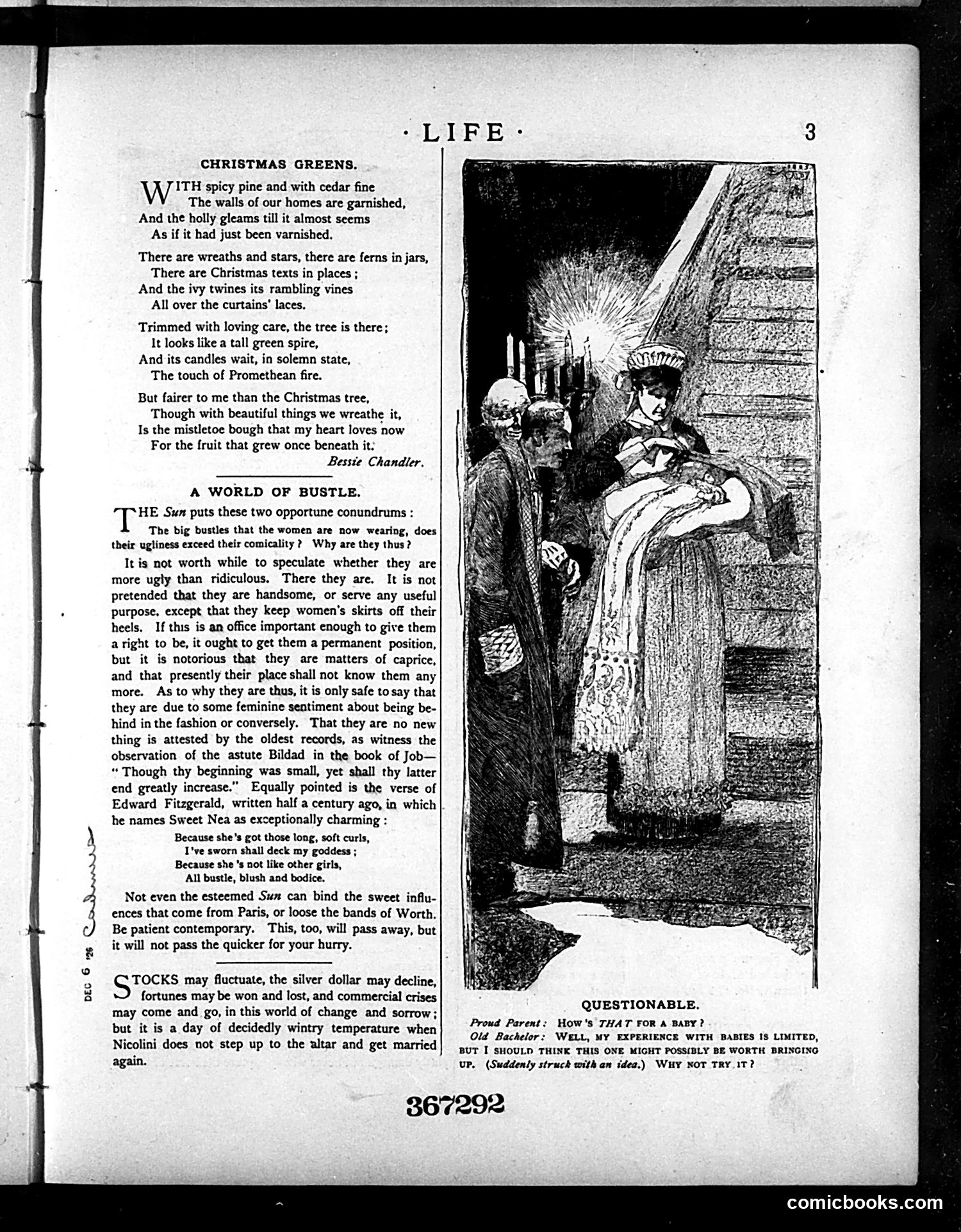
This cartoon illustrates a debate about babies and childbirth. A proud parent asks an old bachelor, "How's that for a baby?" The bachelor replies skeptically that while babies might be worth bringing up, his limited experience suggests otherwise—and he suddenly shrieks in pain. The joke satirizes the disconnect between theory and reality regarding parenthood. The bachelor represents those (typically men of that era) who held romantic notions about children without hands-on experience. His sudden cry suggests a baby has caused him physical harm—likely kicking or pinching—undermining his cautious response. This reflects early 20th-century humor about the challenges of child-rearing and the naïveté of bachelors regarding family life.
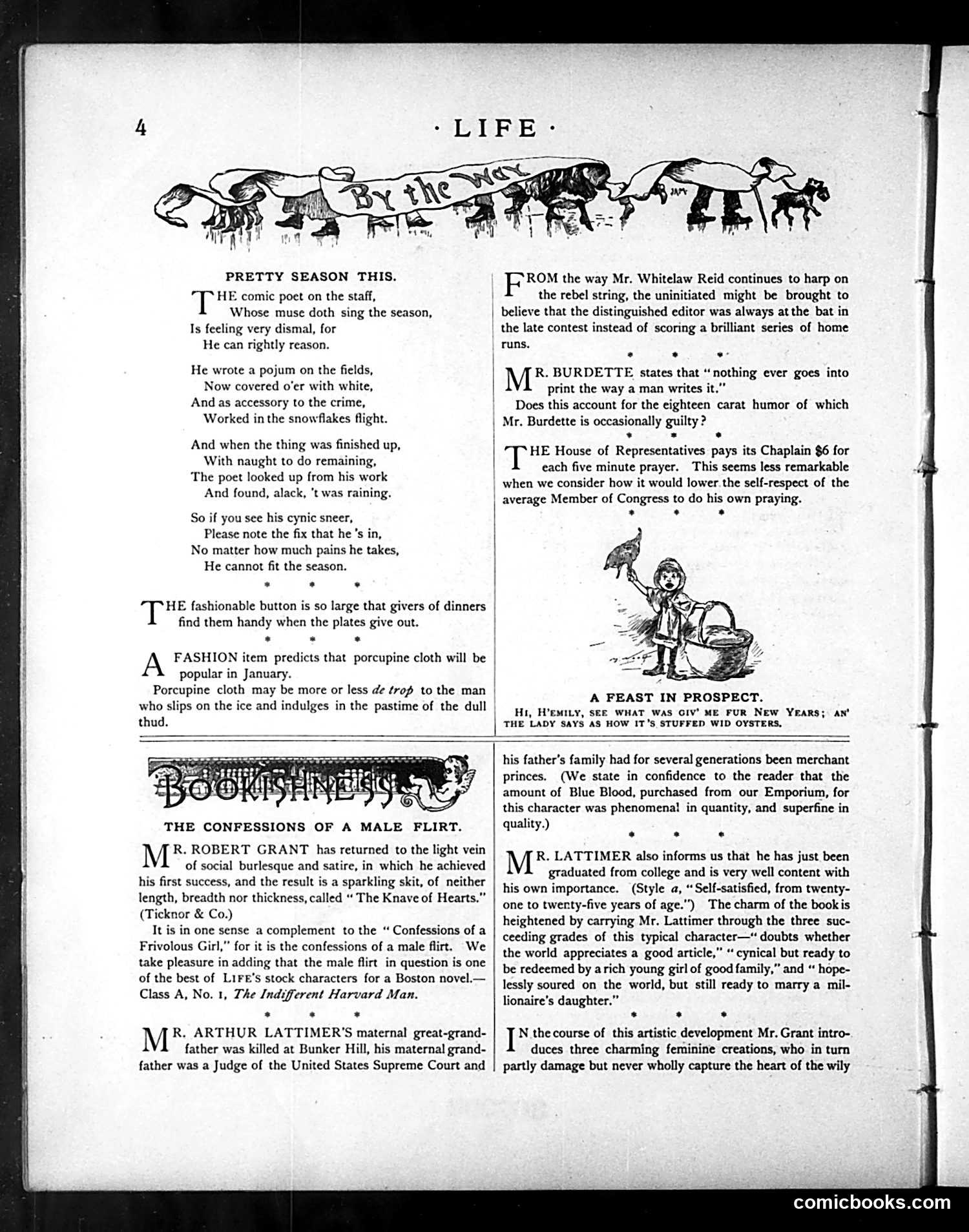
This page contains literary commentary and social satire rather than political cartoons. The main content reviews Robert Grant's novel "The Knave of Hearts," describing it as a sparkling satire about male flirtation in Boston society. The brief satirical items mock contemporary figures: Whitelaw Reid (appearing to be an editor criticized for avoiding home runs in cricket), Mr. Burdette (accused of using eighteen-carat humor), and the House of Representatives chaplain (paid $6 for five-minute prayers). The humor is genteel and topical rather than visually comedic—poking fun at fashionable society, literary pretensions, and institutional absurdities. A small illustration shows a Thanksgiving scene. The satire assumes readers' familiarity with Boston's social elite and contemporary publishing figures.
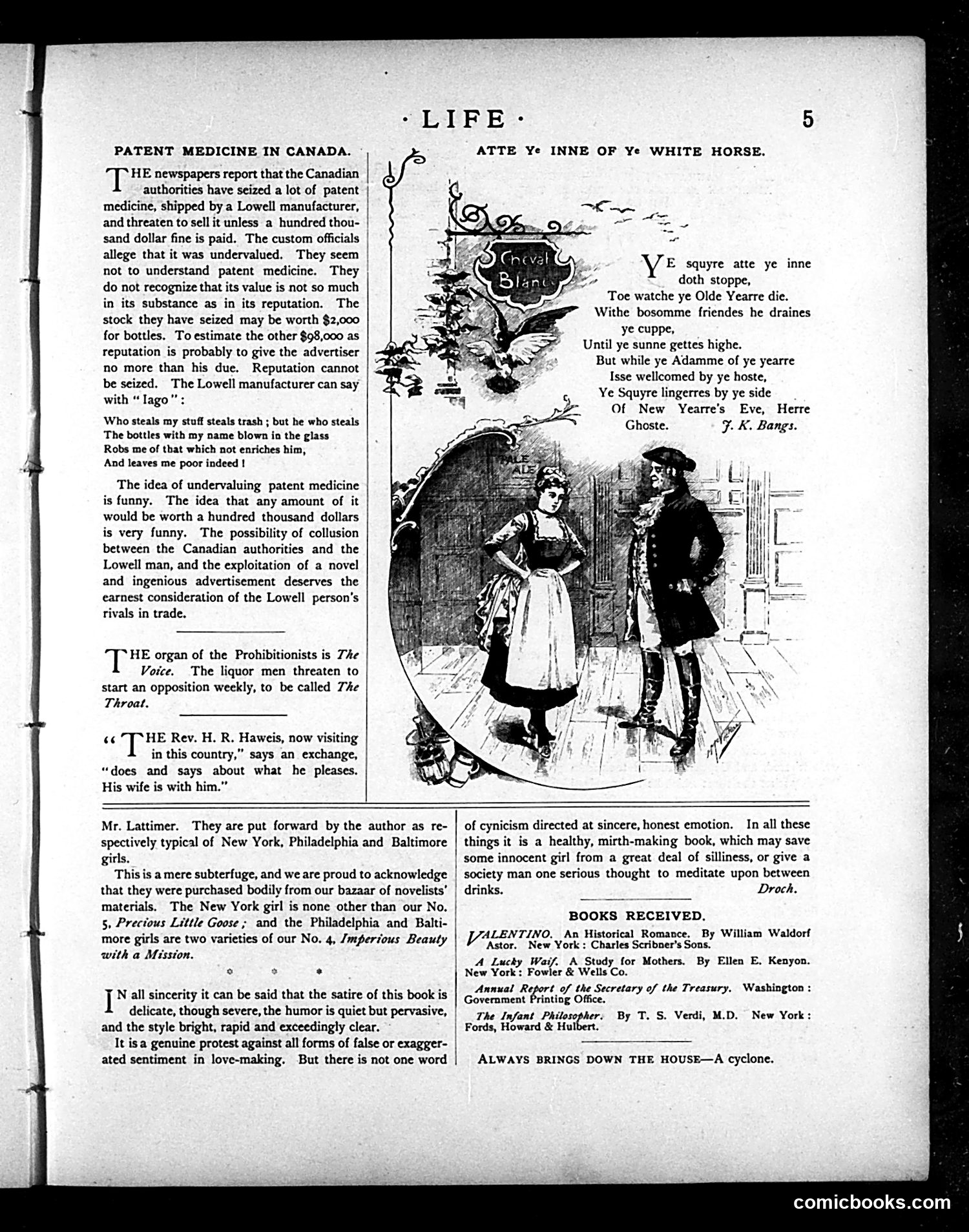
The page contains three distinct sections: **Left column**: An article titled "Patent Medicine in Canada" criticizing Canadian authorities for seizing undervalued patent medicines. The piece satirizes both the medicines' actual worthlessness and the absurdity of valuing seized stock at $2,000 per bottle. It mocks the manufacturers' ability to claim reputation damage while selling worthless products. **Center**: A poem "Atte Ye Inne of Ye White Horse" in pseudo-archaic English, accompanied by a sketch of two figures meeting at an inn—likely period costume satire or parody. **Right section**: Literary reviews of books including historical romance and philosophical works. The overall page satirizes patent medicine fraud and false advertising—common Progressive Era targets—while the archaic poem provides lighter satirical relief.
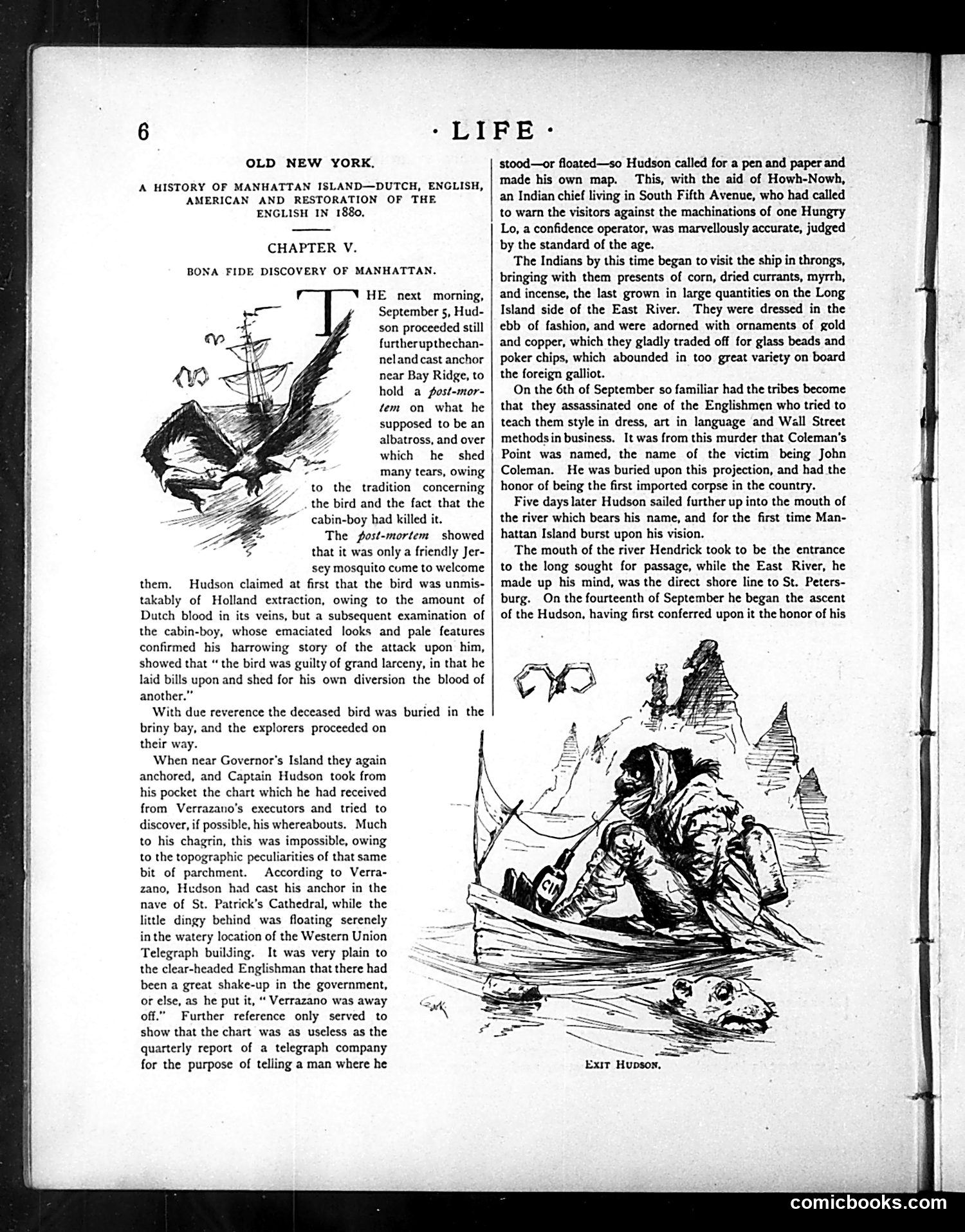
This page is primarily historical narrative, not satire or political cartoon. It's from "Old New York," a historical account of Manhattan Island under Dutch, English, and American rule, focusing on the 1620s exploration period. The two illustrations depict Henry Hudson's 1609 voyage: 1. **Upper left**: Hudson's ship, the *Half Moon*, depicted as a "post-mortem" (dead bird), referencing the text's anecdote about a cabin boy killing a bird that Hudson claimed represented Holland's attraction. 2. **Lower right**: "Exit Hudson"—illustrates Hudson's departure after exploring the river later named for him. The caption is a theatrical pun on Hudson "exiting" the region. These are historical illustrations, not political satire—they document early colonial exploration rather than comment on contemporary 1880s issues.
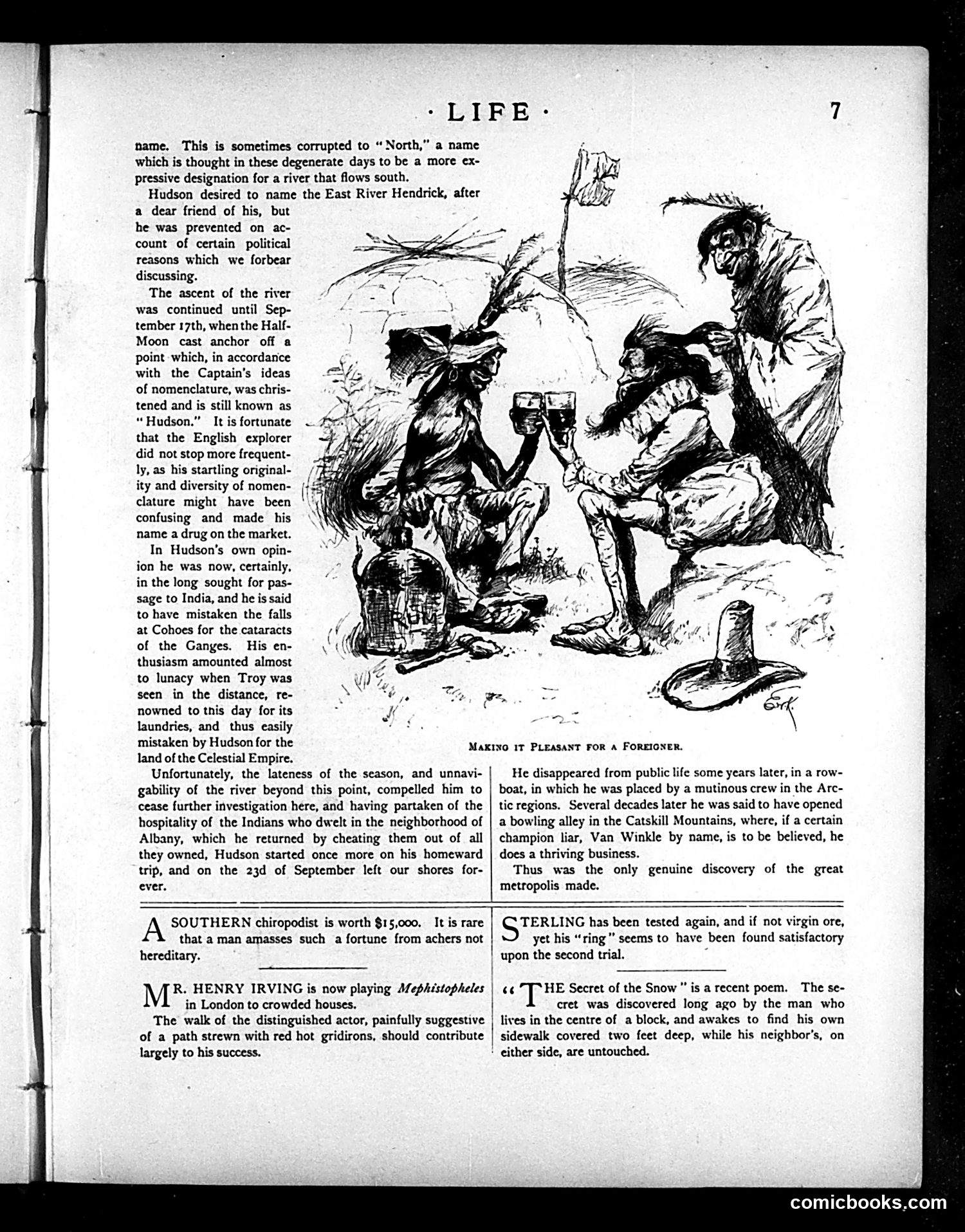
The main illustration, titled "Making it Pleasant for a Foreigner," depicts what appears to be Native Americans sharing a peace pipe or similar ceremonial object with a European explorer or settler. The sketch style is characteristic of early 20th-century satirical illustration. The accompanying text discusses Henry Hudson's exploration and naming of rivers, including details about his journey up the Hudson River and subsequent disappearance. The satire appears to target the romanticized or comedic portrayal of "civilizing" encounters between Europeans and Native peoples—depicting the interaction as quaint or amusing rather than acknowledging the colonial conquest and displacement involved. The smaller text items below discuss unrelated topics (chiropody, theater, poetry), typical of Life's miscellaneous content format.
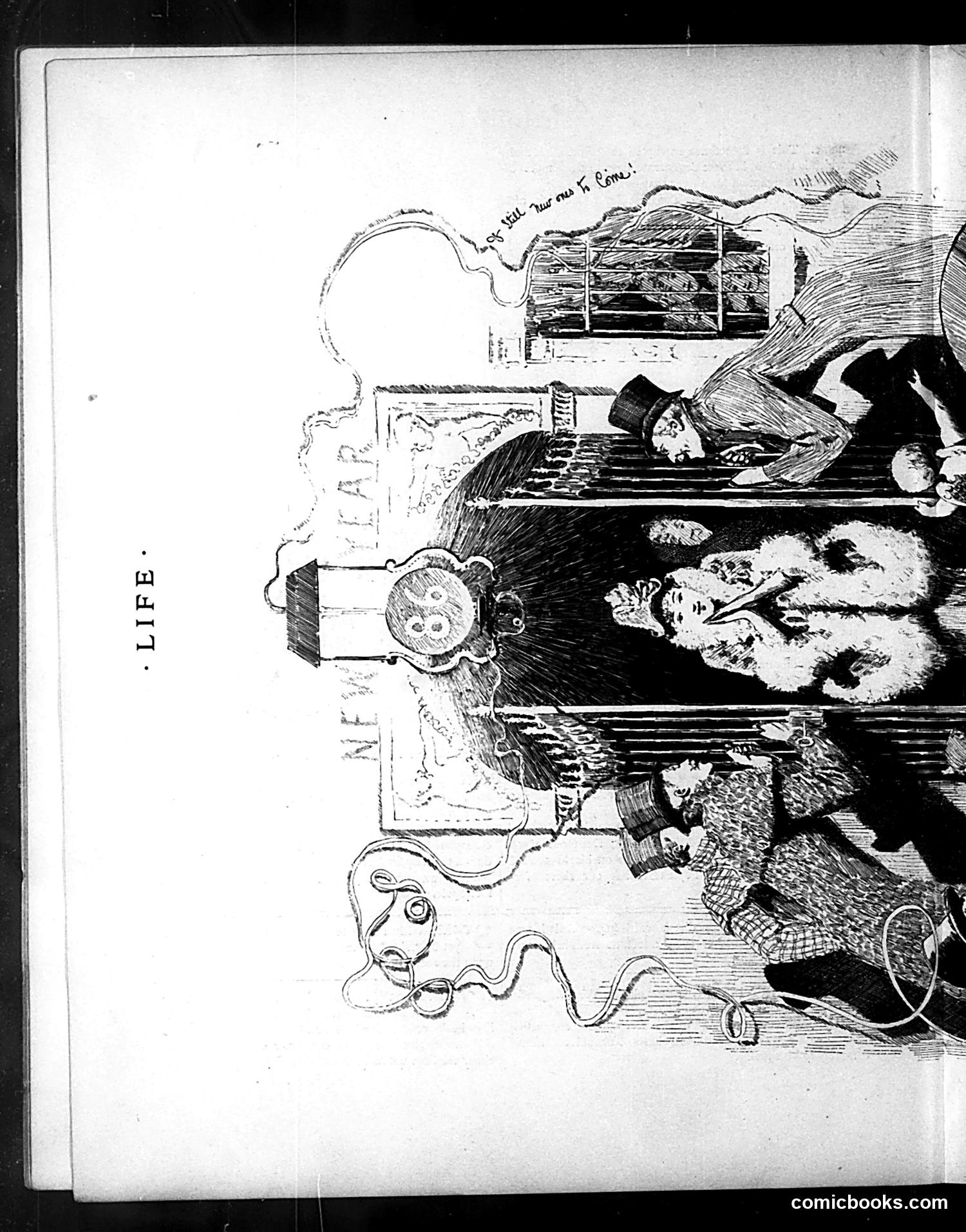
This appears to be a satirical illustration from *Life* magazine, though the image is oriented sideways, making full interpretation challenging. The visible text "LIFE" on the left margin confirms the publication. The cartoon depicts what appears to be a domestic or social scene with multiple figures. There's text at the top that's difficult to read clearly in this orientation, but appears to reference "Rome" or similar. The illustration uses exaggerated caricature style typical of late 19th/early 20th-century American satire. Without being able to read the caption clearly or definitively identify the specific figures, I cannot confidently explain the particular political or social commentary intended. The style suggests social or domestic satire rather than political commentary about specific events or politicians.
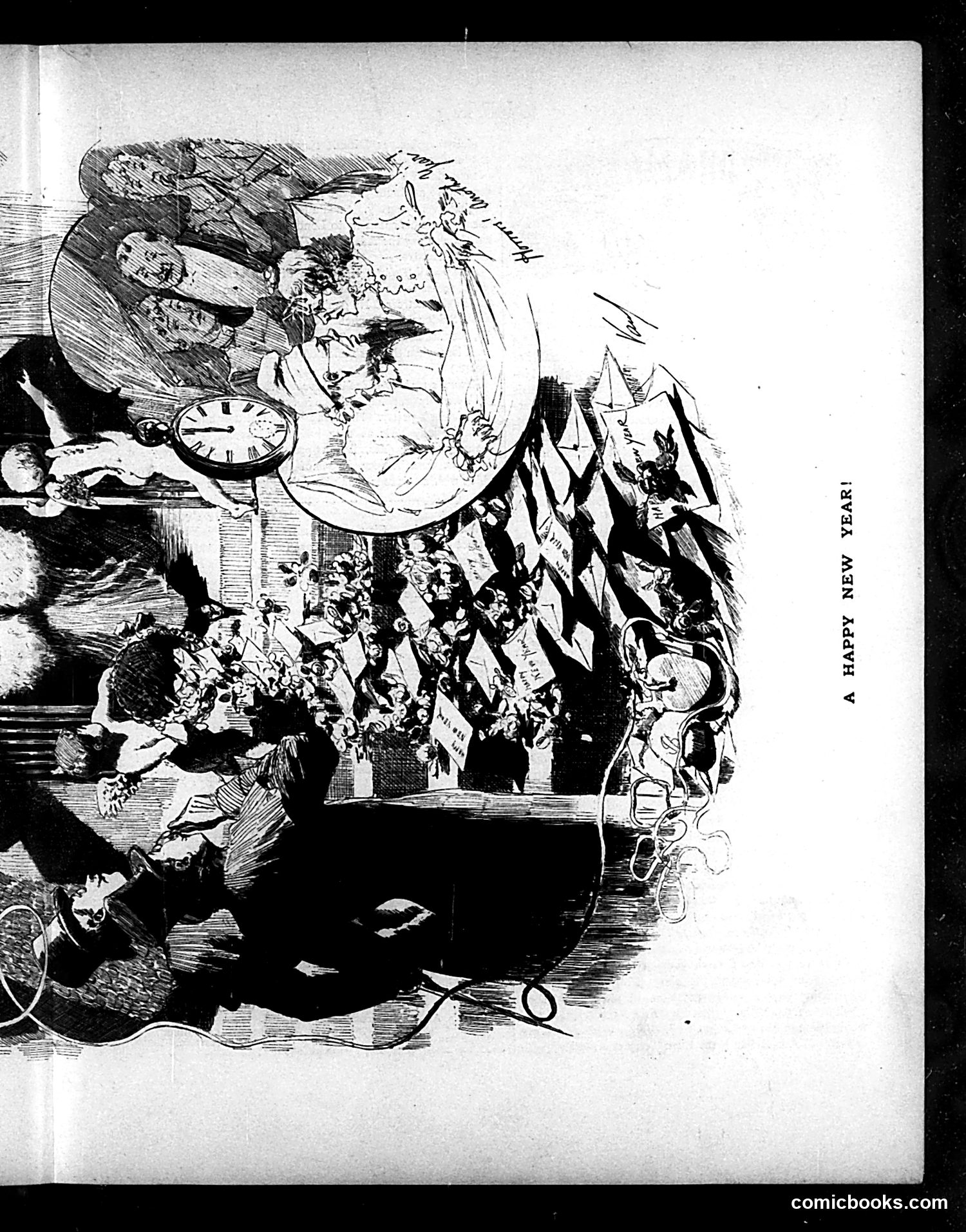
This is a New Year's greeting illustration showing a festive, chaotic celebration scene. The image depicts numerous figures engaged in revelry—drinking, dancing, and celebrating around what appears to be a table or gathering space. A large clock face is visible, marking the passage of time into the new year. The style is typical of Life magazine's satirical illustrations from the late 19th or early 20th century. The crowded composition and exuberant activity convey the boisterous nature of New Year's Eve celebrations of that era. The artistic technique uses heavy cross-hatching and bold linework characteristic of period engraving. Without additional context about specific figures or events referenced, the cartoon appears to be a general satirical commentary on the excesses and chaos of New Year's revelry rather than commentary on particular political figures or events.
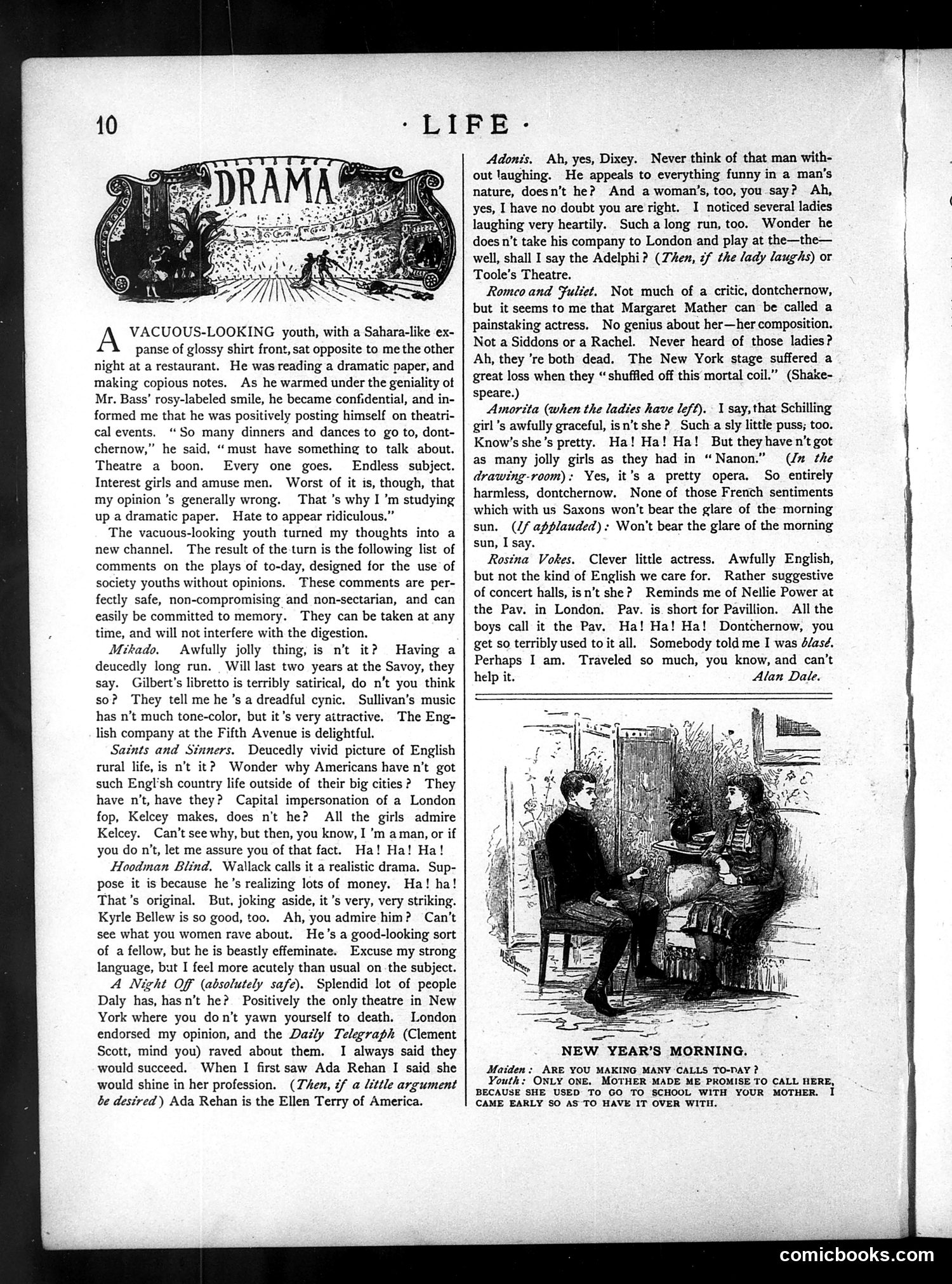
This page satirizes shallow society men who attend theater solely to have conversation fodder for dinners and dances, rather than from genuine interest. The "vacuous-looking youth" openly admits he studies dramatic papers to avoid appearing ridiculous—he has no actual opinions. The text then provides memorized "safe" comments about current Broadway productions (*Mikado*, *Saints and Sinners*, *Hoodman Blind*, *A Night Off*, *Adonis*, *Romeo and Juliet*, *Amorita*). These clichéd remarks are designed to be inoffensive, easily remembered, and interchangeable—allowing users to discuss theater while revealing nothing authentic. The cartoon at bottom ("New Year's Morning") shows a young woman making courtesy calls, with the caption mocking obligatory social visits and promises made under social pressure. The satire targets the performative nature of upper-class social life, where theater attendance and cultural criticism serve as mere social currency rather than genuine engagement with art.
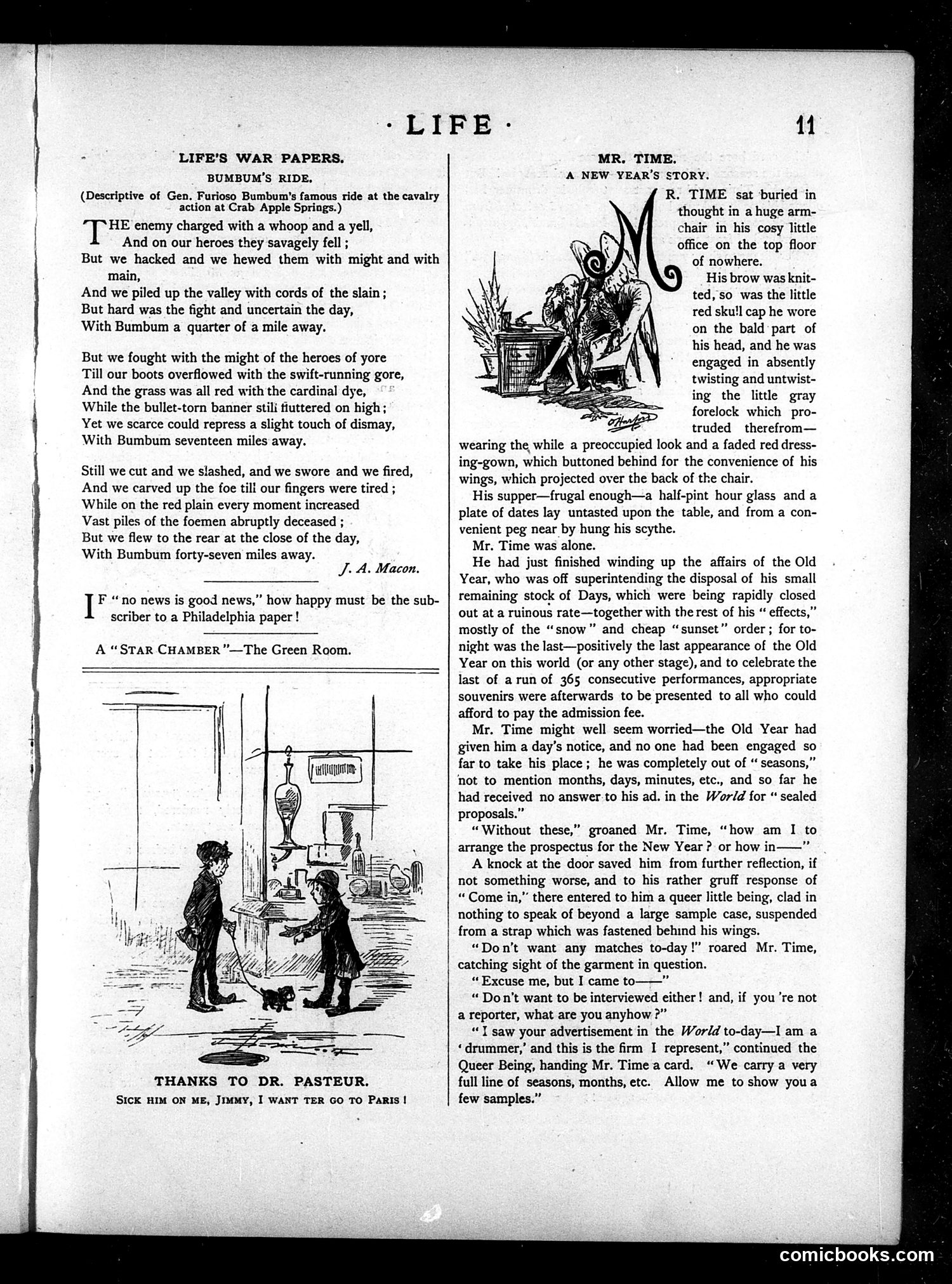
## "Bumbum's Ride" This mock-heroic poem satirizes cowardly military leadership. "General Furioso Bumbum" supposedly commands cavalry but remains increasingly distant from actual combat—first a quarter-mile away, then seventeen miles, finally forty-seven miles. The joke is that while soldiers fight and die heroically ("vast piles of the foemen"), their general flees. The exaggerated distances mock officers who avoid danger while ordering subordinates into it. ## "Mr. Time: A New Year's Story" An allegorical tale where Time (depicted as a winged figure in his office) faces unemployment—the Old Year is retiring after 365 consecutive performances, and Time must find a replacement. A traveling salesman ("drummer") enters hawking seasonal goods. The satire comments on New Year's theatrical conventions and commercial promotion of holidays as consumer events requiring new inventory. Both pieces employ whimsical fantasy-illustrations and verse to critique institutional absurdity: military incompetence and commercialized holidays.
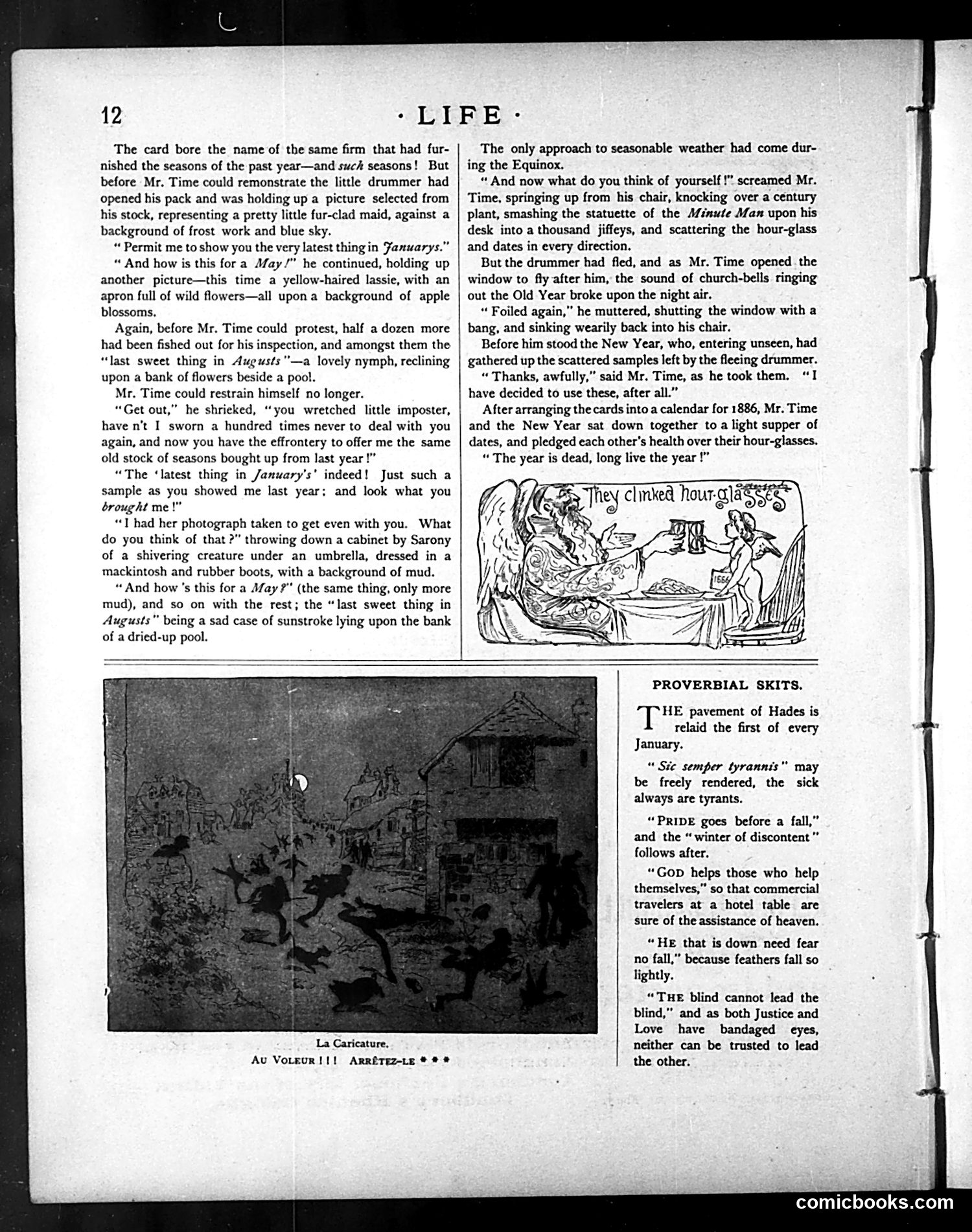
This allegorical cartoon mocks weather unpredictability and false advertising. Mr. Time, representing the year itself, confronts a traveling salesman hawking idealized seasonal pictures—January showing frost and beauty, May with apple blossoms, August with a reclining nymph. When Mr. Time demands actual results, the salesman reveals reality: the same seasons photographed by Sarony (a famous photographer) show misery—umbrellas, mud, sunstroke. The joke satirizes the gap between promised and delivered conditions. The 1886 calendar context suggests the preceding year brought disappointing, inconsistent weather. The New Year appears at story's end to salvage these honest photographs for the coming year's calendar—a wry commentary that even reality's harsh evidence becomes the best we can hope for. The satire targets both false marketing and nature's refusal to cooperate.
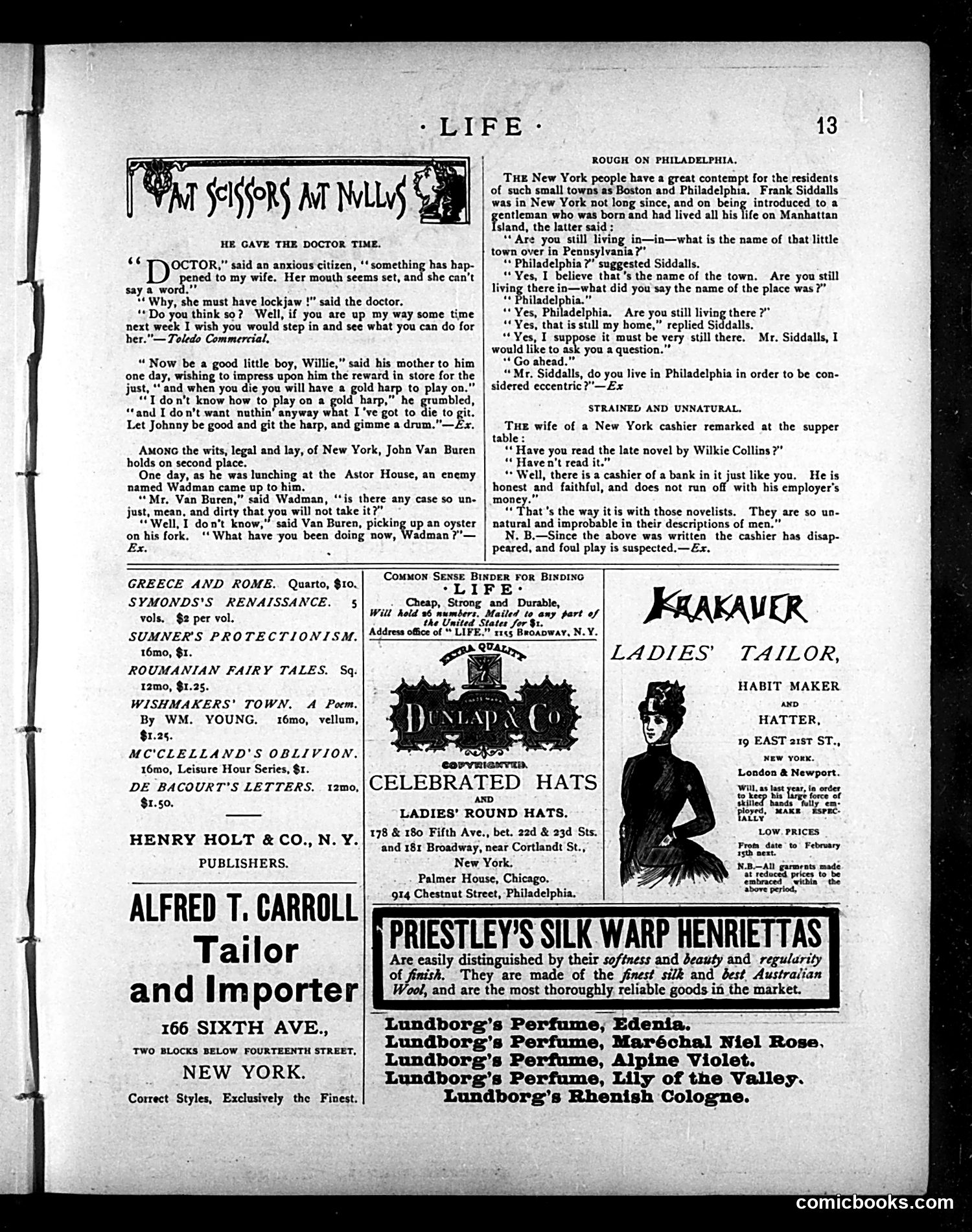
This page from *Life* magazine contains three separate satirical anecdotes mocking social pretension and human folly: **"He Gave the Doctor Time"** jokes about a man's casual indifference to his wife's lockjaw, suggesting he'd only call a doctor if convenient later. **"Rough on Philadelphia"** ridicules Manhattan's condescension toward other cities. A New York gentleman repeatedly forgets Philadelphia's name while speaking to a visitor, treating it as an insignificant backwater. The humor lies in the New Yorker's arrogant dismissal of anywhere outside Manhattan. **"Strained and Unnatural"** satirizes novelists' unrealistic depictions. A banker's wife complains that a novel's honest cashier character is implausibly virtuous—immediately after which the real cashier disappears with employer money, making fiction eerily accurate and the wife's criticism ironically wrong. The remaining content is period advertising for books, hats, tailoring services, and perfume—typical *Life* magazine filler.
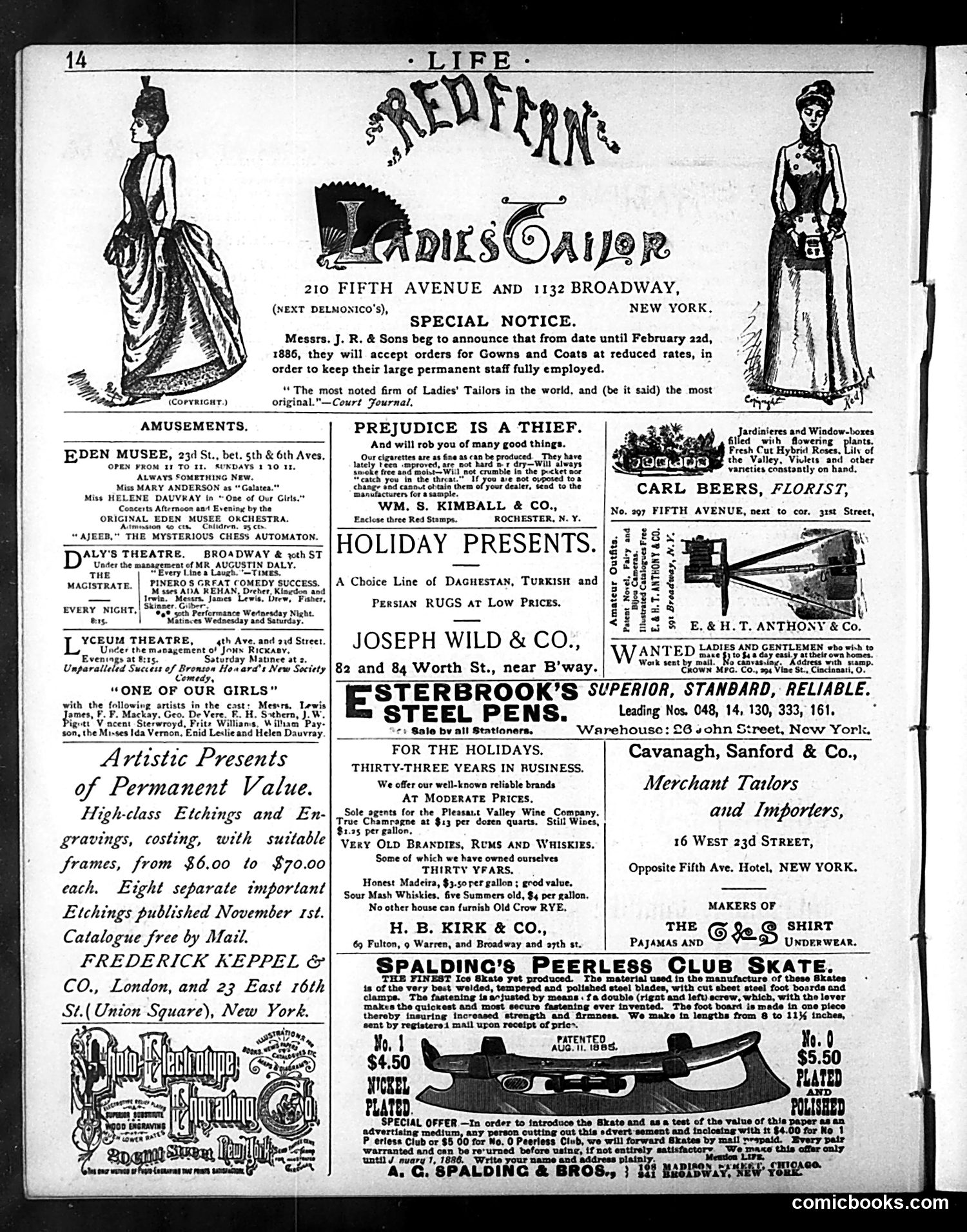
This is primarily an **advertising page** from Life magazine (circa 1886), not a political cartoon. The page features commercial advertisements interspersed with theater listings. The one editorial content is a small box titled **"PREJUDICE IS A THIEF,"** which appears to be a brief moral essay condemning prejudice as destructive ("will rob you of many good things"). It references cigars and cigarettes as examples, suggesting prejudice prevents people from fairly evaluating products. This reflects 19th-century debates about consumer choice and rationality versus tradition. The rest of the page advertises: - Ladies' tailor services (J.R. & Sons) - Theater productions - Rugs, flowers, pens, alcohol, and ice skates - Artistic etchings and engravings The fashion illustrations show elaborate Victorian-era women's clothing with bustles and ornate styling typical of the 1880s. Nothing here constitutes satire or political commentary—it's straightforward period advertising and announcements.
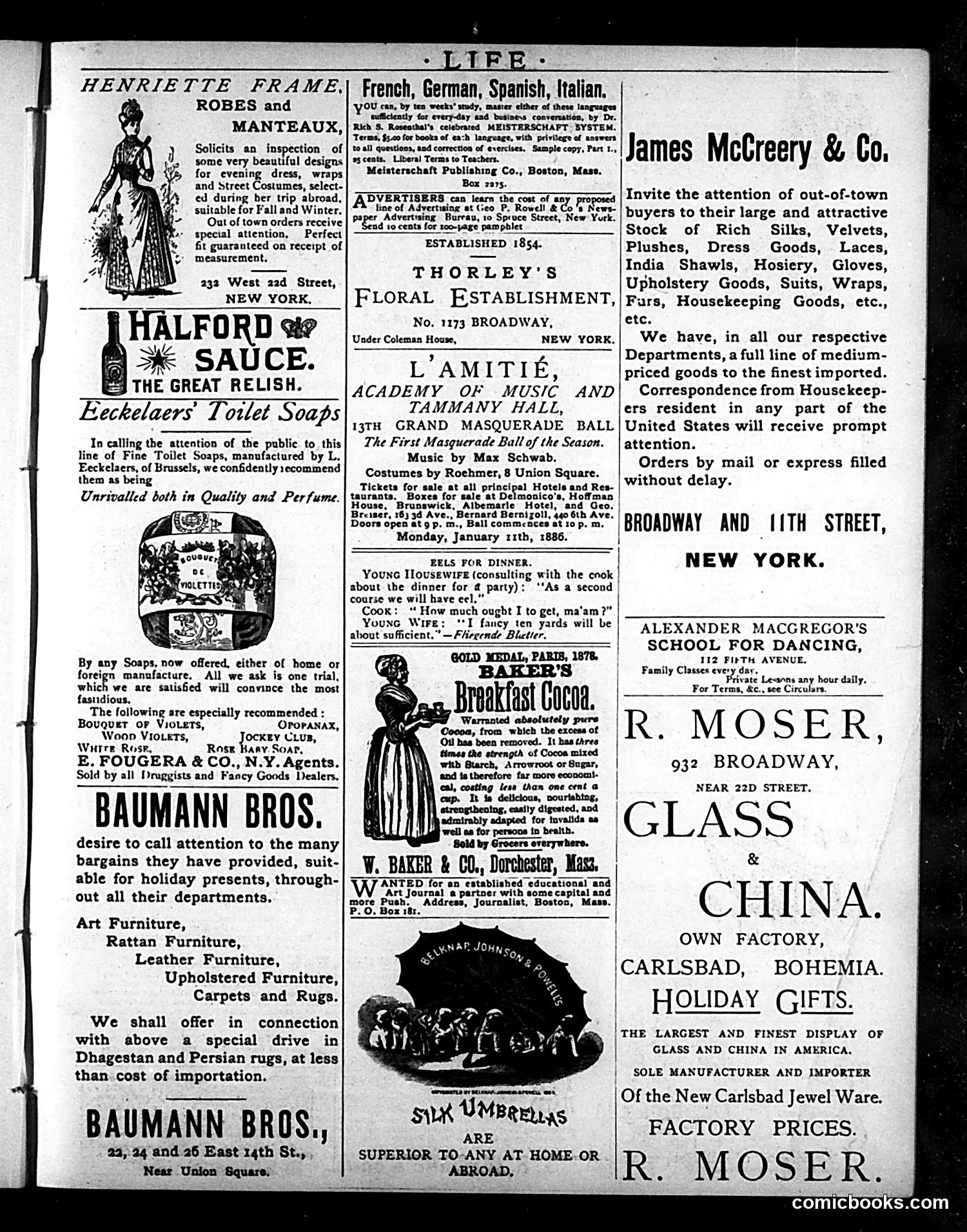
This page is primarily **advertising**, not political satire. It's from *Life* magazine (dated January 11th, 1886, based on the masquerade ball announcement), showing typical commercial notices of the era. The one **joke/cartoon** present is the brief "Eels for Dinner" dialogue: a young housewife, consulting her cook about dinner party preparations, suggests serving eel and casually says "ten yards will be about sufficient." The humor lies in her confusion of measurement—using linear distance (yards) instead of weight or quantity, suggesting comic ignorance about cooking. This satirizes wealthy housewives unfamiliar with practical domestic matters, relying entirely on servants while remaining clueless about actual food preparation. The remaining content—advertisements for soaps, furniture, language instruction, silk umbrellas, glass and china, dancing schools, and fashion services—reflects Gilded Age consumer culture aimed at affluent New York readers.
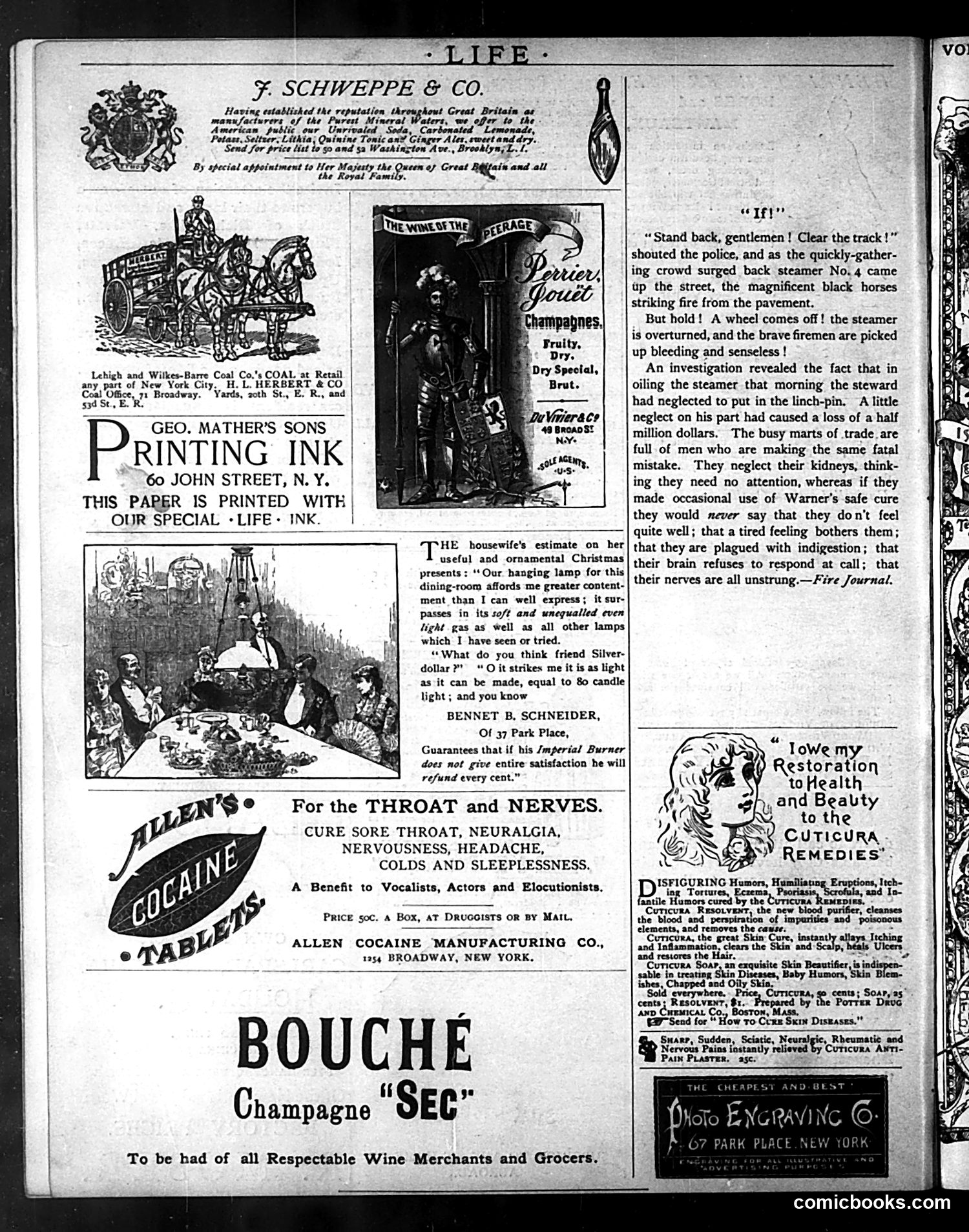
This page is primarily **advertisements** with one notable satirical story. The main content is the narrative "If!" — a cautionary tale about a fire engine accident caused by a fireman's neglect in oiling the machinery (specifically failing to insert a linch-pin). The satire works by **analogy**: just as this small oversight caused catastrophic damage (half a million dollars in losses and injured firemen), the story warns readers that neglecting their health — particularly their kidneys — will similarly cause serious harm. The piece then pivots to promoting **Warner's Safe Cure**, a patent medicine remedy. This represents typical late-19th-century advertising strategy: using dramatic narratives to create anxiety, then offering a commercial product as solution. The surrounding ads reflect period concerns: cocaine tablets for throat/nerve ailments, mineral waters, champagne, and skin remedies (Cuticura) — all presented as remedies for vague ailments like "nervousness" and "indigestion." These advertisements reveal what contemporaries feared health-wise and what "cures" they trusted.