
Life, 1886-01-01 · page 4 of 16
Life — January 1, 1886 — page 4: what you’re looking at
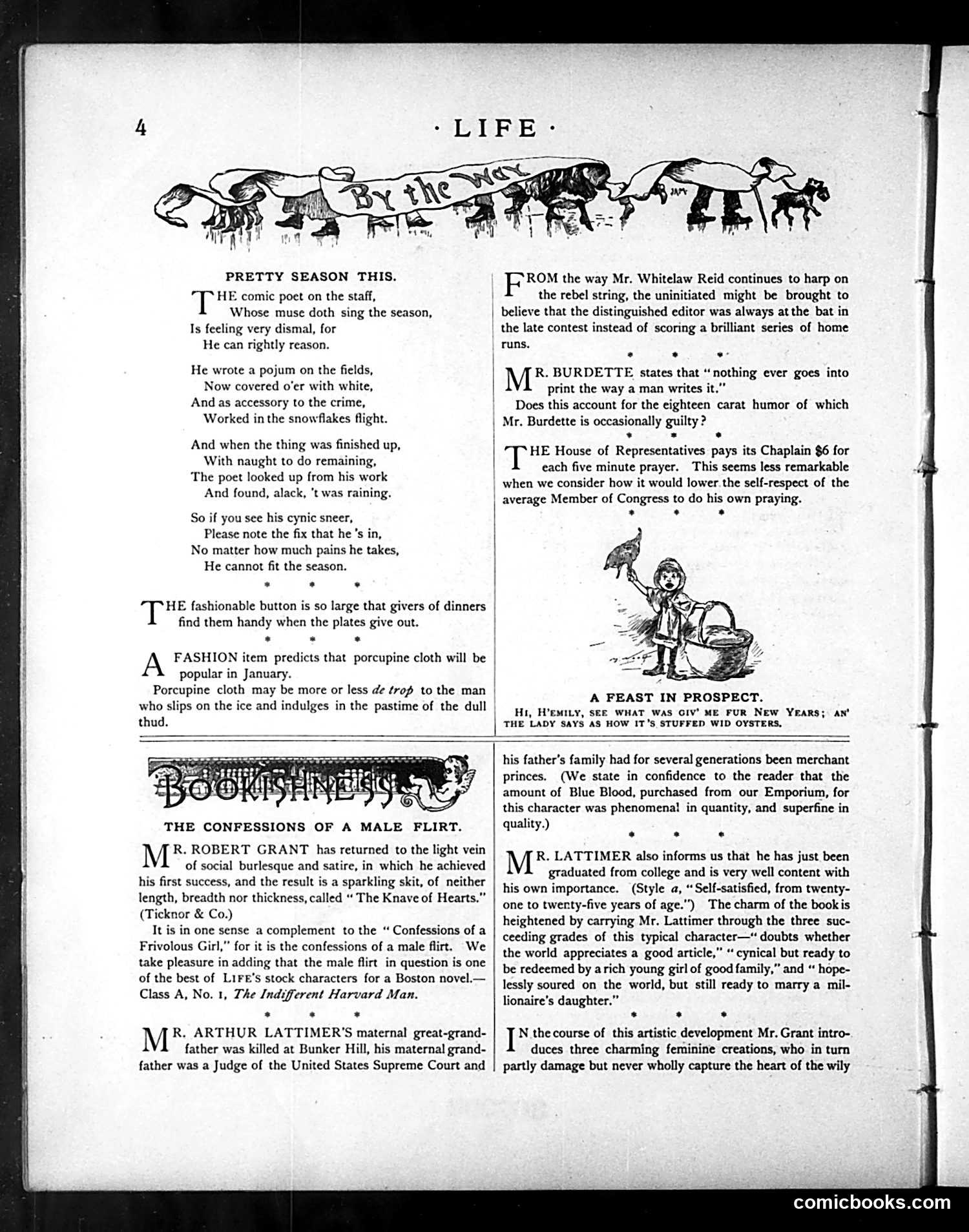
What you’re looking at
This page contains literary commentary and social satire rather than political cartoons. The main content reviews Robert Grant's novel "The Knave of Hearts," describing it as a sparkling satire about male flirtation in Boston society. The brief satirical items mock contemporary figures: Whitelaw Reid (appearing to be an editor criticized for avoiding home runs in cricket), Mr. Burdette (accused of using eighteen-carat humor), and the House of Representatives chaplain (paid $6 for five-minute prayers). The humor is genteel and topical rather than visually comedic—poking fun at fashionable society, literary pretensions, and institutional absurdities. A small illustration shows a Thanksgiving scene. The satire assumes readers' familiarity with Boston's social elite and contemporary publishing figures.
📄 Transcribed text from this page (OCR, searchable)
Machine-transcribed from the original scan — historical spelling and the odd misread are preserved.
PRETTY SEASON THIS. HE comic poet on the staff, Whose muse doth sing the season, Is feeling very dismal, for He can rightly reason. He wrote a pojum on the fields, Now covered o'er with white, And as accessory to the crime, Worked in the snowflakes flight. And when the thing was finished up, With naught to do remaining, The poet looked up from his work And found, alack, 't was raining. So if you see his cynic sneer, Please note the fix that he’s in, No matter how much pains he takes, He cannot fit the season. . . * ROM the way Mr. Whitelaw Reid continues to harp on the rebel string, the uninitiated might be brought to | believe that the distinguished editor was always at the bat in the late contest instead of scoring a brilliant series of home runs, * * - R. BURDETTE states that “ print the way a man writes it Does this account for the eighteen carat humor of which | Mr. Burdette is occasionally guilty ? | . . . | HE House of Representatives pays its Chaplain $6 for each five minute prayer. This seems less remarkable when we consider how it would lower. the self-respect of the average Member of Congress to do his own praying. hing ever goes into HE fashionable button is so large that givers of dinners | find them handy when the plates give out. * * * FASHION item predicts that porcupine cloth will be | popular in January. Porcupine cloth may be more or less de ¢rop to the man who slips on the ice and indulges in the pastime of the dull Hi, H’eMILy, SEE WHAT Was GIV’ ME FUR New YEARS; AN’ THE LADY SAYS AS HOW IT'S STUFFED WID OYSTERS, THE CONFESSIONS OF A MALE FLIRT. R. ROBERT GRANT has returned to the light vein of social burlesque and satire, in which he achieved his first success, and the result is a sparkling skit, of neither length, breadth nor thickness, called “ The Knave of Hearts.” (Ticknor & Co.) It is in one sense a complement to the “ Confessions of a Frivolous Girl,” for it is the confessions of a male flirt. We take pleasure in adding that the male flirt in question is one of the best of Lire’s stock characters for a Boston novel.— Class A, No. 1, The Indifferent Harvard Man. . . * R. ARTHUR LATTIMER’S maternal great-grand- father was killed at Bunker Hill, his maternal grand- father was a Judge of the United States Supreme Court and his father’s family had for several generations been merchant princes. (We state in confidence to the reader that the amount of Blue Blood, purchased from our Emporium, for this character was phenomenal in quantity, and superfine in quality.) . . . R. LATTIMER also informs us that he has just been graduated from college and is very well content with his own importance. (Style a, “Self-satisfied, from twenty- one to twenty-five years of age.) The charm of the bookis heightened by carrying Mr. Lattimer through the three suc- ceeding grades of this typical character—‘“ doubts whether the world appreciates a good article,” “ cynical but ready to be redeemed by arich young girl of good family,” and “ hope- lessly soured on the world, but still ready to marry a mil- lionaire’s daughter.” . . . N the course of this artistic development Mr. Grant intro- duces three charming feminine creations, who in turn partly damage but never wholly capture the heart of the wily comicbooks.com