
Life, 1886-01-01 · page 10 of 16
Life — January 1, 1886 — page 10: what you’re looking at
What you’re looking at
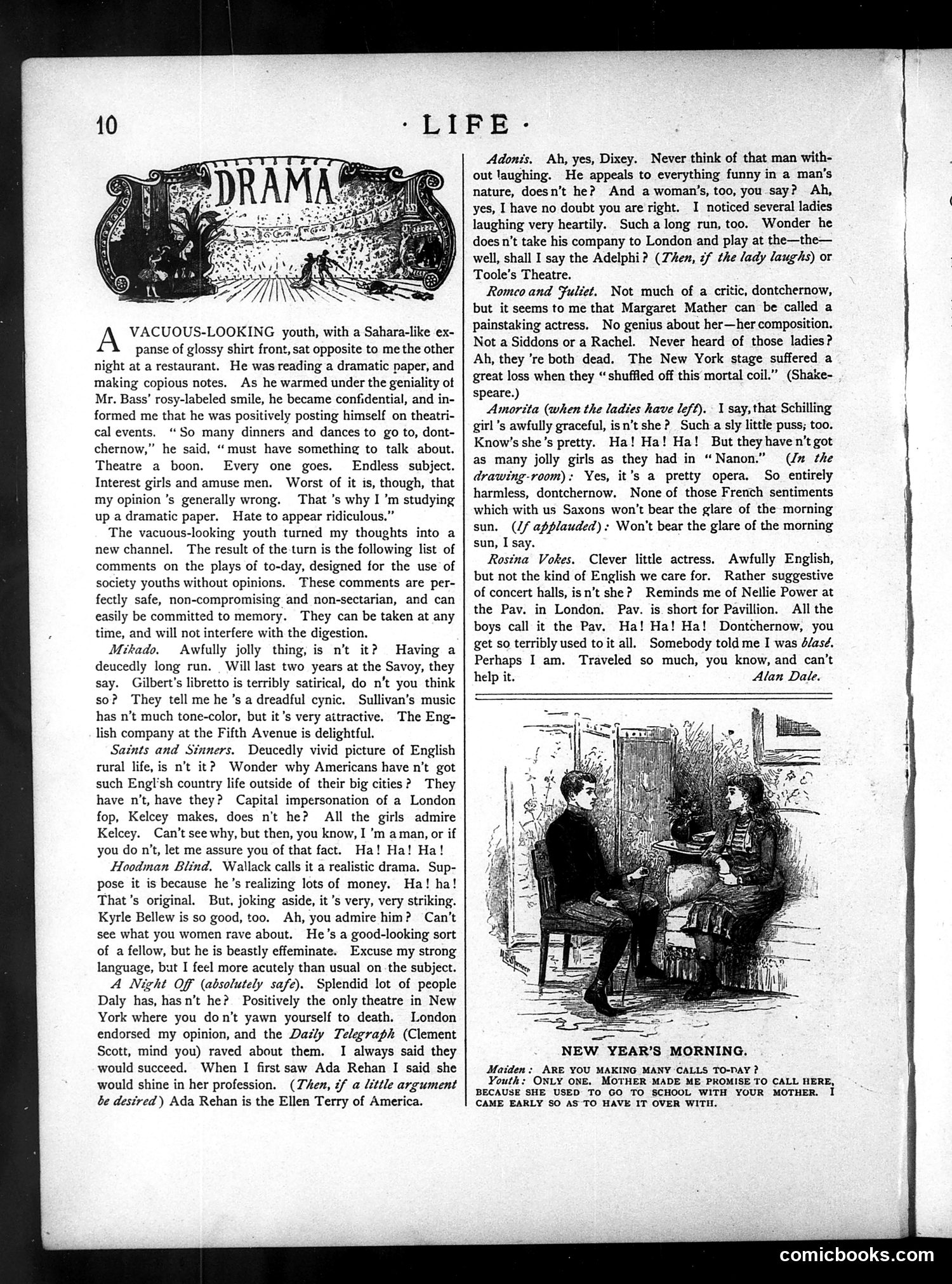
This page satirizes shallow society men who attend theater solely to have conversation fodder for dinners and dances, rather than from genuine interest. The "vacuous-looking youth" openly admits he studies dramatic papers to avoid appearing ridiculous—he has no actual opinions. The text then provides memorized "safe" comments about current Broadway productions (*Mikado*, *Saints and Sinners*, *Hoodman Blind*, *A Night Off*, *Adonis*, *Romeo and Juliet*, *Amorita*). These clichéd remarks are designed to be inoffensive, easily remembered, and interchangeable—allowing users to discuss theater while revealing nothing authentic. The cartoon at bottom ("New Year's Morning") shows a young woman making courtesy calls, with the caption mocking obligatory social visits and promises made under social pressure. The satire targets the performative nature of upper-class social life, where theater attendance and cultural criticism serve as mere social currency rather than genuine engagement with art.
📄 Transcribed text from this page (OCR, searchable)
Machine-transcribed from the original scan — historical spelling and the odd misread are preserved.
EEE : A VACUOUS-LOOKING youth, with a Sahara-like ex- panse of glossy shirt front, sat opposite to me the other night at a restaurant. He was reading a dramatic paper, and making copious notes. As he warmed under the geniality ot Mr. Bass’ rosy-labeled smile, he became confidential, and in- formed me that he was positively posting himself on theatri- cal events. “So many dinners and dances to go to, dont- chernow,” he said, “must have something to talk about. Theatre a boon. Every one goes. Endless subject. Interest girls and amuse men. Worst of it is, though, that my opinion ’s generally wrong. That ’s why I ’m studying up a dramatic paper. Hate to appear ridiculous.” The vacuous-looking youth turned my thoughts into a new channel. The result of the turn is the following list of comments on the plays of to-day, designed for the use of society youths without opinions. These comments are per- fectly safe, non-compromising and non-sectarian, and can easily be committed to memory. They can be taken at any time, and will not interfere with the digestion. Mikado. Awfully jolly thing, is n’t it? Having a deucedly long run. _ Will last two years at the Savoy, they say. Gilbert's libretto is terribly satirical, do n't you think so? They tell me he’s a dreadful cynic. Sullivan's music has n’t much tone-color, but it’s very attractive. The Eng- lish company at the Fifth Avenue is delightful. Saints and Sinners. Deucedly vivid picture of English rural life, is n’t it? Wonder why Americans have n’t got such Engl'sh country life outside of their big cities? They have n’t, have they? Capital impersonation of a London fop, Kelcey makes, does n't he? All the girls admire Kelcey. Can’t see why, but then, you know, I ’m aman, or if you do n’t, let me assure you of that fact. Ha! Ha! Ha! Hoodman Blind. Wallack calls it a realistic drama. Sup- pose it is because he’s realizing lots of money. Ha! ha! That ’s original. But, joking aside, it’s very, very striking. Kyrle Bellew is so good, too. Ah, you admire him? Can’t see what you women rave about. He’s a good-looking sort of a fellow, but he is beastly effeminate. Excuse my strong language, but I feel more acutely than usual on the subject. A Night Of (absolutely safe). Splendid lot of people Daly has, hasn’t he? Positively the only theatre in New York where you don’t yawn yourself to death. London endorsed my opinion, and the Dazly Telegraph (Clement Scott, mind you) raved about them. I always said they would succeed. When I first saw Ada Rehan I said she would shine in her profession. (Then, if a little argument be desired) Ada Rehan is the Ellen Terry of America. Adonis, Ah, yes, Dixey. Never think of that man with- out laughing. He appeals to everything funny in a man’s nature, doesn’t he? And a woman’s, too, you say? Ah, yes, I have no doubt you are right. I noticed several ladies laughing very heartily. Such along run, too. Wonder he does n’t take his company to London and play at the—the— well, shall I say the Adelphi? (Zhen, zf the lady laughs) or Toole’s Theatre. Romcoand Fuliet. Not much of a critic, dontchernow, but it seems to me that Margaret Mather can be called a painstaking actress. No genius about her—her composition. Not a Siddons or a Rachel. Never heard of those ladies? Ah, they 're both dead. The New York stage suffered a great loss when they “shuffled off this mortal coil.” (Shake- speare.) Amorita (when the ladies have left). 1 say, that Schilling girl's awfully graceful, isn’t she? Such a sly little puss; too. Know’s she’s pretty. Ha! Ha! Ha! But they haven't got as many jolly girls as they had in “Nanon.” (ln the drawing-room): Yes, it’s a pretty opera. So entirely harmless, dontchernow. None of those French sentiments which with us Saxons won't bear the glare of the morning sun. (/f applauded): Won't bear the glare of the morning sun, I say. Rosina Vokes. Clever little actress. Awfully English, but not the kind of English we care for. Rather suggestive of concert halls, isn’t she? Reminds me of Nellie Power at the Pav. in London. Pav. is. short for Pavillion. All the boys call it the Pav. Ha! Ha! Ha! Dontchernow, you get so terribly used to it all. Somebody told me I was d/asé. Perhaps I am. Traveled so much, you know, and can’t help it. Alan Dale. NEW YEAR’S MORNING. Maiden: ARE YOU MAKING MANY CALLS TO-DAY? Youth: ONLY ONE. MOTHER MADE ME PROMISE TO CALL HERE, BECAUSE SHE USED To GO TO SCHOOL WITH YOUR MOTHER. I CAME EARLY SO AS TO HAVE IT OVER WITH. comicbooks.com