
Life, 1886-01-01 · page 6 of 16
Life — January 1, 1886 — page 6: what you’re looking at
What you’re looking at
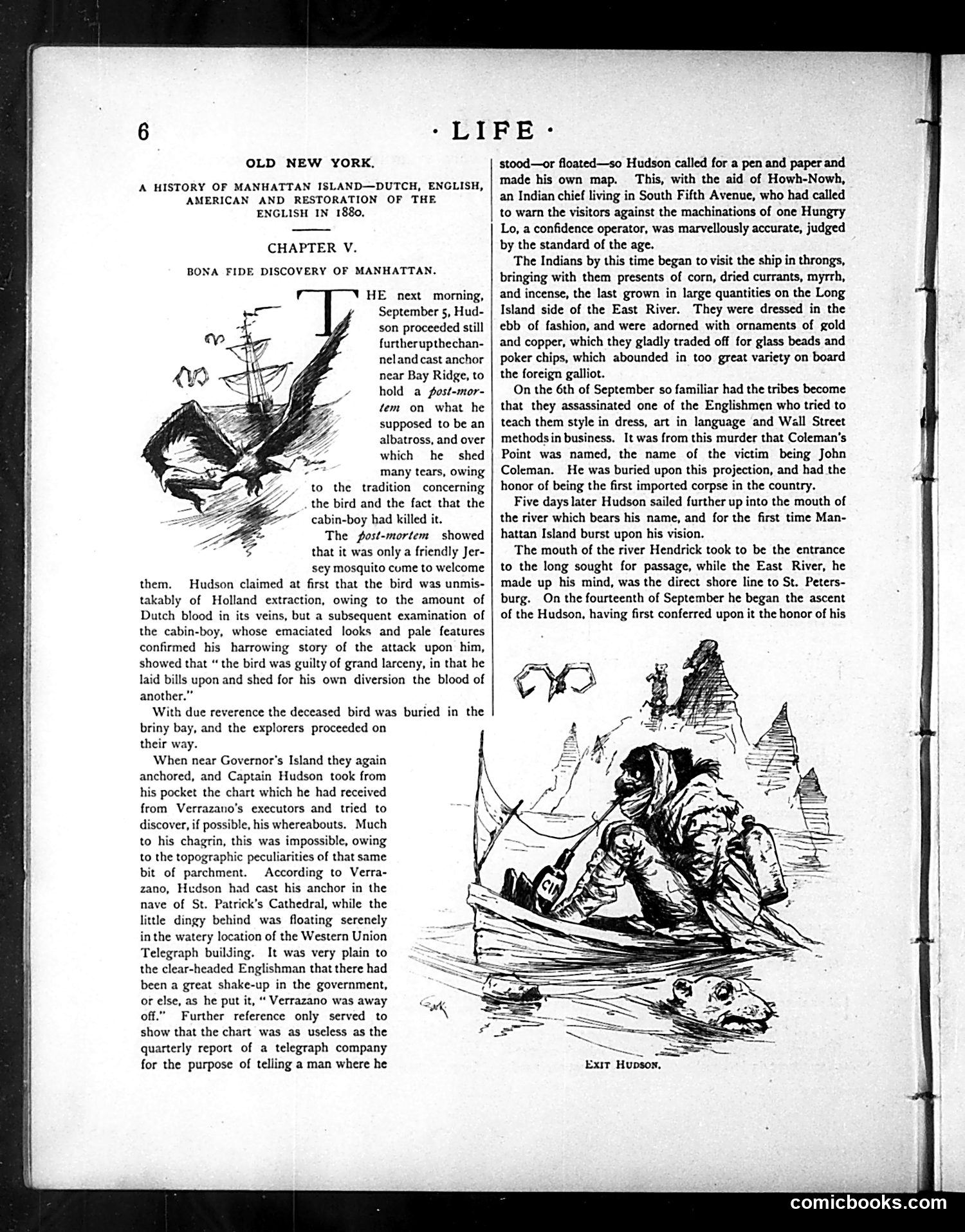
This page is primarily historical narrative, not satire or political cartoon. It's from "Old New York," a historical account of Manhattan Island under Dutch, English, and American rule, focusing on the 1620s exploration period. The two illustrations depict Henry Hudson's 1609 voyage: 1. **Upper left**: Hudson's ship, the *Half Moon*, depicted as a "post-mortem" (dead bird), referencing the text's anecdote about a cabin boy killing a bird that Hudson claimed represented Holland's attraction. 2. **Lower right**: "Exit Hudson"—illustrates Hudson's departure after exploring the river later named for him. The caption is a theatrical pun on Hudson "exiting" the region. These are historical illustrations, not political satire—they document early colonial exploration rather than comment on contemporary 1880s issues.
📄 Transcribed text from this page (OCR, searchable)
Machine-transcribed from the original scan — historical spelling and the odd misread are preserved.
} H | | j | } } i 6 - LIFE: OLD NEW YORK. A HISTORY OF MANHATTAN ISLAND—DUTCH, ENGLISH, AMERICAN AND RESTORATION OF THE ENGLISH IN 1880, CHAPTER V. BONA FIDE DISCOVERY OF MANHATTAN. HE next morning, September 5, Hud- son proceeded still furtherupthechan- neland cast anchor near Bay Ridge, to hold a fost-mor- tem on what he supposed to be an albatross, and over which he shed . many tears, owing to the tradition concerning the bird and the fact that the cabin-boy had killed it. The post-mortem showed that it was only a friendly Jer- sey mosquito come to welcome them. Hudson claimed at first that the bird was unmis- takably of Holland extraction, owing to the amount of Dutch blood in its veins, but a subsequent examination of the cabin-boy, whose emaciated looks and pale features confirmed his harrowing story of the attack upon him, showed that “ the bird was guilty of grand larceny, in that he laid bills upon and shed for his own diversion the blood of another.” With due reverence the deceased bird was buried in the briny bay, and the explorers proceeded on their way. When near Governor's Island they again anchored, and Captain Hudson took from his pocket the chart which he had received from Verrazano’s executors and tried to discover, if possible, his whereabouts. Much to his chagrin, this was impossible, owing to the topographic peculiarities of that same bit of parchment. According to Verra- zano, Hudson had cast his anchor in the nave of St. Patrick’s Cathedral, while the little dingy behind was floating serenely in the watery location of the Western Union Telegraph building. It was very plain to the clear-headed Englishman that there had been a great shake-up in the government, or else, as he put it, “ Verrazano was away off.” Further reference only served to show that the chart was as useless as the quarterly report of a telegraph company for the purpose of telling a man where he stood—or floated—so Hudson called for a pen and paper and made his own map. This, with the aid of Howh-Nowh, an Indian chief living in South Fifth Avenue, who had called to warn the visitors against the machinations of one Hungry Lo, a confidence operator, was marvellously accurate, judged by the standard of the age. The Indians by this time began to visit the ship in throngs, bringing with them presents of corn, dried currants, myrrh, and incense, the last grown in large quantities on the Long Island side of the East River. They were dressed in the ebb of fashion, and were adorned with ornaments of gold and copper, which they gladly traded off for glass beads and poker chips, which abounded in too great variety on board the foreign galliot. On the 6th of September so familiar had the tribes become that they assassinated one of the Englishmen who tried to teach them style in dress, art in language and Wall Street methods in business. It was from this murder that Coleman's Point was named, the name of the victim being John Coleman. He was buried upon this projection, and had the honor of being the first imported corpse in the country. Five days later Hudson sailed further up into the mouth of the river which bears his name, and for the first time Man- hattan Island burst upon his vision. The mouth of the river Hendrick took to be the entrance to the long sought for passage, while the East River, he made up his mind, was the direct shore line to St. Peters- burg. On the fourteenth of September he began the ascent of the Hudson, having first conferred upon it the honor of his Exit Hupsoy, { comicbooks.com