
A complete issue · 18 pages · 1885
Life — December 17, 1885
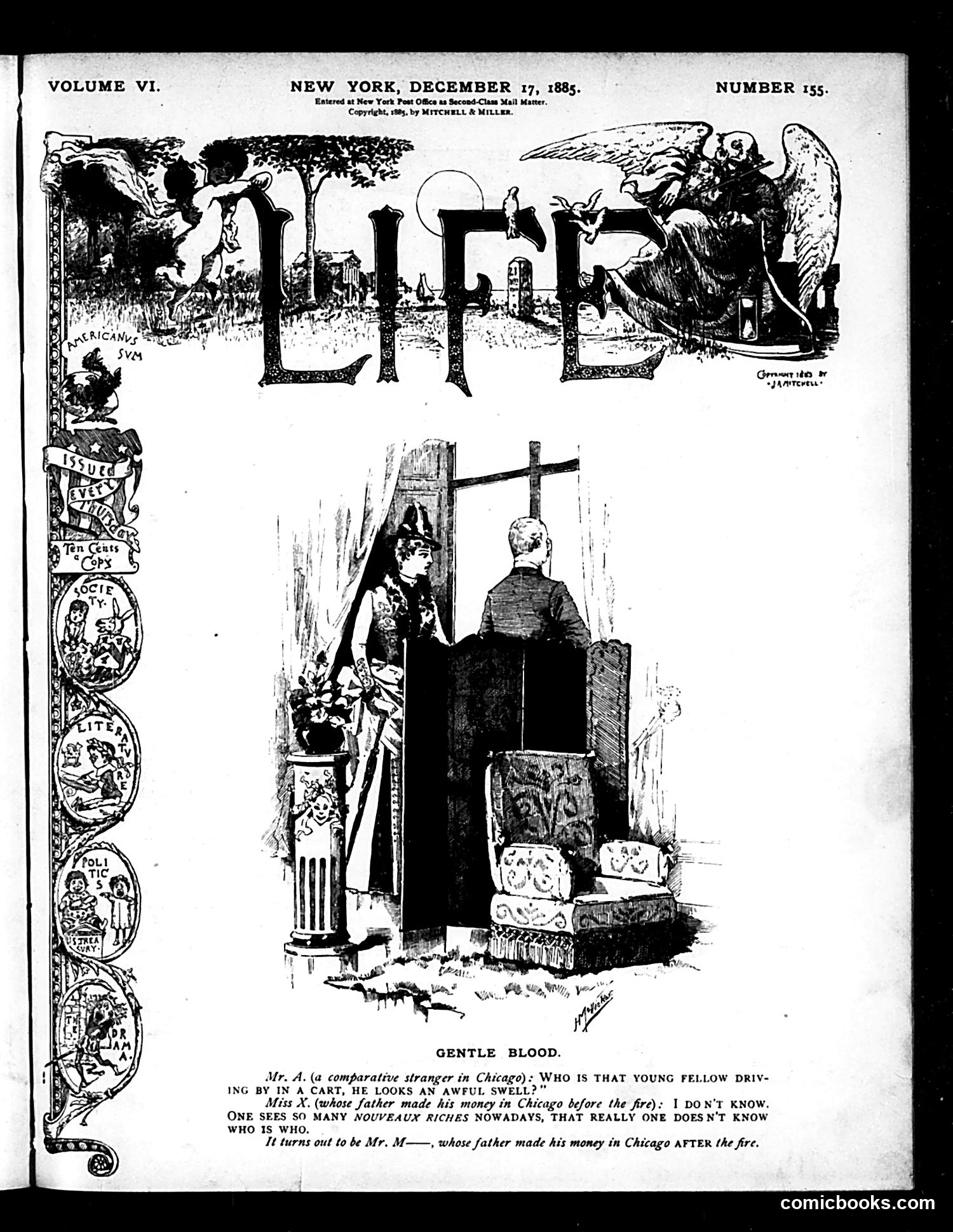
This satirical cartoon depicts a cemetery scene mocking new wealth and social pretension in Chicago. The dialogue reveals the joke: a man from Chicago, Mr. A, encounters a young fellow driving an expensive carriage and asks who he is. The response indicates the youth's father made his money in Chicago "after the fire"—likely referring to the 1871 Great Chicago Fire and subsequent reconstruction. The satire targets the nouveau riche: those who accumulated sudden wealth through post-disaster rebuilding and are now parading their "gentle blood" (aristocratic status) despite their recent poverty. The cemetery setting and religious iconography underscore the irony that such "new money" cannot buy genuine inherited nobility or respectability, only ostentatious display.
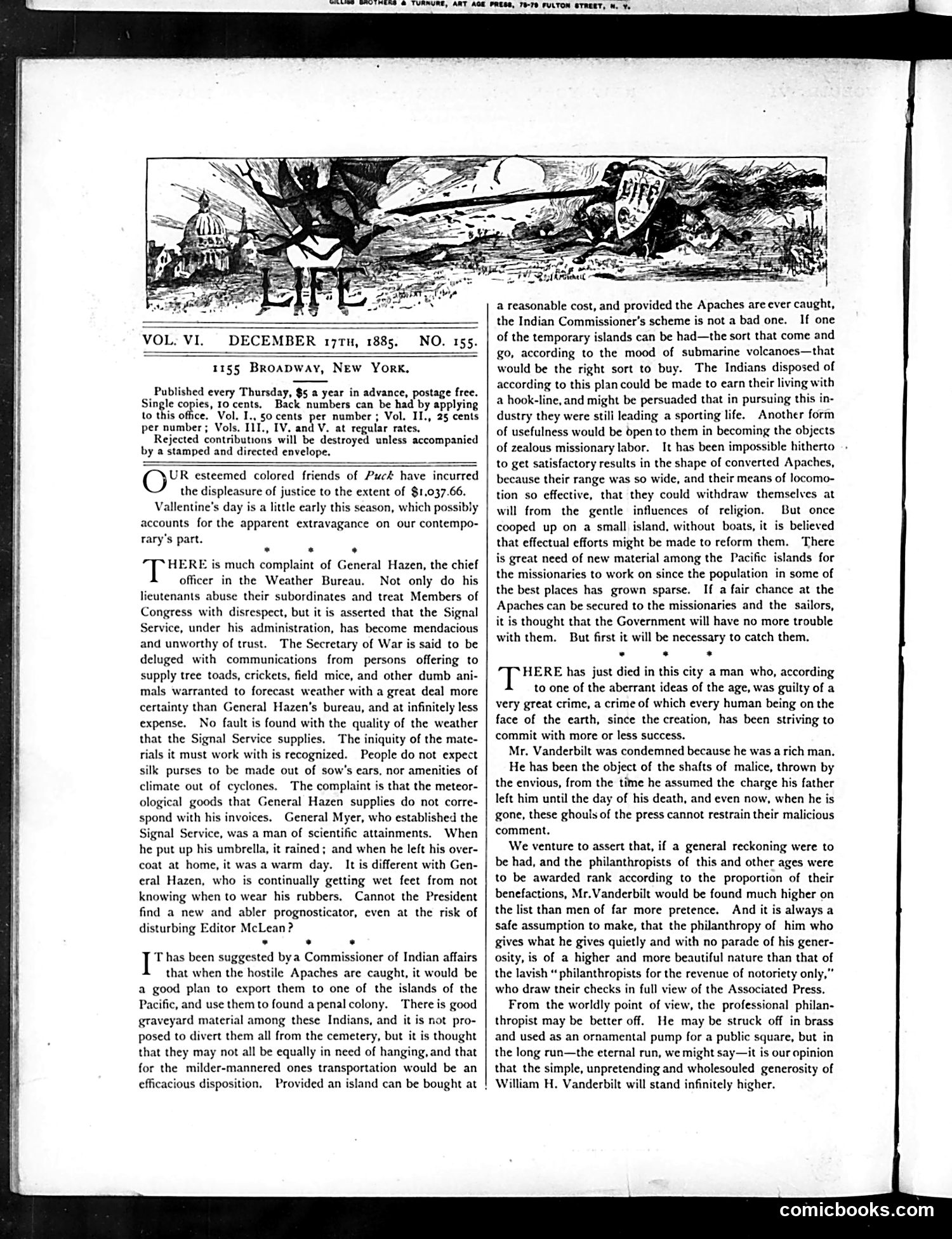
The page contains three separate satirical pieces rather than a unified cartoon: 1. **"Puck" complaint**: Criticizes *Puck* magazine for publishing an article deemed unjust to colored people during Valentine's Day season. 2. **General Hazen criticism**: Attacks General Hazen, chief officer of the Weather Bureau, accusing his lieutenants of abusing Congress members and treating Signal Service supplies poorly. The satire questions his competence—noting he can't even manage an umbrella properly during rain. 3. **William H. Vanderbilt tribute**: Ironically praises the recently deceased millionaire's philanthropy as superior to merely "lavish" charitable giving, though the tone suggests mockery of how wealth buys reputation. The page reflects 1880s concerns: government bureaucratic corruption, racial justice, and wealthy industrialists' public image management.
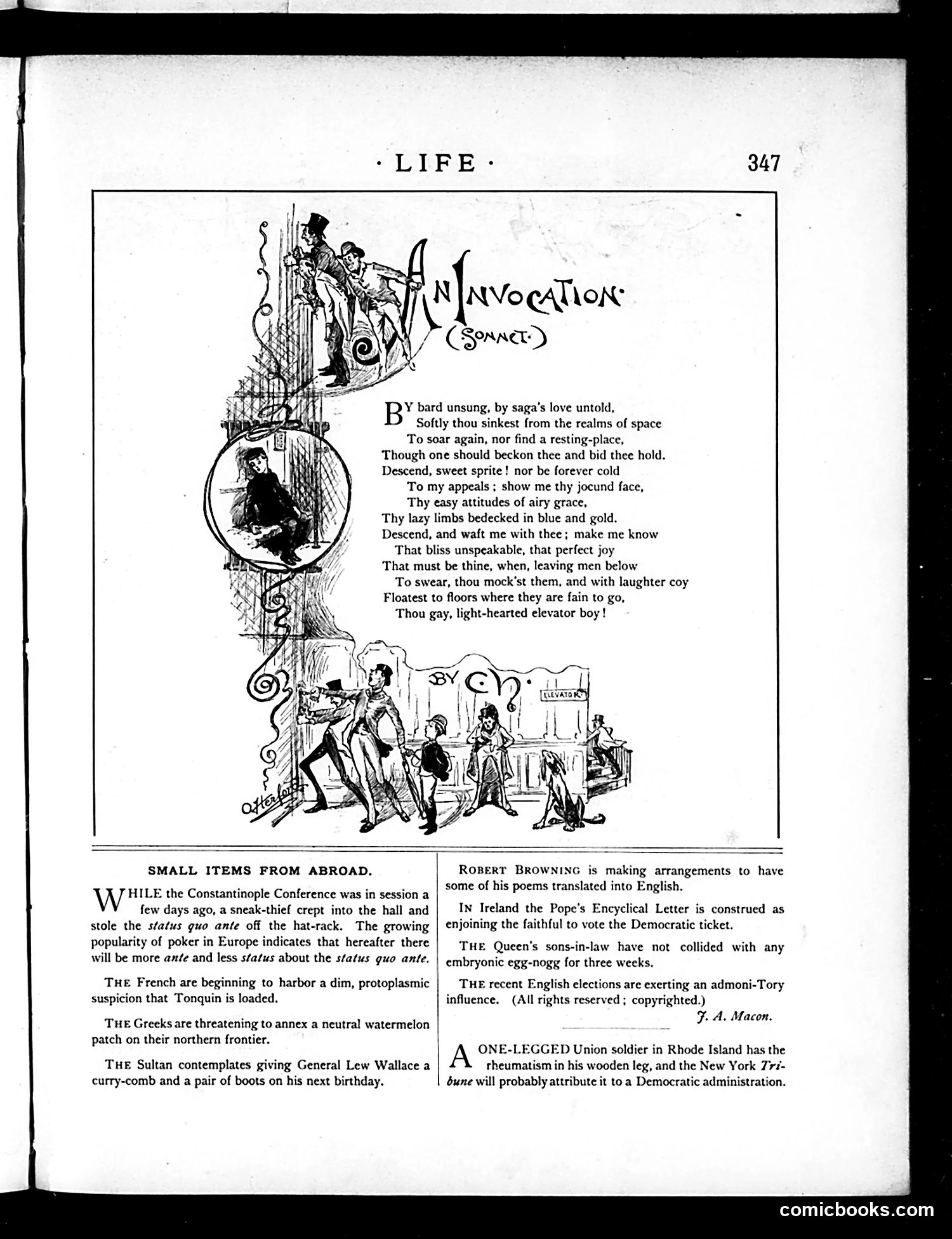
This page features a satirical sonnet addressing an "elevator boy"—likely a modern servant or bellhop figure, depicted in the illustrations. The poem mockingly invokes this lowly worker as if he were a classical muse or sprite, using grandiose language ("bard unsung," "saga's love untold") to humorously elevate his mundane status. The satire targets both the pretentiousness of modern urban life and the absurdity of social hierarchies. By treating an elevator operator with mock-heroic reverence, the poem ridicules either excessive formality toward service workers or, conversely, the workers' own self-importance. The accompanying "Small Items from Abroad" section contains political jabs at contemporary issues: European politics, Irish voting behavior, and American partisan conflicts—typical satirical fodder for *Life* magazine's readership.
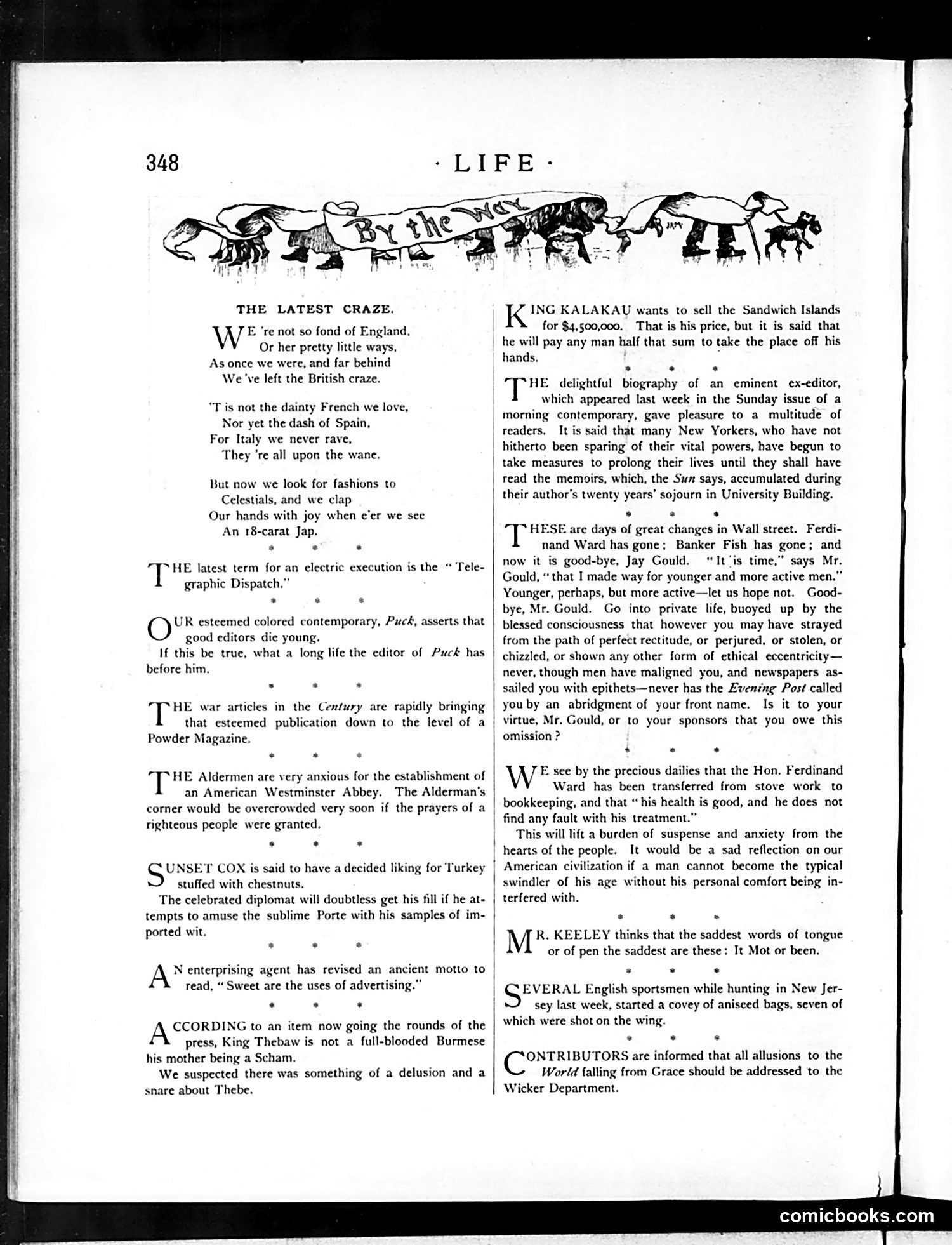
This page contains satirical commentary on contemporary events rather than political cartoons. The decorative header shows various animals in a procession, establishing the satirical tone. "The Latest Craze" poem mocks British enthusiasm for Japanese culture ("18-carat Jap"), reflecting fin-de-siècle Japanism trends. The prose sections reference specific figures: King Kalakau (Hawaii), Ferdinand Ward (a banker involved in financial scandal), Jay Gould (prominent financier), and Sunset Cox (diplomat). The commentary criticizes Ward's transfer from banking to bookkeeping and defends his character against public suspicion. The piece on King Thebaw of Burma questions newspaper accuracy regarding his parentage, suggesting press carelessness. Overall, this page reflects Life's focus on satirizing contemporary society, notable figures, and press reliability circa the 1880s-1890s.
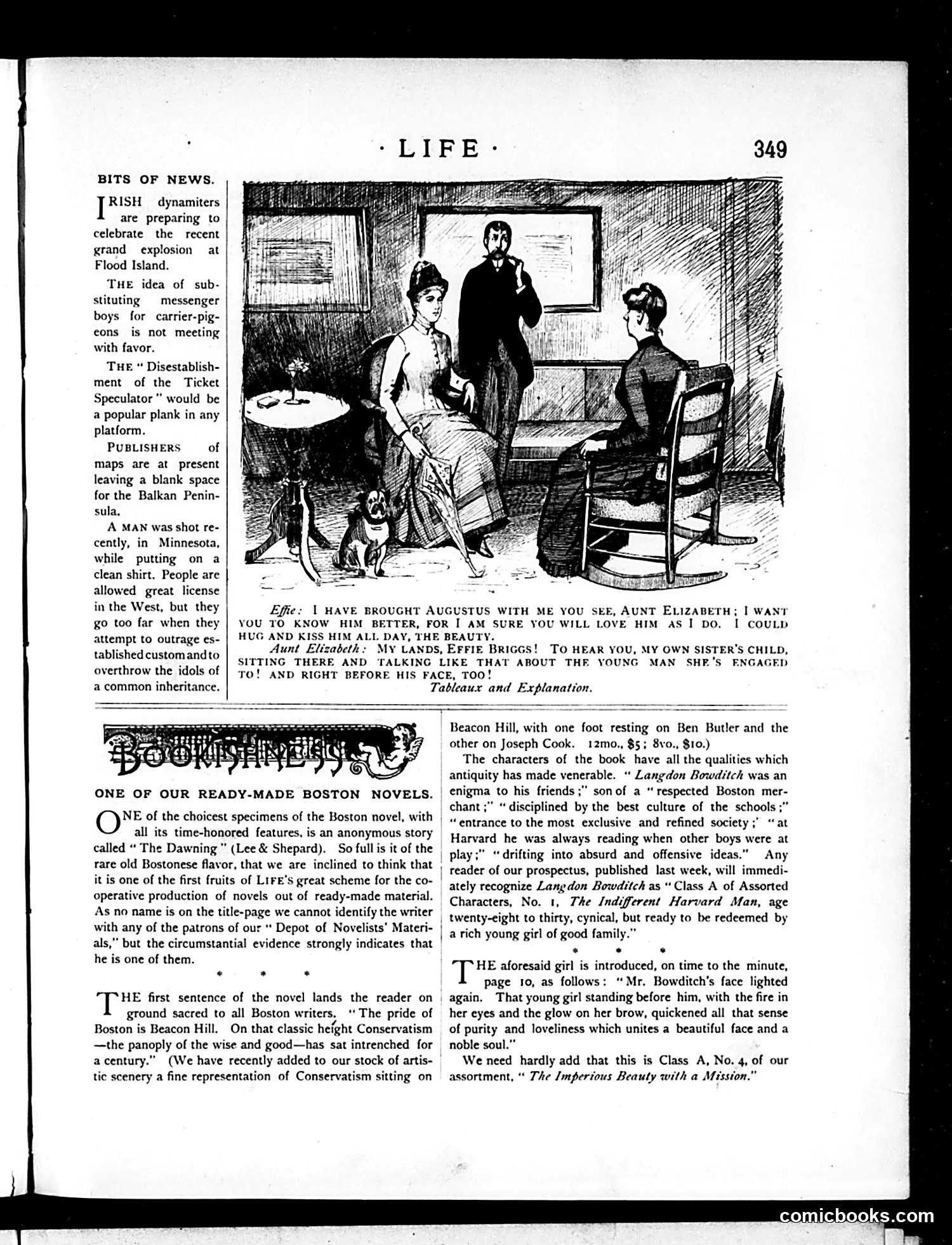
This page contains a literary advertisement and review rather than political satire. The illustration shows a domestic scene with two women and a small dog, with dialogue about introducing someone named Augustus. Below is a promotional piece for "London Bouwditch," described as "one of our ready-made Boston novels." The text satirizes formulaic Boston fiction by listing stereotypical character types—"The Indifferent Harvard Man" and "The Imperious Beauty with a Mission"—suggesting these were stock figures in popular contemporary novels. The satire targets the publishing industry's mass-production of predictable fiction using recycled characters and Boston's Beacon Hill setting as reliable commercial templates. This is literary criticism masked as book promotion.
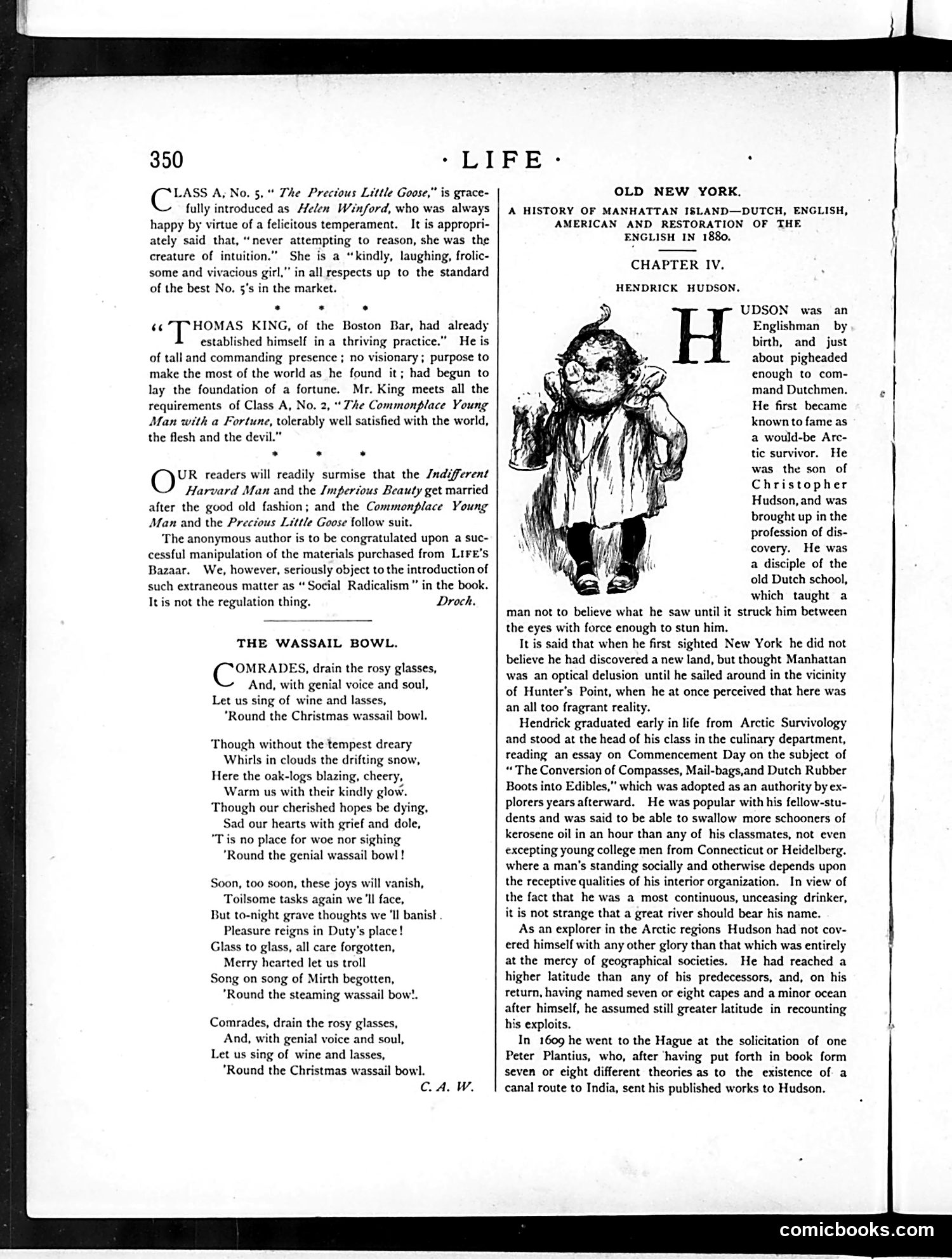
This page contains no political cartoon. Instead, it features: 1. **Book reviews/literary criticism** of three works: *The Precious Little Goose*, *The Commonplace Young Man with a Fortune*, and *The Indifferent Husband and the Imperious Blonde*—all satirizing contemporary social types and fashions. 2. **"The Wassail Bowl,"** a humorous poem (credited C.A.W.) celebrating Christmas drinking traditions among comrades, with typical Victorian sentimentality mixed with satirical jabs at social pretense. 3. **"Hendrick Hudson" article**—the main feature—a historical piece about the explorer, including a caricature illustration of Hudson as a disheveled figure. The text describes Hudson's Arctic explorations and his 1609 voyage to what became New York. The page is primarily textual/literary rather than cartoonist-driven.
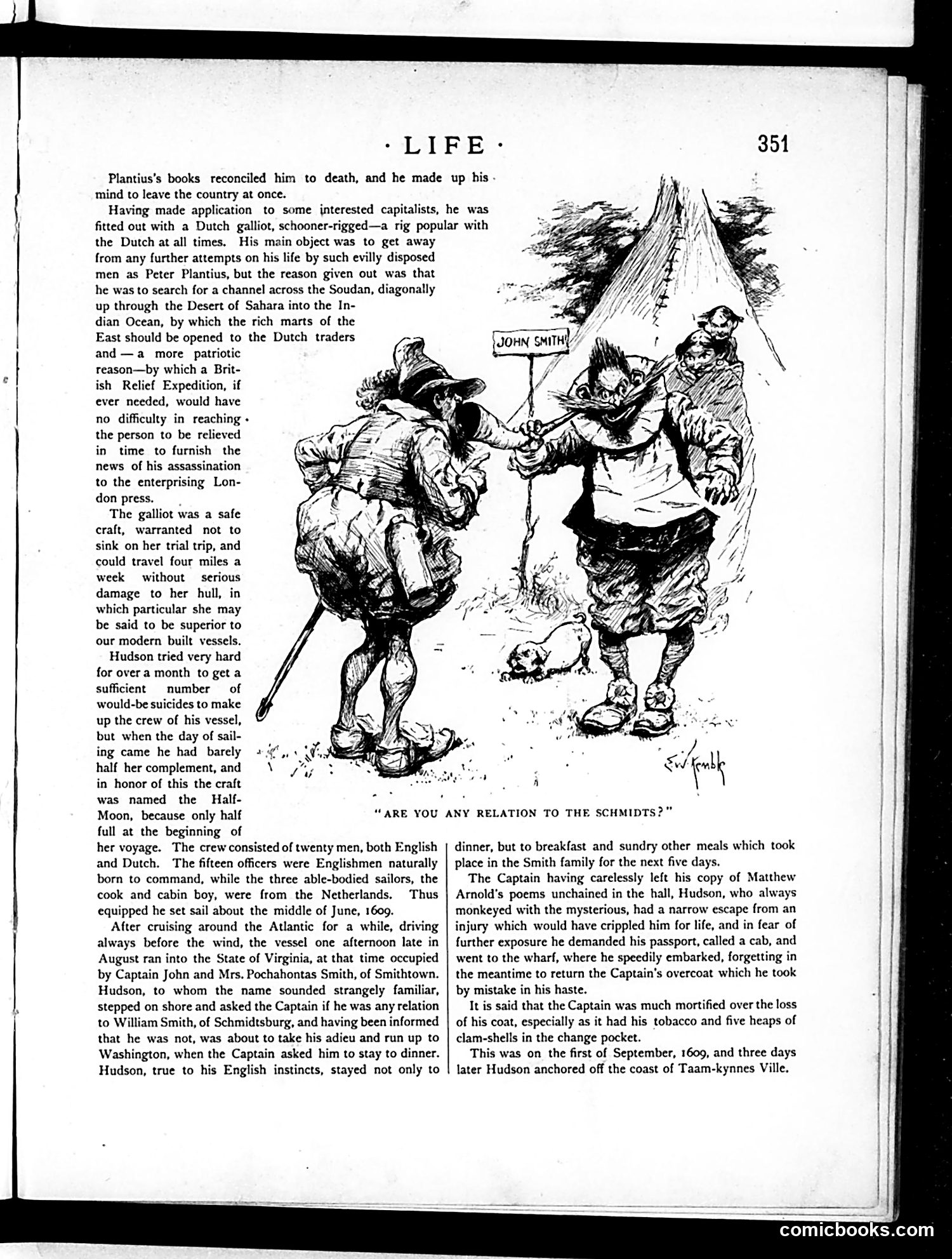
The cartoon depicts an encounter between two colonial-era figures. One man, labeled "JOHN SMITH," confronts a heavily laden traveler, asking "ARE YOU ANY RELATION TO THE SCHMIDTS?" The humor relies on a play on names: it juxtaposes the historically significant English colonist John Smith (associated with early American settlement) against "Schmidts"—a distinctly German surname. The joke appears to mock either: 1. The growing German immigrant population in America, suggesting surprise at encountering Germans in colonial contexts where they weren't historically prominent, or 2. A pun exploiting the phonetic similarity between "Smith" and "Schmidt." The surrounding text discusses Hudson's colonial voyage (1609), providing historical context. The cartoon likely satirizes contemporary anxieties about immigration or ethnic composition of America, though without additional historical context, the specific target remains somewhat unclear.
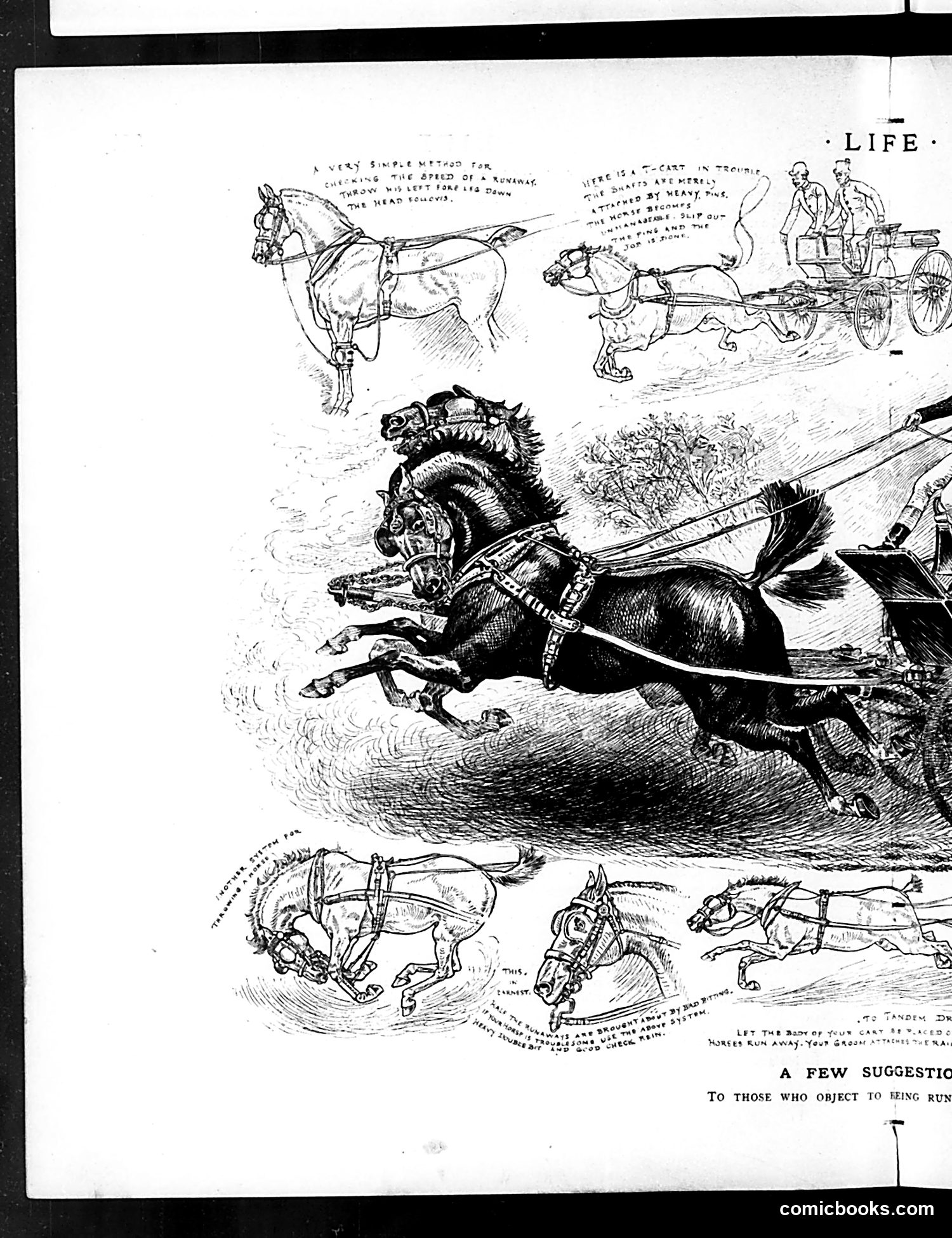
This page from Life magazine satirizes concerns about running horses being used for transportation. The title reads "A Few Suggestions to Those Who Object to Being Run Down by Horses." The cartoons humorously depict various horse-drawn accidents and mishaps—horses bolting, kicking, and causing chaos in urban/rural settings. The visual humor comes from exaggerated depictions of horses in harnesses behaving unpredictably, with dramatic, detailed ink work emphasizing the chaos. The satire appears to mock people who complained about dangerous horse-drawn traffic (a genuine public safety concern in late 19th/early 20th-century cities). The cartoonist sarcastically "suggests" alternatives by showing just how problematic horses themselves were—implying critics faced an impossible situation with horse-dependent transportation. This reflects period anxieties about urban traffic safety before automobiles became standard.
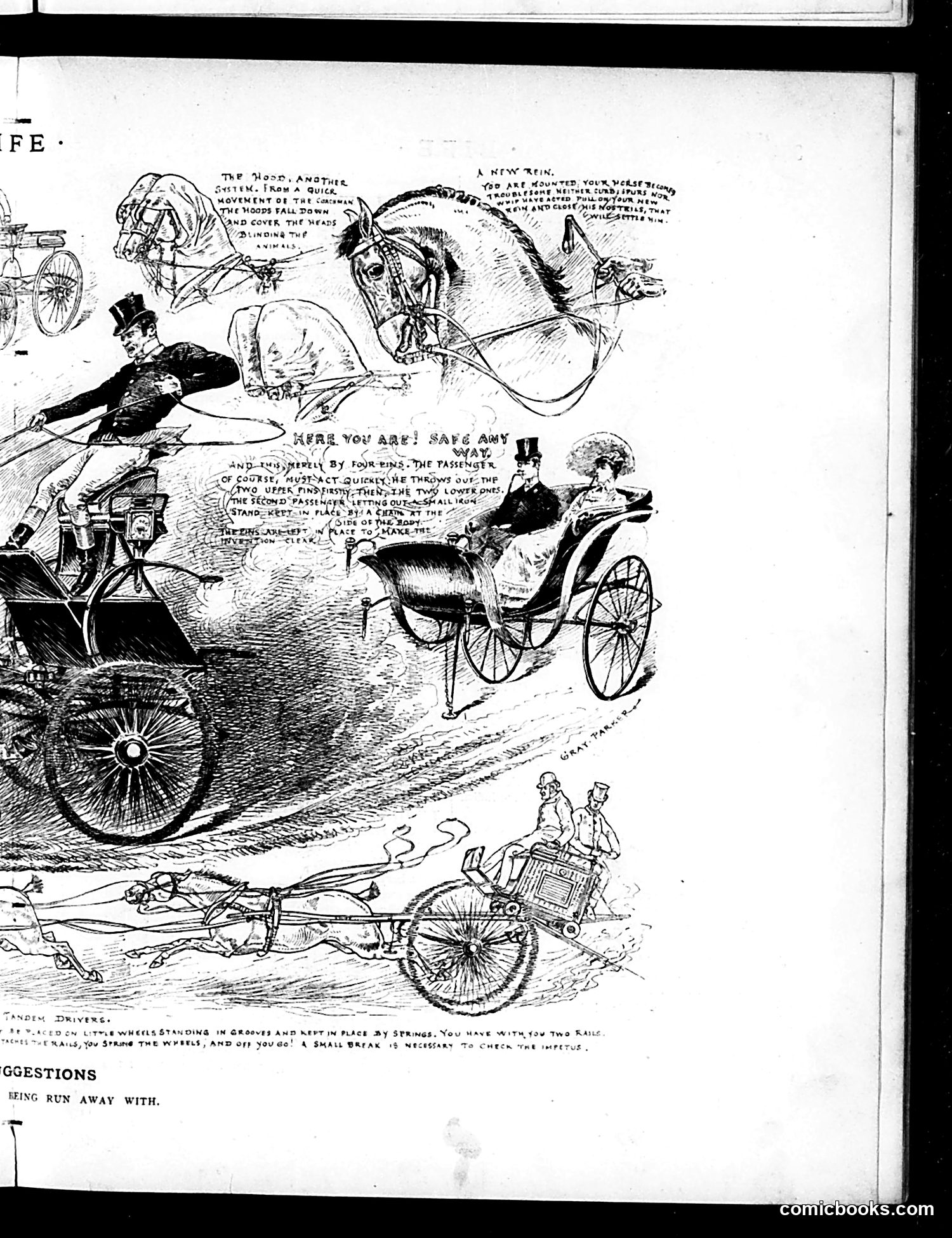
This appears to be early 20th-century satirical commentary on dangerous horse-drawn carriage accidents in urban areas. The cartoon depicts multiple scenes of vehicles losing control, with horses bolting and carriages overturning or colliding. The visible text mentions "HERE YOU ARE! SAVE ANY WAY" and references to passengers being thrown from vehicles, emphasizing the chaos and peril of uncontrolled horses. The bottom section discusses "RUNAWAY DRIVERS" and mentions checking "the reins" and striking wheels to stop runaway carriages—practical (if desperate) safety measures of the era. The satire mocks both the danger these vehicles posed to pedestrians and riders alike, and perhaps the inadequacy of existing safety precautions. This reflects genuine public concern about traffic hazards before automobiles became dominant.
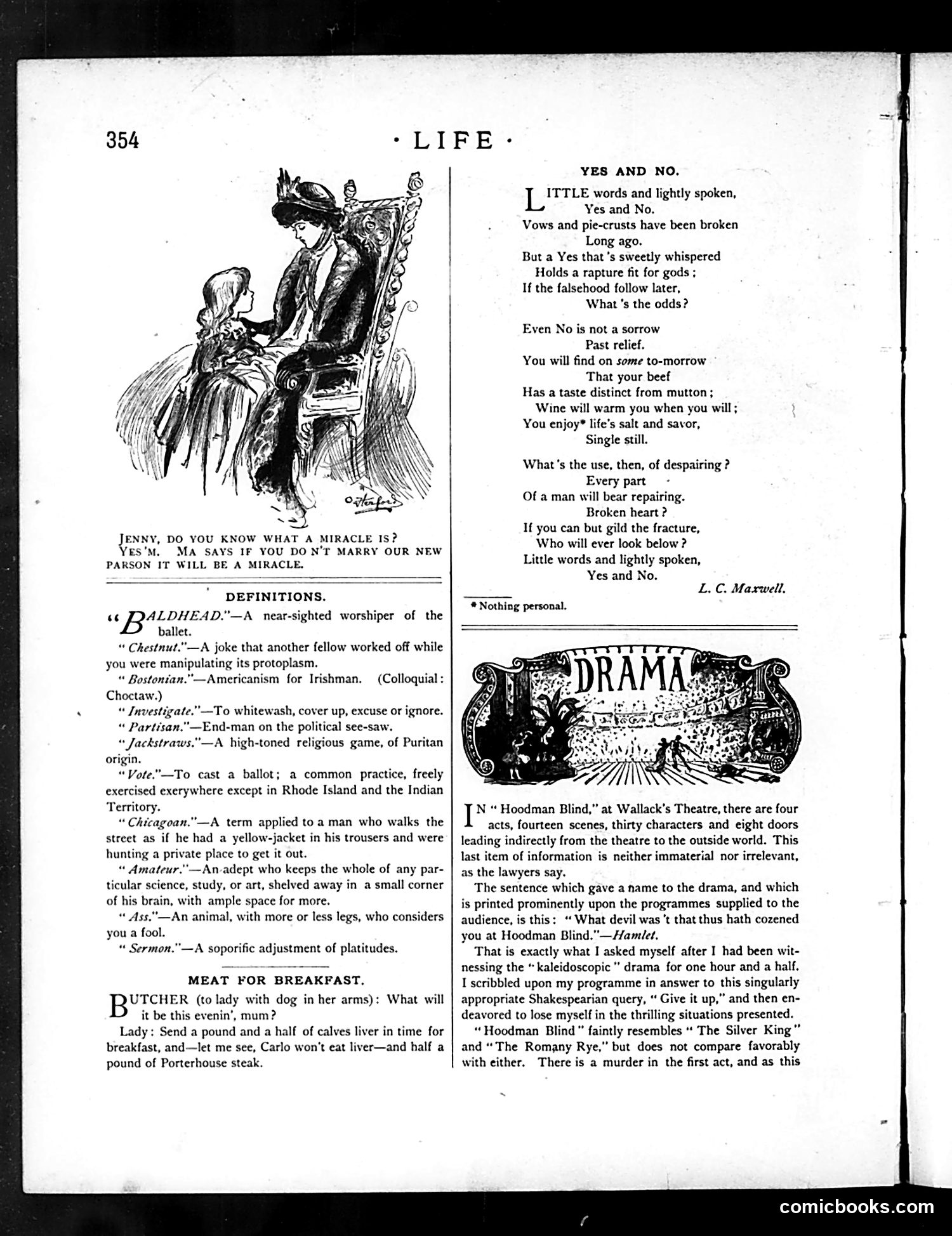
This page contains satirical humor typical of late-19th-century American Life magazine: **Top cartoon**: A young girl tells an older woman that her mother says marrying the new parson would be "a miracle"—implying the parson is so unattractive or unsuitable that such a union would be divinely impossible. The joke satirizes both romantic desperation and clergy. **"Definitions" section**: Sharp, cynical mock-definitions mock contemporary American society—politicians as "partisans" on a "see-saw," voting as restricted except in Rhode Island and Indian Territory (likely referencing voter suppression), Chicagoans as neurotic. These target political corruption and regional stereotypes of the era. **"Meat for Breakfast" sketch**: A butcher serves a lady who absurdly orders calves' liver for herself but refuses it for her dog Carlo, instead buying expensive Porterhouse steak for the animal—satirizing wealthy women's illogical priorities and pet-spoiling. **"Yes and No" poem**: Cynical verse about promises and honesty in relationships, suggesting words mean little and consequences are easily rationalized away. **Drama section**: Reviews the theatrical production "Hoodman Blind," comparing it unfavorably to similar contemporary plays.
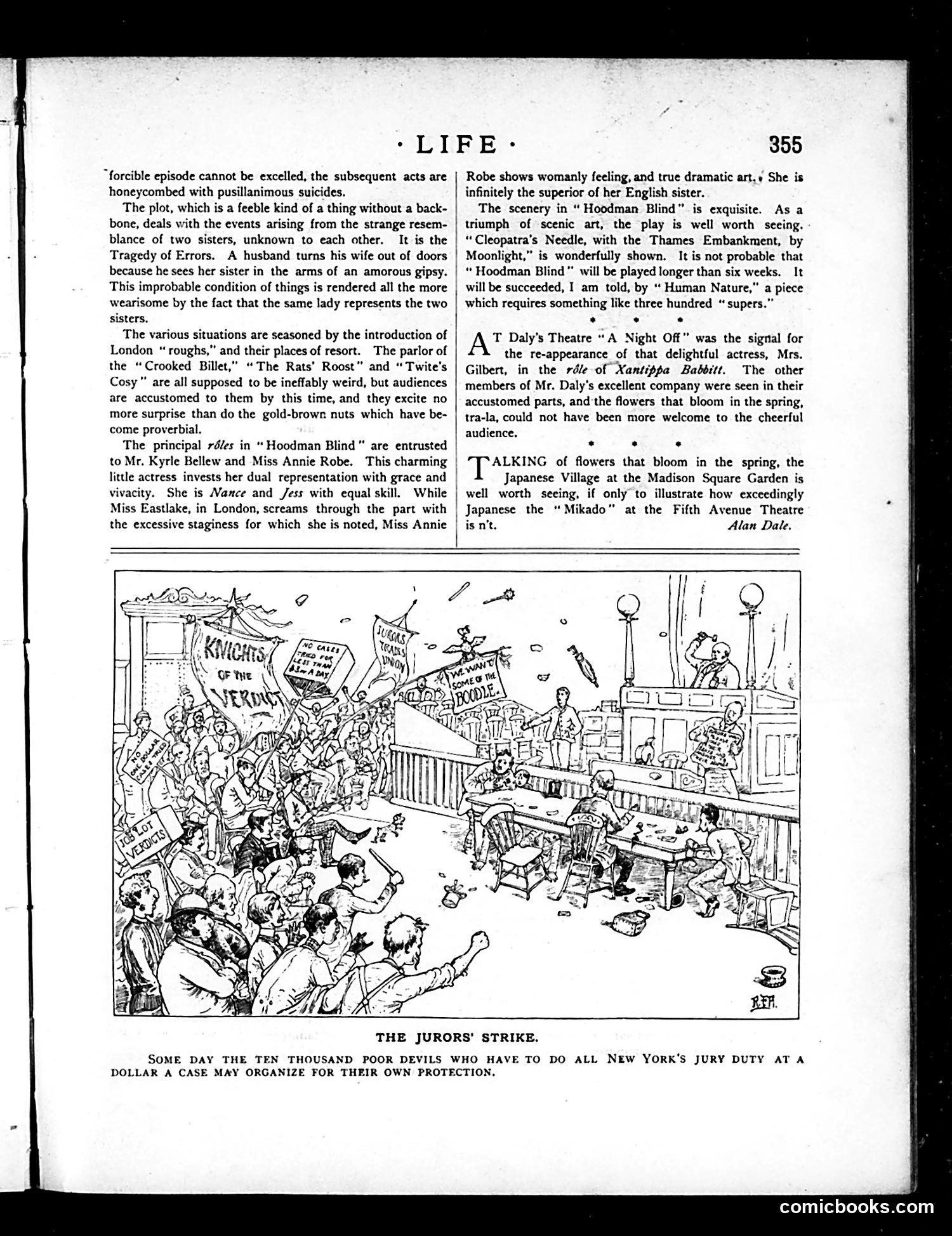
This cartoon satirizes the exploitative jury system in New York City. The caption explains the premise: ten thousand poor citizens are compelled to serve on juries for only one dollar per case—inadequate compensation for lost wages and time. The chaotic illustration depicts a massive, angry crowd of jurors organizing a protest or strike for "their own protection." The crowded scene with banners and agitated figures suggests civil unrest and unionization efforts. The satire mocks the absurdity of the situation: the city extracts civic duty from the poorest residents while barely compensating them, forcing them toward organized rebellion. The joke's premise—that such underpaid jurors *might someday* strike—implies this hasn't happened yet but seems inevitable given the systemic injustice. It's social commentary on labor exploitation and the tension between civic obligation and economic survival for working-class New Yorkers.
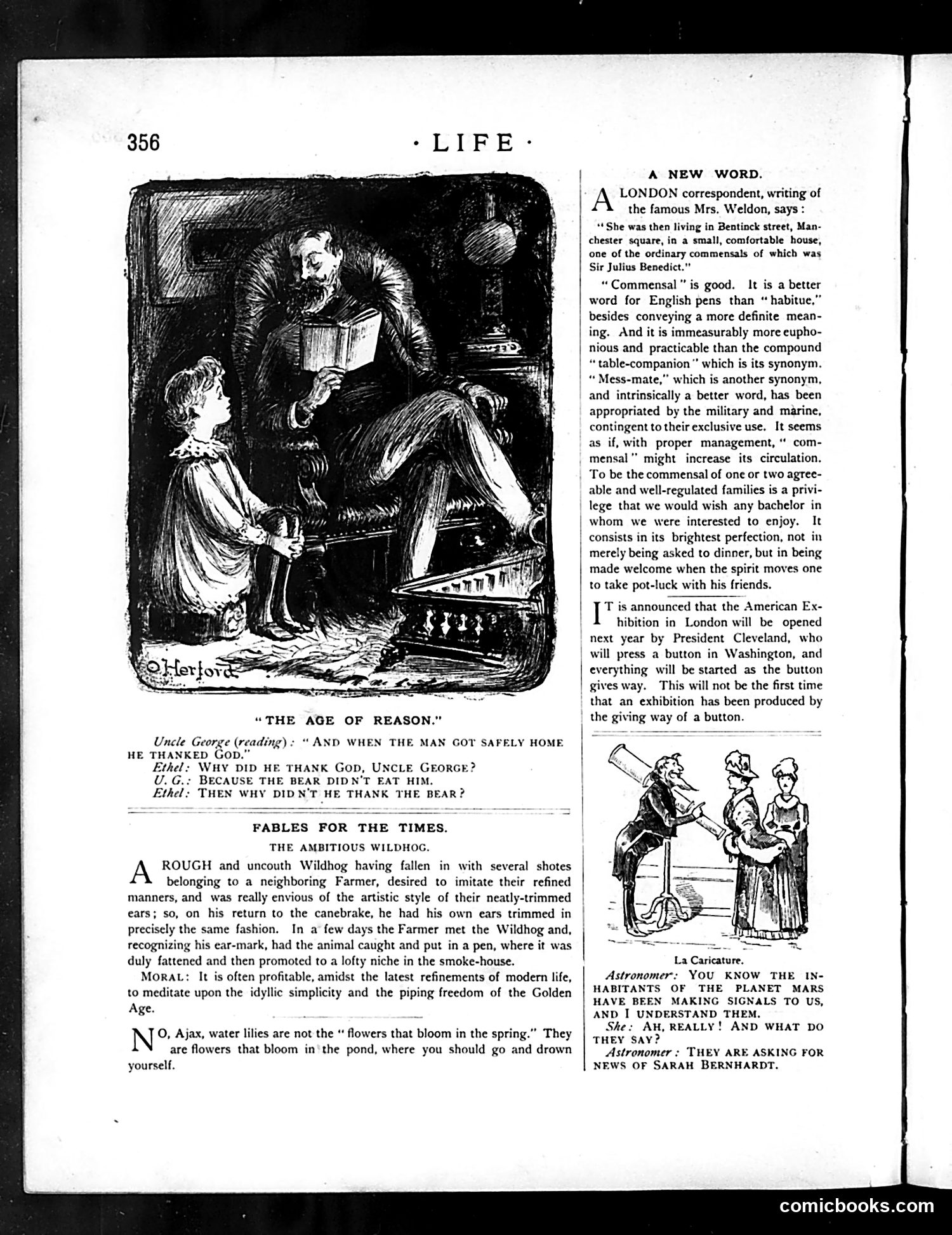
This page contains satirical commentary on contemporary society through multiple pieces: **"The Age of Reason"** cartoon mocks childish logic and religious faith. Uncle George reads a story about thanking God for survival; his niece Ethel asks why he didn't thank the bear instead—exposing the illogic of selective gratitude. **"The Ambitious Wildhog"** fable warns against social climbing. A wild hog imitates refined domestic pigs' ear-trimming, gets caught and marked by this imitation, then gets fattened and slaughtered. The moral satirizes modern refinements as potentially dangerous to one's authentic self. **"A New Word"** discusses the term "commensal" (a regular dinner guest), arguing it's superior to "habitué" or "table-companion" for English usage—light linguistic commentary. The remaining jokes mock electricity's novelty (President Cleveland opening an American Exhibition via button-press) and Sarah Bernhardt's fame (even Martians supposedly want news of her). These reflect turn-of-century fascination with technology and celebrity culture.
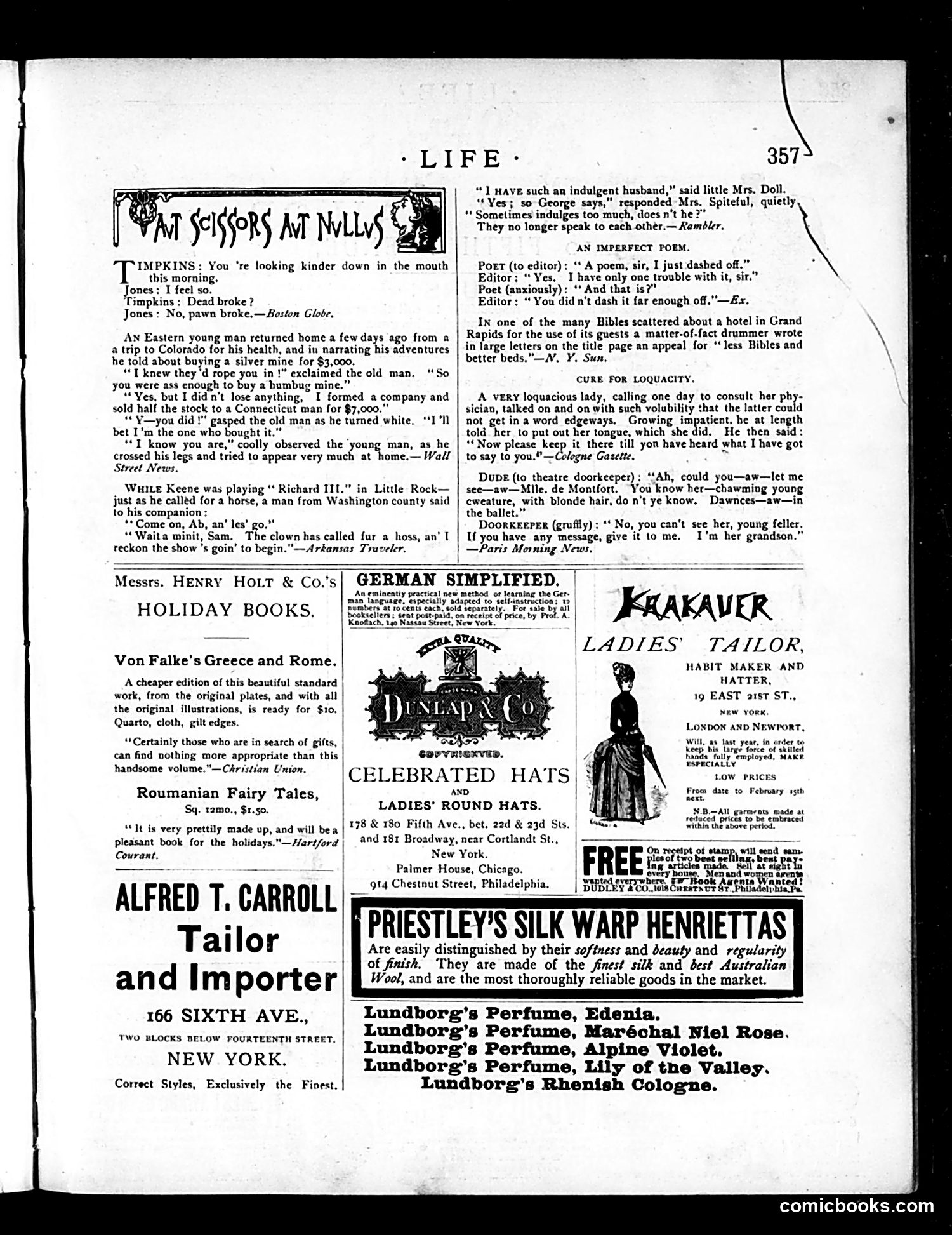
This page contains several brief humorous anecdotes typical of Life magazine's satirical format: **The cartoon title** appears to be a play on words ("M'Scissors" / "Messrs."), introducing comic sketches. **The jokes satirize** common human follies: - A man who loses money in a Colorado silver mine swindle, then turns the tables by selling worthless stock to a Connecticut buyer - An actor performing Shakespeare whose appearance confuses spectators - A poet's work dismissed as needing to be thrown away rather than merely "dashed off" - A garrulous woman silenced by her doctor's instruction to keep her tongue out **The satire targets** gullibility, con-artistry, pretension in theater, and verbose people—universal human weaknesses. The humor relies on ironic reversals and deadpan punchlines typical of late 19th-century American comedy. The remainder of the page contains advertisements for tailoring, books, and perfumes.
This is primarily an **advertising page**, not a satirical cartoon page. It features luxury goods and services aimed at wealthy New York consumers circa the 1880s-1890s. Key advertisers include: - **R. Redfern** (ladies' tailor, Fifth Avenue): High-end fur garments and millinery - **Carl Beers** (florist): Fresh flowers and decorative arrangements - **Frederick Keppel & Co.**: Fine art etchings and engravings - **Cavanagh, Sanford & Co.**: Merchant tailors - **R. Moser** (Broadway): Glass, china, and toilet soaps - **A.G. Spalding & Bros.**: Ice skates - **Esterbrook Steel Pens** and other stationery/goods The page reflects **Gilded Age consumer culture**—advertising reflects aspirational shopping for the wealthy. The two illustrated female heads at top represent fashionable ladies' styling of the era. No political satire is evident; this is a straightforward commercial publication page showcasing New York's upscale retail offerings.
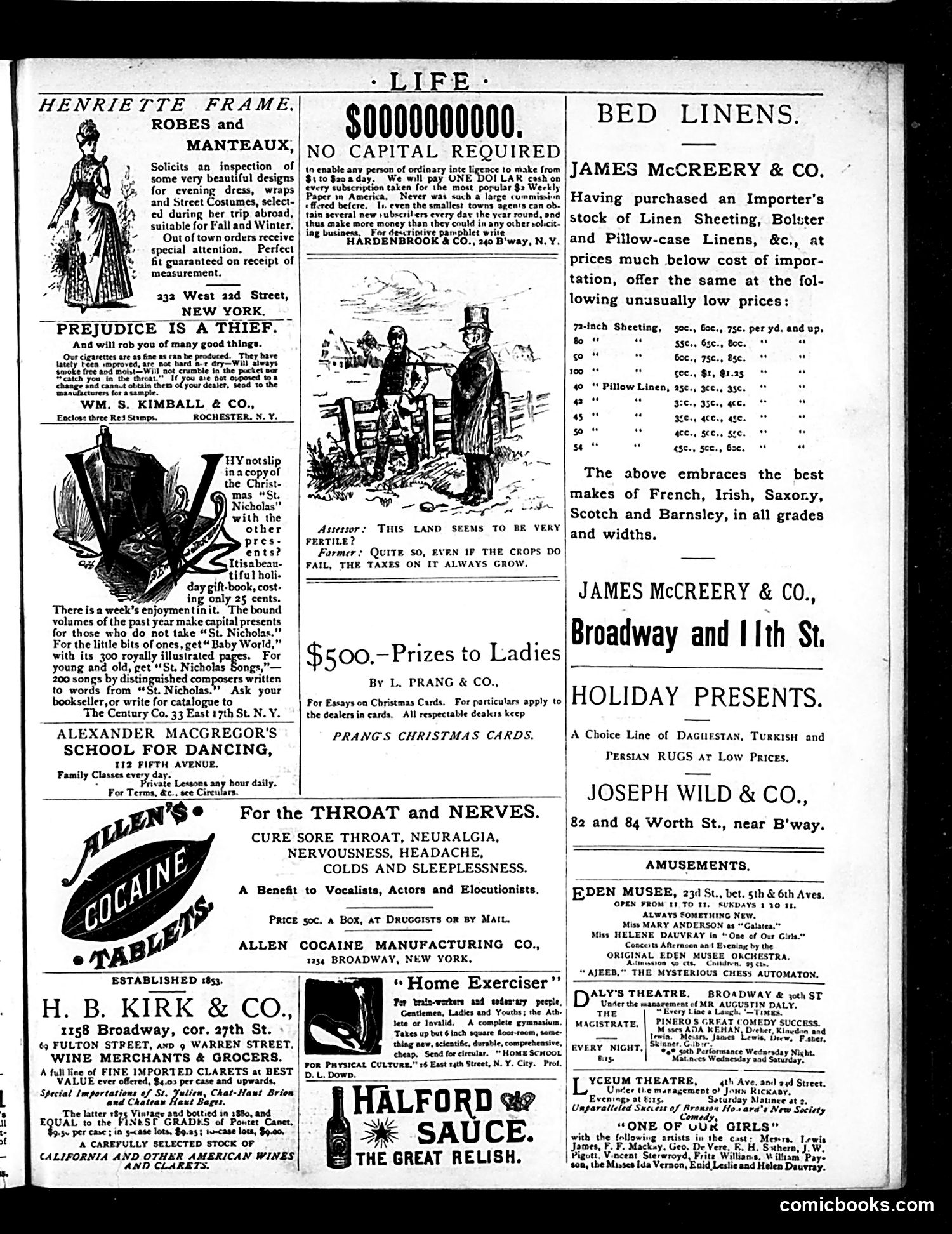
This is primarily an **advertising page** from Life magazine, with one small political cartoon. The main satirical content is a brief two-panel farmer comic: **The Cartoon:** A farmer declares his land "seems to be very fertile," but his companion responds that even when crops fail, "the taxes on it always grow." This is a **critique of agricultural taxation**—a common complaint in the Gilded Age that farmers faced heavy property taxes regardless of harvest success, making farming economically precarious. The joke targets government taxation policy as burdensome to rural workers. **The Advertisements:** The page is otherwise dominated by late-Victorian consumer goods: women's clothing, bed linens, cocaine tablets (then legal), dancing lessons, and theater announcements. The cocaine ad is particularly striking to modern readers—it was marketed as a legitimate medicinal product for throat and nerve ailments. The overall effect reflects how Life balanced political satire with commercial content typical of 1890s American magazines.
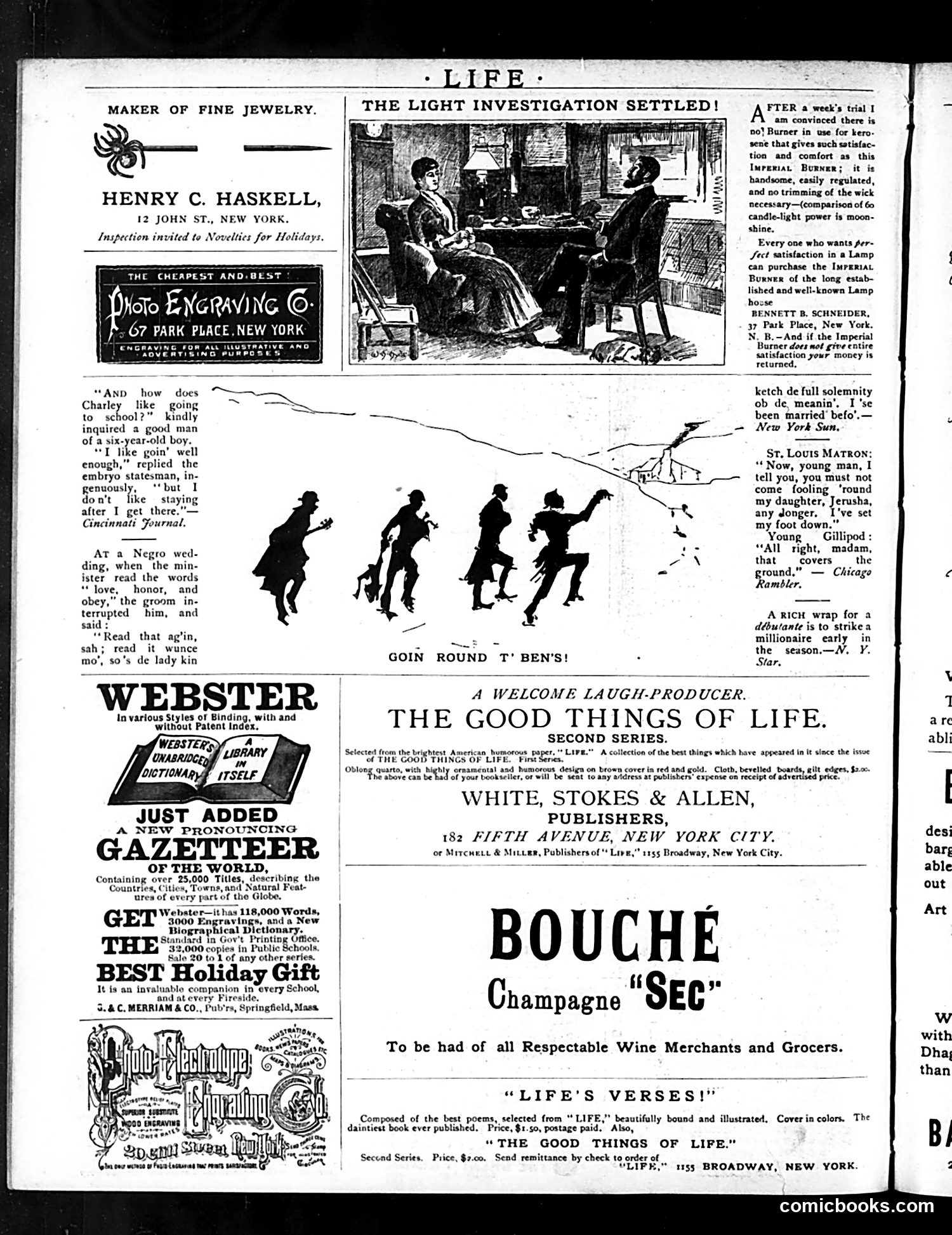
This page's main cartoon depicts a domestic dispute over lighting technology. The illustration shows a couple arguing with what appears to be an investigator or mediator present, referencing a contemporary debate about kerosene lamp burners. The cartoon's title sardonically suggests a "settled" investigation, while the accompanying advertisements for the "Imperial Burner" indicate this was actual product marketing disguised as editorial content—a common practice in 19th-century magazines. The burner promised superior performance and satisfaction guarantees. The humor lies in presenting a marital conflict as resolved by superior lamp technology, satirizing both domestic arguments and the era's enthusiasm for new consumer products claiming to solve everyday problems. The adjacent jokes about children disliking school and racial stereotypes reflect period humor conventions, though these reflect now-offensive attitudes rather than substantive satire. The page is predominantly advertisements and product promotions, with the cartoon serving as subtle marketing for lighting equipment.
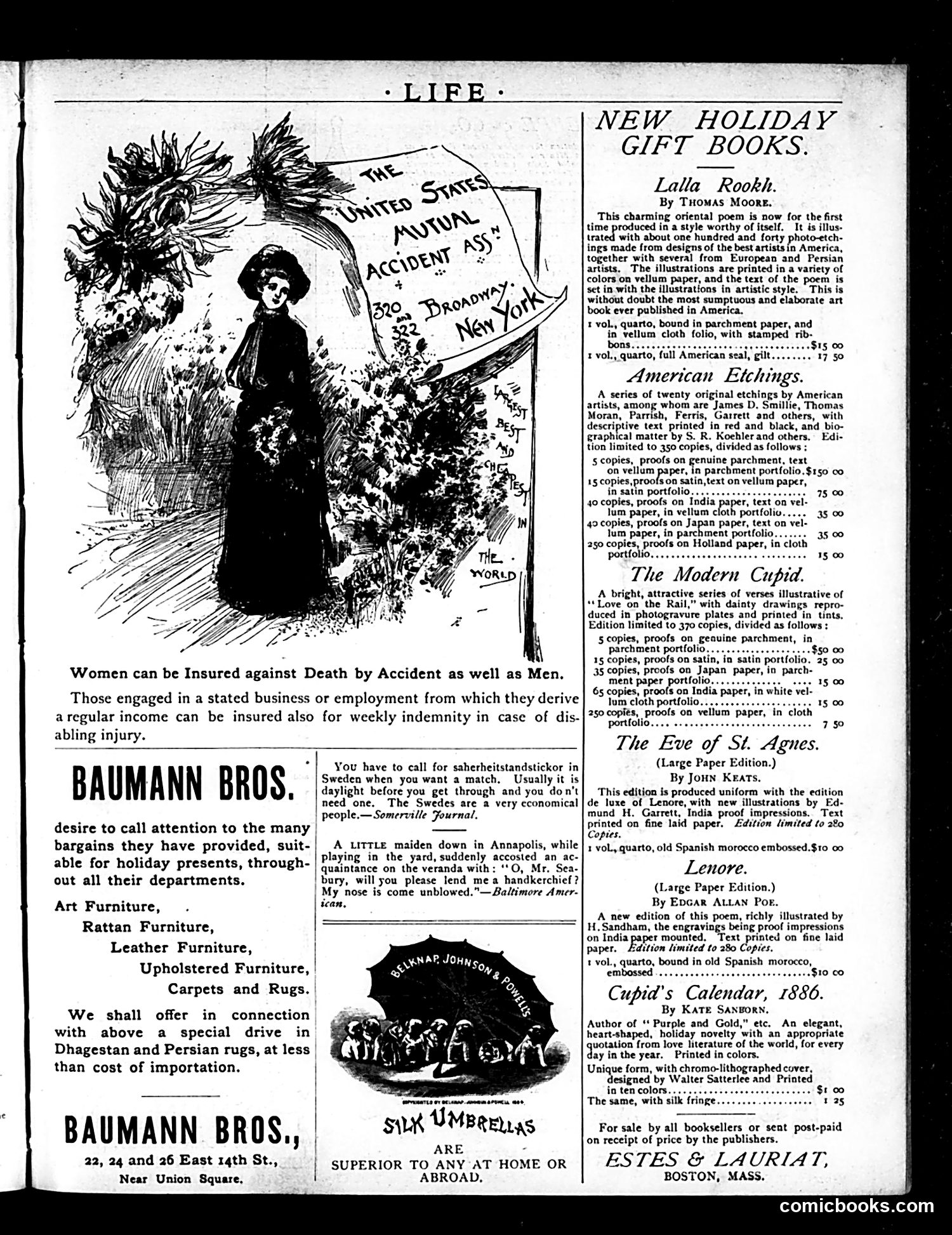
The main cartoon depicts **Lady Liberty or Columbia** (the female personification of America) being struck by disaster—represented by a map of the United States labeled "The United States Mutual Accident Ass'n." The surrounding chaos and debris illustrate widespread accidents or calamities. The accompanying text explains the insurance company's pitch: women can now be insured against accidental death just as men can, and those with regular employment can also receive weekly indemnity for disabling injuries. **The satire's point**: The cartoon mocks insurance companies' expansive claims about coverage by visualizing America itself as a chaotic "accident zone" requiring protection. By showing the entire nation as disaster-prone, it humorously suggests the insurance industry profits by convincing citizens that danger lurks everywhere—even in stable employment. This reflects late-19th-century skepticism toward emerging insurance industries and their marketing tactics.
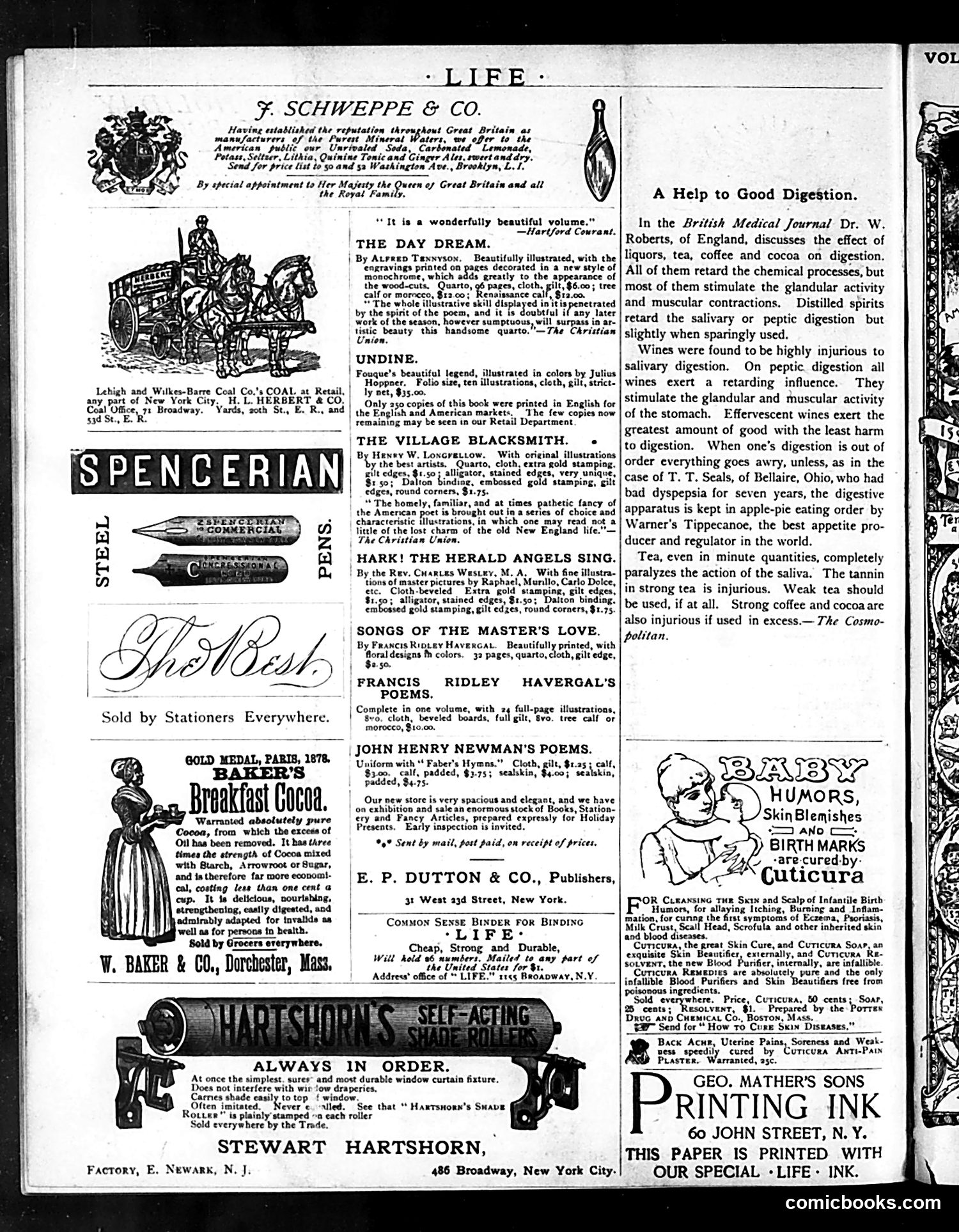
This page is primarily **advertising and book promotion**, not political satire. It showcases luxury goods aimed at middle-class Americans in the late 19th century. The advertisements feature: - **Schweppe's mineral waters** (British luxury beverages with royal appointment) - **Illustrated literary editions** of Tennyson, Newman, and Longfellow—expensive, decorative books for the educated elite - **Baker's Cocoa** (a premium product winning international awards) - **Printing inks and office supplies** The layout uses elaborate engravings and typography typical of Victorian-era marketing, emphasizing quality, exclusivity, and cultural refinement. References to "gold stamping," "beveled boards," and "tree calf" bindings highlight the luxury positioning. **No identifiable political cartoon or satire appears on this page.** It reflects consumer culture and aspirational materialism of the Gilded Age, where owning fine books and imported goods signaled social status.