
Life, 1885-12-17 · page 2 of 18
Life — December 17, 1885 — page 2: what you’re looking at
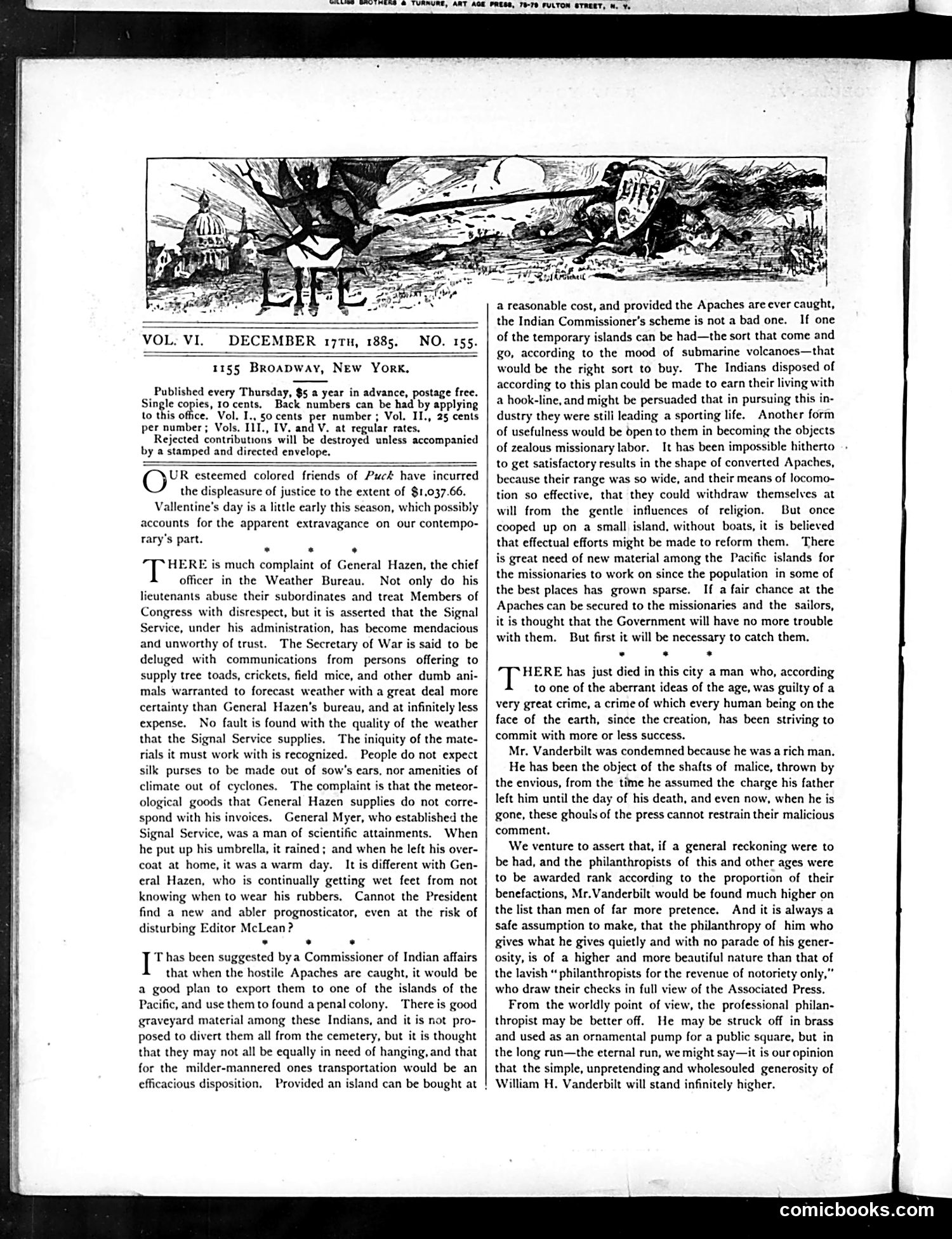
What you’re looking at
The page contains three separate satirical pieces rather than a unified cartoon: 1. **"Puck" complaint**: Criticizes *Puck* magazine for publishing an article deemed unjust to colored people during Valentine's Day season. 2. **General Hazen criticism**: Attacks General Hazen, chief officer of the Weather Bureau, accusing his lieutenants of abusing Congress members and treating Signal Service supplies poorly. The satire questions his competence—noting he can't even manage an umbrella properly during rain. 3. **William H. Vanderbilt tribute**: Ironically praises the recently deceased millionaire's philanthropy as superior to merely "lavish" charitable giving, though the tone suggests mockery of how wealth buys reputation. The page reflects 1880s concerns: government bureaucratic corruption, racial justice, and wealthy industrialists' public image management.
📄 Transcribed text from this page (OCR, searchable)
Machine-transcribed from the original scan — historical spelling and the odd misread are preserved.
“we & FURRURE, ART AGE PRESS, 7O-79 FULTON STREET, VOL. VI. DECEMBER 17TH, 1885. NO. 155. 1155 Broapway, New York. Published every Thursday, $5 a year in advance, postage free. Single copies, 10 cents, Back numbers can be had by applying to this office. Vol. I., s0 cents per number ; Vol. II., 25 cents per number; Vols. I1I., IV, and V. at regular rates, Rejected contributions will be destroyed unless accompanied by a stamped and directed envelope. oO" esteemed colored friends of Puck have incurred the displeasure of justice to the extent of $1,037.66. Vallentine’s day is a little early this season, which possi accounts for the apparent extravagance on our contempo- Tary’s part. . * . HERE is much complaint of General Hazen, the chief officer in the Weather Bureau. Not only do his lieutenants abuse their subordinates and treat Members of Congress with disrespect, but it is asserted that the Signal Service, under his administration, has become mendacious and unworthy of trust. The Secretary of War is said to be deluged with communications from persons offering to supply tree toads, crickets, field mice, and other dumb ani- mals warranted to forecast weather with a great deal more certainty than General Hazen’s bureau, and at infinitely less expense. No fault is found with the quality of the weather that the Signal Service supplies. The iniquity of the mate- rials it must work with is recognized. People do not expect silk purses to be made out of sow’s ears, nor amenities of climate out of cyclones. The complaint is that the meteor- ological goods that General Hazen supplies do not corre- spond with his invoices. General Myer, who established the Signal Service, was a man of scientific attainments. When he put up his umbrella, it rained; and when he left his over- coat at home, it was a warm day. It is different with Gen- eral Hazen, who is continually getting wet feet from not knowing when to wear his rubbers. Cannot the President find a new and abler prognosticator, even at the risk of disturbing Editor McLean ? . . . T has been suggested bya Commissioner of Indian affairs that when the hostile Apaches are caught, it would be a good plan to export them to one of the islands of the Pacific, and use them to found apenal colony. There is good graveyard material among these Indians, and it is not pro- posed to divert them all from the cemetery, but it is thought that they may not all be equally in need of hanging, and that for the milder-mannered ones transportation would be an efficacious disposition, Provided an island can be bought at | a reasonable cost, and provided the Apaches are ever caught, the Indian Commissioner’s scheme is not a bad one. If one of the temporary islands can be had—the sort that come and go, according to the mood of submarine volcanoes—that would be the right sort to buy. The Indians disposed of according to this plan could be made to earn their living with a hook-line, and might be persuaded that in pursuing this in- dustry they were stili leading a sporting life. Another form of usefulness would be open to them in becoming the objects of zealous missionary labor. It has been impossible hitherto to get satisfactory results in the shape of converted Apaches, because their range was so wide, and their means of locomo- tion so effective, that they could withdraw themselves at will from the gentle influences of religion. But once cooped up on a small island, without boats, it is believed that effectual efforts might be made to reform them. There is great need of new material among the Pacific islands for the missionaries to work on since the population in some of the best places has grown sparse. If a fair chance at the Apaches can be secured to the missionaries and the sailors, it is thought that the Government will have no more trouble with them. But first it will be necessary to catch them. . . . HERE has just died in this city a man who, according to one of the aberrant ideas of the age, was guilty of a very great crime, a crime of which every human being on the face of the earth, since the creation, has been striving to commit with more or less success. Mr. Vanderbilt was condemned because he was a rich man. He has been the object of the shafts of malice, thrown by the envious, from the time he assumed the charge his father left him until the day of his death, and even now, when he is gone, these ghouls of the press cannot restrain their malicious comment. We venture to assert that, if a general reckoning were to be had, and the philanthropists of this and other ages were to be awarded rank according to the proportion of their benefactions, Mr.Vanderbilt would be found much higher on the list than men of far more pretence. And it is always a safe assumption to make, that the philanthropy of him who gives what he gives quietly and with no parade of his gener- osity, is of a higher and more beautiful nature than that of the lavish “ philanthropists for the revenue of notoriety only,” who draw their checks in full view of the Associated Press. From the worldly point of view, the professional philan- thropist may be better off. He may be struck off in brass and used as an ornamental pump for a public square, but in the long run—the eternal run, we might say—it is our opinion that the simple, unpretending and wholesouled generosity of William H. Vanderbilt will stand infinitely higher. comicbooks.com