
Life, 1885-12-17 · page 6 of 18
Life — December 17, 1885 — page 6: what you’re looking at
What you’re looking at
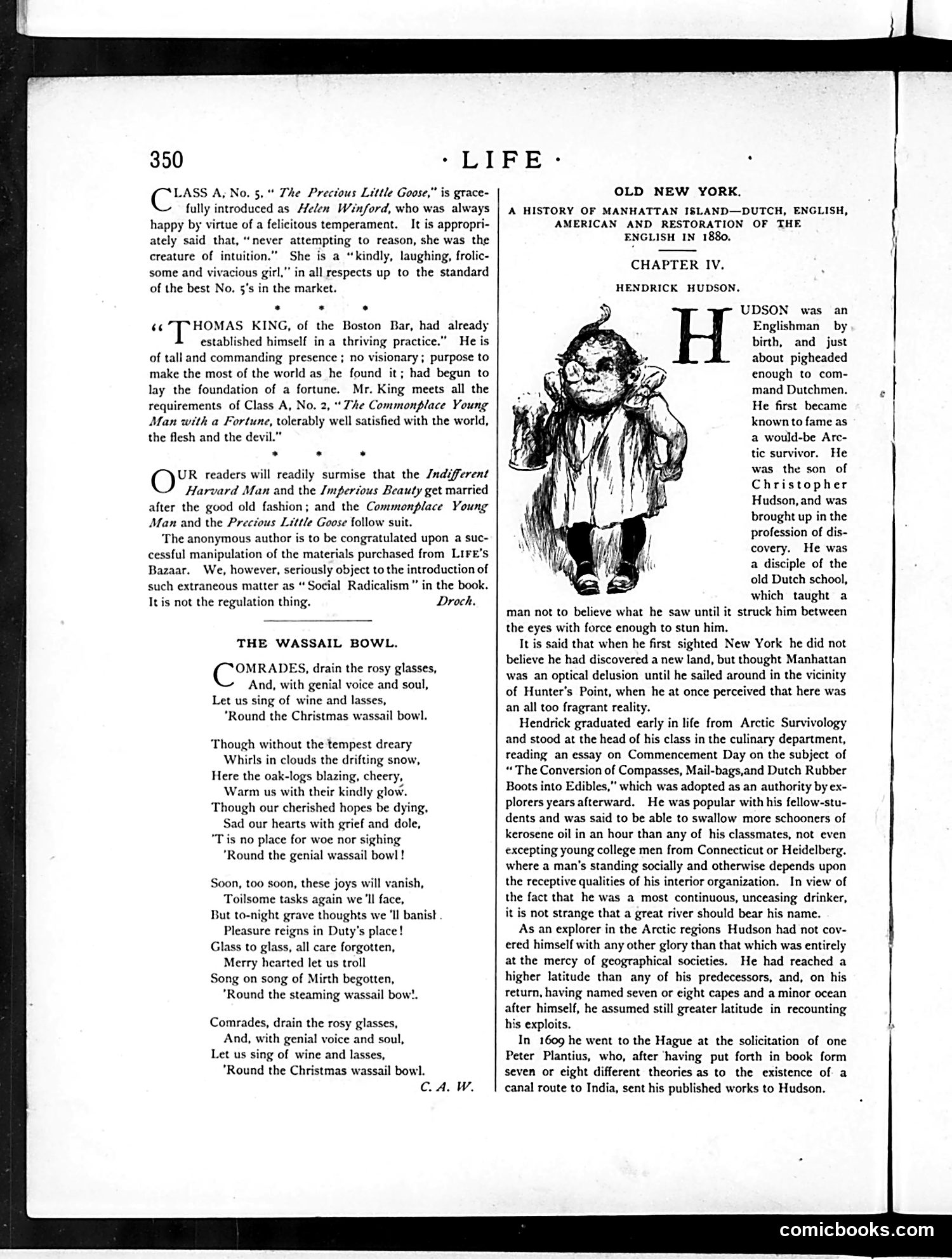
This page contains no political cartoon. Instead, it features: 1. **Book reviews/literary criticism** of three works: *The Precious Little Goose*, *The Commonplace Young Man with a Fortune*, and *The Indifferent Husband and the Imperious Blonde*—all satirizing contemporary social types and fashions. 2. **"The Wassail Bowl,"** a humorous poem (credited C.A.W.) celebrating Christmas drinking traditions among comrades, with typical Victorian sentimentality mixed with satirical jabs at social pretense. 3. **"Hendrick Hudson" article**—the main feature—a historical piece about the explorer, including a caricature illustration of Hudson as a disheveled figure. The text describes Hudson's Arctic explorations and his 1609 voyage to what became New York. The page is primarily textual/literary rather than cartoonist-driven.
📄 Transcribed text from this page (OCR, searchable)
Machine-transcribed from the original scan — historical spelling and the odd misread are preserved.
350 LASS A, No. 5," The Precious Little Goose,” is grace- fully introduced as Helen Winford, who was always happy by virtue of a felicitous temperament. It is appropri- ately said that, ‘never attempting to reason, she was the creature of intuition.” She is a “kindly, laughing, frolic- some and vivacious girl,” in all respects up to the standard of the best No. 5's in the market. . . . ‘“c HOMAS KING, of the Boston Bar, had already established himself in a thriving practice.” He is of tall and commanding presence ; no visionary ; purpose to make the most of the world as he found it; had begun to lay the foundation of a fortune. Mr. King meets all the requirements of Class A, No. 2, “The Commonplace Young Man with a Fortune, tolerably well satisfied with the world, the flesh and the devil.” UR readers will readily surmise that the /adifferent Harvard Man and the Jmpertous Beauty get married after the good old fashion; and the Commonplace Young Man and the Precious Little Goose follow suit. The anonymous author is to be congratulated upon a suc- cessful manipulation of the materials purchased from LiFE’s Bazaar. We, however, seriously object to the introduction of such extraneous matter as “Social Radicalism” in the book. It is not the regulation thing. Droch. THE WASSAIL BOWL, OMRADES, drain the rosy glasses, And, with genial voice and soul, Let us sing of wine and lasses, ‘Round the Christmas wassail bowl. Though without the tempest dreary Whirls in clouds the drifting snow, Here the oak-logs blazing, cheery, Warm us with their kindly glow. Though our cherished hopes be dying, Sad our hearts with grief and dole, ‘T is no place for woe nor sighing ‘Round the genial wassail bowl! Soon, too soon, these joys will vanish, Toilsome tasks again we'll face, But to-night grave thoughts we ‘Il banist . Pleasure reigns in Duty’s place! Glass to glass, all care forgotten, Merry hearted let us troll Song on song of Mirth begotten, "Round the steaming wassail bow!. Comrades, drain the rosy glasses, And, with genial voice and soul, Let us sing of wine and lasses, "Round the Christmas wassail bowl. CA. *> LIFE: OLD NEW YORK. A HISTORY OF MANHATTAN ISLAND—DUTCH, ENGLISH, AMERICAN AND RESTORATION OF THE ENGLISH IN 1880, CHAPTER IV. HENDRICK HUDSON, UDSON was an Englishman by birth, and just about pigheaded enough to com- mand Dutchmen. He first became known to fame as a would-be Arc- tic survivor. He was the son of Christopher Hudson, and was brought up in the profession of dis- covery. He was a disciple of the old Dutch school, which taught a man not to believe what he saw until it struck him between the eyes with force enough to stun him. It is said that when he first sighted New York he did not believe he had discovered a new land, but thought Manhattan was an optical delusion until he sailed around in the vicinity of Hunter's Point, when he at once perceived that here was an all too fragrant reality. Hendrick graduated early in life from Arctic Survivology and stood at the head of his class in the culinary department, reading an essay on Commencement Day on the subject of “ The Conversion of Compasses, Mail-bags,and Dutch Rubber Boots into Edibles,” which was adopted as an authority by ex- plorers years afterward. He was popular with his fellow-stu- dents and was said to be able to swallow more schooners of kerosene oil in an hour than any of his classmates, not even excepting young college men from Connecticut or Heidelberg. where a man's standing socially and otherwise depends upon the receptive qualities of his interior organization. In view of the fact that he was a most continuous, unceasing drinker, it is not strange that a great river should bear his name. As an explorer in the Arctic regions Hudson had not cov- ered himself with any other glory than that which was entirely at the mercy of geographical societies. He had reached a higher latitude than any of his predecessors, and, on his return, having named seven or eight capes and a minor ocean after himself, he assumed still greater latitude in recounting his exploits, In 1609 he went to the Hague at the solicitation of one Peter Plantius, who, after having put forth in book form seven or eight different theories as to the existence of a canal route to India, sent his published works to Hudson. comicbooks.com