
Life, 1885-12-17 · page 7 of 18
Life — December 17, 1885 — page 7: what you’re looking at
What you’re looking at
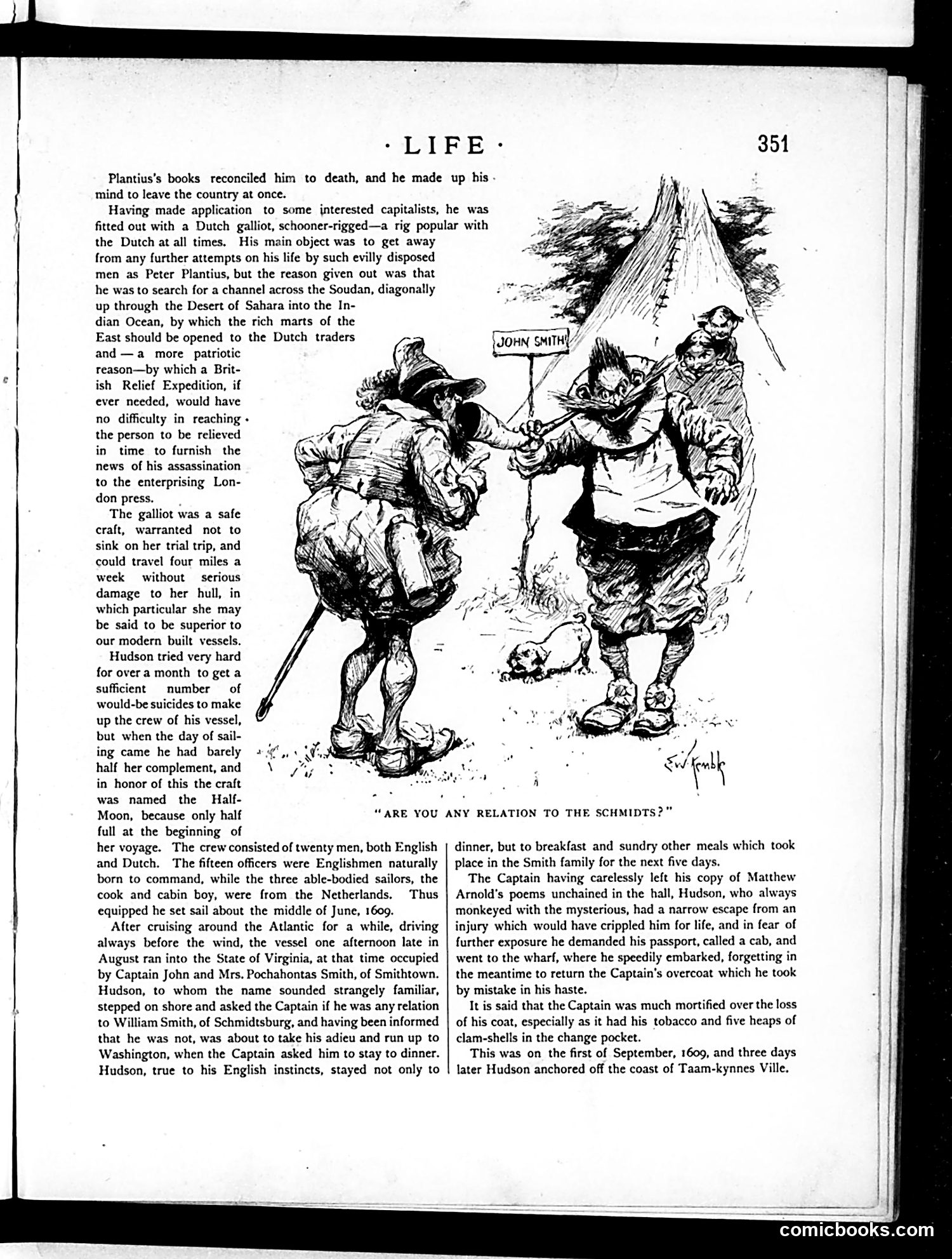
The cartoon depicts an encounter between two colonial-era figures. One man, labeled "JOHN SMITH," confronts a heavily laden traveler, asking "ARE YOU ANY RELATION TO THE SCHMIDTS?" The humor relies on a play on names: it juxtaposes the historically significant English colonist John Smith (associated with early American settlement) against "Schmidts"—a distinctly German surname. The joke appears to mock either: 1. The growing German immigrant population in America, suggesting surprise at encountering Germans in colonial contexts where they weren't historically prominent, or 2. A pun exploiting the phonetic similarity between "Smith" and "Schmidt." The surrounding text discusses Hudson's colonial voyage (1609), providing historical context. The cartoon likely satirizes contemporary anxieties about immigration or ethnic composition of America, though without additional historical context, the specific target remains somewhat unclear.
📄 Transcribed text from this page (OCR, searchable)
Machine-transcribed from the original scan — historical spelling and the odd misread are preserved.
*LIFE- Plantius’s books reconciled him to death, and he made up his - mind to leave the country at once. Having made application to some jnterested capitalists, he was fitted out with a Dutch galliot, schooner-rigged—a rig popular with the Dutch at all times. His main object was to get away from any further attempts on his life by such evilly disposed men as Peter Plantius, but the reason given out was that he was to search for a channel across the Soudan, diagonally up through the Desert of Sahara into the In- dian Ocean, by which the rich marts of the East should be opened to the Dutch traders and —a_ more patriotic reason—by which a Brit- ish Relief Expedition, if ever needed, would have no difficulty in reaching the person to be relieved in time to furnish the news of his assassination to the enterprising Lon- don press. The galliot was a safe craft, warranted not to sink on her trial trip, and could travel four miles a week without serious damage to her hull, in which particular she may be said to be superior to our modern built vessels. Hudson tried very hard for over a month to get a sufficient number of would-be suicides to make up the crew of his vessel, but when the day of sail- ing came he had barely half her complement, and in honor of this the craft was named the Half- rc: Moon, because only half full at the beginning of her voyage. The crew consisted of twenty men, both English and Dutch. The fifteen officers were Englishmen naturally born to command, while the three able-bodied sailors, the cook and cabin boy, were from the Netherlands. Thus equipped he set sail about the middle of June, 1609. After cruising around the Atlantic for a while, driving always before the wind, the vessel one afternoon late in August ran into the State of Virginia, at that time occupied by Captain John and Mrs. Pochahontas Smith, of Smithtown. Hudson, to whom the name sounded strangely familiar, stepped on shore and asked the Captain if he was any relation to William Smith, of Schmidtsburg, and having been informed that he was not, was about to take his adieu and run up to Washington, when the Captain asked him to stay to dinner. Hudson, true to his English instincts, stayed not only to “ARE YOU ANY RELATION TO THE SCHMIDTS?” | dinner, but to breakfast and sundry other meals which took place in the Smith family for the next five days. iB The Captain having carelessly left his copy of Matthew Arnold’s poems unchained in the hall, Hudson, who always monkeyed with the mysterious, had a narrow escape from an | injury which would have crippled him for life, and in fear of | further exposure he demanded his passport, called a cab, and | went to the wharf, where he speedily embarked, forgetting in j the meantime to return the Captain's overcoat which he took 1] by mistake in his haste. | It is said that the Captain was much mortified over the loss | of his coat, especially as it had his tobacco and five heaps of } clam-shells in the change pocket. | This was on the first of September, 1609, and three days later Hudson anchored off the coast of Taam-kynnes Ville. comicbooks.com