
Life, 1885-12-17 · page 11 of 18
Life — December 17, 1885 — page 11: what you’re looking at
What you’re looking at
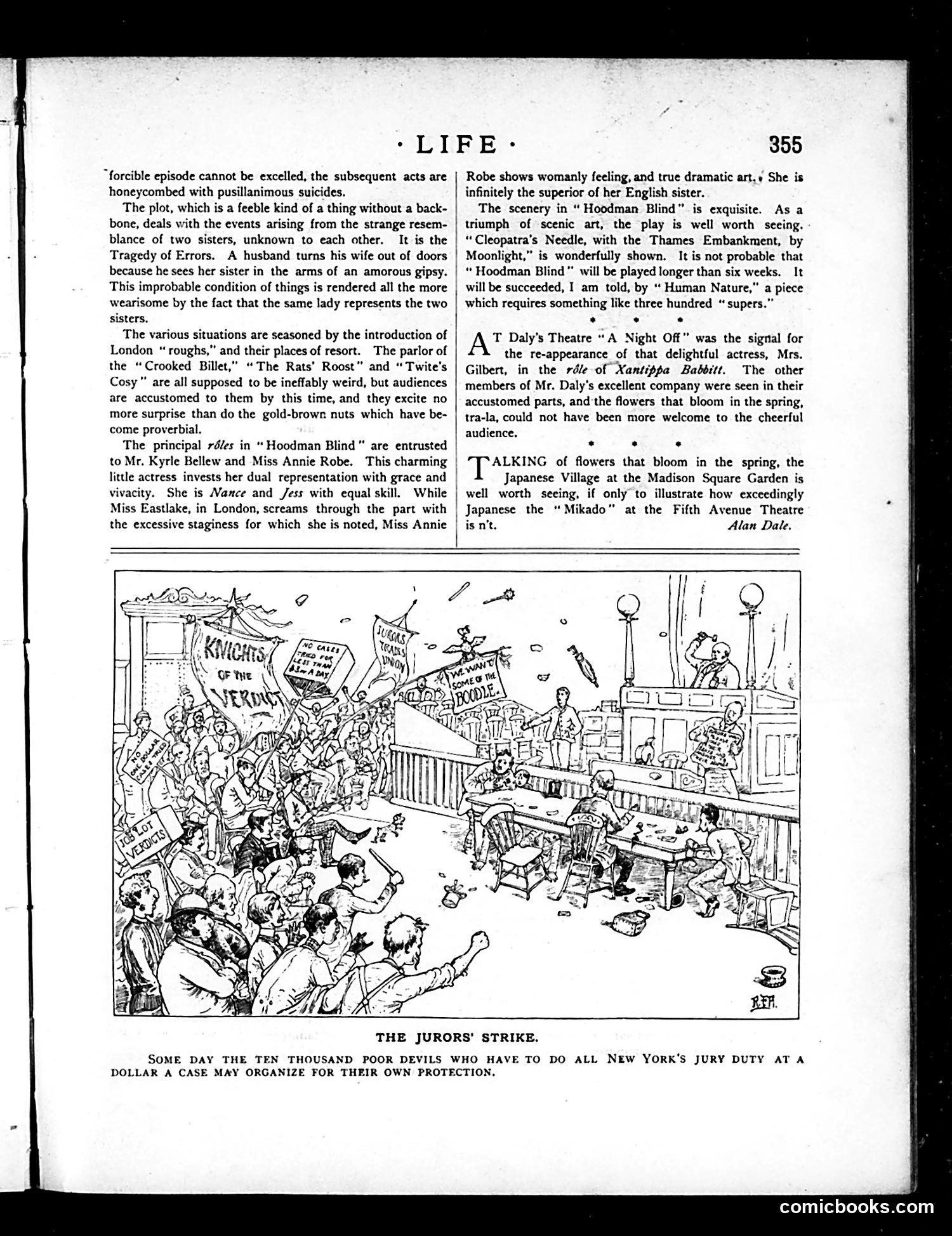
This cartoon satirizes the exploitative jury system in New York City. The caption explains the premise: ten thousand poor citizens are compelled to serve on juries for only one dollar per case—inadequate compensation for lost wages and time. The chaotic illustration depicts a massive, angry crowd of jurors organizing a protest or strike for "their own protection." The crowded scene with banners and agitated figures suggests civil unrest and unionization efforts. The satire mocks the absurdity of the situation: the city extracts civic duty from the poorest residents while barely compensating them, forcing them toward organized rebellion. The joke's premise—that such underpaid jurors *might someday* strike—implies this hasn't happened yet but seems inevitable given the systemic injustice. It's social commentary on labor exploitation and the tension between civic obligation and economic survival for working-class New Yorkers.
📄 Transcribed text from this page (OCR, searchable)
Machine-transcribed from the original scan — historical spelling and the odd misread are preserved.
- LIFE: “forcible episode cannot be excelled, the subsequent acts are honeycombed with pusillanimous suicides. The plot, which is a feeble kind of a thing without a back- bone, deals with the events arising from the strange resem- blance of two sisters, unknown to each other. Tragedy of Errors. A husband turns his wife out of doors because he sees her sister in the arms of an amorous gipsy. This improbable condition of things is rendered all the more wearisome by the fact that the same lady represents the two sisters. The various situations are seasoned by the introduction of London “ roughs,” and their places of resort. The parlor of the “Crooked Billet,” “The Rats’ Roost” and “ Twite’s Cosy" are all supposed to be ineffably weird, but audiences are accustomed to them by this time, and they excite no more surprise than do the gold-brown nuts which have be- come proverbial. The principal ré/es in “ Hoodman Blind” are entrusted to Mr. Kyrle Bellew and Miss Annie Robe. This charming little actress invests her dual representation with grace and vivacity. She is Nance and /ess with equal skill. While Miss Eastlake, in London, screams through the part with the excessive staginess for which she is noted, Miss Annie It is the | 355 Robe shows womanly feeling, and true dramatic art.» She is infinitely the superior of her English sister. The scenery in “ Hoodman Blind” is exquisite. As a triumph of scenic art, the play is well worth secing. “Cleopatra's Needle, with the Thames Embankment, by Moonlight,” is wonderfully shown. It is not probable that “Hoodman Blind” will be played longer than six weeks. It will be succeeded, I am told, by “ Human Nature,” a piece which requires something like three hundred “ supers.” . . . T Daly’s Theatre “A Night Off" was the signal for the re-appearance of that delightful actress, Mrs. Gilbert, in the réle of Xantippa Babbitt. The other members of Mr. Daly's excellent company were seen in their accustomed parts, and'the flowers that bloom in the spring, tra-la, could not have been more welcome to the cheerful audience. . . . ALKING of flowers that bloom in the spring, the Japanese Village at the Madison Square Garden is well worth seeing, if only to illustrate how exceedingly Japanese the “Mikado” at the Fifth Avenue Theatre is n't. Alan Dale, THE JURORS’ STRIKE. SOME DAY THE TEN THOUSAND POOR DEVILS WHO HAVE TO DO ALL NEW YORK'S JURY DUTY AT A DOLLAR A CASE MAY ORGANIZE FOR THEIR OWN PROTECTION. comicbooks.com