
A complete issue · 16 pages · 1885
Life — November 26, 1885
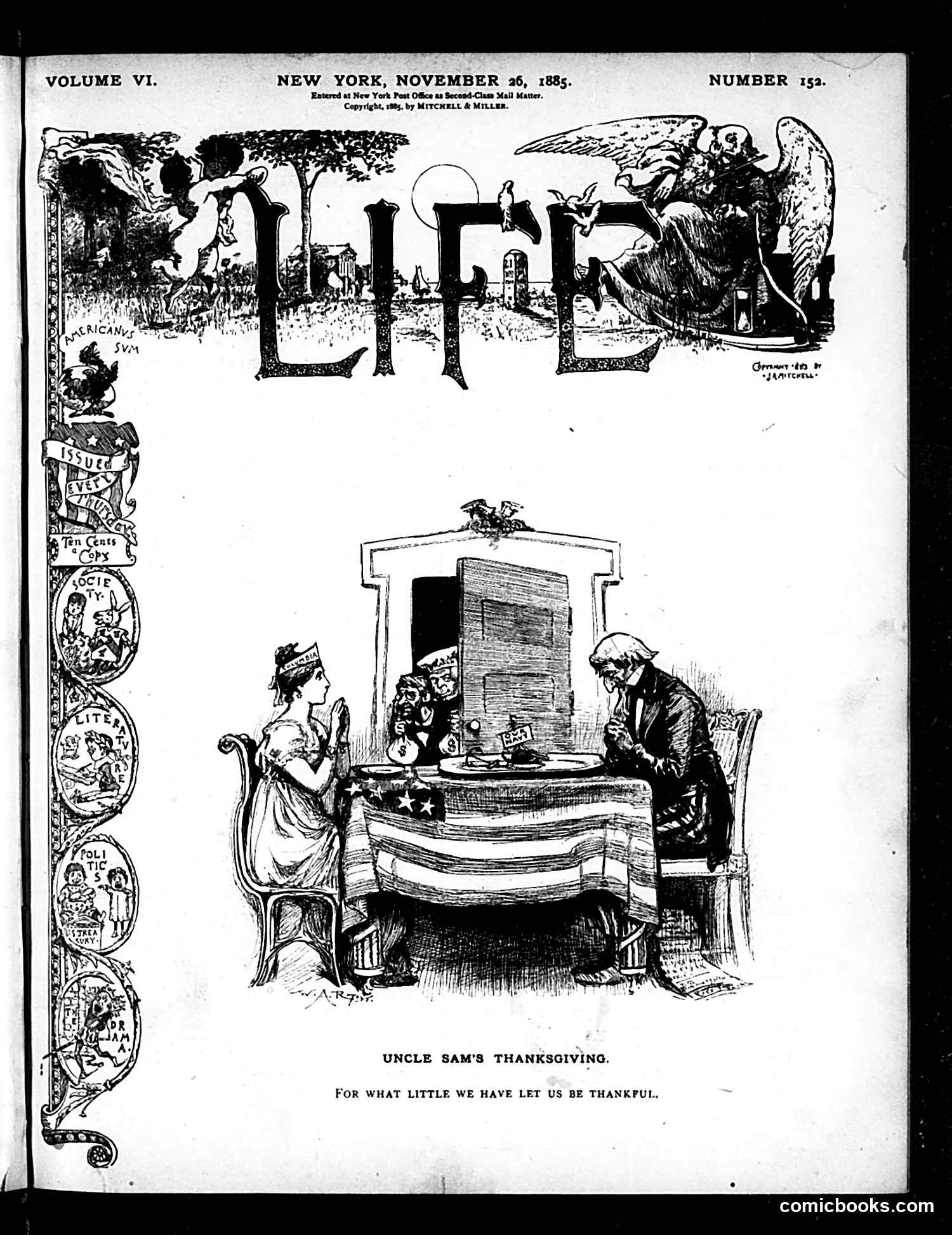
This satirical cartoon depicts Uncle Sam (the bearded man on the right, representing the United States government) seated at a meager table with a woman (likely representing the American people or nation). The table is bare except for what appears to be minimal provisions—a stark contrast to traditional Thanksgiving abundance. The caption reads: "FOR WHAT LITTLE WE HAVE LET US BE THANKFUL." The satire criticizes economic hardship or government scarcity during this period. Rather than celebrating abundance, the cartoon sardonically suggests Americans should be grateful merely for surviving lean times. This likely references economic difficulties or political failures of the mid-1880s era, making a pointed commentary on diminished national prosperity or resources.
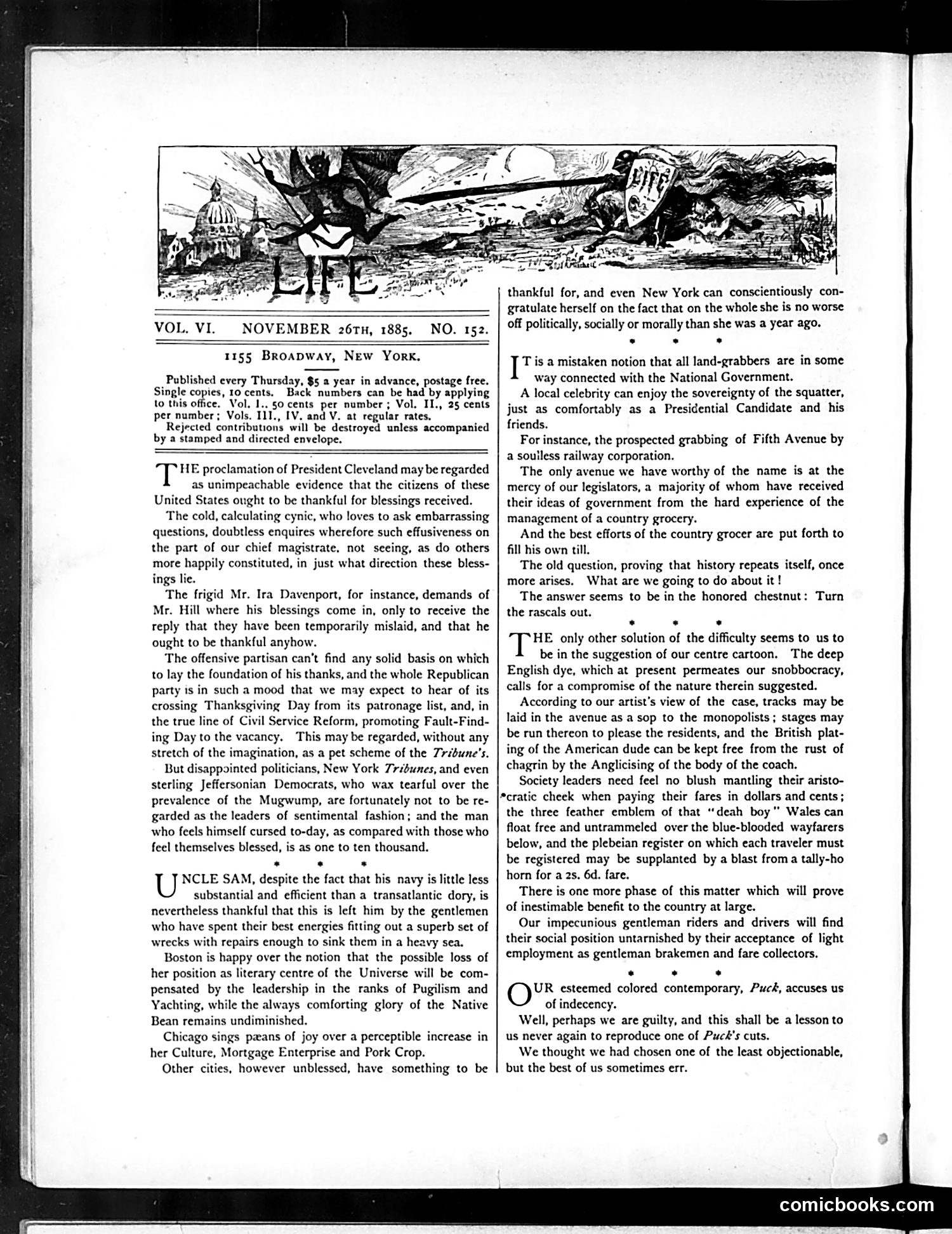
The masthead cartoon depicts what appears to be a chaotic scene with classical architecture (possibly the Capitol dome) amid destruction or turmoil, though specific figures are unclear from the image quality. The editorial content satirizes President Cleveland's proclamation as evidence of national discord. It mocks "land-grabbers" and railway corporations threatening Fifth Avenue, criticizing legislators who've learned governance "from hard experience of the management of a country grocery." The piece proposes absurd solutions like laying streetcar tracks as a "sop to monopolists," with satirical suggestions about "dead boy" Wales and registration for "gentleman trackmen and fare collectors"—mocking both urban development conflicts and the social pretensions of the era. The tone targets both corrupt business interests and ineffectual political responses to Gilded Age problems.
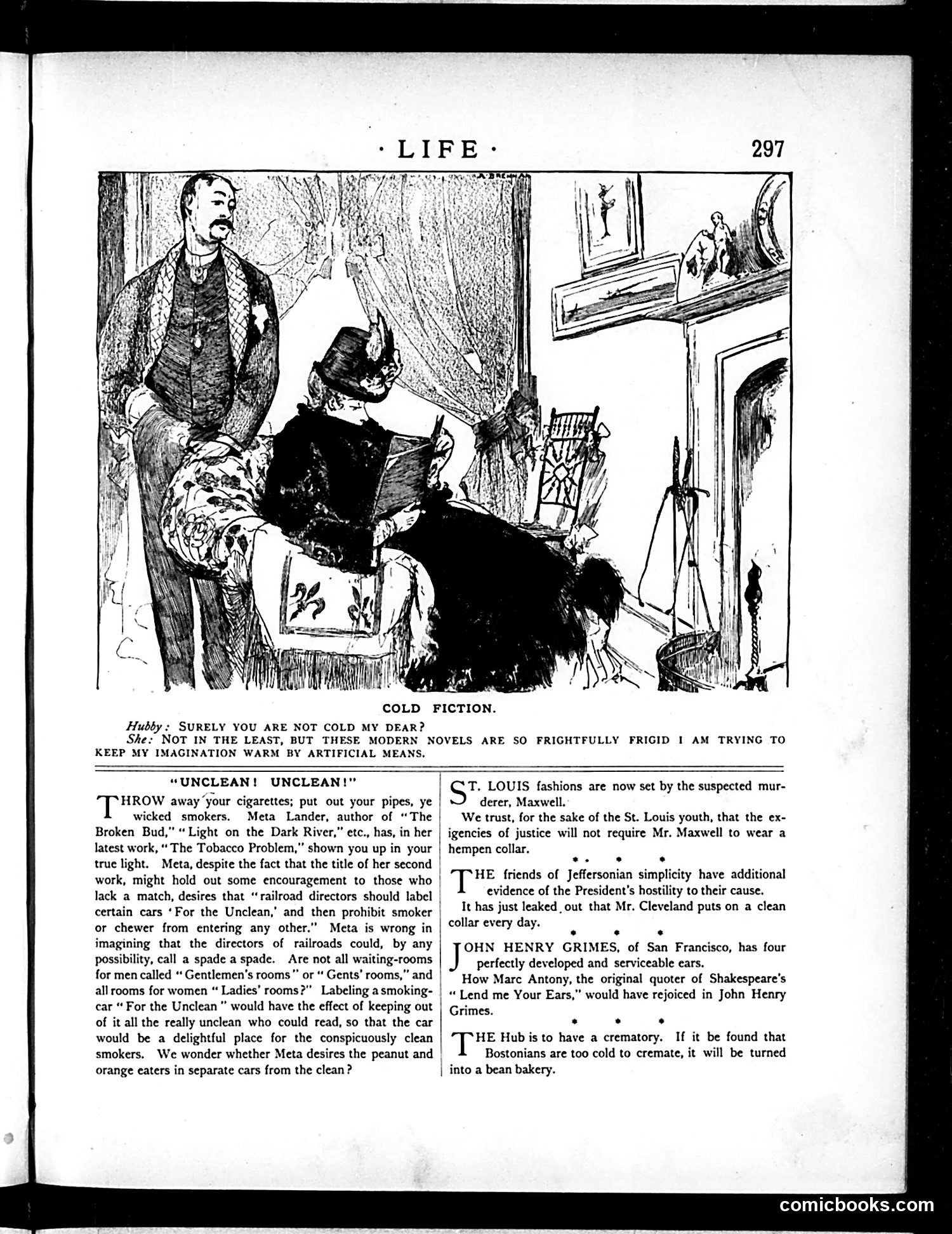
This cartoon satirizes author Meta Lander's second work, "The Tobacco Problem," which apparently advocates for segregating smokers in railroad cars. The humor plays on the contrast between Lander's stated goal—keeping smokers away from others—and the impractical reality shown: a woman reading in a parlor car while a man stands nearby smoking, completely defeating the purpose. The title "Cold Fiction" suggests Lander's solution is unrealistic fantasy. The accompanying text mocks the proposal as ineffective and questions whether separate "smoking cars" would actually work, since truly unclean smokers would still contaminate shared spaces. The satire critiques both overzealous reformers and the practical impossibility of their schemes.
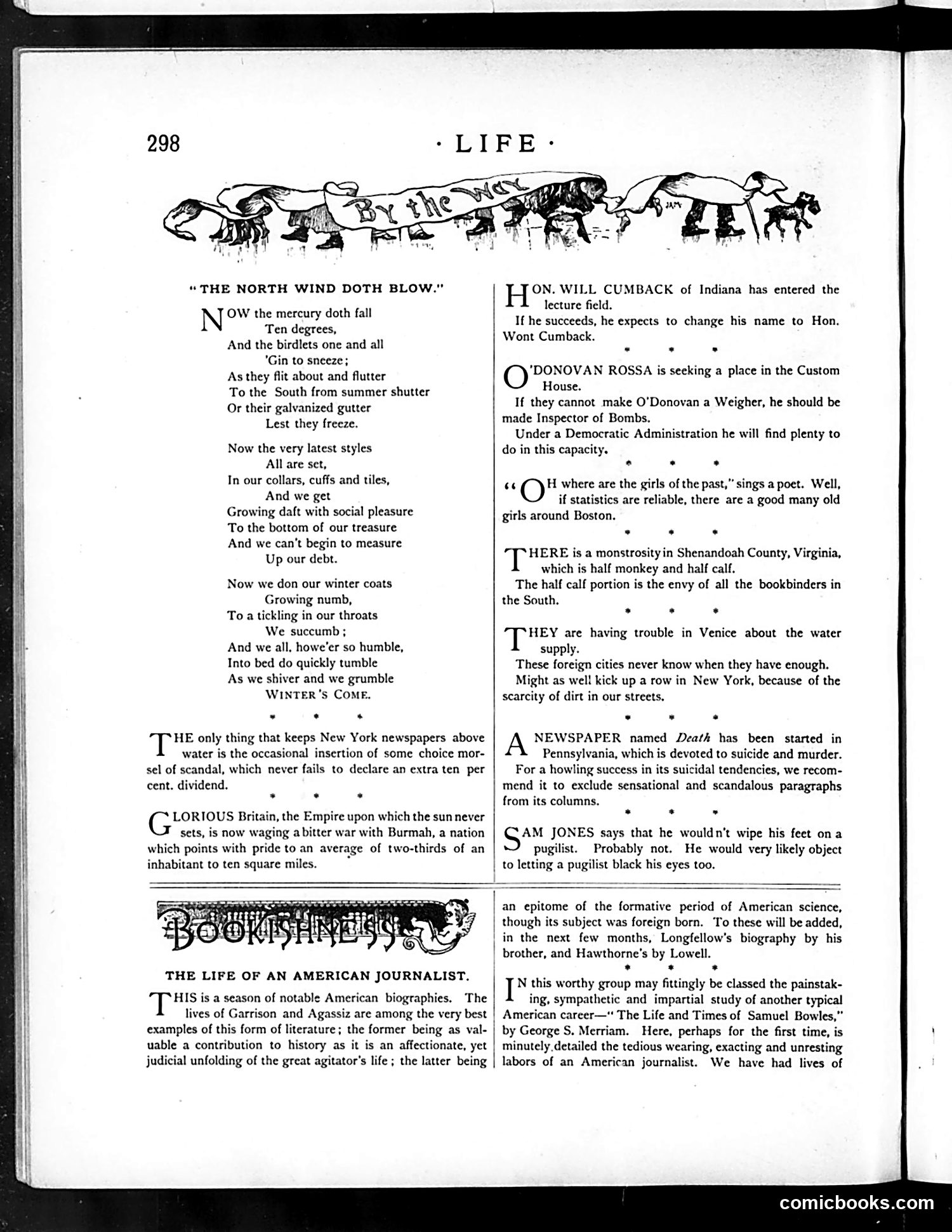
The page contains satirical commentary rather than political cartoons. The header "By the Way" decorative element shows animals in a procession. **Key satirical items:** 1. **"The North Wind Doth Blow"** - A poem mocking fashionable winter clothing and New York's financial struggles, suggesting newspapers stay afloat only through sensational stories offering extra dividends. 2. **Brief jabs** at political figures: Hon. Will Cumback (entering lectures), O'Donovan Rossa (seeking a Custom House position), and Sam Jones (the pugilist reference). 3. Commentary on Venice's water supply crisis and comparing it to New York's street cleanliness. 4. A newspaper called *Death* devoted to suicide and murder coverage. The satire targets contemporary politics, journalism sensationalism, and urban problems without specific detailed illustrations visible in this text-heavy page.
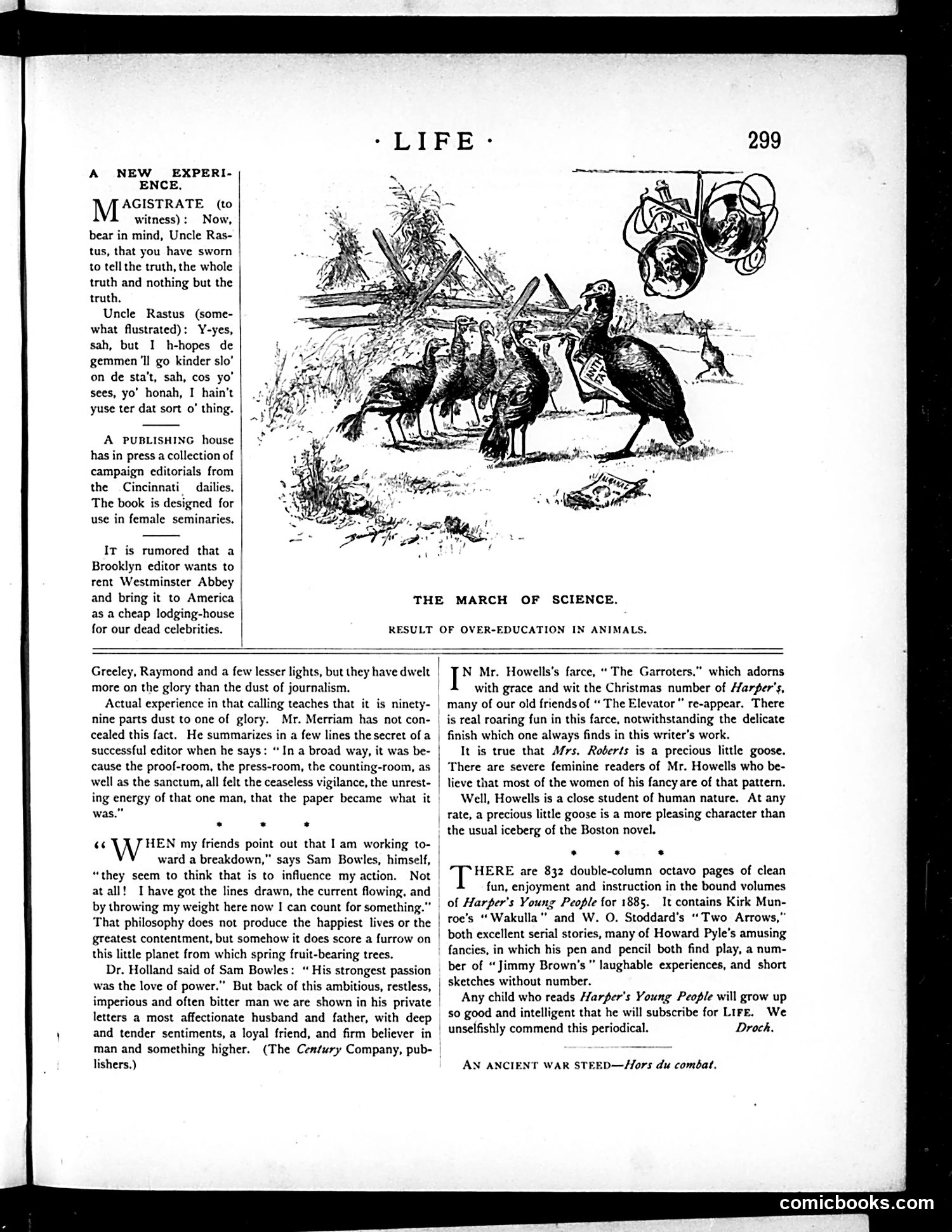
This cartoon satirizes the concept of over-educating animals, likely referencing contemporary debates about animal training and education. The illustration shows various animals (appearing to include birds and possibly other creatures) engaged in what seems like schooling or civilized activity, with one figure appearing to instruct or oversee them. The satire appears to mock the notion that animals could or should be subjected to human-style education and refinement—a commentary on either excessive scientific experimentation with animals or perhaps misguided attempts at "civilizing" nature. The title "Result of Over-Education in Animals" suggests the cartoon criticizes this practice as unnatural or absurd. Without identifying specific animals or instructors clearly, the overall point seems to be satirizing pseudoscientific or foolish notions about animal capability.
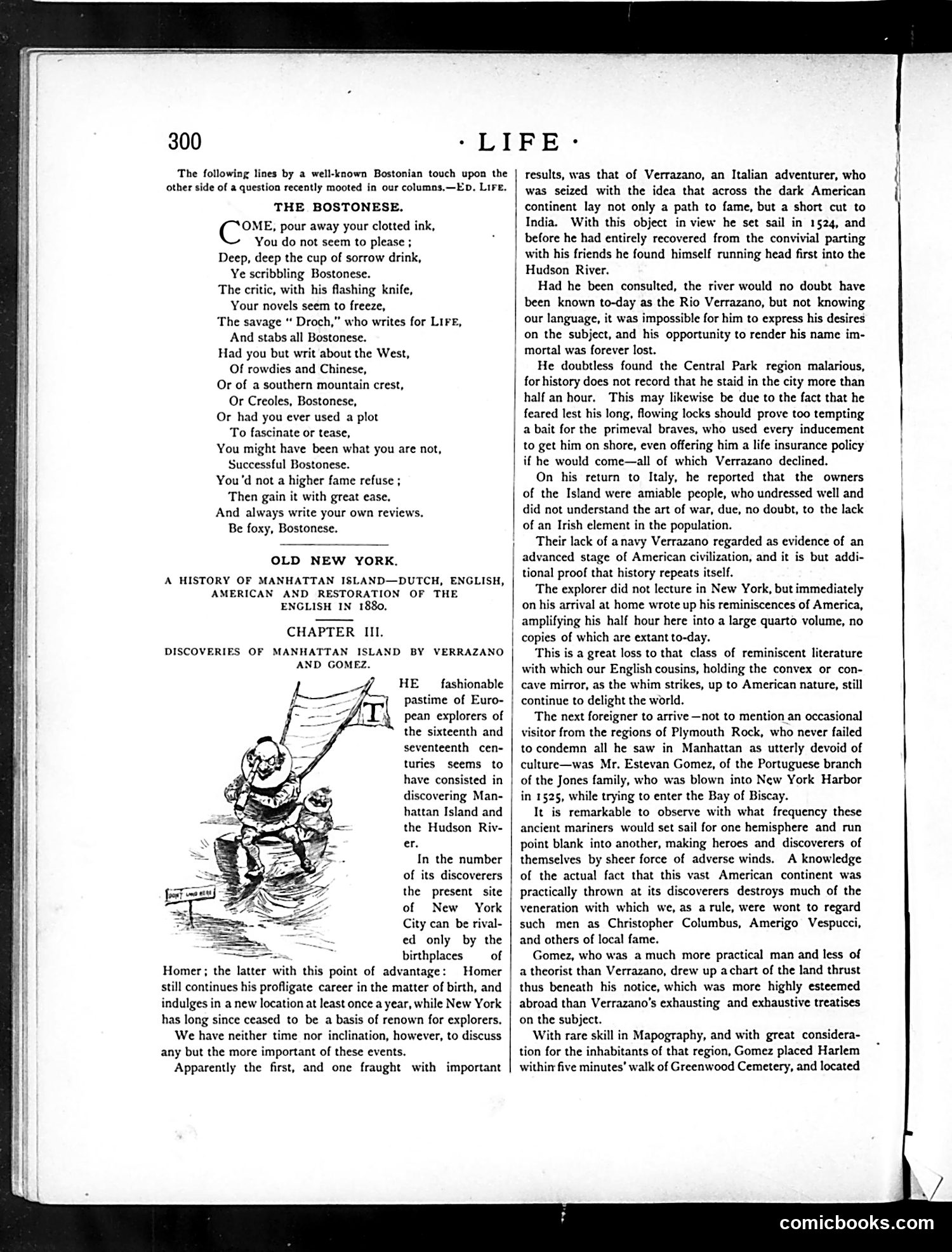
This page contains two distinct elements: 1. **"The Bostonese" poem** (top left): A satirical verse mocking Boston intellectuals and their pretensions. It ridicules their affected literary tastes, snobbish attitudes toward "rowdies and Chinese," and self-regard, advising them to abandon their "higher fame" and accept their mediocrity. The satire targets Boston's cultural elite as pompous and out-of-touch. 2. **"Old New York" historical article** (main text): A serious historical piece about early Manhattan explorers, particularly Verrazano and Gomez. It discusses their 16th-century voyages and notes that Gomez's valuable maps were lost, depriving America of important historical records. The small illustration shows a period explorer or sailor figure, supporting the historical content.
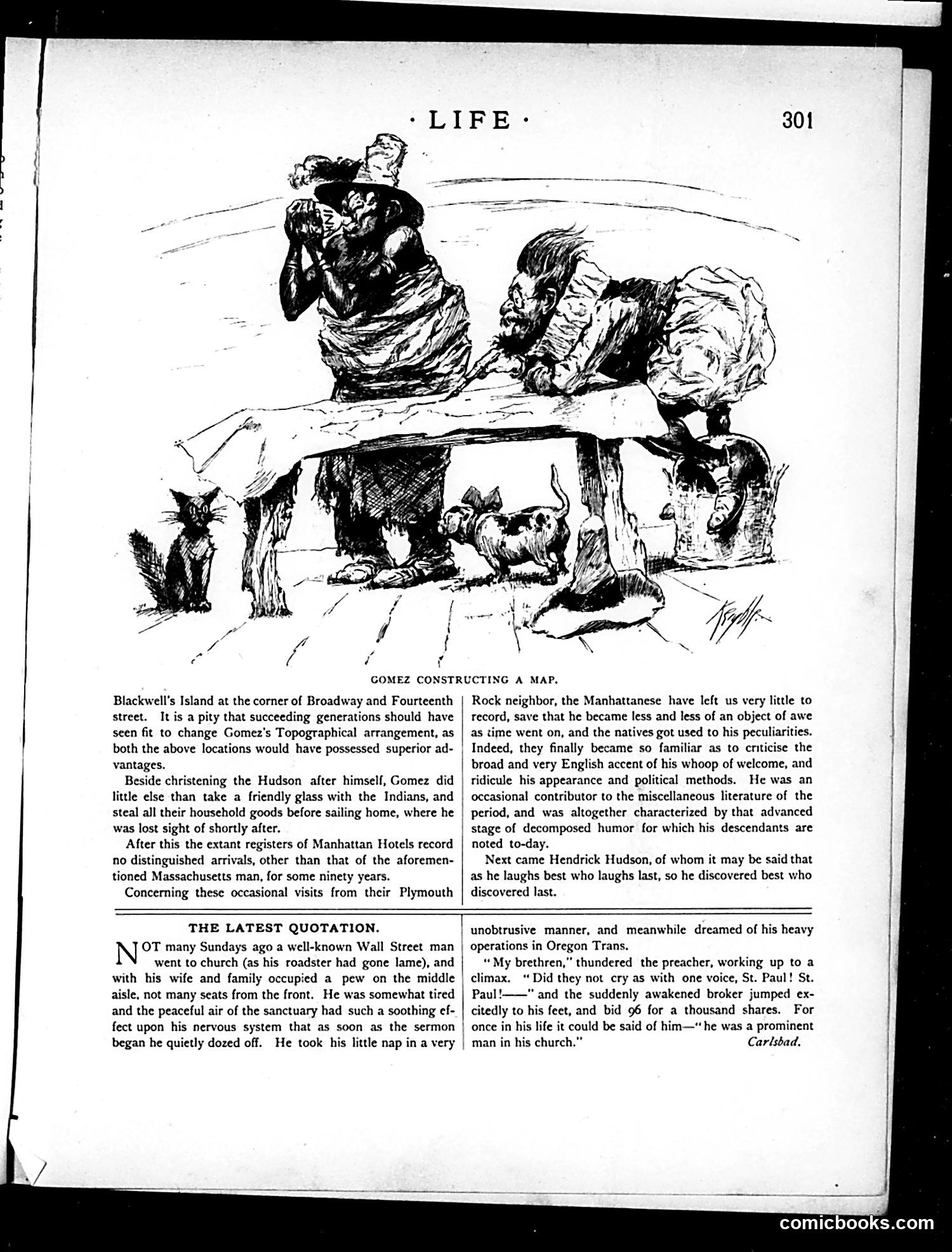
The cartoon depicts **Gomez**, apparently a historical Native American figure associated with Manhattan, attempting to make a map while surrounded by Europeans and animals in a crude shelter. The accompanying text discusses Gomez's role in early Manhattan history—specifically how he assisted Hudson and later became a fixture in Manhattan Hotels, leaving limited historical records of his contributions. The satire appears to critique the erasure of Native American history: despite Gomez's documented presence and usefulness to European colonizers, historical records are sparse. The image of him "constructing a map" likely mocks how indigenous peoples' knowledge was appropriated by colonizers while their own narratives remained marginalized or lost to history.
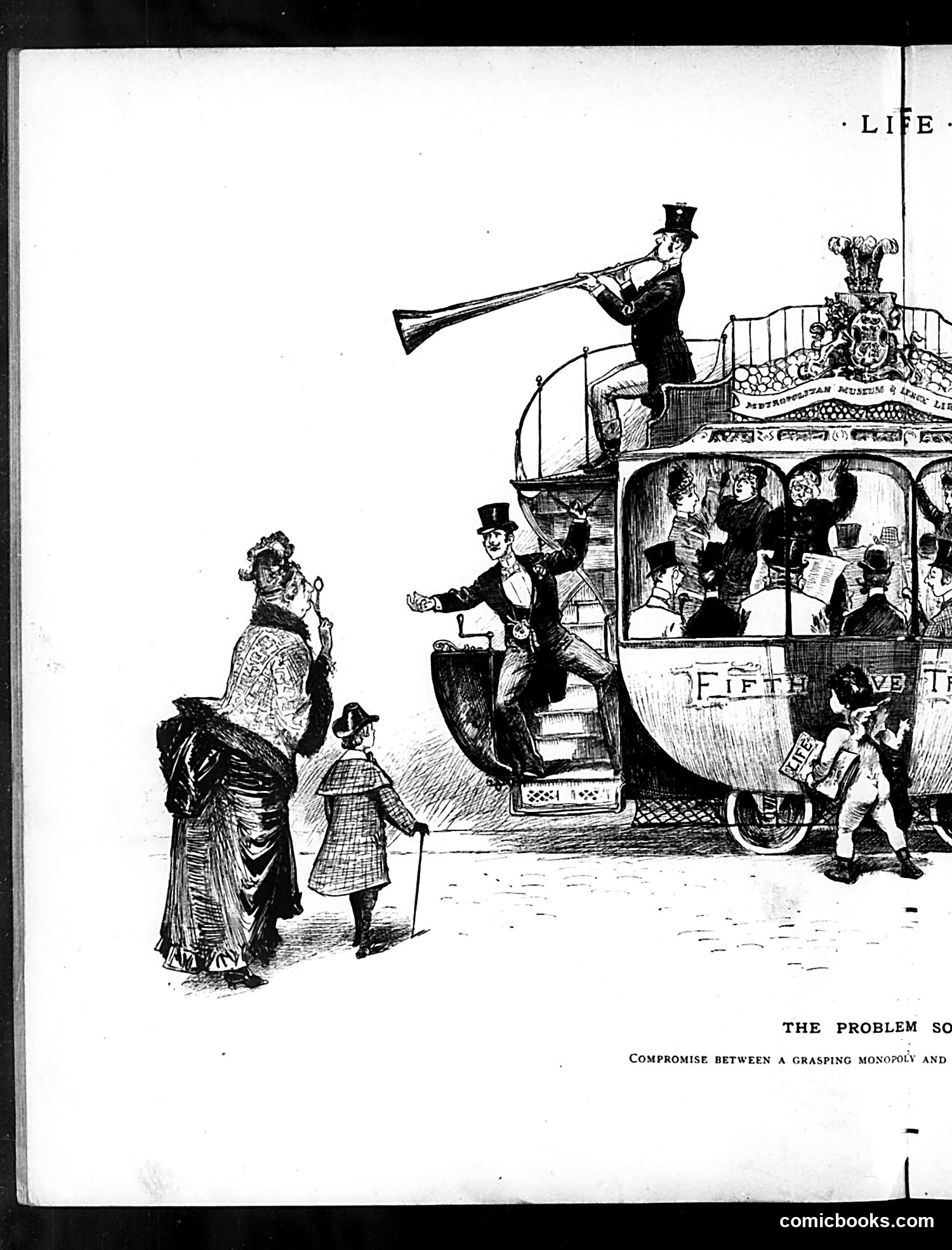
This satirical cartoon from *Life* magazine depicts "The Problem So[lved]" with a subtitle referencing "Compromise between a grasping monopoly and" (text cut off). The image shows an elaborate, multi-story vehicle labeled "FIFTH AVE" (Fifth Avenue) packed with well-dressed passengers. A man in formal attire operates it like a carnival ride, while a uniformed conductor blows a trumpet from the roof. On the street, a mother and child observe this spectacle. The satire appears to critique wealthy Manhattan elites—particularly those on Fifth Avenue, a symbol of upper-class wealth—as operating an exclusive, self-serving system. The "monopoly" referenced likely concerns transportation, real estate, or financial interests controlled by the wealthy. The cartoon suggests their "compromise" amounts to little more than theatrical pageantry masking continued exploitation of ordinary citizens who can only watch from outside.
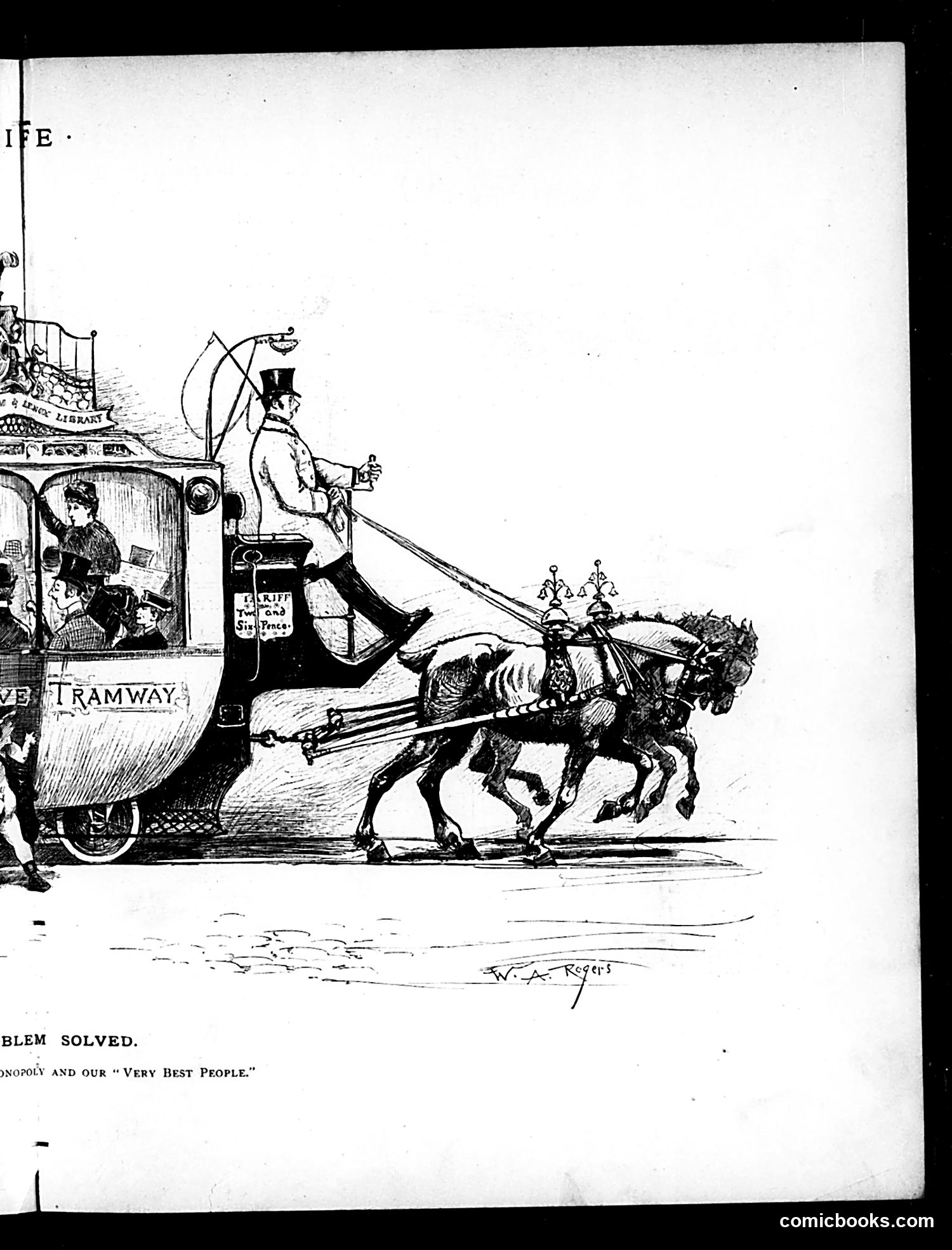
This is a satirical cartoon titled "Problem Solved" with the subtitle "Monopoly and Our 'Very Best People.'" The image depicts a well-dressed man in a top hat riding atop a horse-drawn tramway car. The man appears to be a caricature of a wealthy monopolist or robber baron, steering the vehicle with exaggerated theatrical gestures. Inside the tramway, passengers (appearing to be ordinary citizens) are visible through windows. The satire critiques monopolies and their relationship to the wealthy elite ("our 'Very Best People'"). The cartoon suggests that monopolists control public transportation systems, figuratively "riding" on the backs of common people while presenting themselves as civilized gentlemen. This reflects Progressive Era concerns about corporate monopolies exploiting public resources and ordinary citizens.
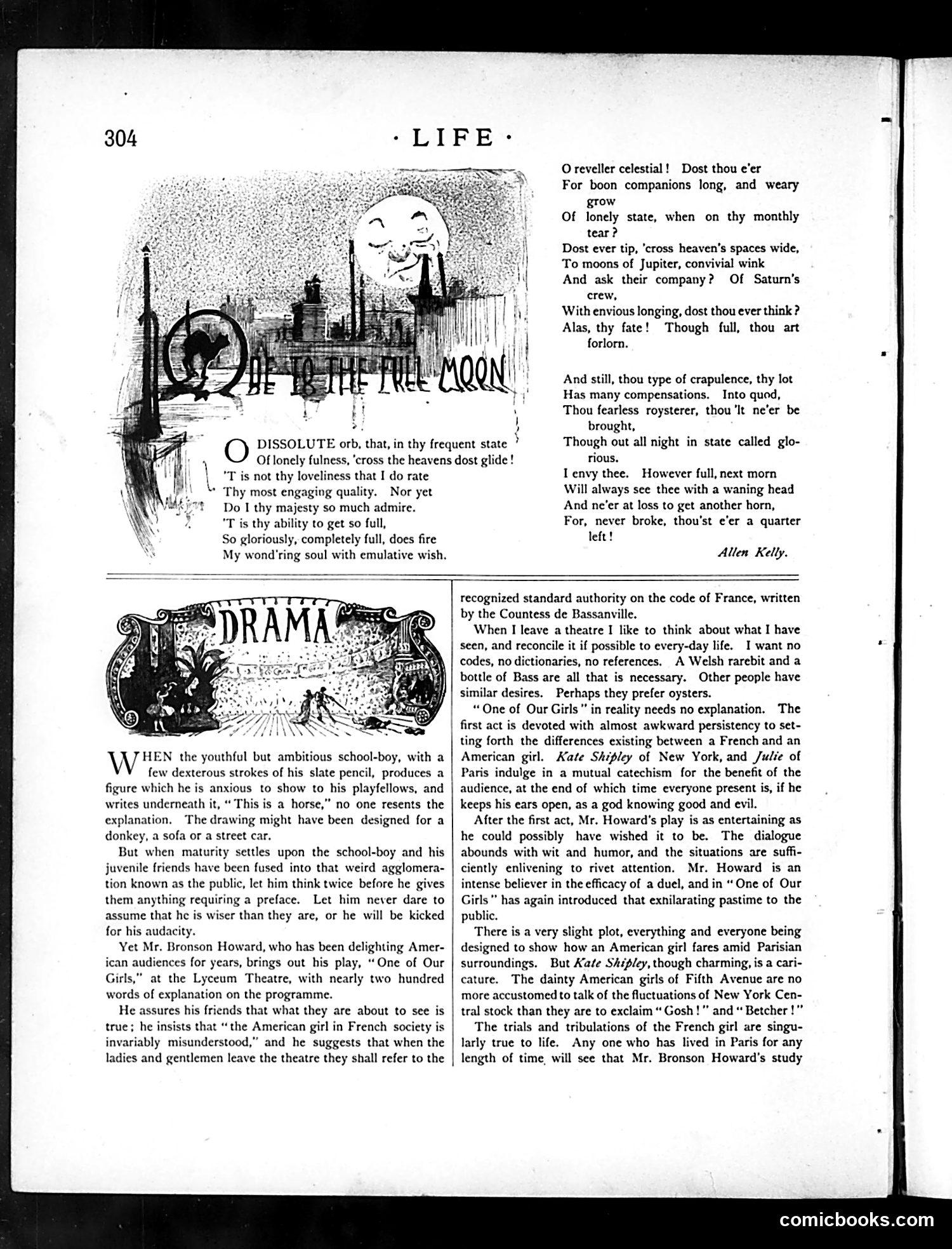
The upper cartoon features a humorous poem by Allen Kelly addressing the moon as a "dissolute orb." The satire mocks human envy of celestial bodies: the moon can get "gloriously, completely full," never faces legal consequences for its nocturnal revelry, and always has "a quarter left"—a clever pun on both lunar phases and drinking. The poem playfully suggests the moon lives without consequences or financial worry, unlike humans. # Theater Criticism: "One of Our Girls" The lower section reviews Bronson Howard's play, criticizing its heavy-handed explanation. Howard provides extensive program notes insisting the American girl in French society is "invariably misunderstood" and even recommends the Countess de Bassanville's etiquette manual. The critic mocks this didacticism, arguing audiences need no such guidance—just "a Welsh rarebit and a bottle of Bass." The play itself, about contrasting French and American female characters, apparently requires no explanation despite Howard's anxiety.
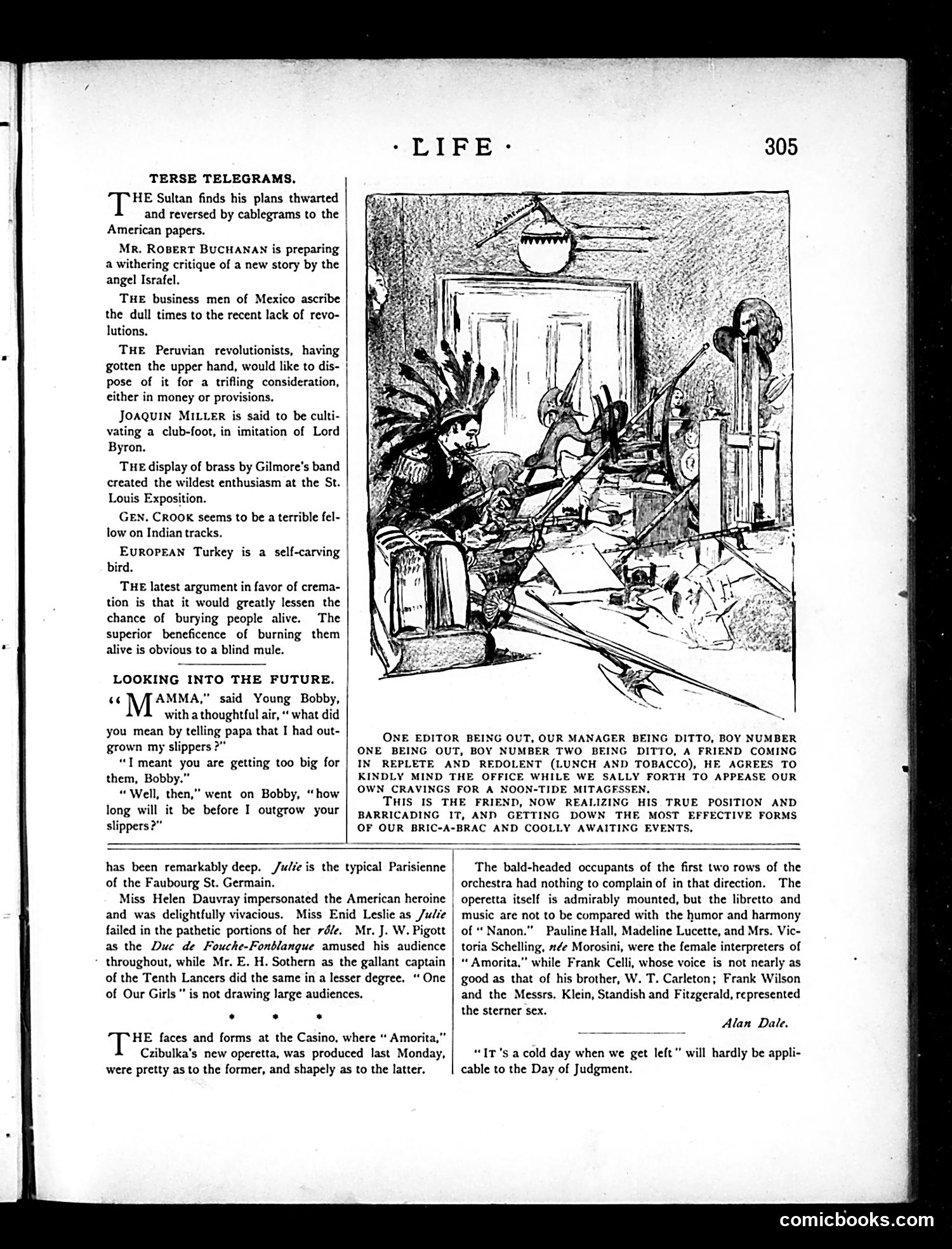
This page contains **brief satirical "telegrams"** mocking contemporary figures and events, plus a comic strip about office chaos. **Key satirical items:** - The Sultan's plans undermined by American newspaper cablegrams (critiquing press influence on foreign policy) - Mexican businessmen wanting revolutions to resume (economic satire—instability drives commerce) - Peruvian revolutionists willing to sell their victory (political corruption joke) - Joaquin Miller cultivating a club-foot imitating Lord Byron (mocking pretentious literary affectation) - General Crook as "terrible" on Indian tracks (likely satirizing Indian Wars tactics) - "European Turkey is a self-carving bird" (Ottoman Empire dismemberment) **The comic strip** depicts an office in chaos: with the editor and manager absent, a friend left in charge barricades himself against two boys wreaking havoc with office supplies and "bric-a-brac," humorously depicting workplace anarchy. The page exemplifies *Life* magazine's characteristic quick-hit political and social satire targeting contemporary personalities, foreign policy, and everyday absurdities.
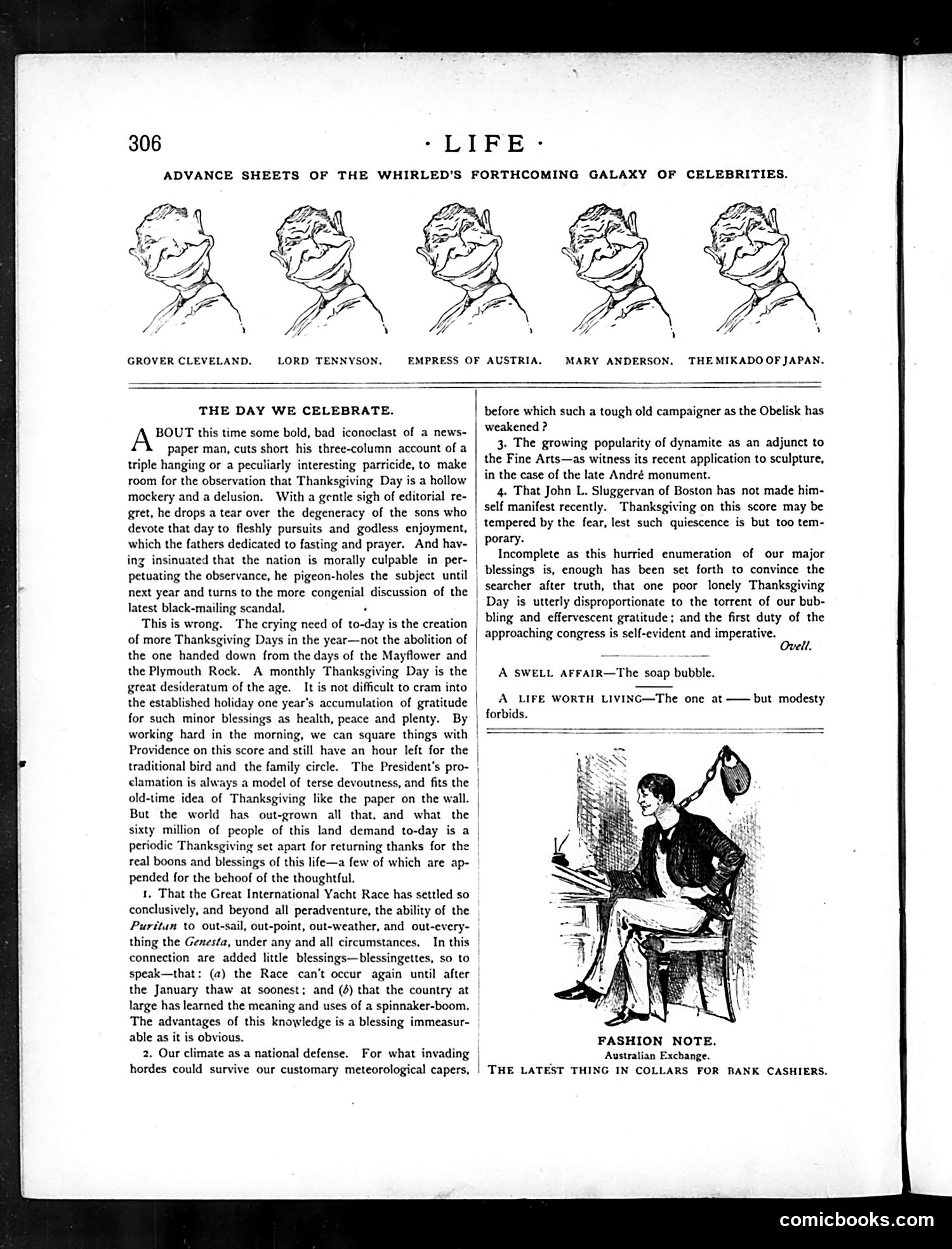
This page from *Life* magazine satirizes American attitudes toward Thanksgiving through mock-serious editorial commentary. The main article argues against the common newspaper practice of criticizing Thanksgiving as morally hollow, instead proposing monthly Thanksgiving Days to accommodate the nation's accumulating blessings. The satire is apparent in the absurd "blessings" listed for gratitude: an America's yacht race victory, climate as national defense, dynamite's "artistic" applications (referencing recent anarchist bombings), and boxer John L. Sullivan's absence from public view. At the top, five caricatured celebrity heads (Grover Cleveland, Lord Tennyson, Empress of Austria, Mary Anderson, and the Mikado of Japan) appear identical, likely mocking celebrity culture's superficiality. The page mixes genuine social commentary with ridicule—poking fun at both newspaper cynicism and American materialism masked as gratitude.
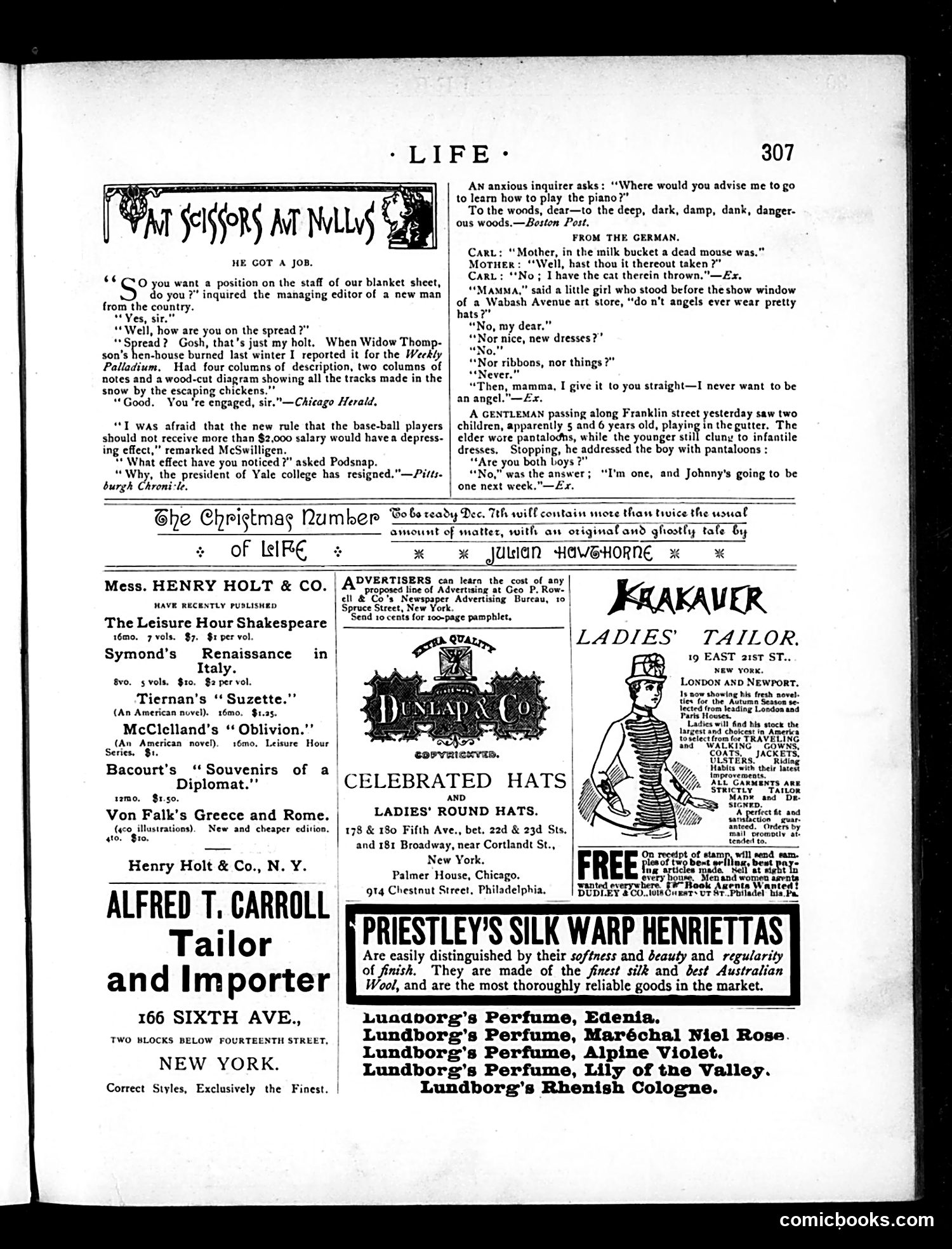
This page combines humor, brief anecdotes, and advertisements typical of Life magazine's satirical format. **The Cartoons/Humor Pieces:** The main cartoon "At Scissors at Nulls" depicts a newspaper editor hiring a country journalist. The joke: the new hire boasts of reporting a burned henhouse with excessive detail (four columns of description, diagrams of chicken tracks in snow), which the editor considers perfect for their "blanket sheet"—meaning sensationalized, padded coverage. **The Anecdotes** include several brief jokes: - A sarcastic response about learning piano ("go to the woods") - German translations featuring malapropisms and household mishaps - A dialogue between a gentleman and children about clothing and gender **The Political/Social Reference:** The Yale college president resignation mention appears to reference real salary disputes affecting collegiate athletics, suggesting tension between academic institutions and growing commercialization of baseball. **The Page is Primarily Advertising:** Most space features book publishers (Henry Holt & Co.), clothing retailers (tailor services), perfume brands (Lundborg's), and fabric goods (Priestley's silk), reflecting 1880s-90s consumer culture.
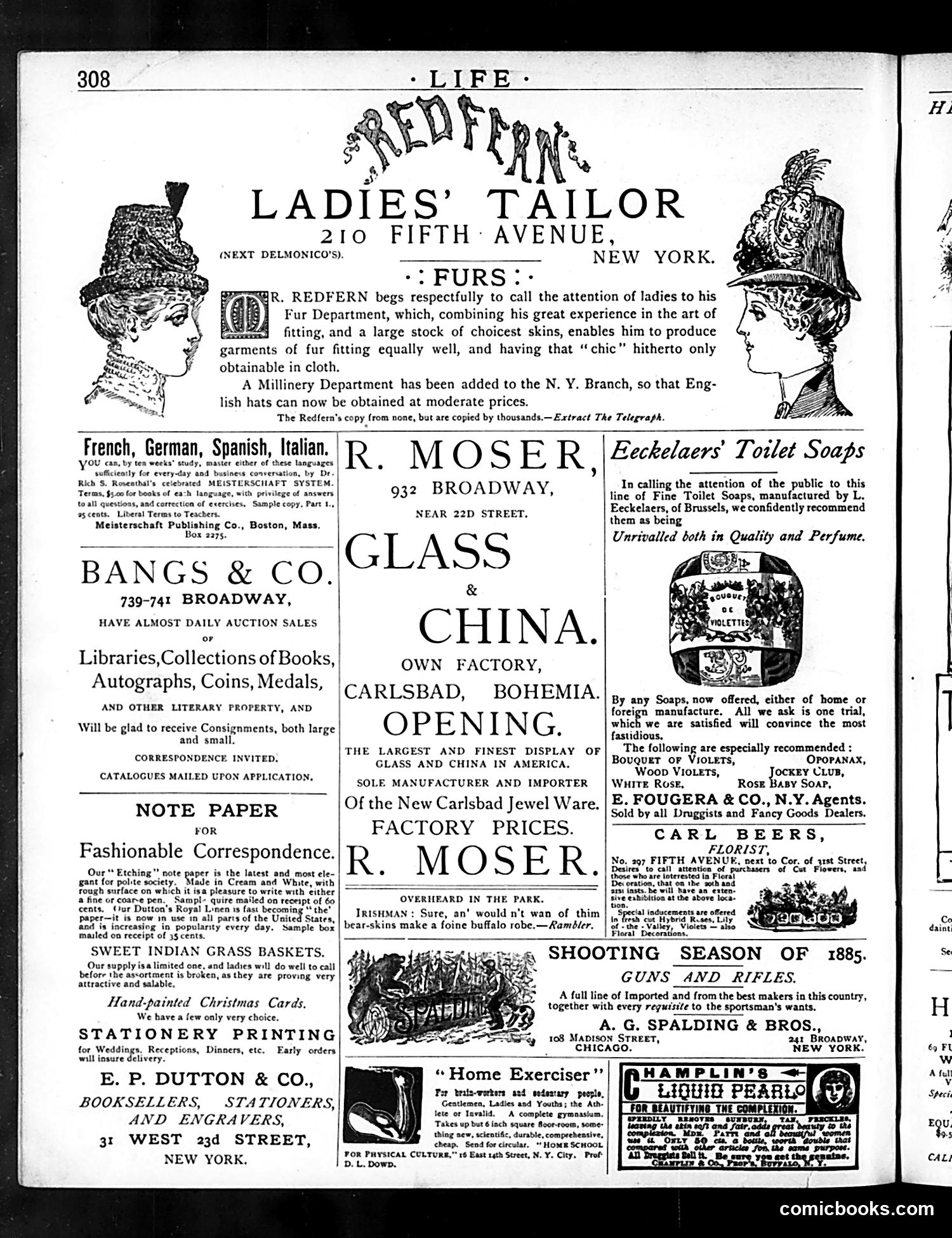
This is primarily an **advertising page** from Life magazine, not a satirical cartoon. The page contains mostly commercial advertisements for fashionable New York businesses circa 1885. The notable content includes: **Redfern's Ladies' Tailor** (top) — advertising fur garments and millinery services on Fifth Avenue, with decorative illustrations of fashionable women's hats. **One embedded joke/caption** labeled "OVERHEARD IN THE PARK": An Irishman observes that a bear-skin would make a fine buffalo robe — a simple ethnic humor joke playing on supposed Irish ignorance of animal identification. The remaining content comprises service advertisements: auctioneers (Bangs & Co.), stationery printers, glassware importers (R. Moser from Bohemia), toilet soaps, florists, and sporting goods merchants. The page reflects **Gilded Age consumer culture** — targeting wealthy New York society with luxury goods and fashionable services. The single joke represents period-typical mild ethnic stereotyping rather than substantive satire.
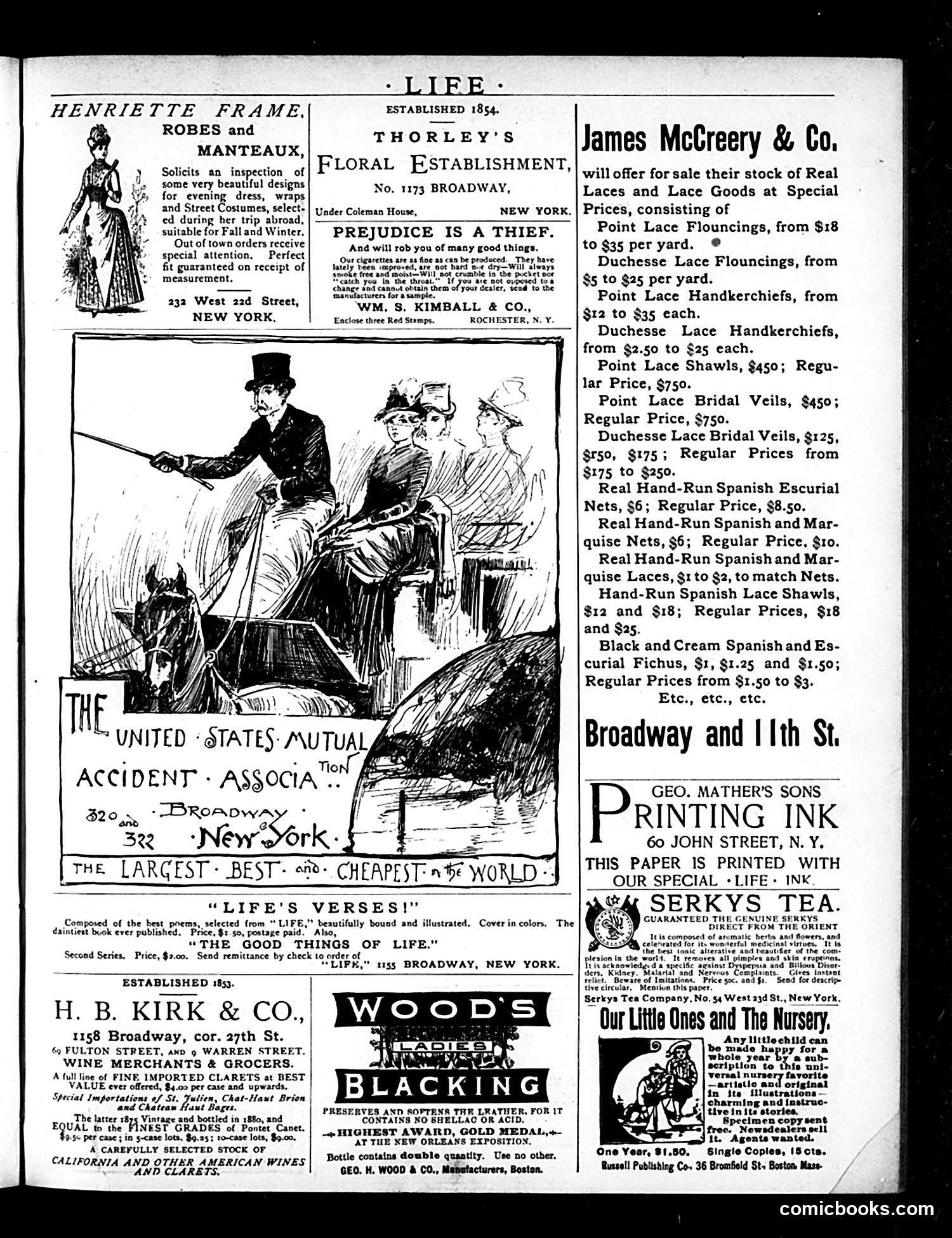
This is primarily an **advertising page** from Life magazine, not a political cartoon page. The dominant image is a satirical advertisement for **The United States Mutual Accident Association** (insurance company). ## The Main Cartoon The illustration depicts three well-dressed Victorian-era figures in a small boat on rough water. One man poles the boat with a long oar while two women sit precariously. The caption reads "THE LARGEST, BEST, AND CHEAPEST IN THE WORLD"—this is ironic commentary on accident insurance. **The satire:** The cartoon mocks accident insurance by showing customers literally in danger (unstable boat situation), suggesting the insurance company won't actually protect them despite advertising claims. It's a visual pun: those who buy this insurance remain vulnerable to accidents anyway. The phrase "PREJUDICE IS A THIEF" (for cigarettes) and other ads fill the remainder of the page, typical of Life's era when satirical magazines relied heavily on advertisements to fund operations.
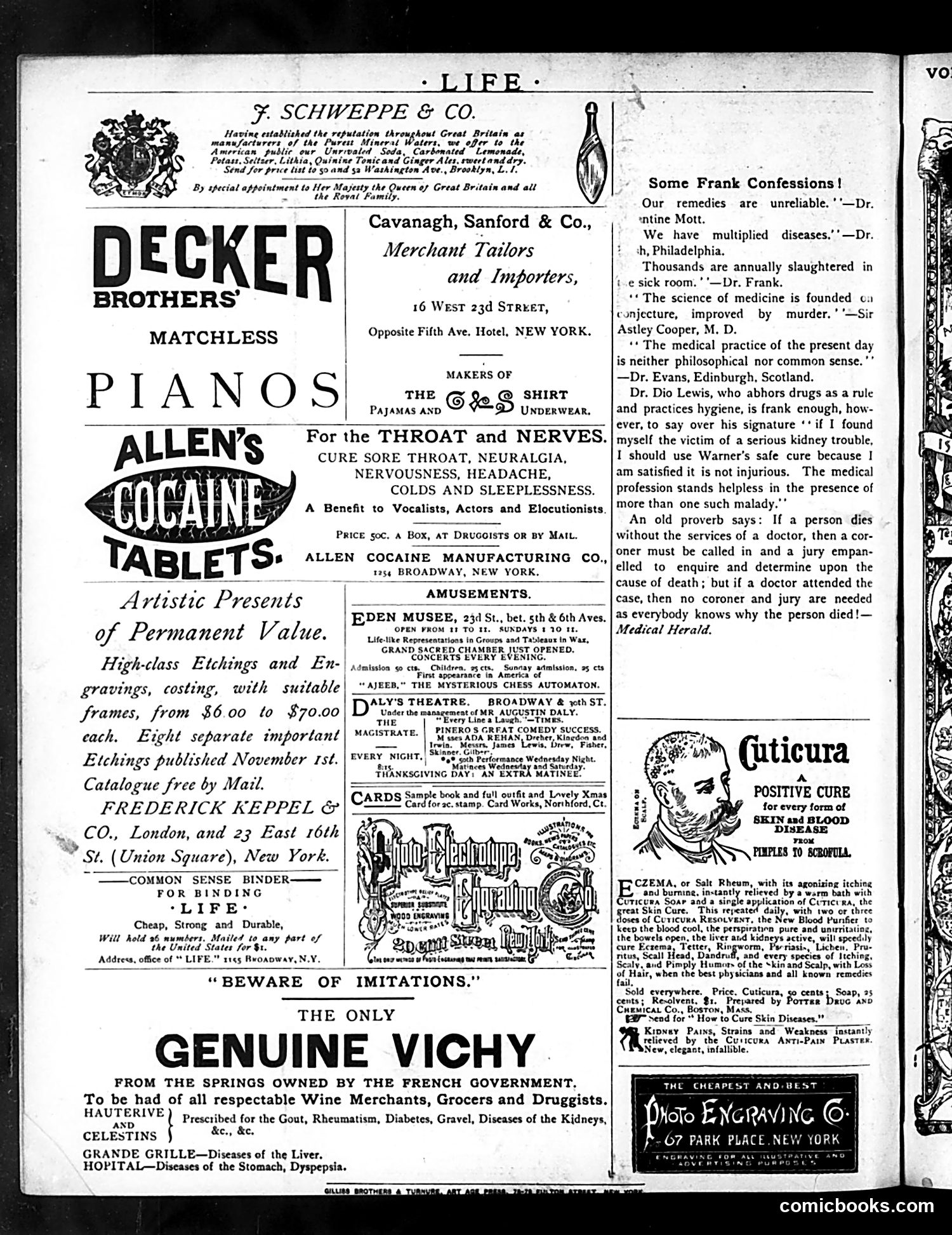
This page is primarily **advertising**, not editorial satire. It contains various commercial advertisements from the late 19th/early 20th century, including: - **Decker Brothers Pianos** and Allen's Cocaine Tablets (marketed for sore throats and nerves) - **Cuticura products** for skin conditions - **Vichy mineral water** (prescribed for gout and kidney diseases) - **Photo Engraving Company** services The only editorial content is "Some Frank Confessions," a brief satirical column mocking the medical profession, quoting doctors admitting their remedies are "unreliable" and that medical practice lacks scientific foundation. The advertisements themselves reveal period attitudes: cocaine and mercury-based treatments were marketed as legitimate remedies. The satire targets medical charlatanism, which was widespread during this era before modern drug regulation.