
Life, 1885-11-26 · page 5 of 16
Life — November 26, 1885 — page 5: what you’re looking at
What you’re looking at
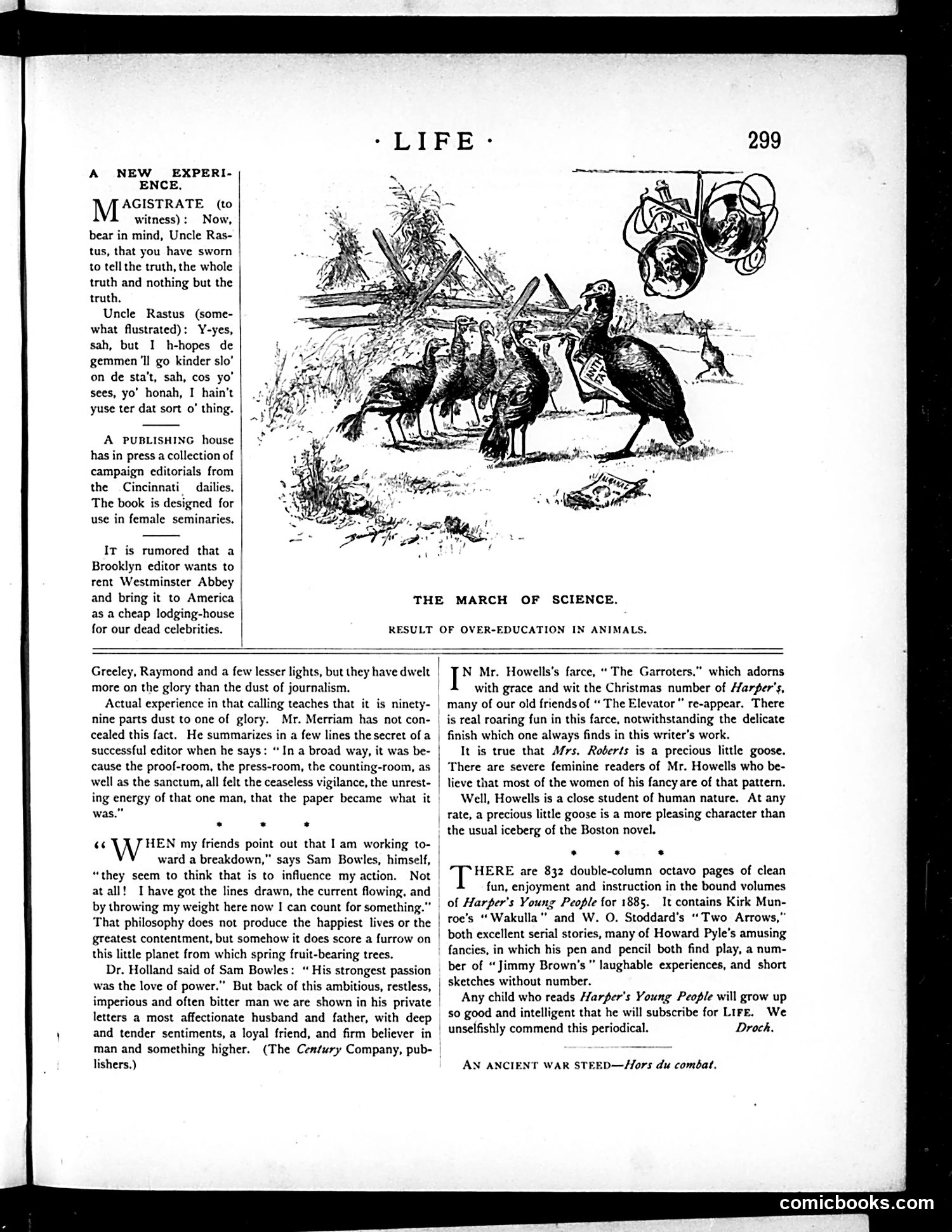
This cartoon satirizes the concept of over-educating animals, likely referencing contemporary debates about animal training and education. The illustration shows various animals (appearing to include birds and possibly other creatures) engaged in what seems like schooling or civilized activity, with one figure appearing to instruct or oversee them. The satire appears to mock the notion that animals could or should be subjected to human-style education and refinement—a commentary on either excessive scientific experimentation with animals or perhaps misguided attempts at "civilizing" nature. The title "Result of Over-Education in Animals" suggests the cartoon criticizes this practice as unnatural or absurd. Without identifying specific animals or instructors clearly, the overall point seems to be satirizing pseudoscientific or foolish notions about animal capability.
📄 Transcribed text from this page (OCR, searchable)
Machine-transcribed from the original scan — historical spelling and the odd misread are preserved.
A NEW _ EXPERI- ENCE, AGISTRATE (to witness): Now, bear in mind, Uncle Ras- | tus, that you have sworn to tell the truth, the whole truth and nothing but the truth, Uncle Rastus (some- what flustrated): Y-yes, sah, but I h-hopes de gemmen ‘ll go kinder slo’ on de sta't, sah, cos yo’ sees, yo’ honah, I hain’t yuse ter dat sort o' thing. A PUBLISHING house has in press a collection of | campaign editorials from | the Cincinnati dailies. The book is designed for use in female seminaries. IT is rumored that a Brooklyn editor wants to | rent Westminster Abbey | and bring it to America | as a cheap lodging-house for our dead celebrities. RESULT OF OVER-EDUCATION IN THE MARCH OF SCIENCE. IMALS. Greeley, Raymond and a few lesser lights, but they have dwelt more on the glory than the dust of journalism. Actual experience in that calling teaches that it is ninety- nine parts dust to one of glory. Mr. Merriam has not con- cealed this fact. He summarizes in a few lines the secret of a successful editor when he says: “In a broad way, it was be- cause the proof-room, the press-room, the counting-room, as well as the sanctum, all felt the ceaseless vigilance, the unrest- ing energy of that one man, that the paper became what it was.” “ HEN my friends point out that I am working to- ward a breakdown,” says Sam Bowles, himself, “they seem to think that is to influence my action. Not atall! I have got the lines drawn, the current flowing, and by throwing my weight here now I can count for something.” That philosophy does not produce the happiest lives or the | greatest contentment, but somehow it does score a furrow on | this little planet from which spring fruit-bearing trees. Dr. Holland said of Sam Bowles: “ His strongest passion was the love of power.” But back of this ambitious, restless, imperious and often bitter man we are shown in his private letters a most affectionate husband and father, with deep and tender sentiments, a loyal friend, and firm believer in man and something higher. (The Cen¢ury Company, pub- lishers.) ] N Mr. Howells’s farce, “ The Garroters,” which adorns with grace and wit the Christmas number of Harper's, many of our old friends of “ The Elevator” re-appear. There is real roaring fun in this farce, notwithstanding the delicate finish which one always finds in this writer’s work. | It is true that AM/rs. Roberts is a precious little goose. | There are severe feminine readers of Mr. Howells who be- | lieve that most of the women of his fancy are of that pattern. Well, Howells is a close student of human nature. At any rate, a precious little goose is a more pleasing character than the usual iceberg of the Boston novel. . * . HERE are 832 double-column octavo pages of clean fun, enjoyment and instruction in the bound volumes of Harper's Young People for 1885. It contains Kirk Mun- | roe’s “ Wakulla” and W. O. Stoddard’s “Two Arrows,” both excellent serial stories, many of Howard Pyle’s amusing fancies, in which his pen and pencil both find play, a num- ber of “Jimmy Brown's” laughable experiences, and short sketches without number. Any child who reads Harper's Young People will grow up so good and intelligent that he will subscribe for LIFE. We unselfishly commend this periodical. Droch. AN ANCIENT WAR STEED—Hors du combat, comicbooks.com