
Life, 1885-11-26 · page 4 of 16
Life — November 26, 1885 — page 4: what you’re looking at
What you’re looking at
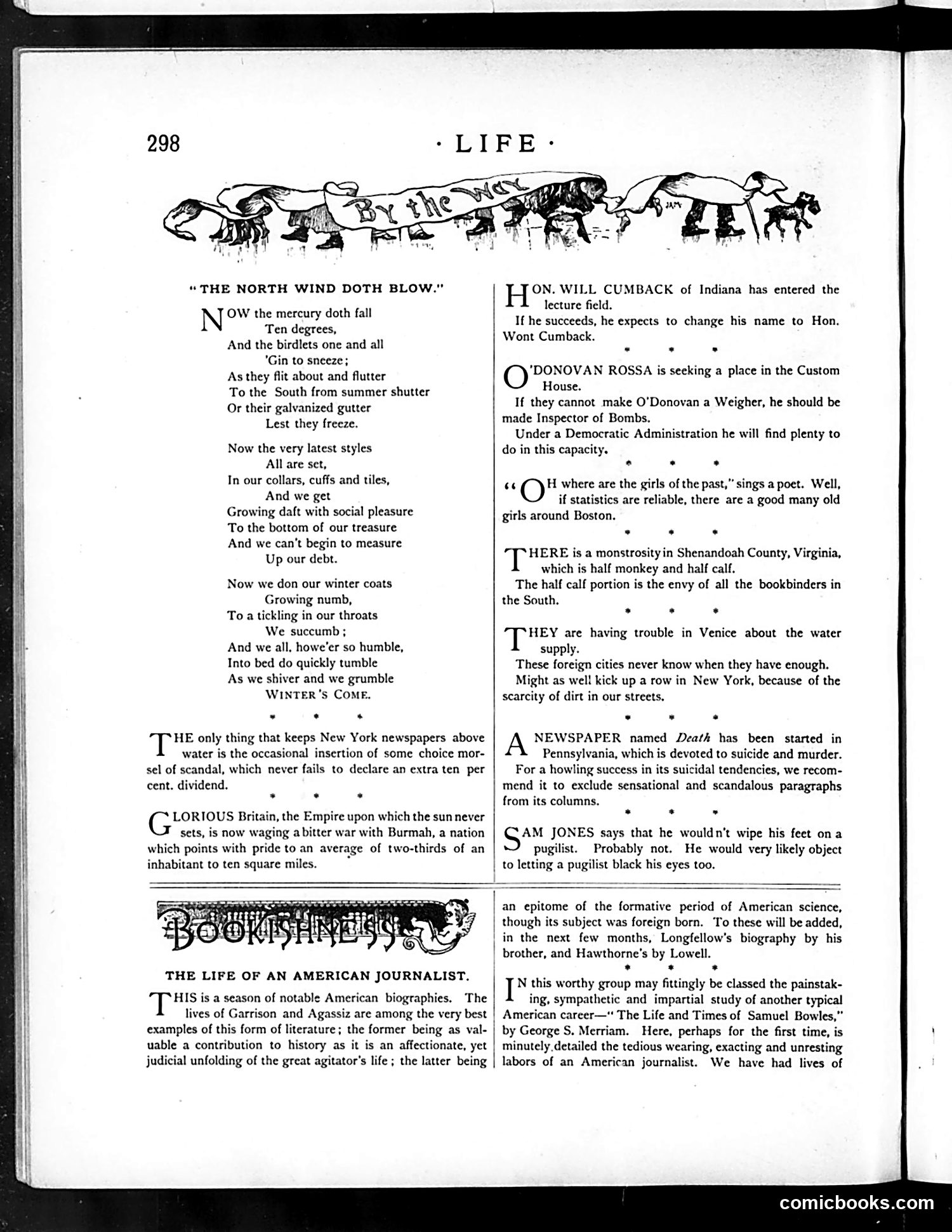
The page contains satirical commentary rather than political cartoons. The header "By the Way" decorative element shows animals in a procession. **Key satirical items:** 1. **"The North Wind Doth Blow"** - A poem mocking fashionable winter clothing and New York's financial struggles, suggesting newspapers stay afloat only through sensational stories offering extra dividends. 2. **Brief jabs** at political figures: Hon. Will Cumback (entering lectures), O'Donovan Rossa (seeking a Custom House position), and Sam Jones (the pugilist reference). 3. Commentary on Venice's water supply crisis and comparing it to New York's street cleanliness. 4. A newspaper called *Death* devoted to suicide and murder coverage. The satire targets contemporary politics, journalism sensationalism, and urban problems without specific detailed illustrations visible in this text-heavy page.
📄 Transcribed text from this page (OCR, searchable)
Machine-transcribed from the original scan — historical spelling and the odd misread are preserved.
“THE NORTH WIND DOTH BLOW." N OW the mercury doth fall Ten degrees, And the birdlets one and all ‘Gin to sneeze; As they flit about and flutter To the South from summer shutter Or their galvanized gutter Lest they freeze. Now the very latest styles All are set, In our collars, cuffs and tiles, And we get Growing daft with social pleasure To the bottom of our treasure And we can't begin to measure Up our debt. Now we don our winter coats Growing numb, To a tickling in our throats We succumb ; And we all, howe’er so humble, Into bed do quickly tumble As we shiver and we grumble WINTER'S COME. . . . HE only thing that keeps New York newspapers above water is the occasional insertion of some choice mor- sel of scandal, which never fails to declare an extra ten per cent. dividend, . . . LORIOUS Britain, the Empire upon which the sun never sets, is now waging a bitter war with Burmah, a nation which points with pride to an average of two-thirds of an inhabitant to ten square miles. . ON. WILL CUMBACK of Indiana has entered the lecture field. If he succeeds, he expects to change his name to Hon, Wont Cumback. . . . es ROSSA is seeking a place in the Custom House. If they cannot make O'Donovan a Weigher, he should be made Inspector of Bombs. Under a Democratic Administration he will find plenty to do in this capacity. . . . “ H where are the girls of the past,” sings a poet. Well, if statistics are reliable, there are a good many old girls around Boston. . . . HERE is a monstrosity in Shenandoah County, Virginia, which is half monkey and half calf. The half calf portion is the envy of all the bookbinders in the South. . . . HEY are having trouble in Venice about the water supply. These foreign cities never know when they have enough. Might as wel! kick up a row in New York, because of the scarcity of dirt in our streets. NEWSPAPER named Death has been started in Pennsylvania, which is devoted to suicide and murder. For a howling success in its suicidal tendencies, we recom- mend it to exclude sensational and scandalous paragraphs from its columns. . AM JONES says that he wouldn't wipe his feet ona pugilist. Probably not. He would very likely object | to letting a pugilist black his eyes too. THE LIFE OF AN AMERICAN JOURNALIST. HIS is a season of notable American biographies. The lives of Garrison and Agassiz are among the very best examples of this form of literature; the former being as val- uable a contribution to history as it is an affectionate, yet judicial unfolding of the great agitator's life ; the latter being an epitome of the formative period of American science, though its subject was foreign born. ‘To these will be added, | in the next few months, Longfellow’s biography by his | brother, and Hawthorne's by Lowell. . * . I N this worthy group may fittingly be classed the painstak- ing, sympathetic and impartial study of another typical American carcer—“ The Life and Times of Samuel Bowles,” by George S. Merriam. Here, perhaps for the first time, is minutely detailed the tedious wearing, exacting and unresting labors of an American journalist. We have had lives of comicbooks.com