
Life, 1885-11-26 · page 2 of 16
Life — November 26, 1885 — page 2: what you’re looking at
What you’re looking at
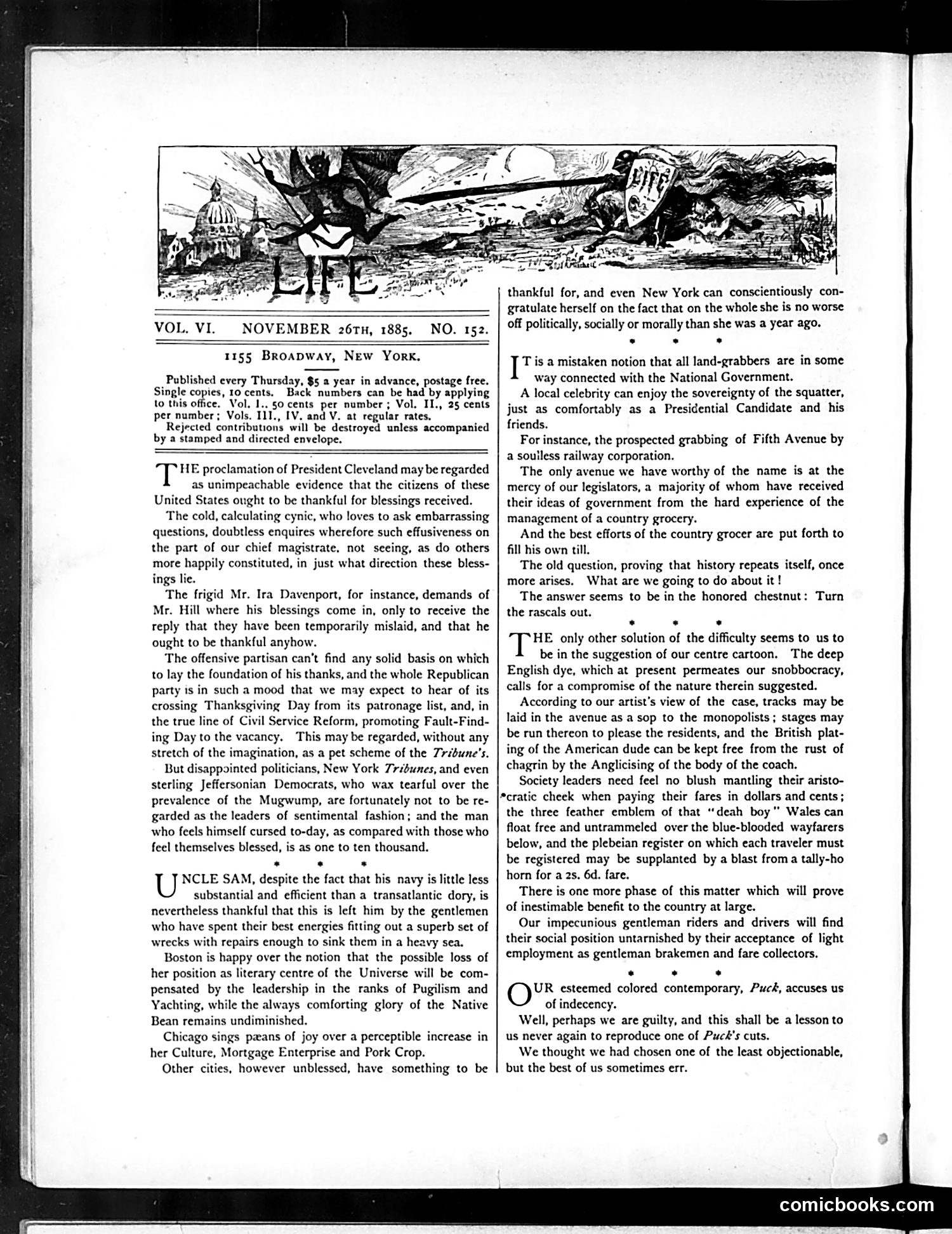
The masthead cartoon depicts what appears to be a chaotic scene with classical architecture (possibly the Capitol dome) amid destruction or turmoil, though specific figures are unclear from the image quality. The editorial content satirizes President Cleveland's proclamation as evidence of national discord. It mocks "land-grabbers" and railway corporations threatening Fifth Avenue, criticizing legislators who've learned governance "from hard experience of the management of a country grocery." The piece proposes absurd solutions like laying streetcar tracks as a "sop to monopolists," with satirical suggestions about "dead boy" Wales and registration for "gentleman trackmen and fare collectors"—mocking both urban development conflicts and the social pretensions of the era. The tone targets both corrupt business interests and ineffectual political responses to Gilded Age problems.
📄 Transcribed text from this page (OCR, searchable)
Machine-transcribed from the original scan — historical spelling and the odd misread are preserved.
VOL. VI. NOVEMBER 26tH, 1885. NO. 152. 1155 Broapway, New York. _Published every Thursday, $5 a year in advance, postage free. Single copies, 10 cents, Back numbers can be had by applying to this office. Vol. 1.. 50 cents per number ; Vol. II., 25 cents per number; Vols. I1I., IV. and V. at regular rates, Rejected contributions will be destroyed unless accompanied by a stamped and directed envelope. HE proclamation of President Cleveland may be regarded as unimpeachable evidence that the citizens of these United States ought to be thankful for blessings received. The cold, calculating cynic, who loves to ask embarrassing questions, doubtless enquires wherefore such effusiveness on the part of our chief magistrate, not seeing, as do others more happily constituted, in just what direction these bless- ings lie. The frigid Mr. Ira Davenport, for instance, demands of Mr. Hill where his blessings come in, only to receive the reply that they have been temporarily mislaid, and that he ought to be thankful anyhow. The offensive partisan can’t find any solid basis on which to lay the foundation of his thanks, and the whole Republican party is in such a mood that we may expect to hear of its crossing Thanksgiving Day from its patronage list, and, in the true line of Civil Service Reform, promoting Fault-Find- ing Day to the vacancy. This may be regarded, without any stretch of the imagination, as a pet scheme of the 7rsbune’s. But disappointed politicians, New York 7ribunes, and even sterling Jeffersonian Democrats, who wax tearful over the thankful for, and even New York can conscientiously con- gratulate herself on the fact that on the whole she is no worse off politically, socially or morally than she was a year ago. . . . T is a mistaken notion that all land-grabbers are in some way connected with the National Government. A local celebrity can enjoy the sovereignty of the squatter, just as comfortably as a Presidential Candidate and his friends. For instance, the prospected grabbing of Fifth Avenue by a souiless railway corporation. The only avenue we have worthy of the name is at the mercy of our legislators, a majority of whom have received their ideas of government from the hard experience of the management of a country grocery. And the best efforts of the country grocer are put forth to fill his own till. The old question, proving that history repeats itself, once more arises. What are we going to do about it! The answer seems to be in the honored chestnut: Turn the rascals out. . . HE only other solution of the difficulty seems to us to be in the suggestion of our centre cartoon. The deep English dye, which at present permeates our snobbocracy, calls for a compromise of the nature therein suggested. According to our artist's view of the case, tracks may be laid in the avenue as a sop to the monopolists ; stages may be run thereon to please the residents, and the British plat- ing of the American dude can be kept free from the rust of chagrin by the Anglicising of the body of the coach. Society leaders need feel no blush mantling their aristo- prevalence of the Mugwump, are fortunately not to be re- |*cratic cheek when paying their fares in dollars and cents; garded as the leaders of sentimental fashion; and the man who feels himself cursed to-day, as compared with those who feel themselves blessed, is as one to ten thousand. . . . NCLE SAM, despite the fact that his navy is little less substantial and efficient than a transatlantic dory, is nevertheless thankful that this is left him by the gentlemen who have spent their best energies fitting out a superb set of wrecks with repairs enough to sink them in a heavy sea. Boston is happy over the notion that the possible loss of her position as literary centre of the Universe will be com- pensated by the leadership in the ranks of Pugilism and Yachting, while the always comforting glory of the Native Bean remains undiminished. Chicago sings paans of joy over a perceptible increase in her Culture, Mortgage Enterprise and Pork Crop. Other cities, however unblessed, have something to be the three feather emblem of that “deah boy" Wales can float free and untrammeled over the blue-blooded wayfarers below, and the plebeian register on which each traveler must be registered may be supplanted by a blast froma tally-ho horn for a 2s. 6d. fare. There is one more phase of this matter which will prove of inestimable benefit to the country at large. Our impecunious gentleman riders and drivers will find their social position untarnished by their acceptance of light employment as gentleman brakemen and fare collectors. . . . UR esteemed colored contemporary, Puck, accuses us of indecency. Well, perhaps we are guilty, and this shall be a lesson to us never again to reproduce one of Puck's cuts. We thought we had chosen one of the least objectionable, but the best of us sometimes err. comicbooks.com