
Life, 1885-11-26 · page 7 of 16
Life — November 26, 1885 — page 7: what you’re looking at
What you’re looking at
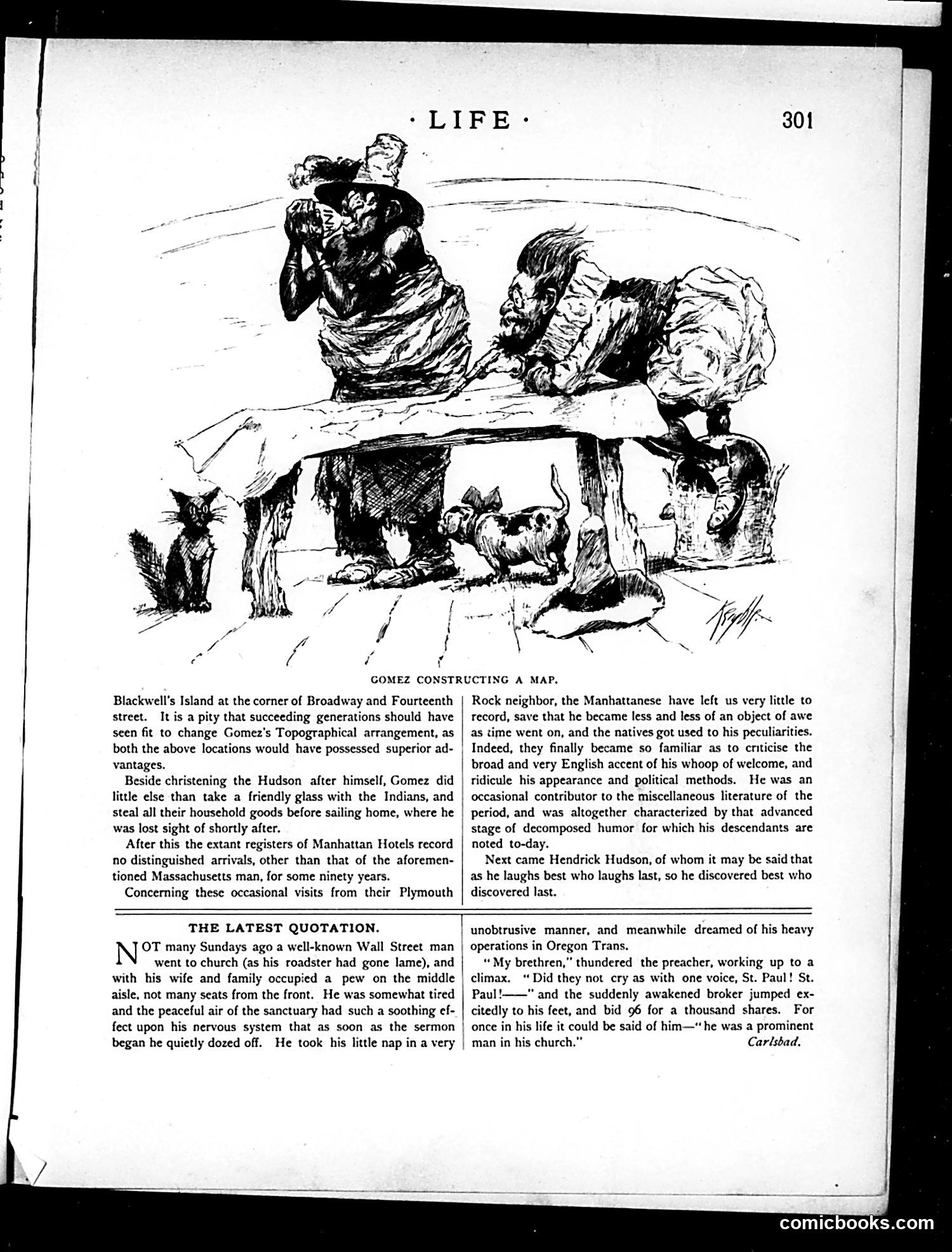
The cartoon depicts **Gomez**, apparently a historical Native American figure associated with Manhattan, attempting to make a map while surrounded by Europeans and animals in a crude shelter. The accompanying text discusses Gomez's role in early Manhattan history—specifically how he assisted Hudson and later became a fixture in Manhattan Hotels, leaving limited historical records of his contributions. The satire appears to critique the erasure of Native American history: despite Gomez's documented presence and usefulness to European colonizers, historical records are sparse. The image of him "constructing a map" likely mocks how indigenous peoples' knowledge was appropriated by colonizers while their own narratives remained marginalized or lost to history.
📄 Transcribed text from this page (OCR, searchable)
Machine-transcribed from the original scan — historical spelling and the odd misread are preserved.
GOMEZ CONSTRUCTING A MAP. Blackwell's Island at the corner of Broadway and Fourteenth street. It is a pity that succeeding generations should have seen fit to change Gomez's Topographical arrangement, as both the above locations would have possessed superior ad- vantages. Beside christening the Hudson after himself, Gomez did little else than take a friendly glass with the Indians, and steal all their household goods before sailing home, where he | was lost sight of shortly after. After this the extant registers of Manhattan Hotels record no distinguished arrivals, other than that of the aforemen- tioned Massachusetts man, for some ninety years. Concerning these occasional visits from their Plymouth Rock neighbor, the Manhattanese have left us very little to record, save that he became less and less of an object of awe as time went on, and the natives got used to his peculiarities. Indeed, they finally became so familiar as to criticise the broad and very English accent of his whoop of welcome, and ridicule his appearance and political methods. He was an occasional contributor to the miscellaneous literature of the period, and was altogether characterized by that advanced stage of decomposed humor for which his descendants are noted to-day. Next came Hendrick Hudson, of whom it may be said that as he laughs best who laughs last, so he discovered best who discovered last. THE LATEST QUOTATION. N OT many Sundays ago a well-known Wall Street man went to church (as his roadster had gone lame), and with his wife and family occupied a pew on the middle aisle, not many seats from the front. He was somewhat tired and the peaceful air of the sanctuary had such a soothing ef- unobtrusive manner, and meanwhile dreamed of his heavy operations in Oregon Trans. “My brethren,” thundered the preacher, working up to a climax. “Did they not cry as with one voice, St. Paul! St. Paul!——” and the suddenly awakened broker jumped ex- citedly to his feet, and bid 96 for a thousand shares. For fect upon his nervous system that as soon as the sermon | once in his life it could be said of him—“ he was a prominent began he quietly dozed off. He took his little nap in a very | man in his church.” Carlsbad. comicbooks.com