
Life, 1885-11-26 · page 10 of 16
Life — November 26, 1885 — page 10: what you’re looking at
What you’re looking at
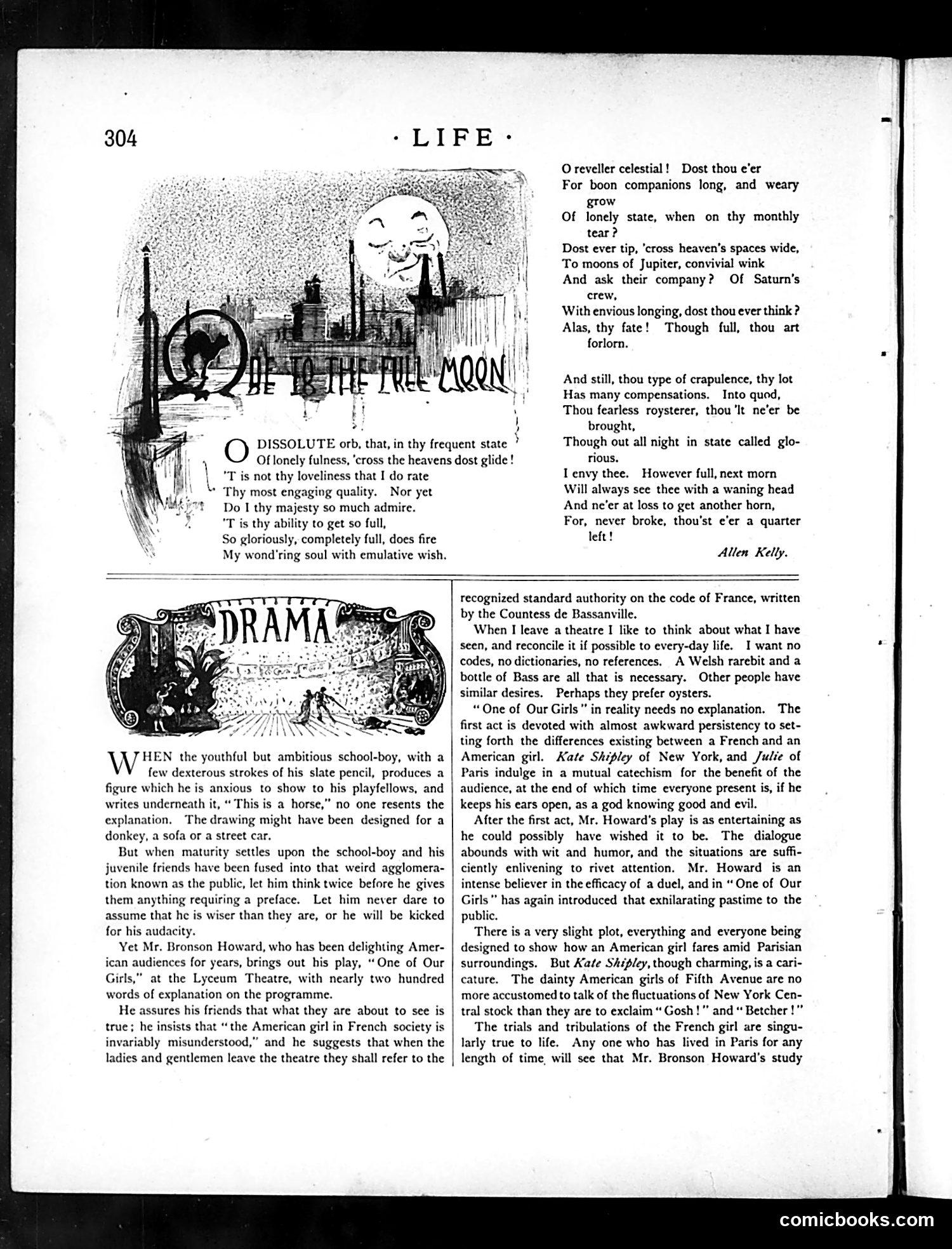
The upper cartoon features a humorous poem by Allen Kelly addressing the moon as a "dissolute orb." The satire mocks human envy of celestial bodies: the moon can get "gloriously, completely full," never faces legal consequences for its nocturnal revelry, and always has "a quarter left"—a clever pun on both lunar phases and drinking. The poem playfully suggests the moon lives without consequences or financial worry, unlike humans. # Theater Criticism: "One of Our Girls" The lower section reviews Bronson Howard's play, criticizing its heavy-handed explanation. Howard provides extensive program notes insisting the American girl in French society is "invariably misunderstood" and even recommends the Countess de Bassanville's etiquette manual. The critic mocks this didacticism, arguing audiences need no such guidance—just "a Welsh rarebit and a bottle of Bass." The play itself, about contrasting French and American female characters, apparently requires no explanation despite Howard's anxiety.
📄 Transcribed text from this page (OCR, searchable)
Machine-transcribed from the original scan — historical spelling and the odd misread are preserved.
DISSOLUTE orb, that, in thy frequent state ? Of lonely fulness, ‘cross the heavens dost glide ! ‘T is not thy loveliness that I do rate \ \ Thy most engaging quality. Nor yet t Do I thy majesty so much admire. 'T is thy ability to get so full, So gloriously, completely full, does fire My wond'ring soul with emulative wish, Oreveller celestial! Dost thou e’er For boon companions long, and weary grow Of lonely state, when on thy monthly tear? Dost ever tip, ‘cross heaven's spaces wide, To moons of Jupiter, convivial wink And ask their company? Of Saturn’s crew, With envious longing, dost thou ever think ? Alas, thy fate! Though full, thou art forlorn. And still, thou type of crapulence, thy lot Has many compensations. Into quod, Thou fearless roysterer, thou ‘It ne’er be brought, Though out all night in state called glo- rious, Tenvy thee. However full, next morn Will always see thee with a waning head And ne'er at loss to get another horn, For, never broke, thou'st e’er a quarter left! Allen Kelly. V HEN the youthful but ambitious school-boy, with a few dexterous strokes of his slate pencil, produces a figure which he is anxious to show to his playfellows, and writes underneath it, “ This is a horse,” no one resents the explanation. The drawing might have been designed for a donkey, a sofa or a street car. But when maturity settles upon the school-boy and his juvenile friends have been fused into that weird agglomera- tion known as the public, let him think twice before he gives them anything requiring a preface. Let him never dare to assume that he is wiser than they are, or he will be kicked for his audacity. Yet Mr. Bronson Howard, who has been delighting Amer- ican audiences for years, brings out his play, “One of Our Girls," at the Lyceum Theatre, with nearly two hundred words of explanation on the programme. He assures his friends that what they are about to see is | true; he insists that “the American girl in French society is invariably misunderstood,” and he suggests that when the ladies and gentlemen leave the theatre they shall refer to the recognized standard authority on the code of France, written by the Countess de Bassanville. When I leave a theatre I like to think about what I have seen, and reconcile it if possible to every-day life. I want no codes, no dictionaries, no references. A Welsh rarebit and a bottle of Bass are all that is necessary. Other people have similar desires. Perhaps they prefer oysters. “One of Our Girls” in reality needs no explanation. The | first act is devoted with almost awkward persistency to set- ting forth the differences existing between a French and an American girl. Kate Shipley of New York, and /ulse of Paris indulge in a mutual catechism for the benefit of the audience, at the end of which time everyone present is, if he keeps his ears open, as a god knowing good and evil. After the first act, Mr. Howard's play is as entertaining as he could possibly have wished it to be. The dialogue abounds with wit and humor, and the situations are suffi- ciently enlivening to rivet attention. Mr. Howard is an intense believer in the efficacy of a duel, and in “ One of Our Girls” has again introduced that exnilarating pastime to the public. There is a very slight plot, everything and everyone being designed to show how an American girl fares amid Parisian surroundings. But Kate Ship/ey, though charming, is a cari- cature. The dainty American girls of Fifth Avenue are no more accustomed to talk of the fluctuations of New York Cen- tral stock than they are to exclaim “ Gosh!" and “ Betcher !” The trials and tribulations of the French girl are singu- larly true to life. Any one who has lived in Paris for any length of time, will see that Mr. Bronson Howard's study comicbooks.com