
Life, 1885-11-26 · page 6 of 16
Life — November 26, 1885 — page 6: what you’re looking at
What you’re looking at
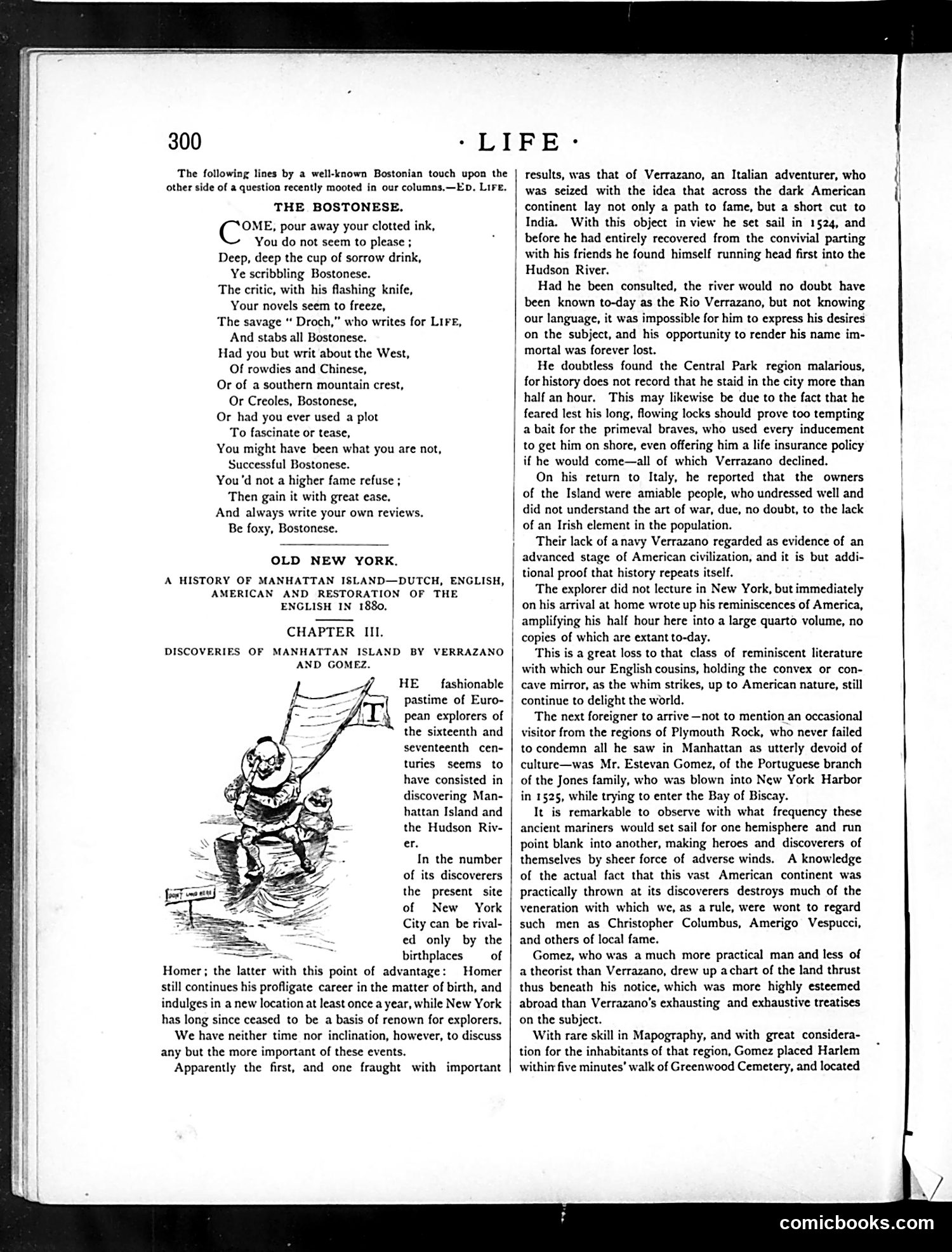
This page contains two distinct elements: 1. **"The Bostonese" poem** (top left): A satirical verse mocking Boston intellectuals and their pretensions. It ridicules their affected literary tastes, snobbish attitudes toward "rowdies and Chinese," and self-regard, advising them to abandon their "higher fame" and accept their mediocrity. The satire targets Boston's cultural elite as pompous and out-of-touch. 2. **"Old New York" historical article** (main text): A serious historical piece about early Manhattan explorers, particularly Verrazano and Gomez. It discusses their 16th-century voyages and notes that Gomez's valuable maps were lost, depriving America of important historical records. The small illustration shows a period explorer or sailor figure, supporting the historical content.
📄 Transcribed text from this page (OCR, searchable)
Machine-transcribed from the original scan — historical spelling and the odd misread are preserved.
The following lines by a well-known Bostonian touch upon the other side of a question recently mooted in our columns,—Ep, LiFe. THE BOSTONESE, OME, pour away your clotted ink, You do not seem to please ; Deep, deep the cup of sorrow drink, Ye scribbling Bostonese. The critic, with his flashing knife, Your novels seem to freeze, The savage ‘“ Droch,” who writes for LIFE, And stabs all Bostonese. Had you but writ about the West, Of rowdies and Chinese, Or of a southern mountain crest, Or Creoles, Bostonese, Or had you ever used a plot To fascinate or tease, You might have been what you are not, Successful Bostonese. You'd not a higher fame refuse ; Then gain it with great ease, And always write your own reviews. Be foxy, Bostonese. OLD NEW YORK. A HISTORY OF MANHATTAN ISLAND—DUTCH, ENGLISH, AMERICAN AND RESTORATION OF THE ENGLISH IN 1880, CHAPTER III. DISCOVERIES OF MANHATTAN ISLAND BY VERRAZANO AND GOMEZ. HE fashionable pastime of Euro- pean explorers of the sixteenth and seventeenth cen- turies seems to have consisted in discovering Man- hattan Island and the Hudson Riv- er. In the number of its discoverers the present. site of New York City can be rival- ed only by the birthplaces of Homer; the latter with this point of advantage: still continues his profligate career in the matter of birth, and indulges in a new location at least once a year, while New York has long since ceased to be a basis of renown for explorers. We have neither time nor inclination, however, to discuss any but the more important of these events. Apparently the first, and one fraught with important Homer | - LIFE: results, was that of Verrazano, an Italian adventurer, who was seized with the idea that across the dark American continent lay not only a path to fame, but a short cut to India. With this object in view he set sail in 1524, and before he had entirely recovered from the convivial parting with his friends he found himself running head first into the Hudson River. Had he been consulted, the river would no doubt have been known to-day as the Rio Verrazano, but not knowing our language, it was impossible for him to express his desires on the subject, and his opportunity to render his name im- mortal was forever lost. He doubtless found the Central Park region malarious, for history does not record that he staid in the city more than half an hour. This may likewise be due to the fact that he feared lest his long, flowing locks should prove too tempting a bait for the primeval braves, who used every inducement to get him on shore, even offering him a life insurance policy if he would come—all of which Verrazano declined. On his return to Italy, he reported that the owners of the Island were amiable people, who undressed well and did not understand the art of war, due, no doubt, to the lack of an Irish element in the population. Their lack of anavy Verrazano regarded as evidence of an advanced stage of American civilization, and it is but addi- tional proof that history repeats itself. The explorer did not lecture in New York, but immediately on his arrival at home wrote up his reminiscences of America, amplifying his half hour here into a large quarto volume, no copies of which are extant to-day. This is a great loss to that class of reminiscent literature with which our English cousins, holding the convex or con- cave mirror, as the whim strikes, up to American nature, still continue to delight the world. The next foreigner to arrive —not to mention an occasional visitor from the regions of Plymouth Rock, who never failed to condemn all he saw in Manhattan as utterly devoid of culture—was Mr. Estevan Gomez, of the Portuguese branch of the Jones family, who was blown into New York Harbor in 1525, while trying to enter the Bay of Biscay. It is remarkable to observe with what frequency these ancient mariners would set sail for one hemisphere and run point blank into another, making heroes and discoverers of themselves by sheer force of adverse winds. A knowledge of the actual fact that this vast American continent was practically thrown at its discoverers destroys much of the veneration with which we, as a rule, were wont to regard such men as Christopher Columbus, Amerigo Vespucci, and others of local fame. Gomez, who was a much more practical man and less of a theorist than Verrazano, drew up achart of the land thrust thus beneath his notice, which was more highly esteemed abroad than Verrazano’s exhausting and exhaustive treatises on the subject. With rare skill in Mapography, and with great considera- tion for the inhabitants of that region, Gomez placed Harlem within five minutes’ walk of Greenwood Cemetery, and located comicbooks.com