
A complete issue · 14 pages · 1885
Life — November 12, 1885
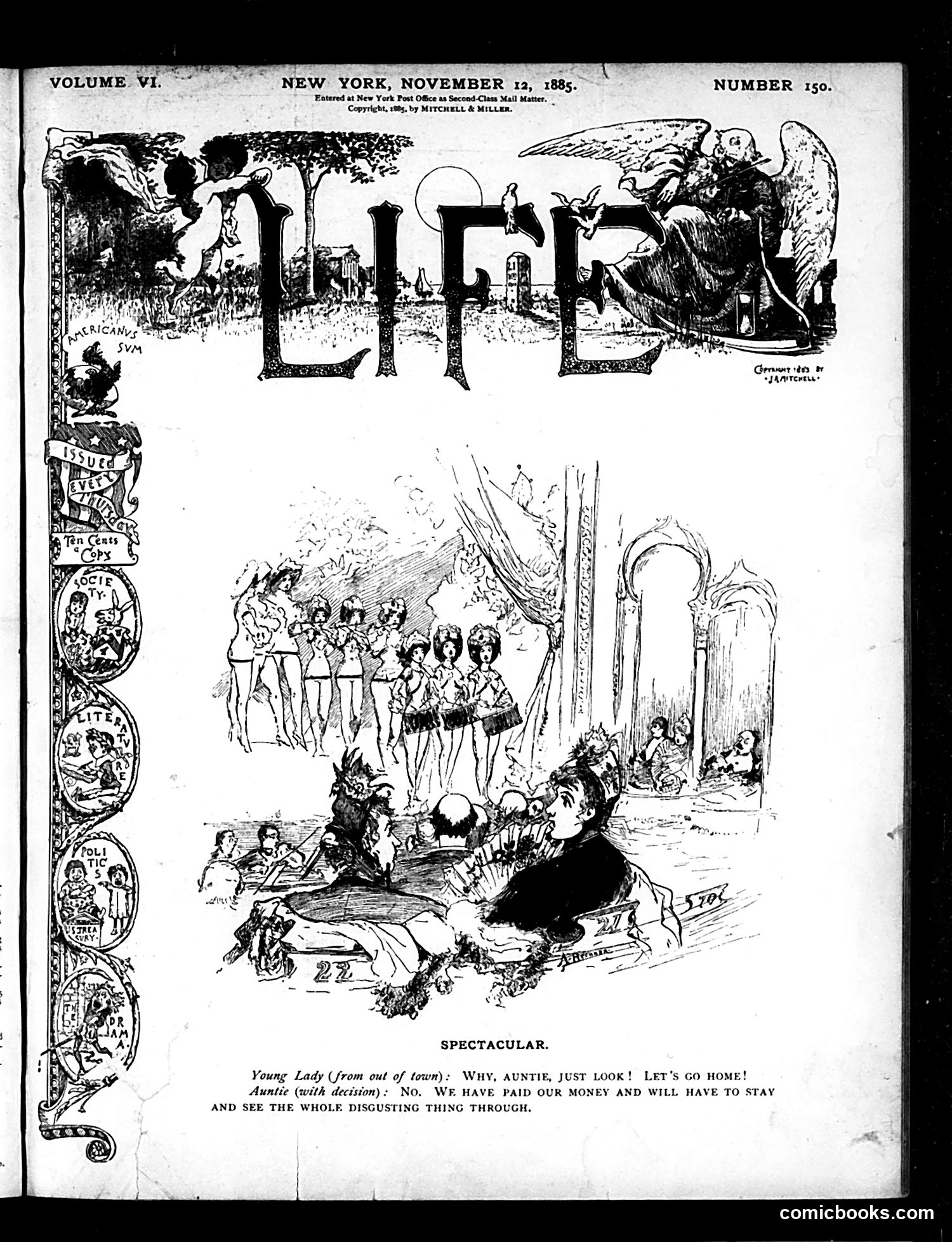
This cartoon satirizes the theatrical spectacle of the era. The scene depicts an elaborate stage production with performers in costume, while in the foreground, two women argue about leaving. The younger woman (from out of town) wants to exit early, but her aunt insists they stay despite finding the show "disgusting"—simply because they've already paid for tickets and must see it through. The satire mocks both the pretentious nature of theatrical entertainment and the stubborn determination to get one's money's worth, regardless of quality or moral objection. It captures a recognizable human behavior: feeling obligated to endure something unpleasant because of sunk costs, a timeless comedy about practicality versus preference.
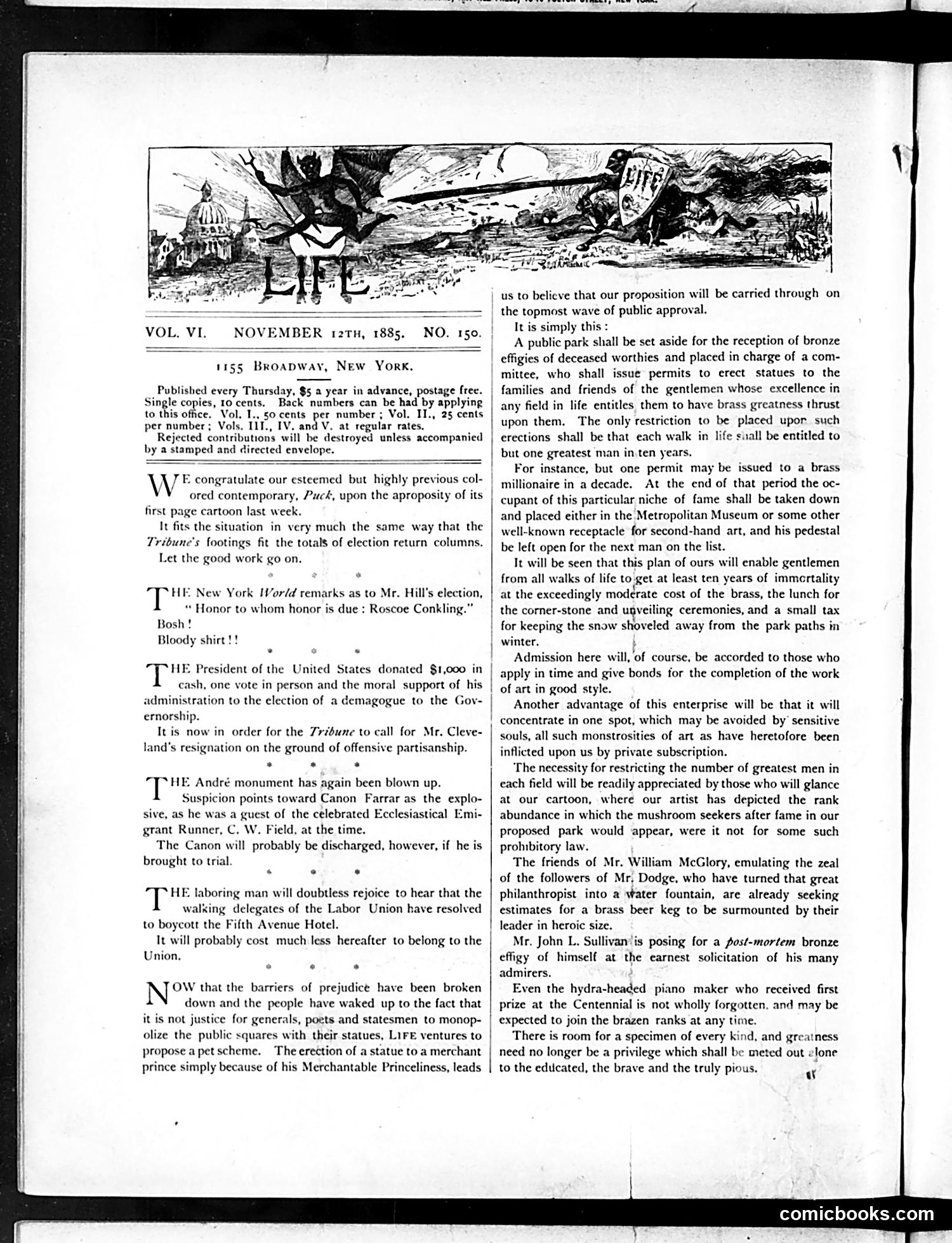
The header cartoon depicts a chaotic scene with a large figure (possibly representing Death or Chaos) looming over a landscape featuring the Eiffel Tower and labeled "LIFE." The image appears satirical about contemporary events or social upheaval. The text discusses monuments and public memorials. It mentions the "André monument" being "blown up," references the Cathedral of Chartres, and discusses proposals for a public park to display bronze effigies of "deceased worthies." The satire seems to mock the impulse to memorialize great men with statuary, suggesting this scheme concentrates "monstrosities" in one location. The piece criticizes the tendency to monopolize public squares with statues of important figures while satirizing the democratic pretense that merit alone determines who gets commemorated.
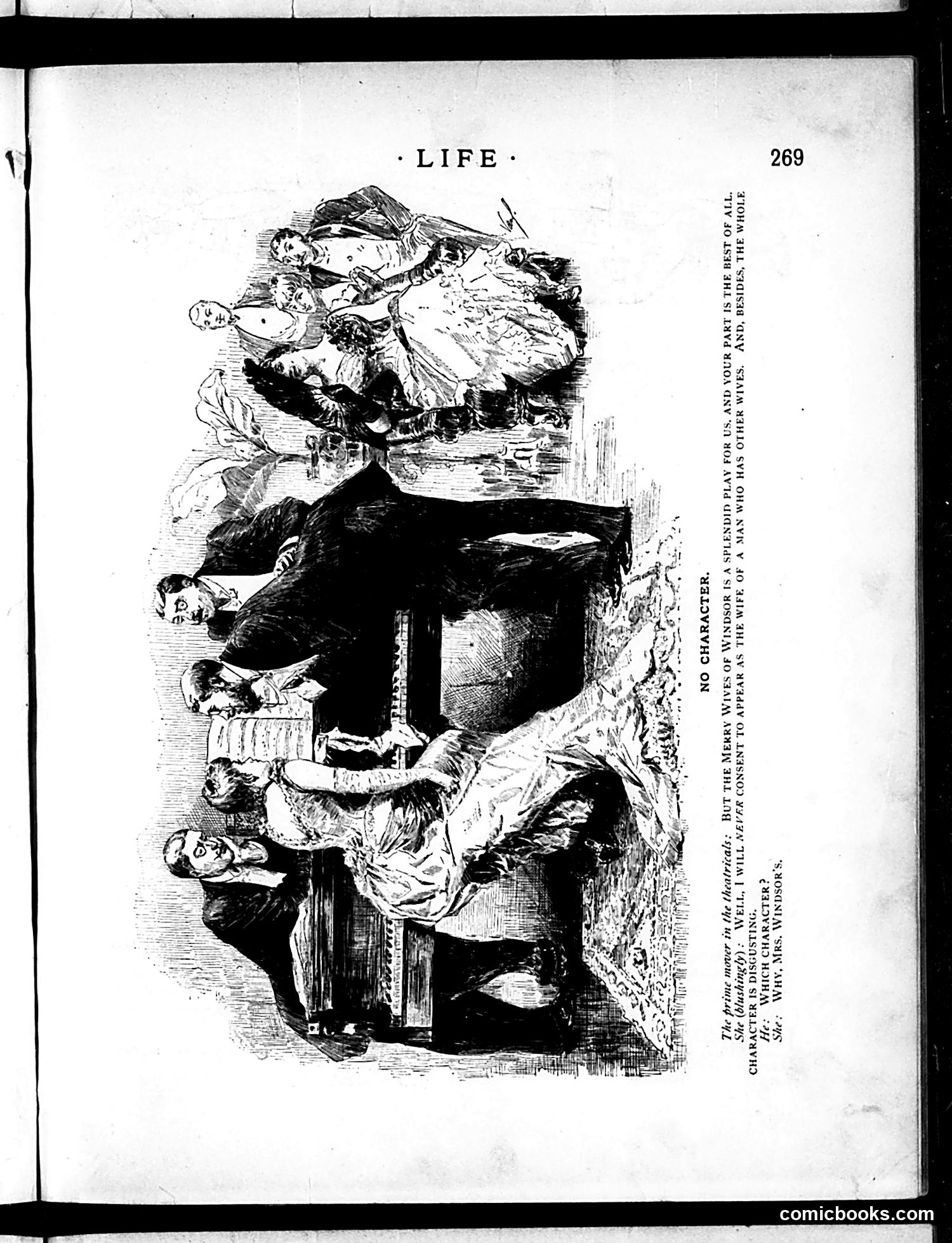
This satirical illustration critiques someone's lack of moral character. The image shows a figure seated in a chair, appearing hollow or empty—literally depicted as an absence where a person should be. Around this void stand several other figures observing the vacant space. The caption "NO CHARACTER" is explicit, and the accompanying text (partially visible) appears to reference someone who lacks integrity or moral standing, suggesting their "character" is essentially nonexistent. Without clearer identifying details or caption text, I cannot definitively name the subject of this satire. However, the visual metaphor—depicting a person as an empty void—powerfully communicates the cartoon's message about moral emptiness. This appears typical of Life magazine's pointed political and social commentary from the early 20th century.
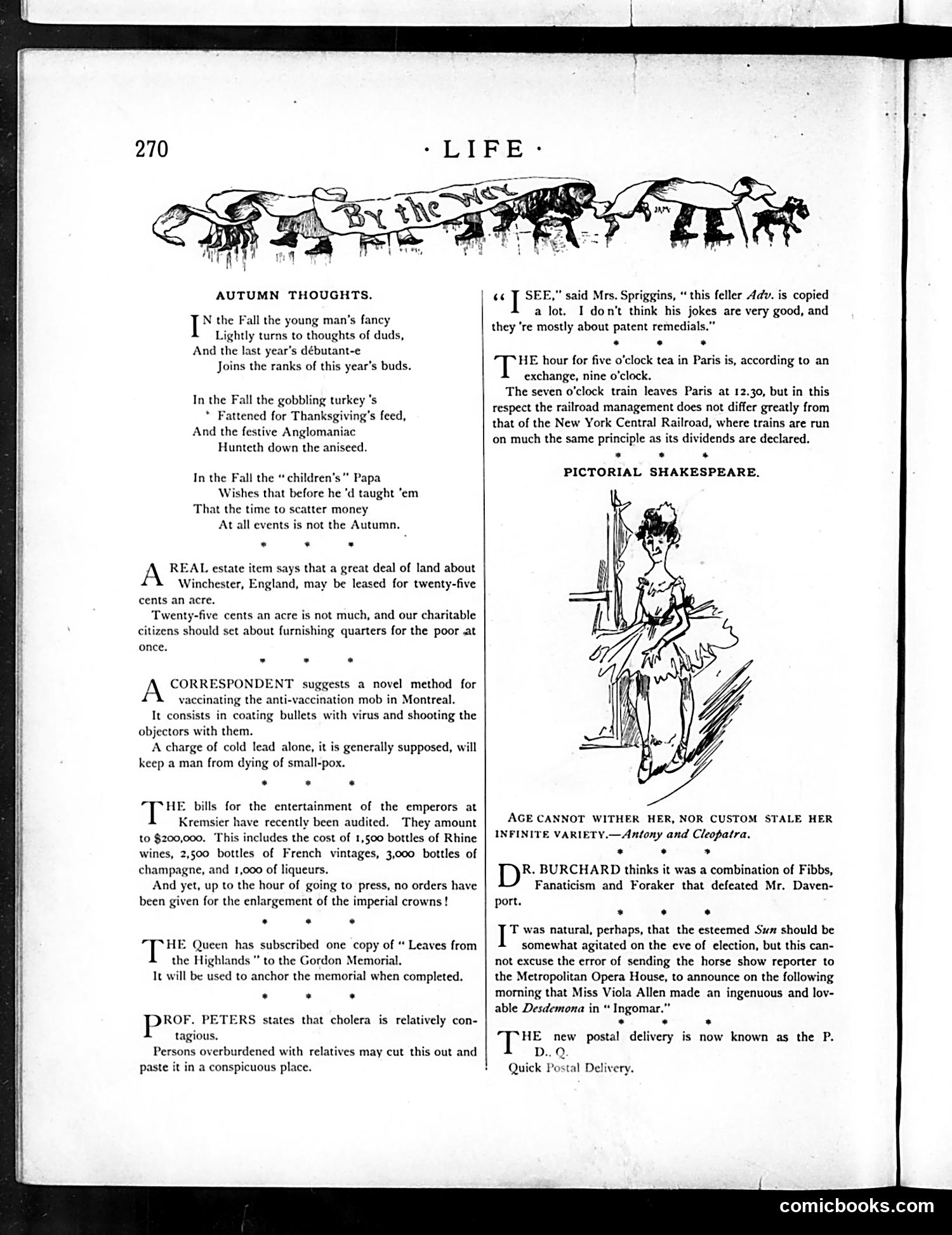
This page contains miscellaneous short humor pieces rather than political cartoons. Key content includes: **"Autumn Thoughts"** — A poem playing on the phrase "Turning to thoughts of duds" (fashionable clothing), using seasonal transitions as metaphor. **"Pictorial Shakespeare"** — An illustration of a woman in classical dress, captioned with a Shakespeare quote about variety and custom. The remaining items are brief satirical notes on various topics: land prices in England, anti-vaccination protests in Montreal, entertainment costs at Russian imperial venues, and postal delivery systems. There are no clearly identifiable political figures or specific current events referenced. The satire is gentle and observational rather than pointed political commentary—typical of Life magazine's general humor content.
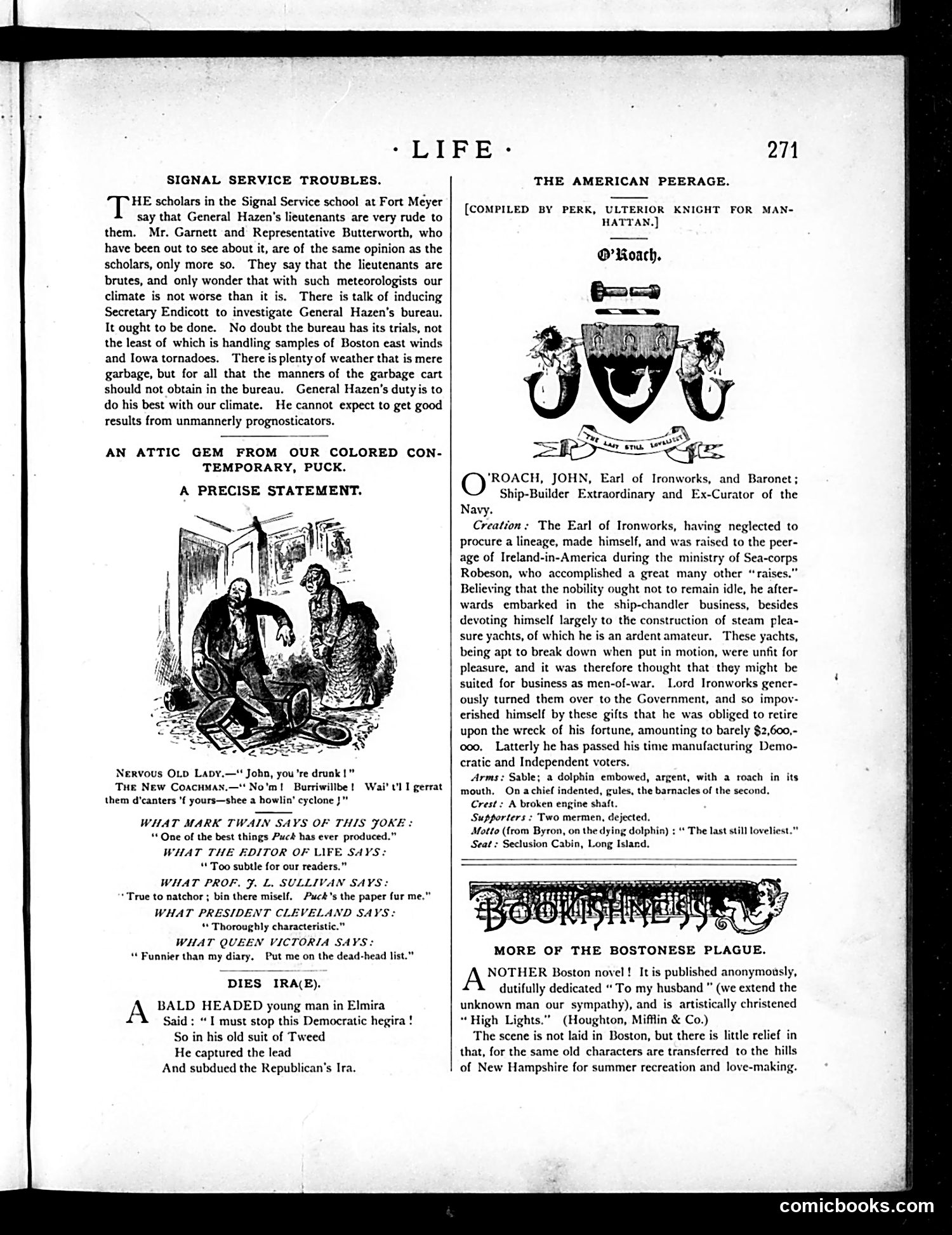
This page contains several satirical pieces targeting late 19th-century American politics and society: **"Signal Service Troubles"** criticizes General Hazen's meteorological bureau, suggesting his weather forecasts are unreliable and comparing the service to "garbage cart" operations. **"The American Peerage"** is a mock-heraldic entry for "O'Roach, John, Earl of Ironworks"—satirizing an Irish-American industrialist who made a fortune building steam yachts but squandered it, eventually becoming dependent on Democratic and Independent voters. The heraldic parody mocks his pretensions to aristocratic status. **"Dies Irae"** is a brief satirical poem about a bald man in Elmira who switched from Democratic to Republican politics—mocking political flip-flopping. **"More of the Bostonese Plague"** advertises a novel set in New Hampshire, suggesting Boston's literary scene is stale or overused.
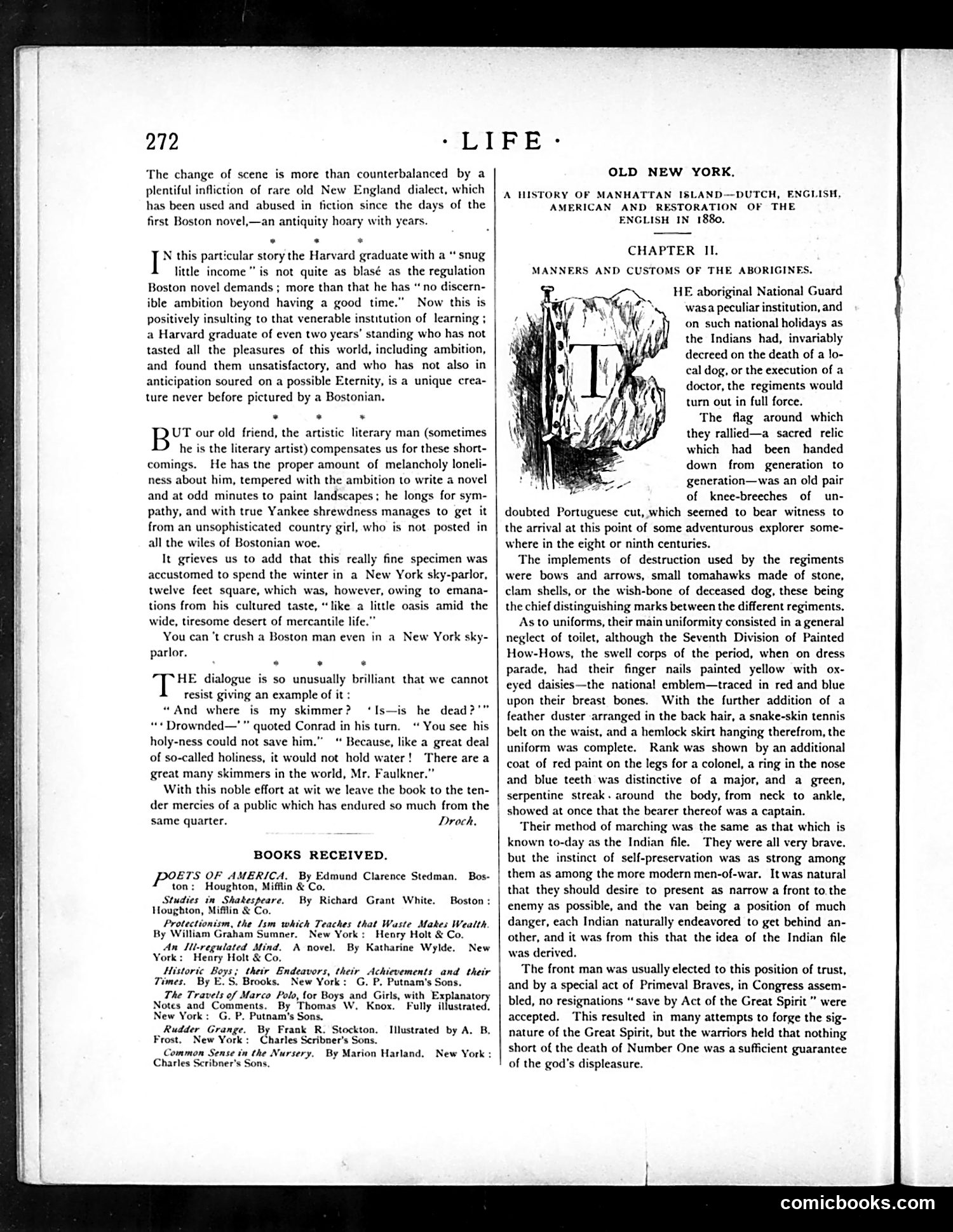
This page is primarily **literary content**, not political satire. The left column contains a book review discussing a novel set in old New York, critiquing a Harvard graduate character for his pretentious writing style. The reviewer praises instead "the artistic literary man" who writes with authentic "Yankee shrewdness." The right side begins "Chapter II" of what appears to be a serialized historical account titled "Old New York," focusing on the manners and customs of indigenous peoples and early colonial military units. It describes their uniforms, weapons, and marching methods. The small decorative illustration shows what appears to be a wrapped bundle or artifact. **This is not political cartoon satire**—it's a literary and historical magazine article page from the 1880s era.
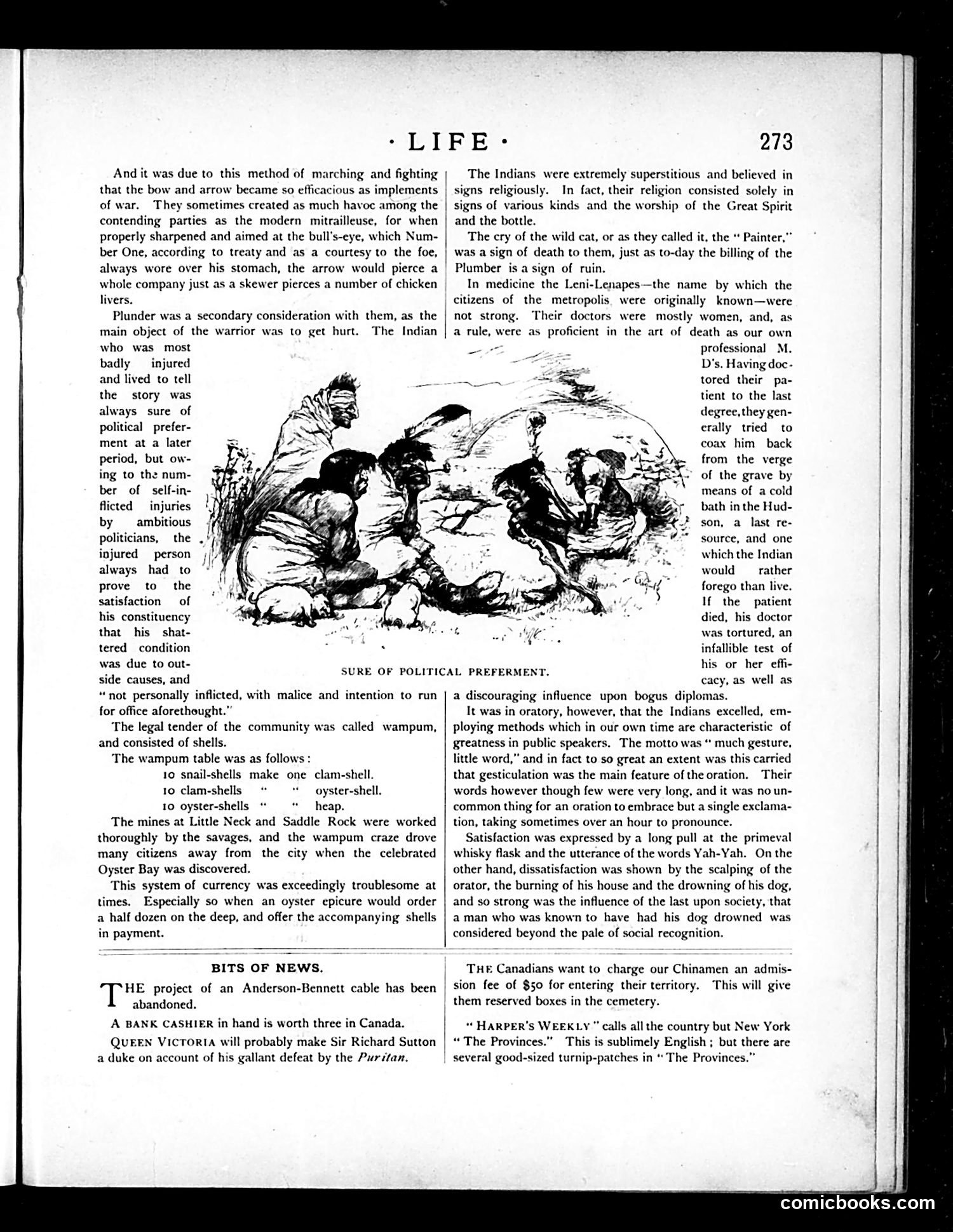
This cartoon satirizes Native American medical practices by depicting indigenous healers treating a patient. The caption "Sure of Political Preferment" suggests the satire targets **political favoritism and patronage** rather than the medical scene itself. The text indicates the Leni-Lenape had female doctors who employed unconventional treatments (cold Hudson River baths) with dubious efficacy. The joke appears to be that despite such questionable methods, these practitioners enjoyed social status and political influence within their community—a commentary on how connections matter more than competence in securing advancement. This reflects 19th-century American attitudes toward Native American practices as inherently inferior, while also mocking how patronage systems reward the undeserving.
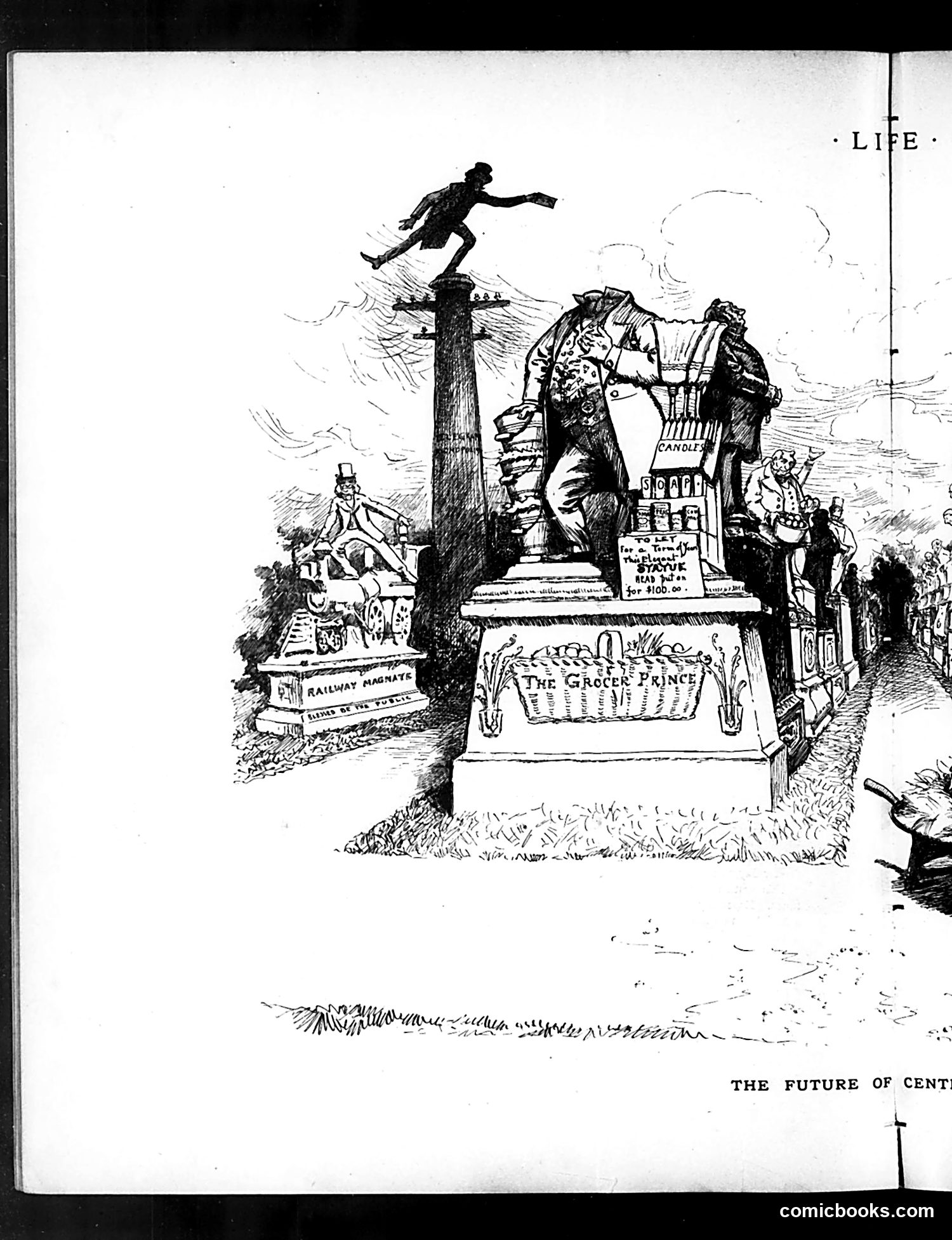
This satirical illustration depicts a monument to commercial figures and enterprises. The central pedestal is labeled "THE GROCER PRINCE" and features a horse-drawn carriage with what appears to be a merchant or businessman. A tall pole rises from this base, topped by a figure in acrobatic pose. To the left stands a monument labeled "RAILWAY MAGNATE," showing another figure of wealth and power. The cartoon satirizes American capitalism and the elevation of commercial figures to heroic or monumental status. By depicting grocers and railroad tycoons as princes and magnates deserving public monuments, the artist mocks the era's obsession with wealth accumulation and the celebration of business titans as cultural icons. The crowded, chaotic arrangement suggests the proliferation of such commercialism.
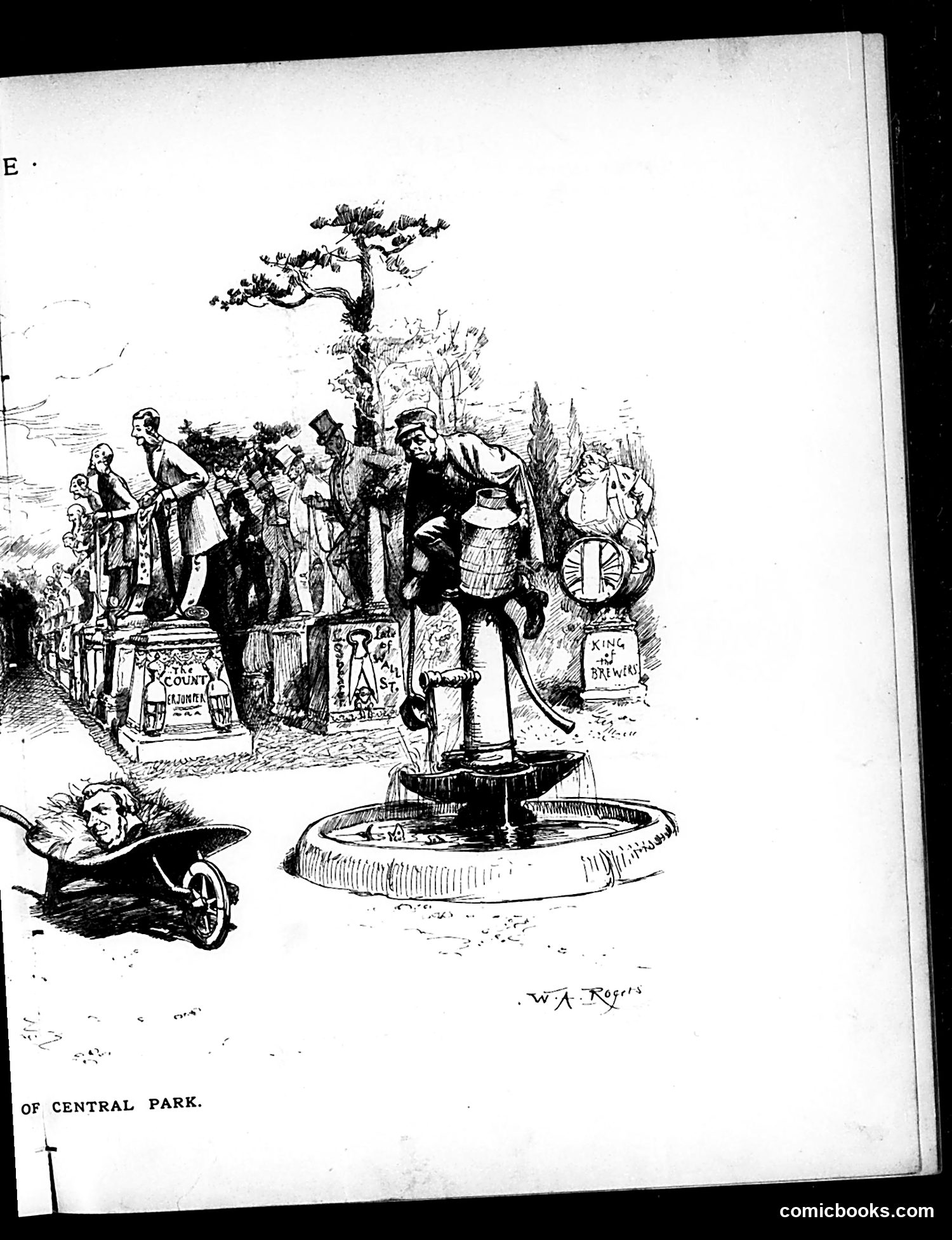
This appears to be a W.A. Rogers illustration titled "Of Central Park," showing a satirical scene of a figure standing in a circular fountain or pool while a crowd of well-dressed people gather behind, observing from an elevated platform. The central figure appears to be a caricatured man in dark clothing, posed in an exaggerated stance within the water. Signs visible in the background include references to "King," "Brewery," and what appears to be a counting house, suggesting commercial or business-related satire. A cherub or child figure appears in the lower left corner, possibly representing innocence or commentary on the scene. Without additional context about the specific date and Life magazine issue, the exact political or social target remains unclear, though the composition suggests mockery of either a public figure, commercial enterprise, or social behavior occurring in Central Park.
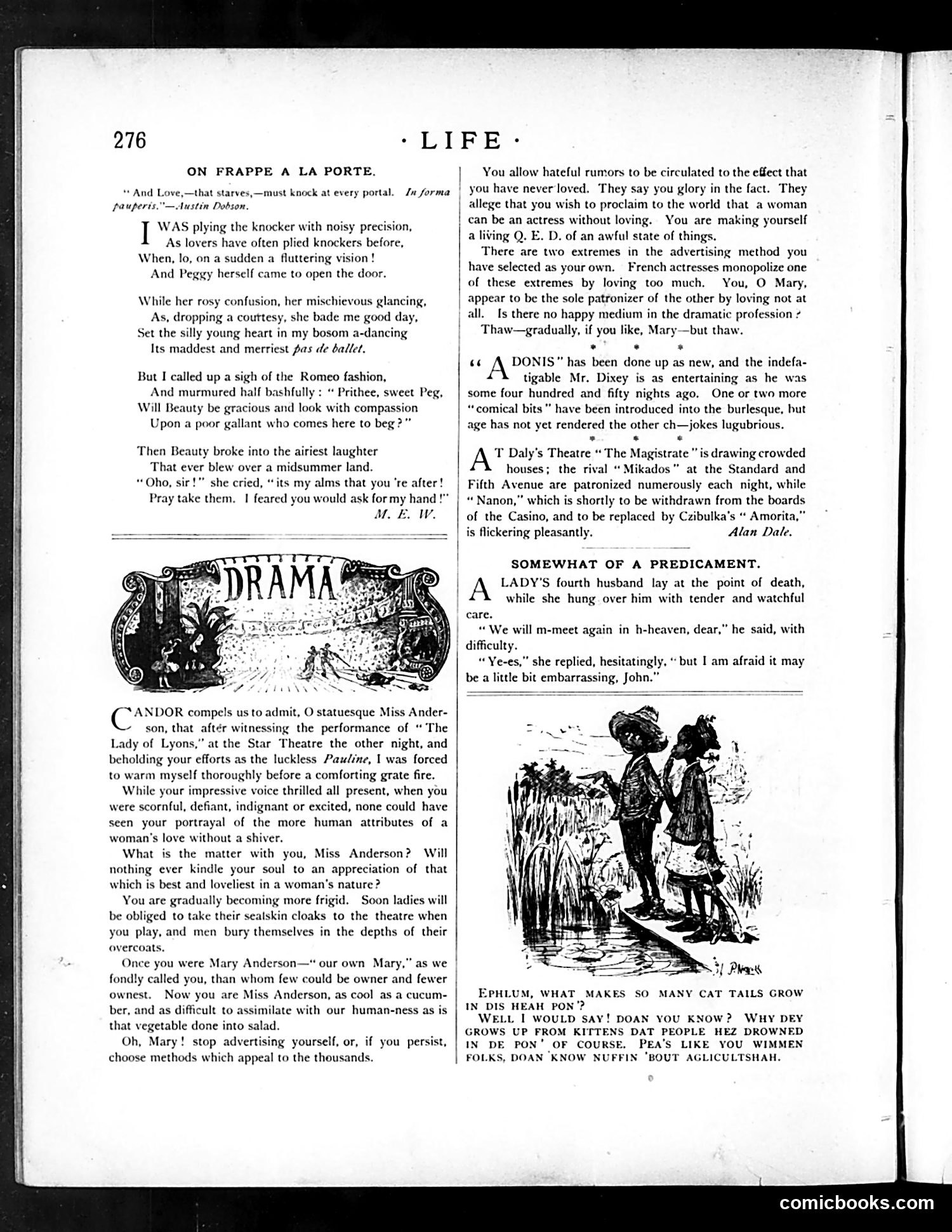
This page contains theatrical criticism and light satirical verse from what appears to be the 1880s-90s. **Main Content:** - A romantic poem ("On Frappe À La Porte") about a suitor's witty rejection by a woman named Peggy - Sharp theatrical criticism of actress **Mary Anderson**, who performed in "The Lady of Lyons" at the Star Theatre. The critic attacks her as increasingly "frigid" and emotionally cold, suggesting she's deliberately cultivating an image of being incapable of love to advertise herself - Brief theater reviews mentioning performances of "Adonis," "The Magistrate," and "Mikado" productions - A crude joke about a woman whose multiple husbands have died, with dark implications about her reliability **The Satire:** The Mary Anderson piece uses hyperbolic language ("sealskin cloaks," "depths of overcoats") to mock both her icy stage presence and her apparent self-promotion strategy—suggesting her coldness is calculated marketing rather than genuine artistic choice.
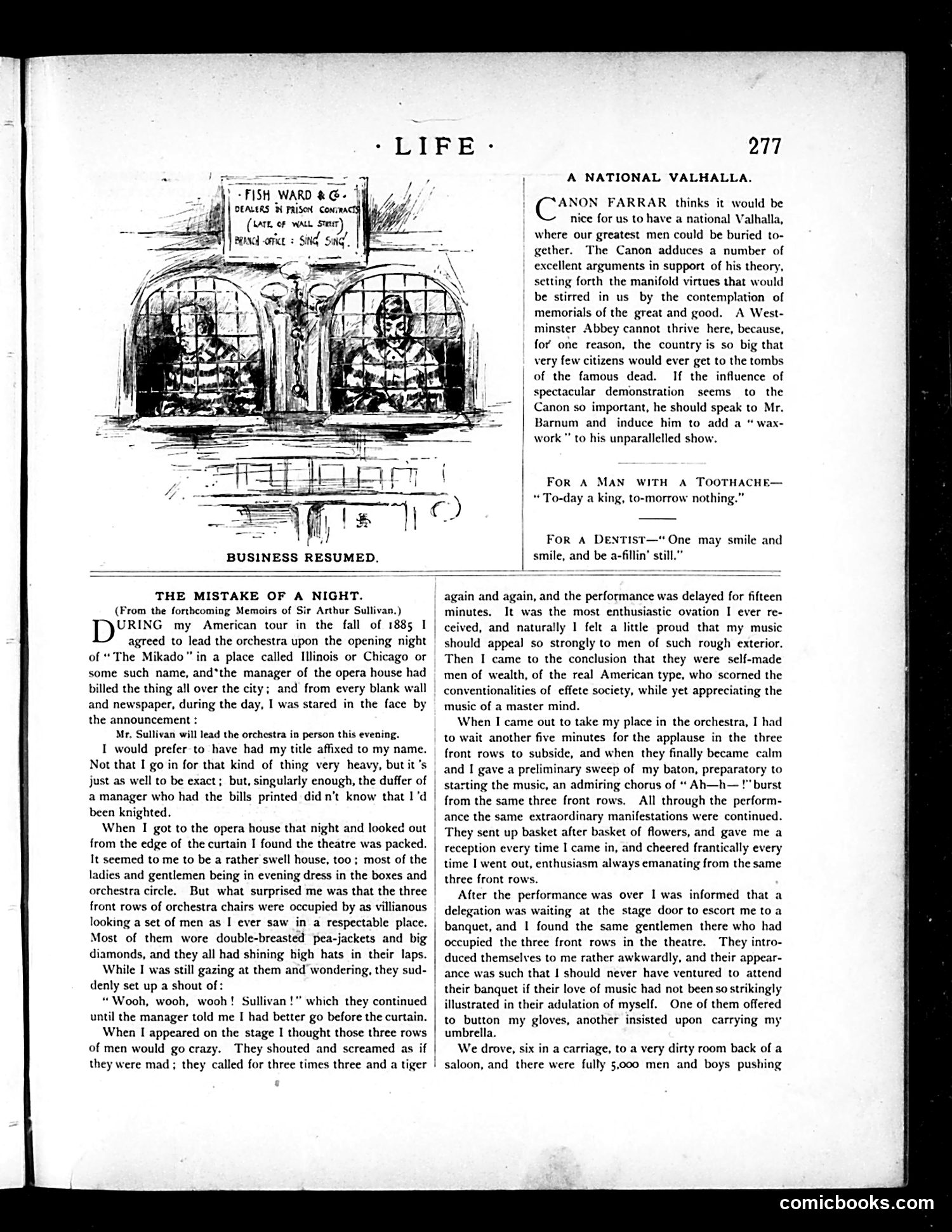
The sketch depicts a fish market or shop reopening after closure. Two figures—appearing to be working-class men in period dress—stand behind counters with windows, resuming their trade. The caption "Business Resumed" suggests this is satirizing the resumption of commercial activity, likely after a strike, shutdown, or disruption. The accompanying text column discusses Canon Farrar's proposal for a "National Valhalla"—a burial ground for America's greatest citizens. The satire mocks this grandiose idea as impractical for a vast country, and sarcastically suggests P.T. Barnum should add a "wax-work" exhibit instead, reducing national commemoration to carnival entertainment. Below, a humorous piece purports to be from Sir Arthur Sullivan's memoirs, describing his conducting debut at an American production of "The Mikado" in 1885, where rough-looking wealthy men gave him excessive applause—satirizing American audiences' earnest but uncultured enthusiasm for high art.
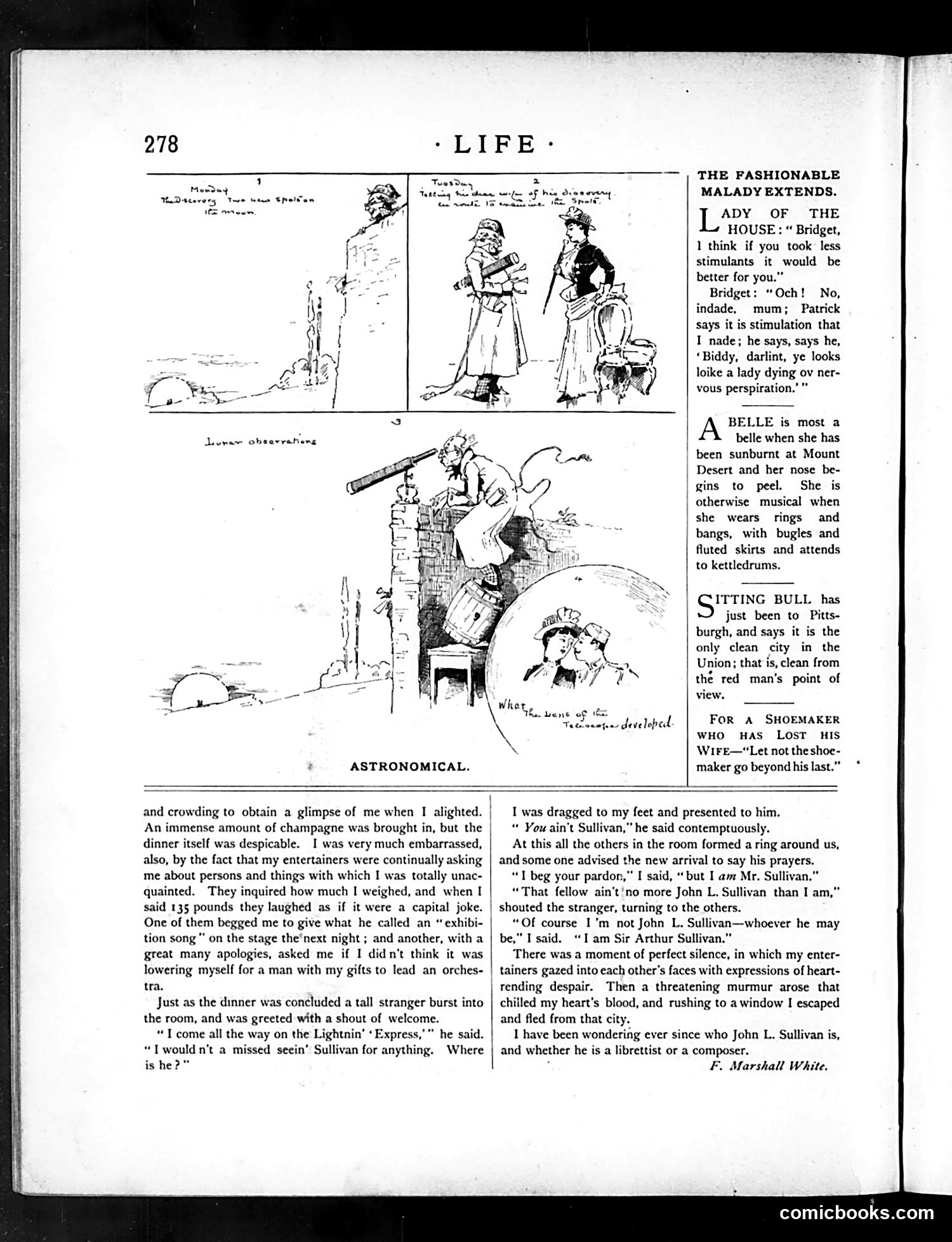
This page contains satirical sketches and brief humorous observations mocking fashionable society's affectations and absurdities. **The cartoons** (labeled "Astronomical") appear to depict upper-class women engaged in frivolous activities—observing through telescopes and socializing—satirizing their pretensions to intellectual pursuits. **The sidebar quips** mock contemporary fashions and social trends: a "fashionable malady" where nervous exhaustion signals status; a "belle" whose appeal depends on sunburned, peeling skin from Mount Desert vacations; and Sitting Bull's approval of Pittsburgh's cleanliness (likely ironic given industrial pollution). **The main story** by F. Marshall White describes a case of mistaken identity: the narrator, Sir Arthur Sullivan (the famous composer), is confused at a dinner for boxer John L. Sullivan, causing guests acute embarrassment when they realize their celebrated guest isn't the prize-fighter they expected. The humor lies in the guests' disappointed realization that the famous person present is utterly unknown to them.
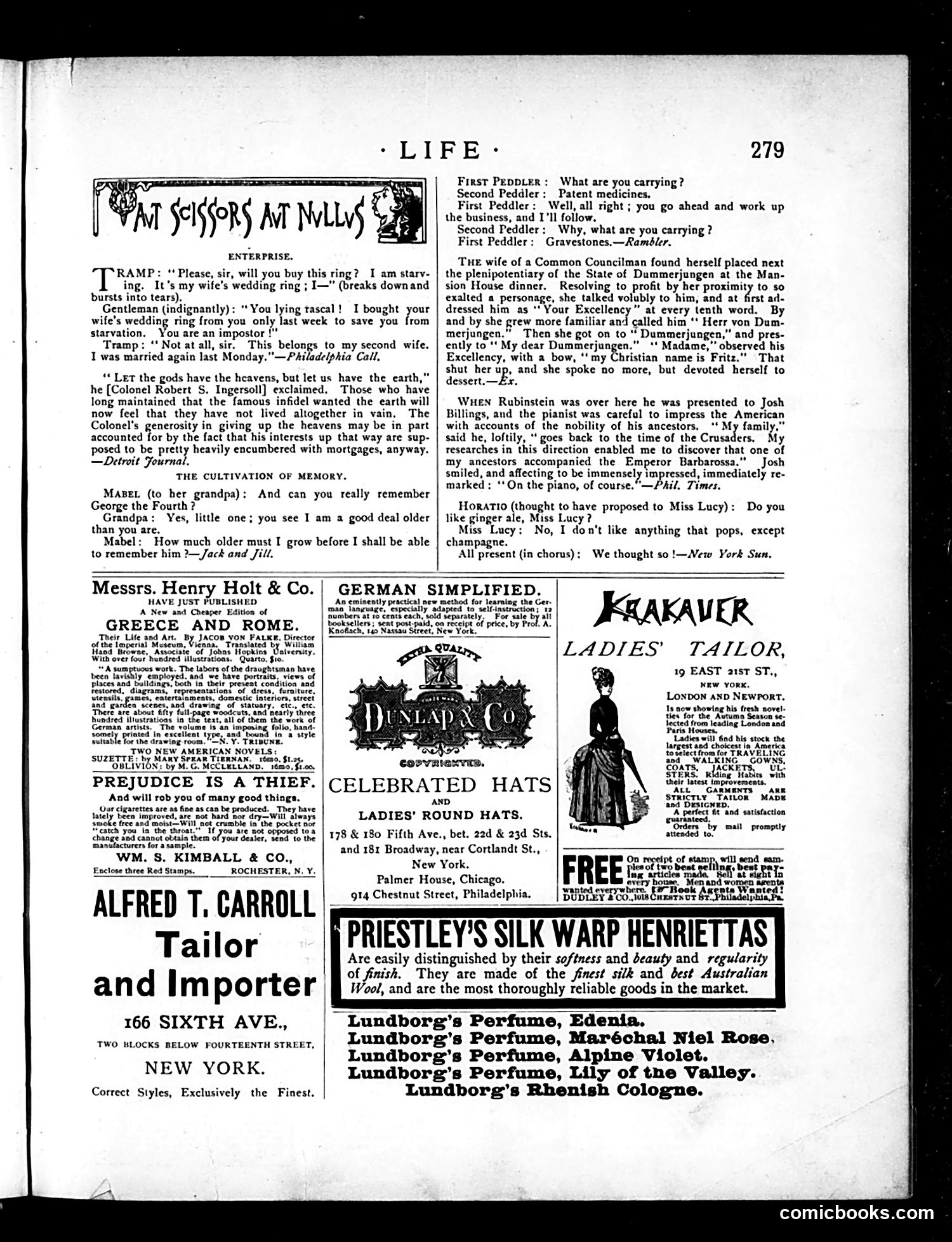
This page is primarily **advertising and humor columns** rather than a political cartoon. The content consists of several short satirical anecdotes and jokes typical of late 19th-century American humor magazines. The jokes target common social types: a con-artist tramp who repeatedly sells the same wedding ring, a boastful Russian pianist (Rubinstein) who exaggerates his ancestry, and a woman who presumptuously addresses a foreign diplomat too familiarly. One item mocks spiritualist Robert Ingersoll's atheism by joking he's willing to give up heaven since his interests there are "encumbered with mortgages." Another ridicules a woman's presumption in discussing genealogy. The humor relies on irony, social embarrassment, and gentle mockery of pretension and dishonesty. The advertisements for tailors, hat makers, and perfumes occupy significant space, reflecting the publication's commercial function alongside satire.
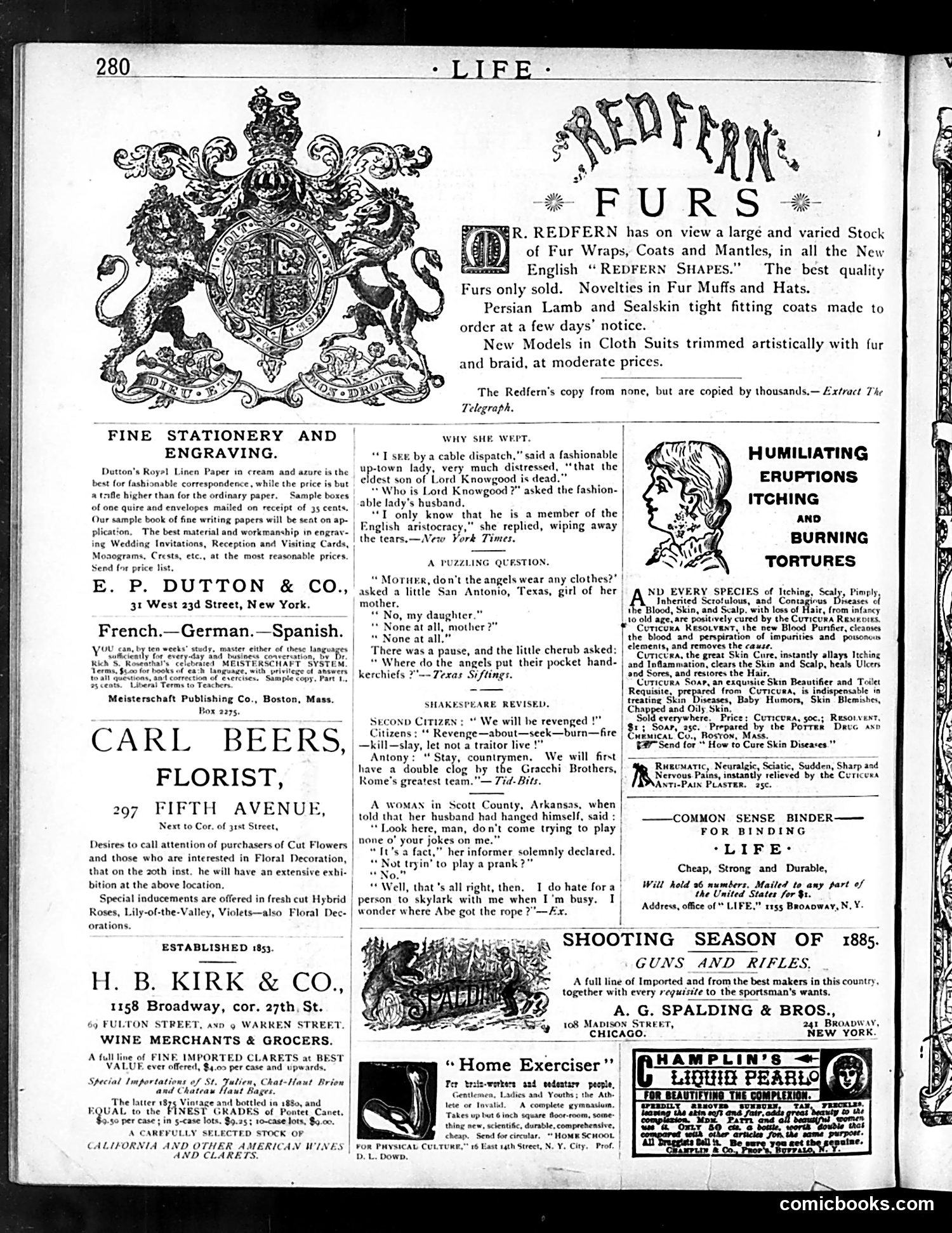
This page is primarily **advertising**, typical of 1880s American magazines. The content includes: **Visible Jokes/Humor:** - "Why She Wept": A society lady is distressed that an English aristocrat died, but admits she doesn't know who he is—satirizing shallow upper-class pretension and obsession with titles. - "A Puzzling Question": A child asks where angels keep their handkerchiefs, mocking the literalism of children's religious questions. **Advertisements:** The page features period luxury goods: fine stationery, flowers, wine merchants, fur coats (Redfern brand), language instruction, and skin treatments (Cuticura remedies). The Redfern's ad boasts their designs are "copied by thousands." **Social Context:** This reflects Gilded Age consumer culture—the advertisements target wealthy New Yorkers interested in European fashions, imported wines, and social status symbols. The humor mocks both aristocratic pretension and bourgeois aspiration. The page demonstrates how Life magazine mixed satirical comedy with advertising directed at affluent readers.