
Life, 1885-11-12 · page 6 of 14
Life — November 12, 1885 — page 6: what you’re looking at
What you’re looking at
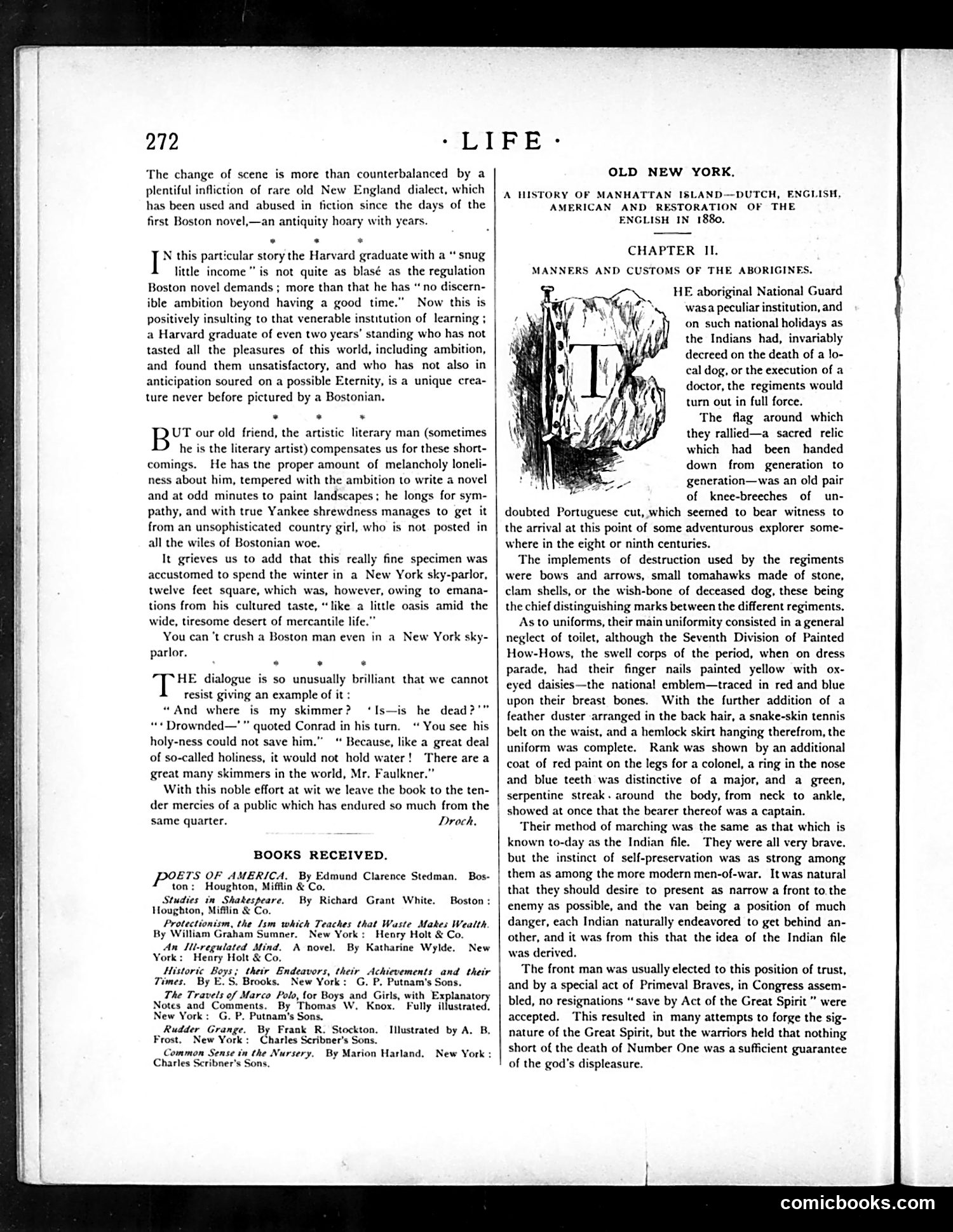
This page is primarily **literary content**, not political satire. The left column contains a book review discussing a novel set in old New York, critiquing a Harvard graduate character for his pretentious writing style. The reviewer praises instead "the artistic literary man" who writes with authentic "Yankee shrewdness." The right side begins "Chapter II" of what appears to be a serialized historical account titled "Old New York," focusing on the manners and customs of indigenous peoples and early colonial military units. It describes their uniforms, weapons, and marching methods. The small decorative illustration shows what appears to be a wrapped bundle or artifact. **This is not political cartoon satire**—it's a literary and historical magazine article page from the 1880s era.
📄 Transcribed text from this page (OCR, searchable)
Machine-transcribed from the original scan — historical spelling and the odd misread are preserved.
272 ‘The change of scene is more than counterbalanced by a plentiful infliction of rare old New England dialect, which has been used and abused in fiction since the days of the first Boston novel,—an antiquity hoary with years. ° . * N this particular story the Harvard graduate with a “ snug little income” is not quite as blasé as the regulation Boston novel demands ; more than that he has “no discern- ible ambition beyond having a good tim positively insulting to that venerable institution of learning ; a Harvard graduate of even two years’ standing who has not tasted all the pleasures of this world, including ambition, and found them unsatisfactory, and who has not also in anticipation soured on a possible Eternity, is a unique crea- ture never before pictured by a Bostonian. . . . UT our old friend, the artistic literary man (sometimes he is the literary artist) compensates us for these short- comings. He has the proper amount of melancholy loneli- ness about him, tempered with the ambition to write a novel and at odd minutes to paint landscapes; he longs for sym- pathy, and with true Yankee shrewdness manages to get it from an unsophisticated country girl, who is not posted in all the wiles of Bostonian woe. It grieves us to add that this really fine specimen was accustomed to spend the winter in a New York sky-parlor, twelve feet square, which was, however, owing to emana- tions from his cultured taste, “like a little oasis amid the wide, tiresome desert of mercantile life.” You can ‘t crush a Boston man even in a New York sky- parlor. . . . HE dialogue is so unusually brilliant that we cannot resist giving an example of it : “And where is my skimmer? ‘Is—is he dead? “* Drownded—’ ” quoted Conrad in his turn. “ You see his holy-ness could not save him.” “ Because, like a great deal of so-called holiness, it would not hold water! There are a great many skimmers in the world, Mr. Faulkner.” With this noble effort at wit we leave the book to the ten- der mercies of a public which has endured so much from the same quarter. Droch. BOOKS RECEIVED. POETS OF AMERICA. By Edmund Clarence Stedman, Bos- ton: Houghton, Mifflin & Co. Studies in Shakespeare. By Richard Grant White. Houghton, Mifflin & Co. Protectionism, the sm which Teaches that Waste Makes Wealth. By William Graham Sumner. New York: Henry Holt & Co. ‘An Mt-regulated Mind. A novel. By Katharine Wylde. York: Henry Holt & Co. their Endeavors, their Achievements and their . S. Brooks. New York: G. P, Putnam's Sons. The Travels of Marco Polo, {or Boys and Girls, with Explanatory Notes and Comments. By Thomas W. Knox. Fully illustrated. New York: G. P. Putnam's Sons. Rudder Grange. By Frank R. Stockton. Frost, New York: Charles Scribner's Sons. Common Sense in the Nursery. By Marion Harland. Charles Scribner's Sons, Boston : New Illustrated by A. B. New York : Now this is | -LIFE- OLD NEW YORK, A HISTORY OF MANHATTAN ISLAND—DUTCH, ENGLISH, AMERICAN AND RESTORATION OF THE ENGLISH IN 1880. CHAPTER II. MANNERS AND CUSTOMS OF THE ABORIGINES. HE aboriginal National Guard wasa peculiar institution, and on such national holidays as the Indians had, invariably decreed on the death of a lo- cal dog, or the execution of a doctor, the regiments would turn out in full force. The flag around which they rallied—a sacred relic which had been handed down from generation to generation—was an old pair of knee-breeches of un- doubted Portuguese cut, which seemed to bear witness to the arrival at this point of some adventurous explorer some- where in the eight or ninth centuries. The implements of destruction used by the regiments were bows and arrows, small tomahawks made of stone, clam shells, or the wish-bone of deceased dog, these being the chief distinguishing marks between the different regiments. As to uniforms, their main uniformity consisted in a general neglect of toilet, although the Seventh Division of Painted How-Hows, the swell corps of the period, when on dress parade, had their finger nails painted yellow with ox- eyed daisies—the national emblem—traced in red and blue upon their breast bones. With the further addition of a feather duster arranged in the back hair, a snake-skin tennis belt on the waist, and a hemlock skirt hanging therefrom, the uniform was complete. Rank was shown by an additional coat of red paint on the legs for a colonel, a ring in the nose and blue teeth was distinctive of a major, and a green, serpentine streak. around the body, from neck to ankle, showed at once that the bearer thereof was a captain. ‘Their method of marching was the same as that which is known to-day as the Indian file. They were all very brave. but the instinct of self-preservation was as strong among them as among the more modern men-of-war. It was natural that they should desire to present as narrow a front to. the enemy as possible, and the van being a position of much danger, each Indian naturally endeavored to get behind an- other, and it was from this that the idea of the Indian file was derived. The front man was usually elected to this position of trust, and by a special act of Primeval Braves, in Congress assem- bled, no resignations “save by Act of the Great Spirit” were accepted. This resulted in many attempts to forge the sig- nature of the Great Spirit, but the warriors held that nothing short of the death of Number One was a sufficient guarantee of the god's displeasure. comicbooks.com