
Life, 1885-11-12 · page 10 of 14
Life — November 12, 1885 — page 10: what you’re looking at
What you’re looking at
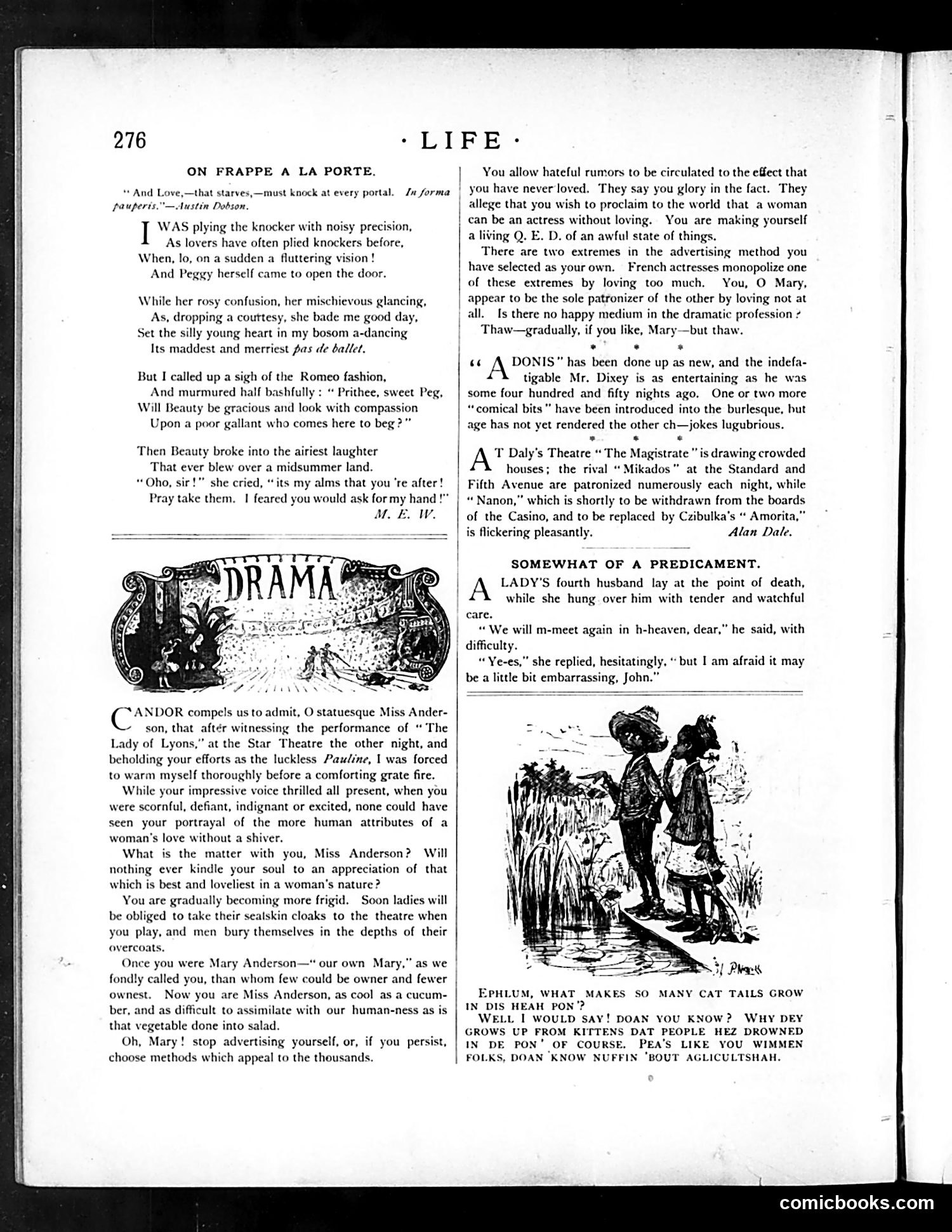
This page contains theatrical criticism and light satirical verse from what appears to be the 1880s-90s. **Main Content:** - A romantic poem ("On Frappe À La Porte") about a suitor's witty rejection by a woman named Peggy - Sharp theatrical criticism of actress **Mary Anderson**, who performed in "The Lady of Lyons" at the Star Theatre. The critic attacks her as increasingly "frigid" and emotionally cold, suggesting she's deliberately cultivating an image of being incapable of love to advertise herself - Brief theater reviews mentioning performances of "Adonis," "The Magistrate," and "Mikado" productions - A crude joke about a woman whose multiple husbands have died, with dark implications about her reliability **The Satire:** The Mary Anderson piece uses hyperbolic language ("sealskin cloaks," "depths of overcoats") to mock both her icy stage presence and her apparent self-promotion strategy—suggesting her coldness is calculated marketing rather than genuine artistic choice.
📄 Transcribed text from this page (OCR, searchable)
Machine-transcribed from the original scan — historical spelling and the odd misread are preserved.
- LIFE: ON FRAPPE A LA PORTE, ve,—that starves,—must knock at every portal. J forma pauperis."—Austin Dobson. WAS plying the knocker with noisy precision, As lovers have often plied knockers before, When, lo, on a sudden a fluttering vision ! And Peggy herself came to open the door, While her rosy confusion, her mischievous glancing, As, dropping a couttesy, she bade me good day, Set the silly young heart in my bosom a-dancing Its maddest and merriest pas de ballet. But I called up a sigh of the Romeo fashion, And murmured half bashfully : “ Prithee, sweet Peg, Will Beauty be gracious and look with compassion Upon a poor gallant who comes here to beg?” Then Beauty broke into the airiest laughter That ever blew over a midsummer land. “Oho, sir!” she cried, “its my alms that you ‘re after! Pray take them. I feared you would ask for my hand !" Cc ANDOR compels us to admit, O statuesque Miss Ander- ~ son, that after witnessing the performance of “ The Lady of Lyons,” at the Star Theatre the other night, and beholding your efforts as the luckless Pauline, | was forced to warm myself thoroughly before a comforting grate fire. While your impressive voice thrilled all present, when you were scornful, defiant, indignant or excited, none could have seen your portrayal of the more human attributes of a woman's love without a shiver. What is the matter with you, Miss Anderson? Will nothing ever kindle your soul to an appreciation of that which is best and loveliest in a woman's nature? You are gradually becoming more frigid, Soon ladies will be obliged to take their sealskin cloaks to the theatre when you play, and men bury themselves in the depths of their overcoats. Once you were Mary Anderson—* our own Mary,” as we fondly called you, than whom few could be owner and fewer ownest. Now you are Miss Anderson, as cool as a cucum- ber, and as difficult to assimilate with our human-ness as is that vegetable done into salad. Oh, Mary! stop advertising yourself, or, if you persist, choose methods which appeal to the thousands. You allow hateful rumors to be circulated to the effect that you have never loved. They say you glory in the fact. They | allege that you wish to proclaim to the world that a woman | can be an actress without loving. You are making yourself a living Q. E. D. of an awful state of things. There are two extremes in the advertising method you have selected as your own. French actresses monopolize one of these extremes by loving too much. You, O Mary, appear to be the sole patronizer of the other by loving not at all. Is there no happy medium in the dramatic profession ¢ Thaw—gradually, if you like, Mary—but thaw. . . * DONIS” has been done up as new, and the indefa- tigable Mr. Dixey is as entertaining as he was some four hundred and fifty nights ago, One or two more “comical bits" have been introduced into the burlesque, but age has not yet rendered the other ch—jokes lugubrious. * . * T Daly's Theatre “ The Magistrate " is drawing crowded houses; the rival “ Mikados” at the Standard and | Fifth Avenue are patronized numerously each night, while “Nanon,” which is shortly to be withdrawn from the boards of the Casino, and to be replaced by Czibulka’s “ Amoritz is flickering pleasantly. Alan Dale. “cc SOMEWHAT OF A PREDICAMENT. LADY'S fourth husband lay at the point of death, while she hung over him with tender and watchful care. “ We will m-meet again in h-heaven, dear,” he said, with difficulty. “Ye-es,” she replied, hesitatingly, * but I am afraid it may be a little bit embarrassing, John.” EPHLUM, WHAT MAKES SO MANY CAT TALLS GROW IN DIS HEAH PON’? WELL I WOULD SAY! DOAN YOU KNOW? WHY DEY GROWS UP FROM KITT DAT PEOPLE HEZ DROWNED IN DE PON’ OF COUR PEA’S LIKE YOU WIMMEN | FOLKS, DOAN KNOW NUFFIN "BOUT AGLICULTSHAH. comicbooks.com