
Life, 1885-11-12 · page 11 of 14
Life — November 12, 1885 — page 11: what you’re looking at
What you’re looking at
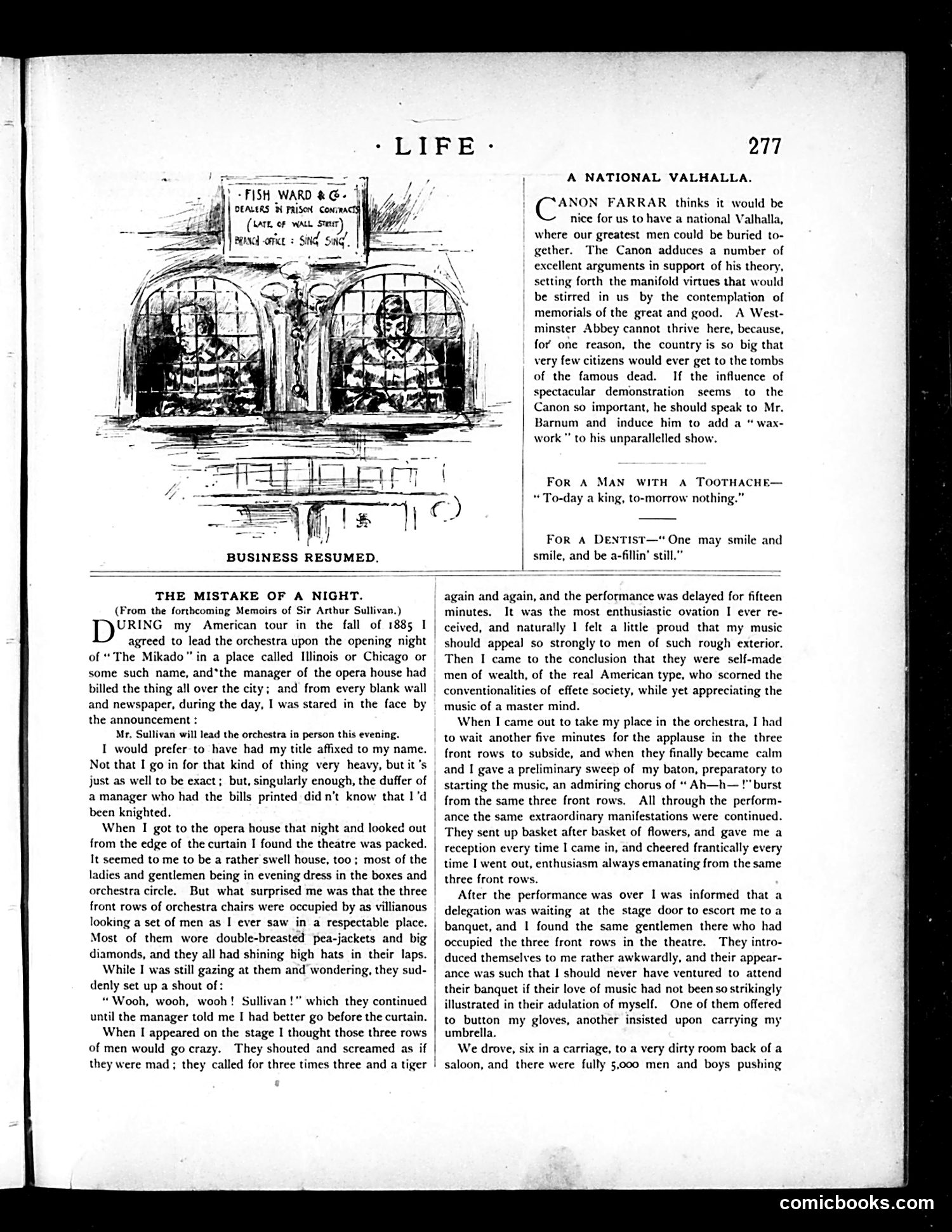
The sketch depicts a fish market or shop reopening after closure. Two figures—appearing to be working-class men in period dress—stand behind counters with windows, resuming their trade. The caption "Business Resumed" suggests this is satirizing the resumption of commercial activity, likely after a strike, shutdown, or disruption. The accompanying text column discusses Canon Farrar's proposal for a "National Valhalla"—a burial ground for America's greatest citizens. The satire mocks this grandiose idea as impractical for a vast country, and sarcastically suggests P.T. Barnum should add a "wax-work" exhibit instead, reducing national commemoration to carnival entertainment. Below, a humorous piece purports to be from Sir Arthur Sullivan's memoirs, describing his conducting debut at an American production of "The Mikado" in 1885, where rough-looking wealthy men gave him excessive applause—satirizing American audiences' earnest but uncultured enthusiasm for high art.
📄 Transcribed text from this page (OCR, searchable)
Machine-transcribed from the original scan — historical spelling and the odd misread are preserved.
FISH WARD &G@- | DEALERS ¥N PRIScH Cominn BUSINESS RESUMED. 277 A NATIONAL VALHALLA. ANON FARRAR thinks it would be nice for us to have a national Valhalla, where our greatest men could be buried to- gether. The Canon adduces a number of excellent arguments in support of his theory, setting forth the manifold virtues that would be stirred in us by the contemplation of memorials of the great and good. A West- minster Abbey cannot thrive here, because, for one reason, the country is so big that very few citizens would ever get to the tombs | of the famous dead. If the influence of spectacular demonstration seems to the Canon so important, he should speak to Mr. Barnum and induce him to add a “ wax- work " to his unparallelled show. FOR A MAN WITH A TOOTHACHE— “ To-day a king, to-morrow nothing.” For a Dentist—* One may smile and | smile, and be a-fillin’ still.” THE MISTAKE OF A NIGHT. (From the forthcoming Memoirs of Sir Arthur Sullivan.) URING my American tour in the fall of 1885 1 agreed to lead the orchestra upon the opening night of “The Mikado” in a place called Illinois or Chicago or some such name, and*the manager of the opera house had billed the thing all over the city; and from every blank wall and newspaper, during the day, I was stared in the face by the announcement : Mr. Sullivan will lead the orchestra in person this evening. I would prefer to have had my title affixed to my name. Not that I go in for that kind of thing very heavy, but it’s just as well to be exact; but, singularly enough, the duffer of a manager who had the bills printed didn’t know that | 'd been knighted. When I got to the opera house that night and looked out from the edge of the curtain I found the theatre was packed. It seemed to me to be a rather swell house, too ; most of the ladies and gentlemen being in evening dress in the boxes and orchestra circle. But what surprised me was that the three front rows of orchestra chairs were occupied by as villianous looking a set of men as I ever saw in a respectable place. Most of them wore double-breasted pea-jackets and big diamonds, and they all had shining high hats in their laps. While I was still gazing at them and wondering, they sud- denly set up a shout of: “Wooh, wooh, wooh! Sullivan!" which they continued until the manager told me I had better go before the curtain. When I appeared on the stage I thought those three rows of men would go crazy. They shouted and screamed as if they were mad ; they called for three times three and a tiger | minutes, again and again, and the performance was delayed for fifteen It was the most enthusiastic ovation I ever re- ceived, and naturally I felt a little proud that my music should appeal so strongly to men of such rough exterior. Then I came to the conclusion that they were self-made men of wealth, of the real American type, who scorned the conventionalities of effete society, while yet appreciating the music of a master mind. When I came out to take my place in the orchestra, I had to wait another five minutes for the applause in the three front rows to subside, and when they finally became calm | and I gave a preliminary sweep of my baton, preparatory to starting the music, an admiring chorus of “ Ah—h— !" burst from the same three front rows. All through the perform- ance the same extraordinary manifestations were continued. They sent up basket after basket of flowers, and gave me a reception every time I came in, and cheered frantically every time I went out, enthusiasm always emanating from the same three front rows. After the performance was over I was informed that a delegation was waiting at the stage door to escort me toa banquet, and | found the same gentlemen there who had occupied the three front rows in the theatre. They intro- duced themselves to me rather awkwardly, and their appear- ance was such that | should never have ventured to attend their banquet if their love of music had not been so strikingly illustrated in their adulation of myself. One of them offered to button my gloves, another insisted upon carrying my umbrella. We drove, six in a carriage, to a very dirty room back of a saloon, and there were fully 5,000 men and boys pushing comicbooks.com