
Life, 1885-11-12 · page 7 of 14
Life — November 12, 1885 — page 7: what you’re looking at
What you’re looking at
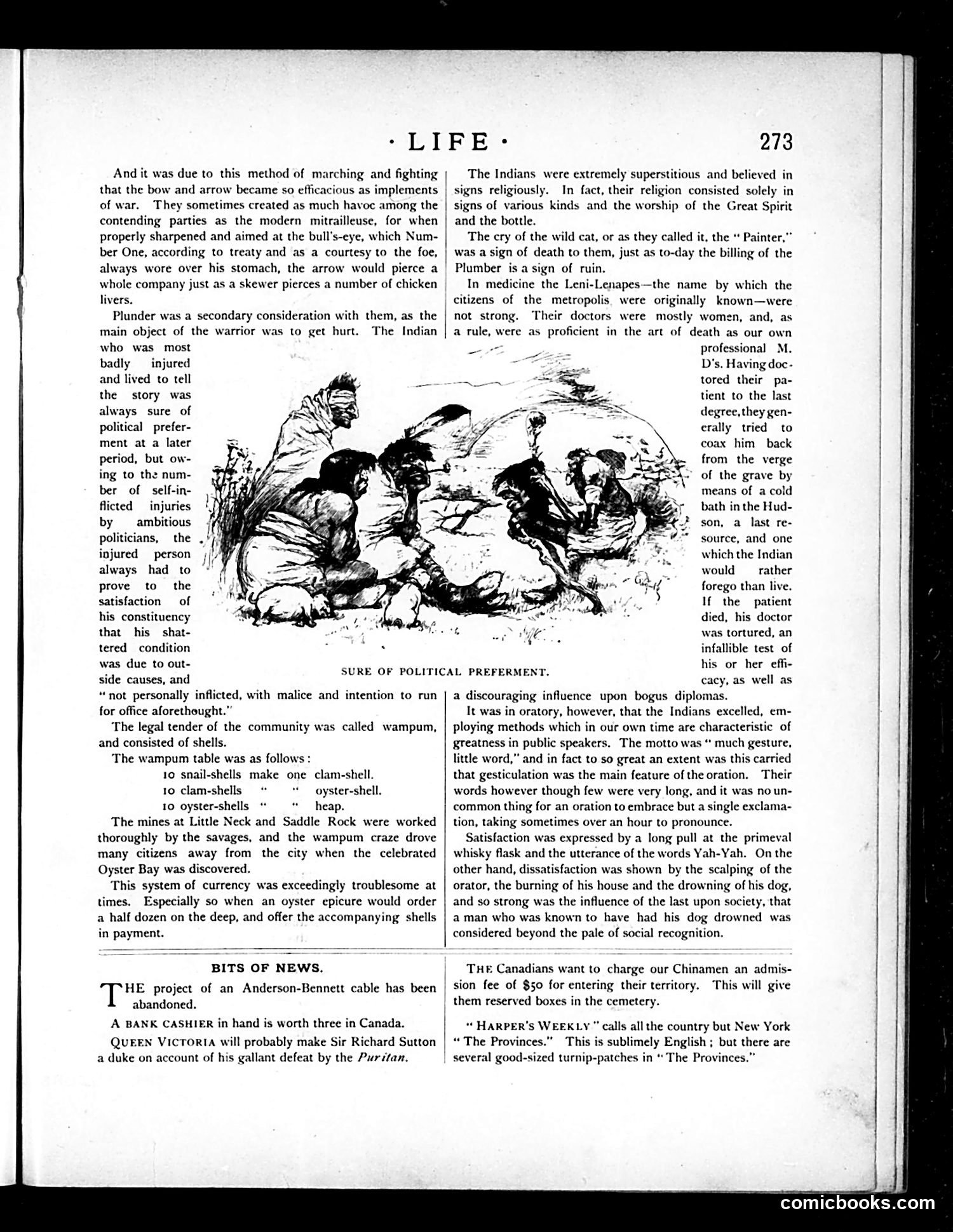
This cartoon satirizes Native American medical practices by depicting indigenous healers treating a patient. The caption "Sure of Political Preferment" suggests the satire targets **political favoritism and patronage** rather than the medical scene itself. The text indicates the Leni-Lenape had female doctors who employed unconventional treatments (cold Hudson River baths) with dubious efficacy. The joke appears to be that despite such questionable methods, these practitioners enjoyed social status and political influence within their community—a commentary on how connections matter more than competence in securing advancement. This reflects 19th-century American attitudes toward Native American practices as inherently inferior, while also mocking how patronage systems reward the undeserving.
📄 Transcribed text from this page (OCR, searchable)
Machine-transcribed from the original scan — historical spelling and the odd misread are preserved.
- LIFE: And it was due to this method of marching and fighting that the bow and arrow became so efficacious as implements of war. They sometimes created as much havoc among the | contending parties as the modern mitrailleuse, for when | properly sharpened and aimed at the bull’s-eye, which Num- ber One, according to treaty and as a courtesy to the foe, always wore over his stomach, the arrow would pierce a whole company just as a skewer pierces a number of chicken livers. Plunder wa main object of the warrior was to get hurt. who was most badly injured and lived to tell the story was always sure of political prefer- ment at a later period, but ow- ing to the num- ber of self-in- flicted injuries by ambitious politicians, the injured person always had to prove to the satisfaction of his constituency that his shat- tered condition was due to out- side causes, and “not personally inflicted, with malice and intention to run for office aforethought.”” The legal tender of the community was called wampum, and consisted of shells. The wampum table was as follows : 10 snail-shells make one clam-shell. 1o clam-shells * “ — oyster-shell. 10 oyster-shells “ “heap. The mines at Little Neck and Saddle Rock were worked thoroughly by the savages, and the wampum craze drove many citizens away from the city when the celebrated Oyster Bay was discovered. This system of currency was exceedingly troublesome at times. Especially so when an oyster epicure would order a half dozen on the deep, and offer the accompanying shells in payment. a secondary consideration with them, as the The Indian SURE OF POLITICAL BITS OF NEWS. HE project of an Anderson-Bennett cable has been abandoned. A BANK CASHIER in hand is worth three in Canada. QUEEN VicTorta will probably make Sir Richard Sutton a duke on account of his gallant defeat by the Purstan. 273 The Indians were extremely superstitious and believed in signs religiously. In fact, their religion consisted solely in signs of various kinds and the worship of the Great Spirit and the bottle. The cry of the wild cat, or as they called it, the “ Painter,” was a sign of death to them, just as to-day the billing of the Plumber is a sign of ruin. In medicine the Leni-Lenapes—the name by which the citizens of the metropolis. were originally known—were not strong. Their doctors were mostly women, and, as a rule, were as proficient in the art of death as our own < professional M. D's. Having doc- tored their pa- tient to the last degree, they gen- erally tried to coax him back from the verge of the grave by means of a cold bath in the Hud- son, a last re- source, and one which the Indian would rather forego than li If the patient died, his doctor was tortured, an infallible test of his or her effi- cacy, as well as a discouraging influence upon bogus diplomas. It was in oratory, however, that the Indians excelled, em- ploying methods which in our own time are characteristic of greatness in public speakers. The motto was “ much gesture, little word,” and in fact to so great an extent was this carried that gesticulation was the main feature of the oration. Their words however though few were very long, and it was no un- common thing for an oration to embrace but a single exclama- tion, taking sometimes over an hour to pronounce. Satisfaction was expressed by a long pull at the primeval whisky flask and the utterance of the words Yah-Yah. On the other hand, dissatisfaction was shown by the scalping of the orator, the burning of his house and the drowning of his dog, and so strong was the influence of the last upon society, that a man who was known to have had his dog drowned was considered beyond the pale of social recognition. PREFERMENT, THE Canadians want to charge our Chinamen an admis- sion fee of $50 for entering their territory. This will give them reserved boxes in the cemetery. * HARPER'S WEEKLY " calls all the country but New York “The Provinces.” This is sublimely English ; but there are | several good-sized turnip-patches in “ The Provinces.” comicbooks.com