
A complete issue · 16 pages · 1885
Life — October 8, 1885
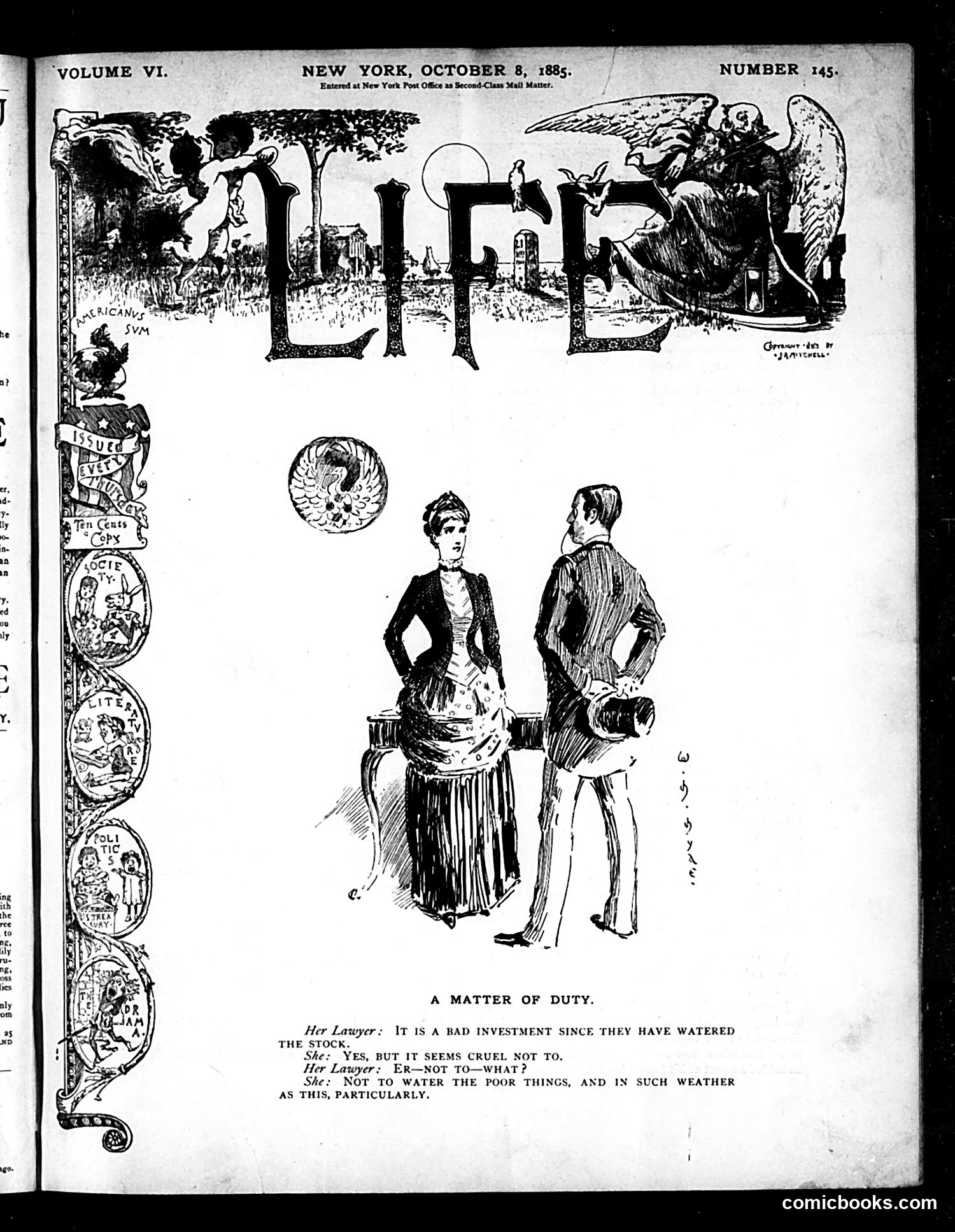
This cartoon satirizes wealthy investors' hypocrisy regarding the poor. The scene depicts a well-dressed man (her lawyer) and woman in conversation. She notes it's "a bad investment since they have watered the stock"—referring to a fraudulent practice where company value was artificially inflated. The lawyer agrees it's cruel "not to water the poor things" during bad weather. The satire targets the contradiction: these financiers refuse ethical responsibility toward actual poor people, yet concern themselves with protecting their own fraudulent investments. The joke exposes how the wealthy used legal language to justify both stock manipulation and indifference to human suffering. The ornate border featuring classical medallions emphasizes Life's satirical editorial stance.
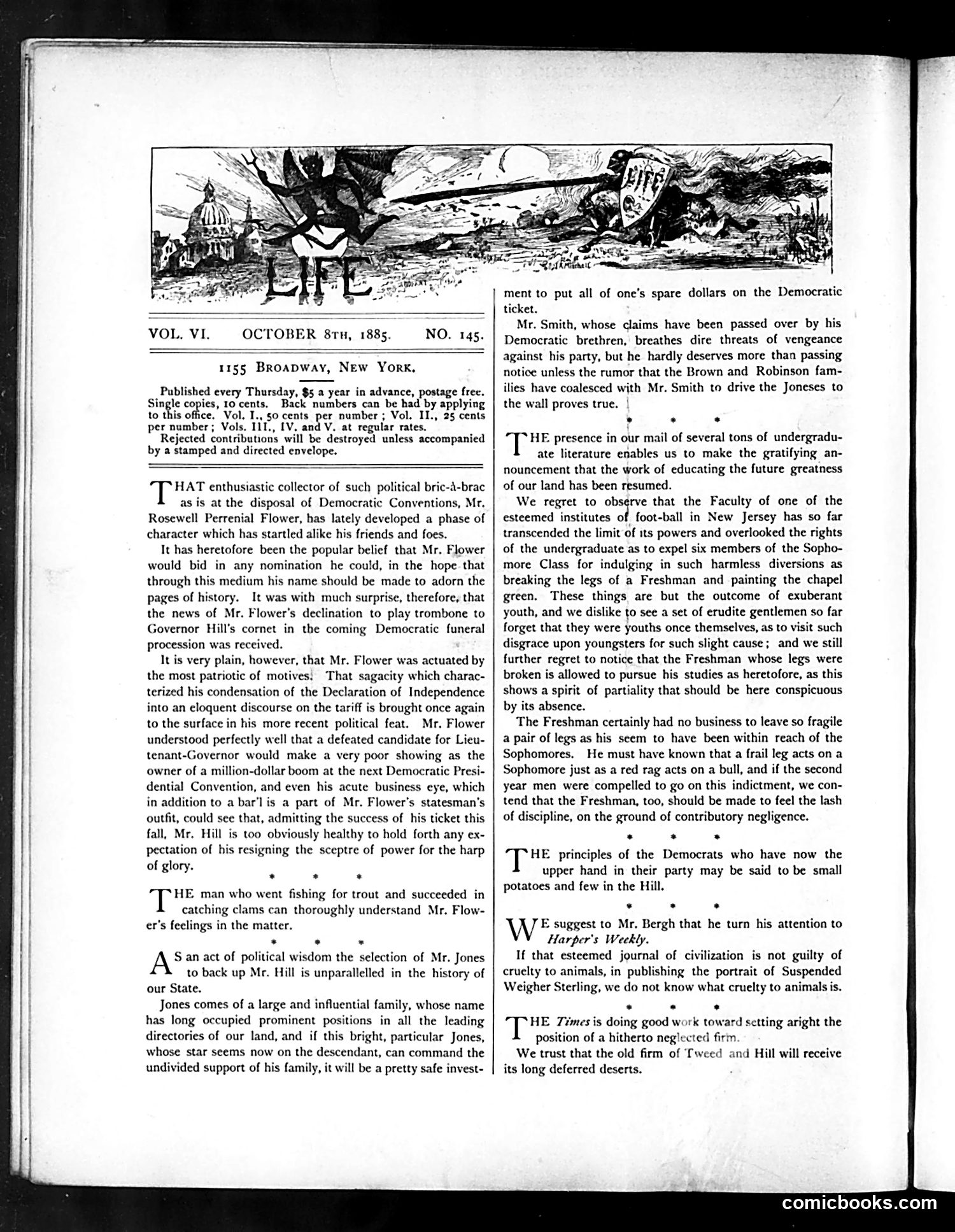
The masthead illustration depicts "LIFE" amid classical and industrial imagery, establishing the magazine's satirical voice. The text criticizes **Roosevelt Perennial Flower**, apparently a Democratic political operative, for his ambitions to become Lieutenant-Governor. The satire mocks his pretensions—comparing his failed candidacy to someone who went "fishing for trout and succeeded in catching claims," suggesting self-delusion. The passage also attacks Democratic principles as "small potatoes," questions the judgment of nominating failed candidates, and ridicules a Freshman at an unnamed institution for breaking his leg while being disciplined—sarcastically defending youth while criticizing the institution's severity. References to "Mr. Jones," "Mr. Hill," and Democratic Convention politics suggest local New York political conflicts, but specific identities remain unclear without additional context.
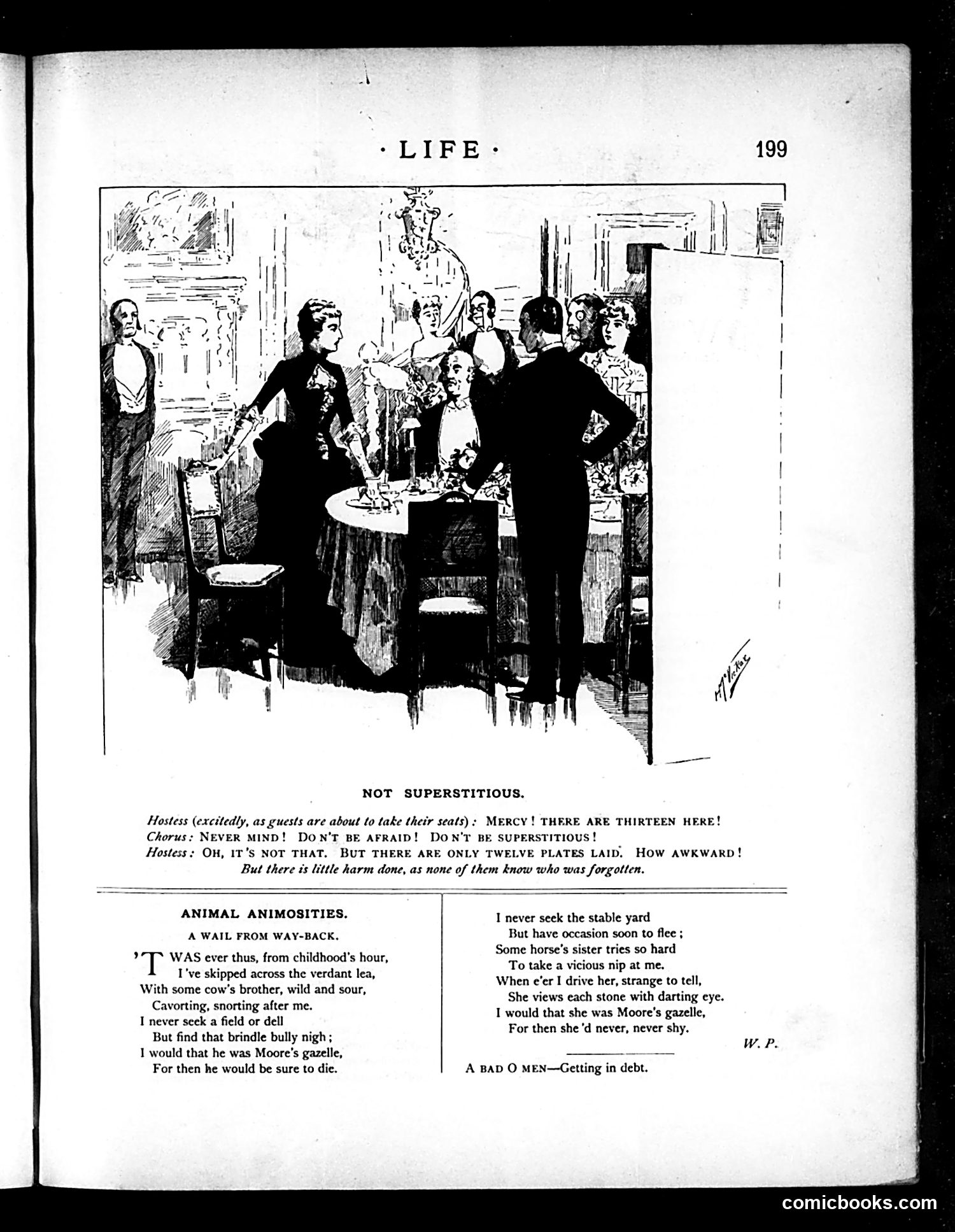
This cartoon satirizes the persistence of superstition among educated society. The scene shows a formal dinner party where the hostess anxiously counts guests—there are thirteen present, traditionally considered unlucky. The humor lies in the contradiction: the guests insist they're rational and "not superstitious," yet they're visibly anxious about the number thirteen. The hostess awkwardly notes that only twelve plates were laid, attempting to rationalize away the bad omen by claiming one guest was "forgotten"—a transparent and absurd solution that undermines their claimed rationality. The satire targets Victorian-era society's simultaneous embrace of modernity and education while remaining bound by old folk superstitions—revealing that enlightenment was only surface-deep.
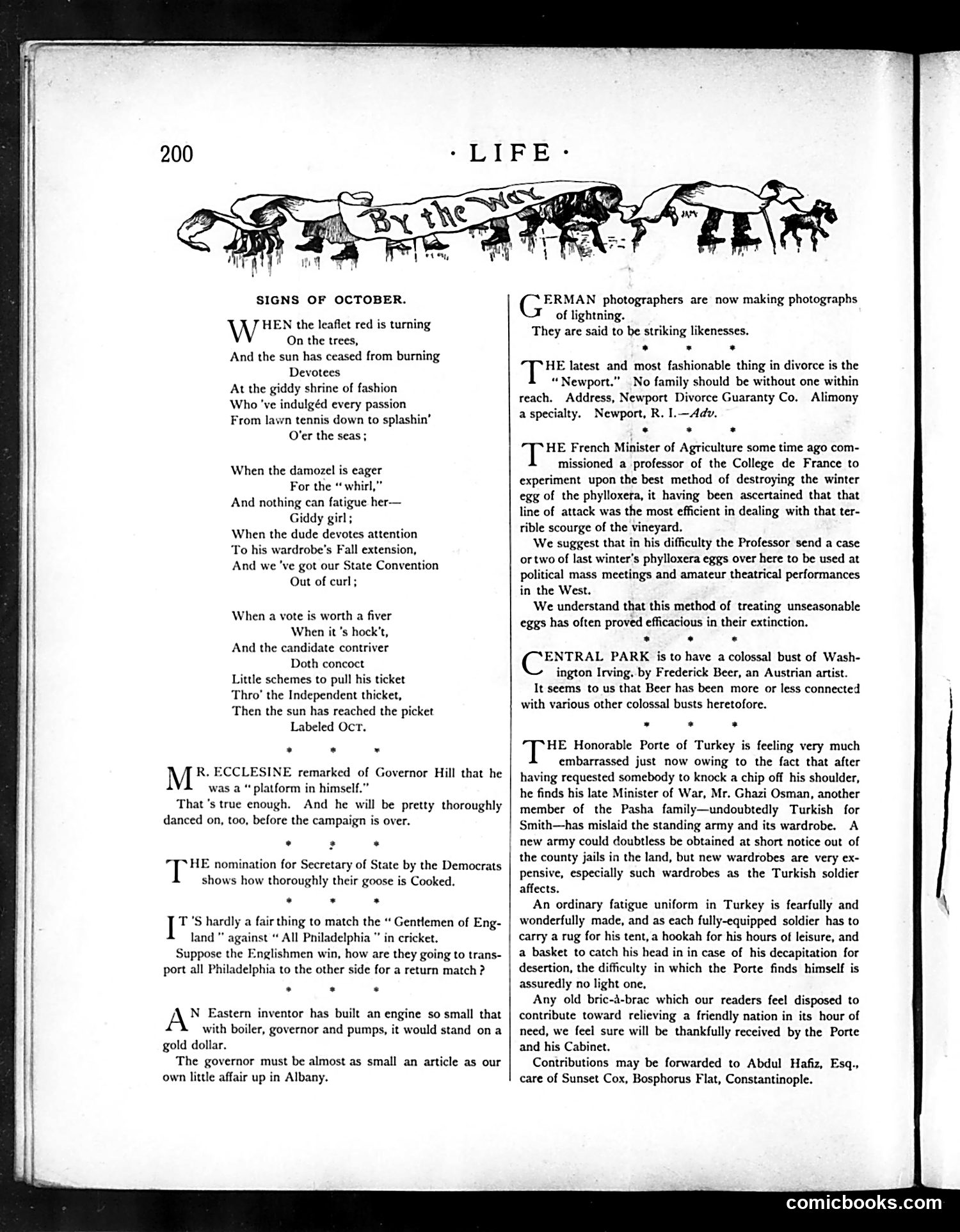
The page contains a satirical poem titled "Signs of October" mocking the 1904 election cycle. It ridicules various political activities—candidates pulling "tickets," schemes to "pull his ticket," and the "Independent thicket"—with the refrain "Labeled Oct." The satire suggests election season involves hollow political theater and manipulation. Below the poem, brief news items parody contemporary issues: German lightning photography, Newport divorce services, and a jab at Philadelphia's baseball team losing to the English. The most substantial item concerns Turkey's government crisis, sarcastically offering to collect old military equipment to help the Turkish army, mocking Turkey's military weakness during a period of imperial decline. The decorative header shows silhouetted animals and figures—likely representing "Life" magazine's satirical perspective on human folly.
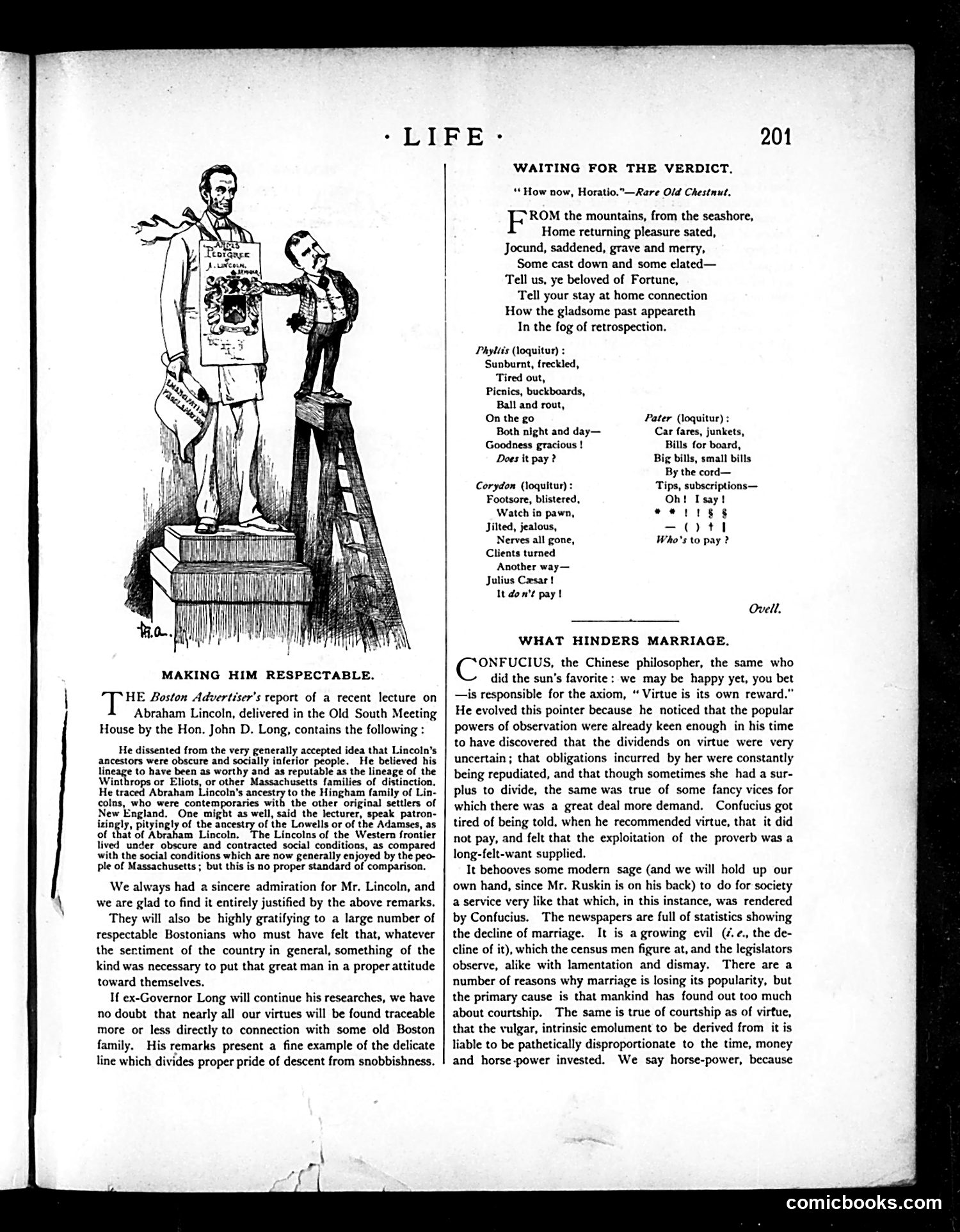
This cartoon satirizes efforts to rehabilitate Abraham Lincoln's ancestry and social standing. The image shows a tall figure (Lincoln) being elevated on a pedestal while someone below works to polish or "make respectable" his image—literally scrubbing away his humble origins. The accompanying text discusses a Boston lecture claiming Lincoln descended from the "respectable" Hingham family of Lincolns rather than from "obscure and socially inferior people." The article mocks this revisionism, arguing that Lincoln's virtue came from his own character, not his ancestry. It criticizes the impulse to retroactively elevate his family background to match his accomplishments, suggesting such efforts reveal snobbish attitudes about social class that undermine genuine pride in his humble beginnings and self-made success.
This page contains literary content rather than political cartoons. The left column continues an essay defending fishing as a worthwhile leisure activity, arguing that anglers shouldn't be criticized for their sport. The right side features "The Last Guests," a poem about seaside activities, followed by a decorative "Boulshevism" header (a pun on Bolshevism). Below that is an article titled "Something About Bouquets for Murderers," critiquing a Boston woman's novel "For a Woman" that sympathetically portrays a criminal. The piece argues such romanticization of crime is irresponsible, using this case to satirize sentimental literature that glorifies criminals. The page represents Life's typical approach: mixing humor, social commentary, and literary criticism to mock contemporary trends and attitudes.
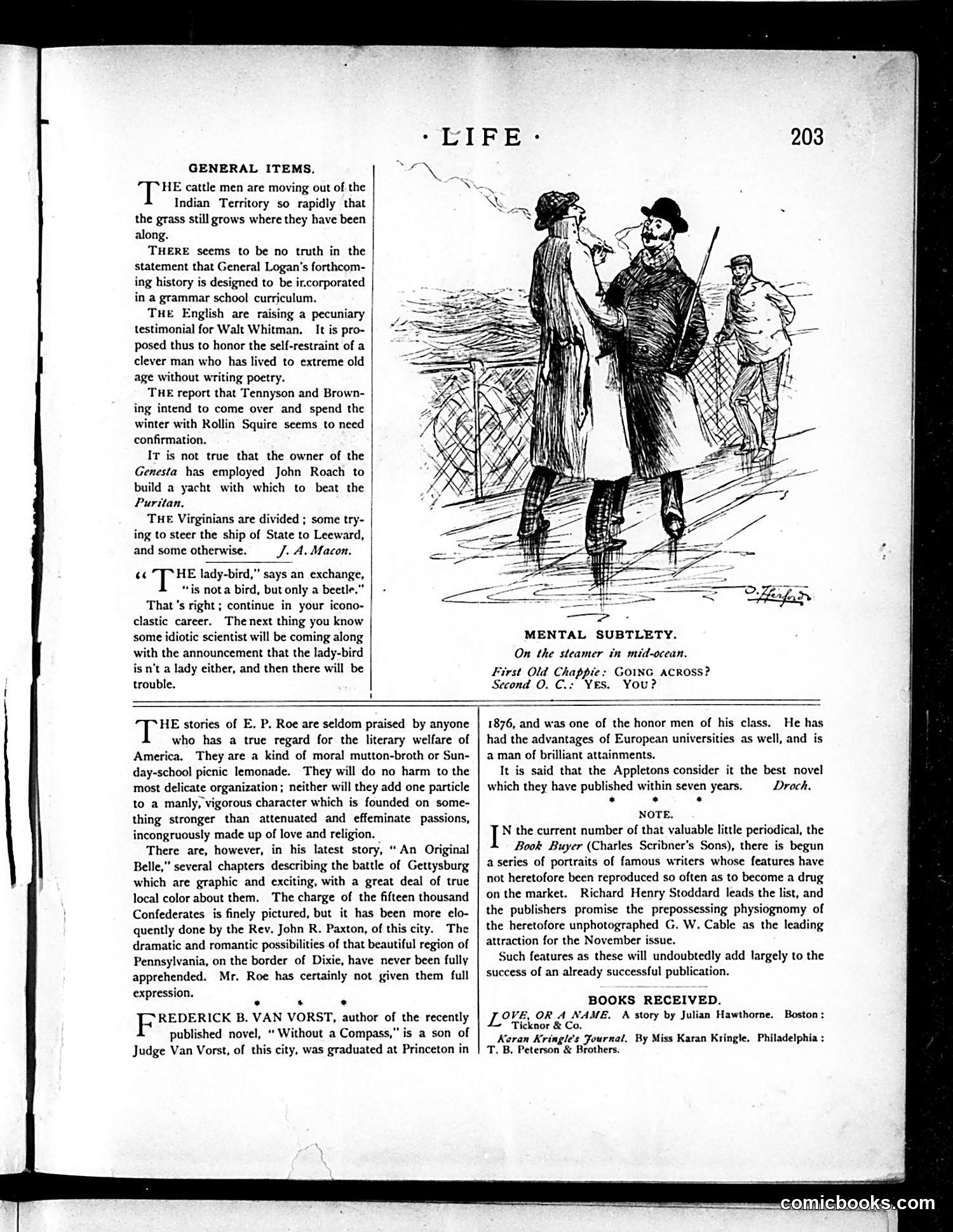
The cartoon depicts two gentlemen on a steamer's deck in mid-ocean. The caption records their exchange: **First Old Chappie:** "Going across?" **Second O.C.:** "Yes. You?" This appears to be satirizing the banality of polite conversation among upper-class travelers. The joke hinges on the absurdity of the question—they're obviously both on the same ship crossing the ocean, making the inquiry pointlessly obvious. The title "Mental Subtlety" underscores the satire: these supposedly refined gentlemen are engaging in the most vapid small talk imaginable, demonstrating that wealth and social station don't guarantee wit or intelligence. It's gentle mockery of Victorian conversational pretension.
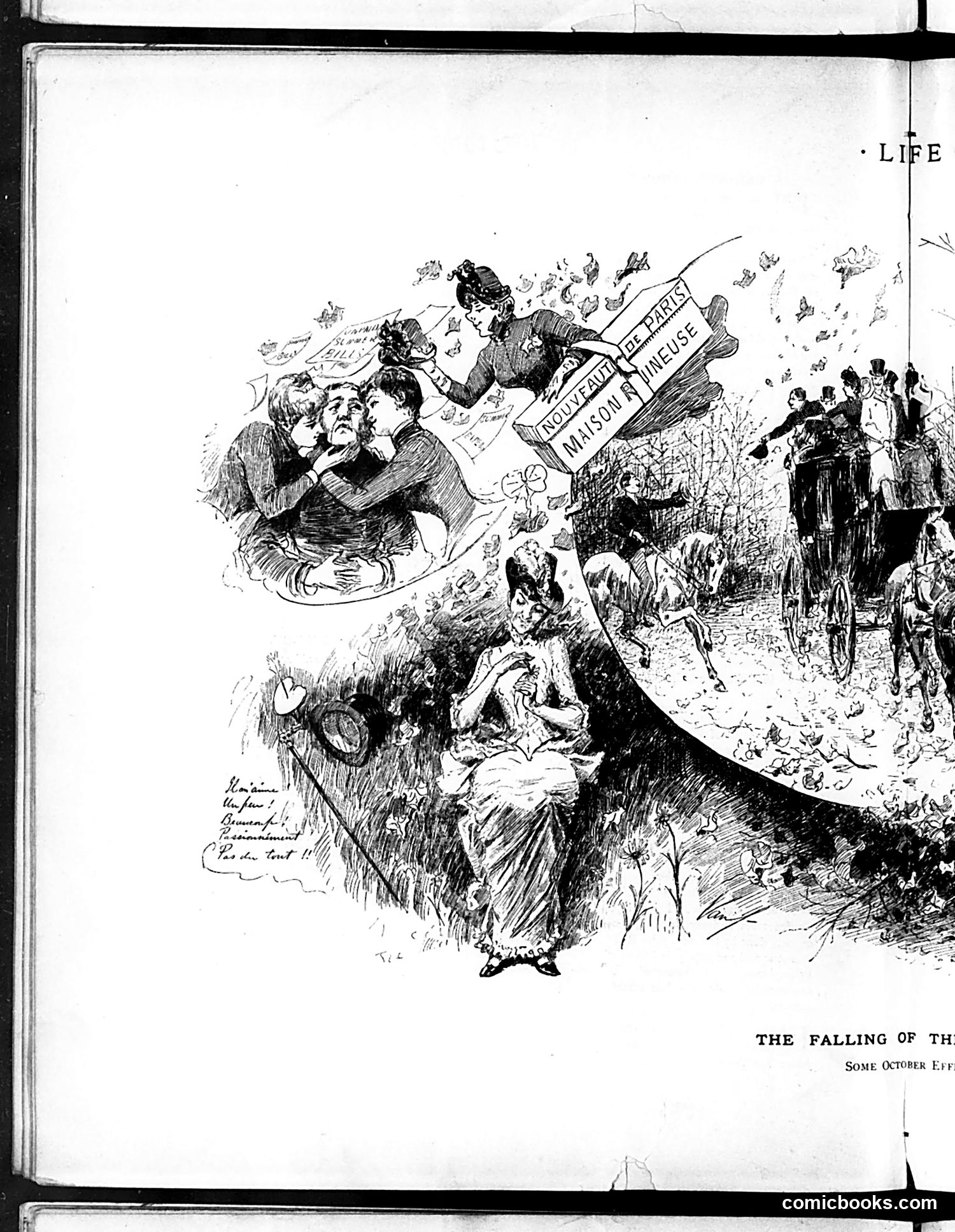
This is a satirical illustration titled "THE FALLING OF TH[E]" (title cut off), subtitled "SOME OCTOBER EFF[ECT]" (also incomplete). The cartoon depicts a domestic scene with social commentary. A couple embraces in the foreground while a woman above holds a banner reading "MAISON D'UNE JEUNE FILLE" (a young woman's house). To the right, figures on bicycles and horseback appear to be departing or fleeing. The satire likely critiques October social changes—possibly related to the departure of summer society or the end of a social season. The banner and the contrast between intimate domestic life and the exodus of visitors suggests commentary on social pretension or the artificial nature of seasonal gatherings. The style and content are consistent with *Life* magazine's turn-of-century satirical approach to American social customs.
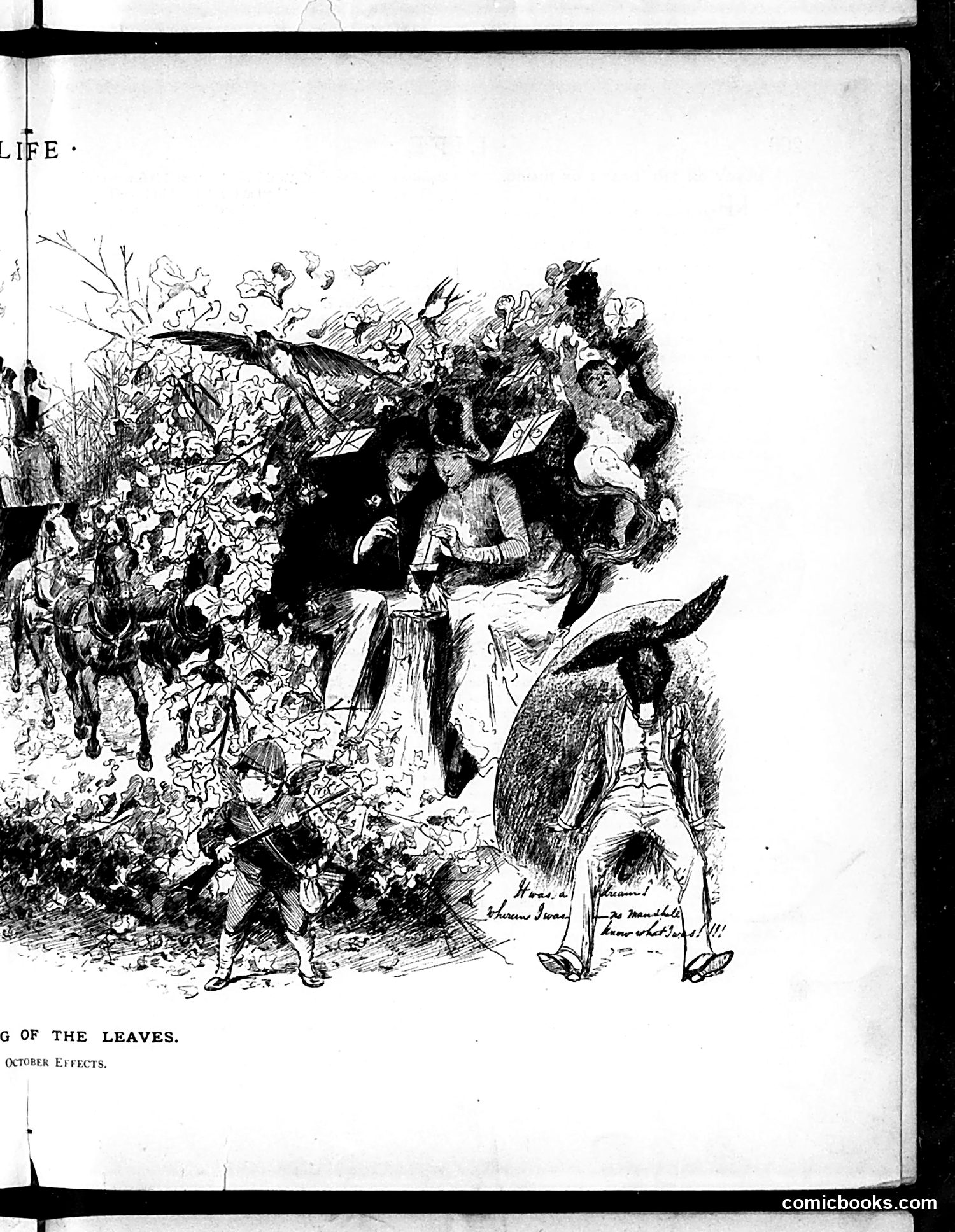
This appears to be a satirical illustration about autumn social activities. The sketch shows well-dressed figures gathered around foliage, with what seems to be a small child or figure at the bottom left. The dense, chaotic vegetation dominates the composition. The title "A Rustling of the Leaves" likely plays on double meaning—both literal autumn leaves and the "rustling" of social gossip or activity during fall season. "October Effects" suggests seasonal social behaviors or fashions. Without clearer identification of specific figures or visible text in the illustration itself, I cannot definitively identify which contemporary political or social figures are being caricatured. The satire appears directed at upper-class autumn social gatherings and their pretensions, though the exact targets remain unclear from this image alone.
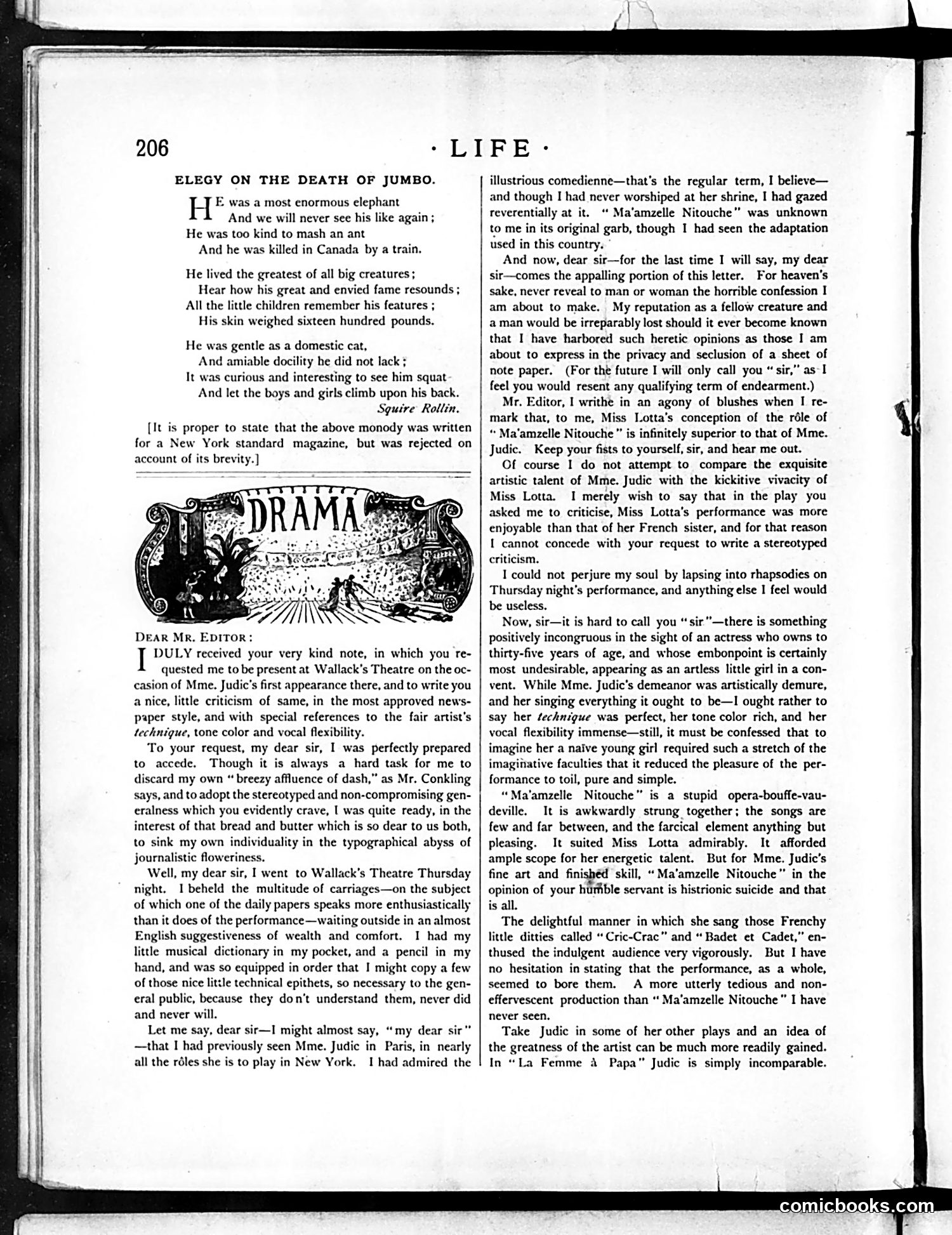
This page contains two distinct pieces of satirical content: **"Elegy on the Death of Jumbo"** (top): A mock-serious poem mourning Jumbo, a famous elephant who died when struck by a train in Canada. The satire lies in treating the elephant's death with overwrought, grandiose language typically reserved for human tragedy. A footnote jokes that the piece was rejected by a New York magazine for being "too brief"—absurd given that it's already quite lengthy for an animal's obituary. This mocks both sentimental Victorian excess and magazine editorial standards. **"Drama" section (bottom)**: A letter from a theater critic describing his experience attending Mme. Judic's performance at Wallack's Theatre. The satire targets critical pretension: the writer ironically claims to adopt "journalistic floweriness" and uses technical musical terminology that audiences don't understand. The punchline is his heretical confession that American actress Miss Lotta gave a superior performance to the celebrated French actress Mme. Judic—he's admitting personal preference contradicts expected critical orthodoxy. Both pieces mock Victorian affectation and institutional authority.
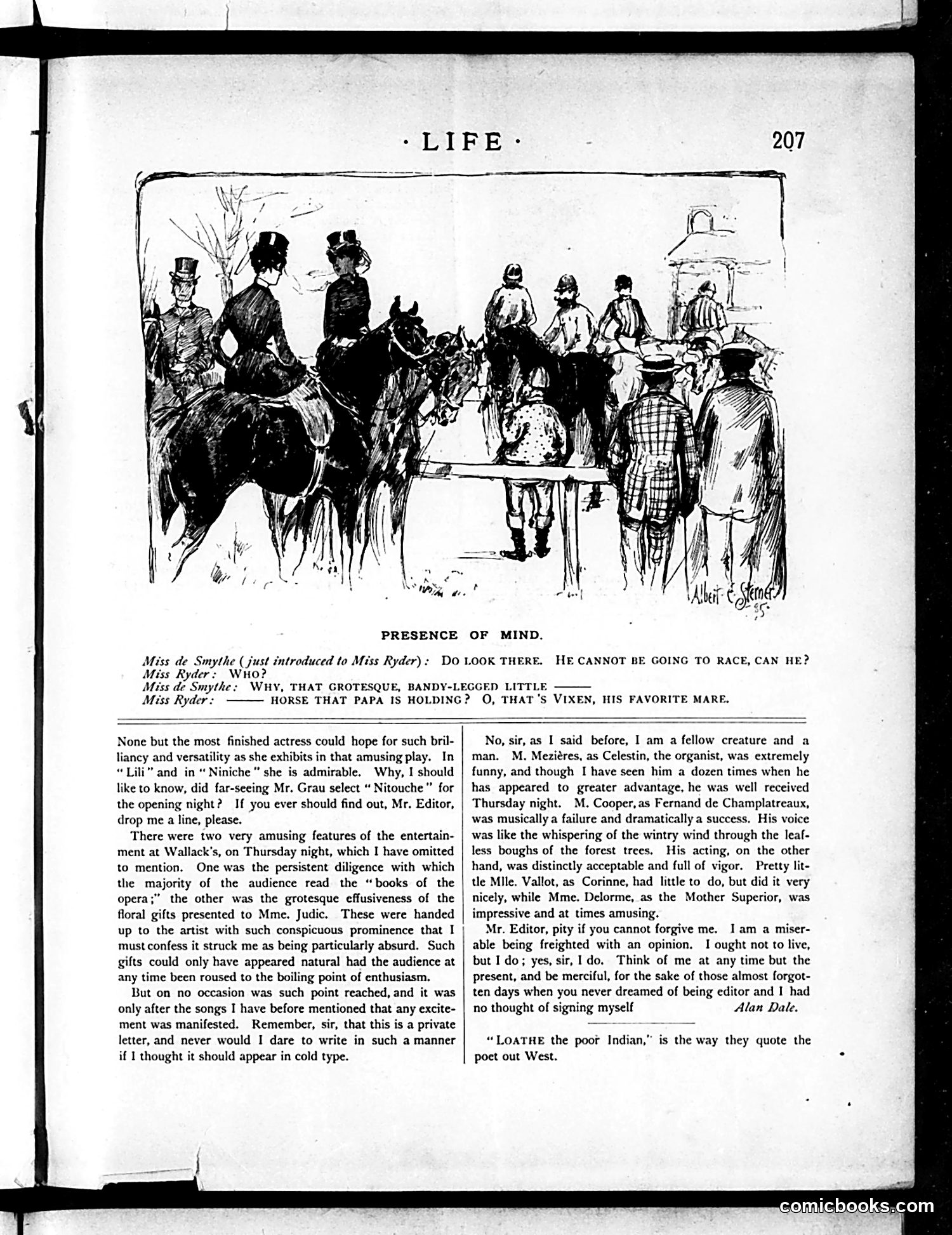
This cartoon depicts a social comedy of manners set at a horse race. Two women—Miss de Smythe and Miss Ryder—are introduced to each other. De Smythe, making conversation, points to a horse and begins insulting it as "grotesque" and "bandy-legged," unaware it belongs to Ryder's father and is his prized mare named Vixen. The joke is one of embarrassment and "presence of mind"—Ryder must quickly recover from the insult to her family's beloved animal. The satire targets upper-class social pretension: De Smythe's careless rudeness and assumption that any poorly-formed horse must be beneath notice, only to be humbled by the revelation of ownership. The cartoon exemplifies Victorian-era salon humor about navigating polite society's pitfalls—particularly women's social performance and the need for quick wit to escape awkward situations.
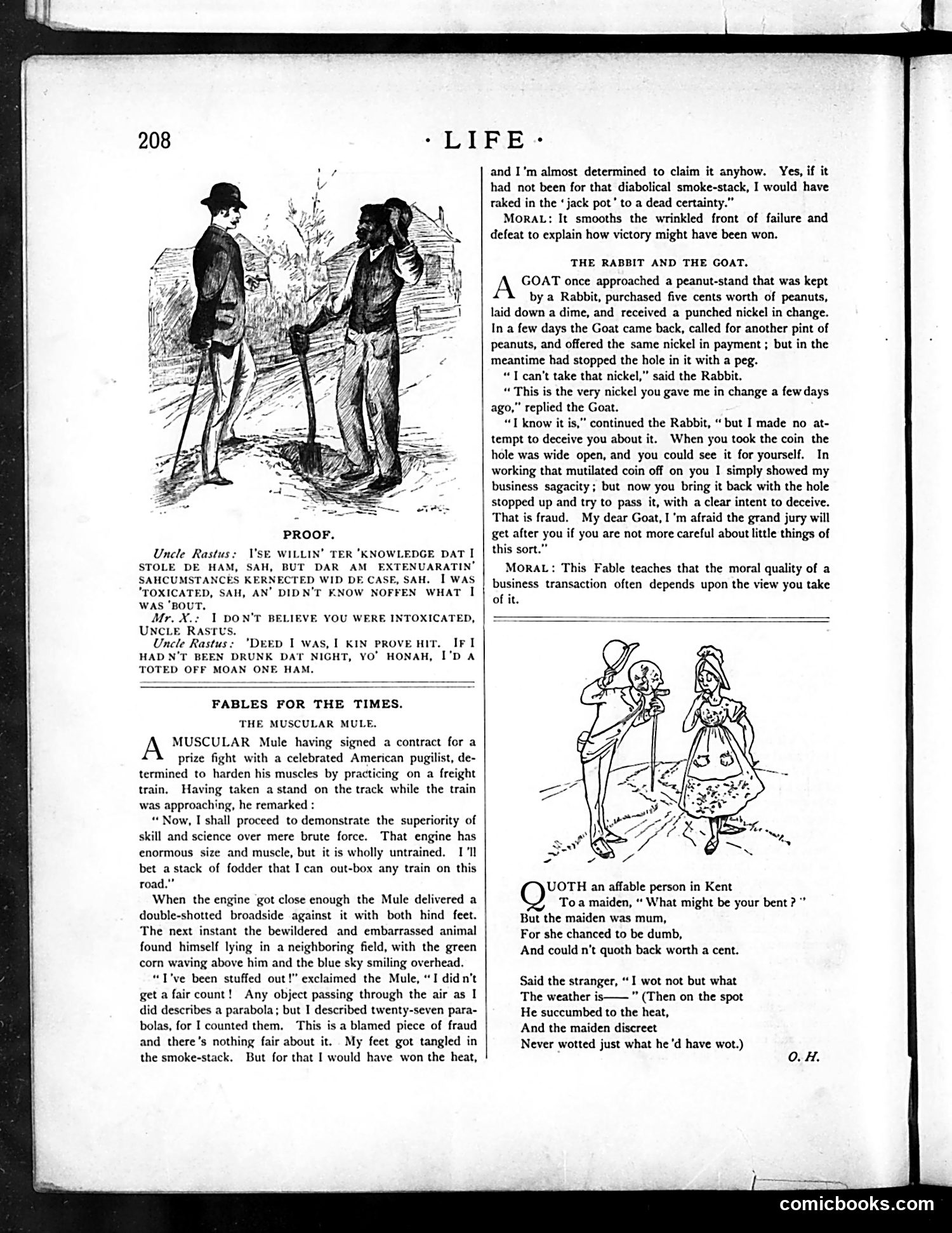
This page contains three satirical fables teaching moral lessons to modern readers. **"The Rabbit and the Goat"** depicts a dishonest goat attempting to pass a defective coin (with a plugged hole) to a rabbit vendor. The moral: business fraud depends on *intent to deceive*—the goat's act is wrong because it deliberately conceals a defect, unlike the rabbit's innocent acceptance of the damaged coin initially. **"The Muscular Mule"** mocks overconfidence. A mule challenges a train to a boxing match, boasting that "skill and science" overcome "brute force." He's thrown into a field and absurdly blames the outcome on mathematics (counting parabolas) and the smoke-stack—rationalizing defeat rather than accepting reality. **The top dialogue** shows "Uncle Rastus" (a stereotypical Black character in offensive dialect) claiming intoxication excuses stealing ham, while Mr. X skeptically notes that without intoxication, he'd have stolen *more*—dark satire on excuse-making. All three fables critique self-deception, rationalization, and moral relativism in contemporary society.
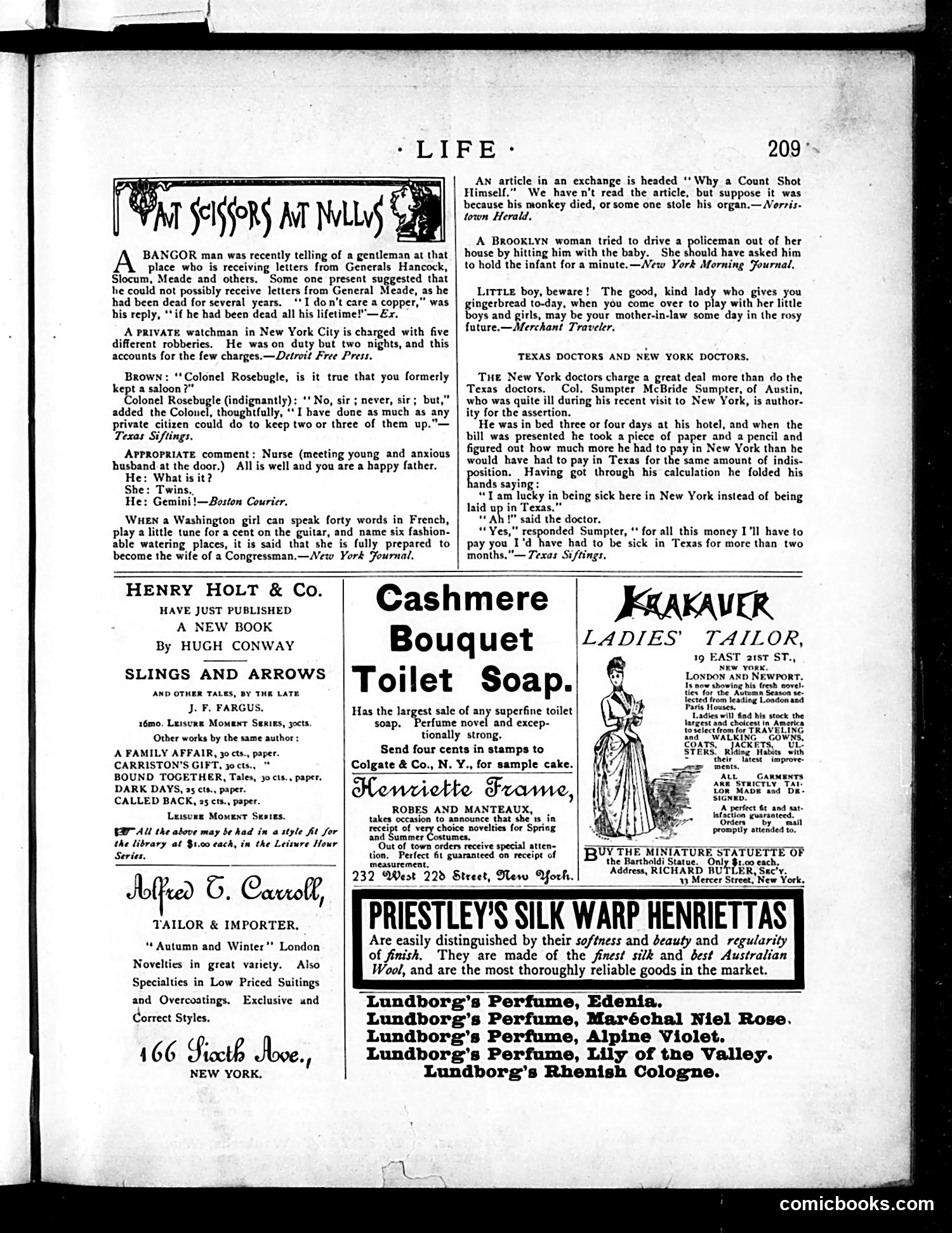
This page from *Life* magazine consists primarily of **brief humorous anecdotes** and **advertisements**, rather than political cartoons. The jokes target various social absurdities: a credulous man accepting letters from deceased generals; a watchman committing robberies during his few nights on duty; a former saloon-keeper boasting about his contributions to tavern operations; and a Washington girl acquiring superficial accomplishments to marry a congressman. The longest piece contrasts **Texas and New York doctors' fees**—a Colonel Sumpter calculates that his New York medical bill for a few days' illness would cost him two months of treatment in Texas, satirizing Northern urban price-gouging versus Southern affordability. The page is dominated by **period advertisements** for books, tailoring services, perfume, and toilet soap, reflecting *Life's* reliance on advertising revenue. There are no identifiable political figures or events—these are general social satirical observations typical of 19th-century humor magazines.
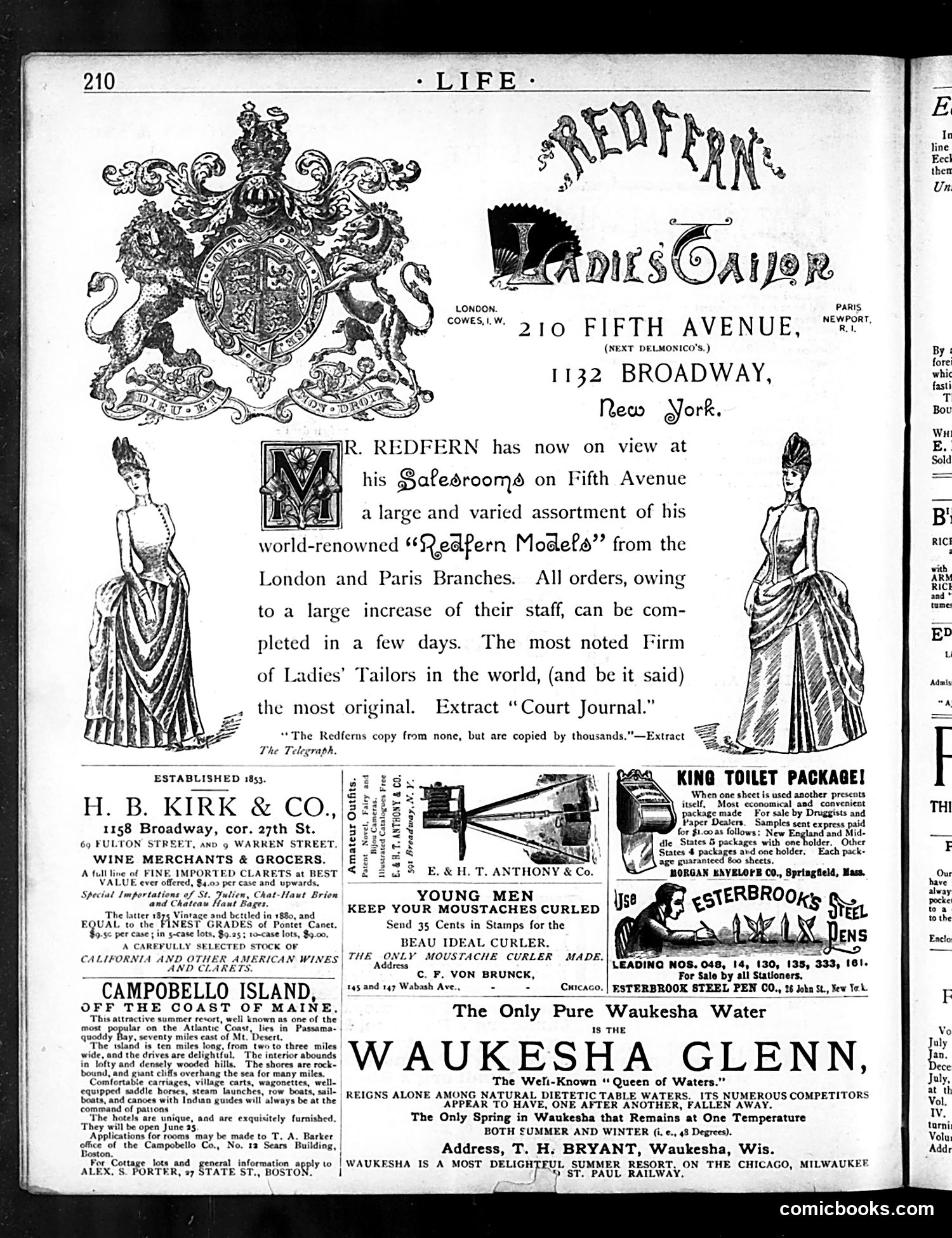
This page is **primarily advertising**, not satirical content. It features commercial announcements for upscale goods and services targeting wealthy Americans, circa 1880s-1890s. The main advertisement showcases **R. Redfern's Ladies' Tailor business** on Fifth Avenue and Broadway in New York, promoting "Redfern Models" from London and Paris branches. The accompanying fashion illustrations depict Victorian-era women's formal wear—the elaborate gowns and styling were status symbols of elite fashion. The page also advertises H.B. Kirk & Co. wine merchants, Campobello Island resort in Maine, and various patent products (toilet paper dispensers, mustache curlers, steel pens). The **Waukesha Glenn mineral water advertisement** emphasizes its purity and consistency—"the only spring in Waukesha that remains at one temperature"—reflecting contemporary health trends crediting mineral waters with medicinal properties. No political satire or caricature appears here; this is a window into Gilded Age consumer culture and aspirational marketing.
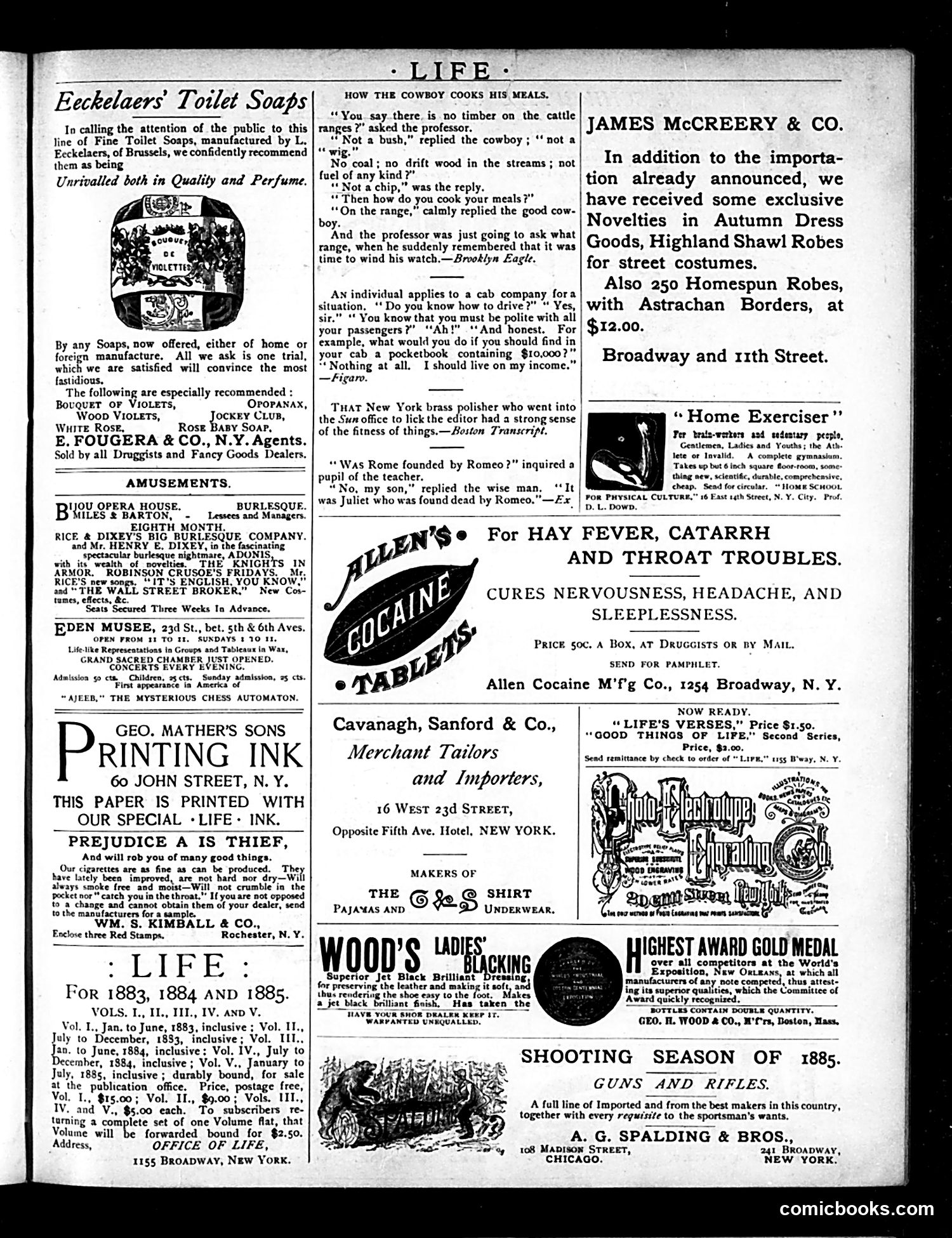
This page is primarily **advertisements and miscellaneous content** from Life magazine, circa 1883-1885. The only humor pieces are brief anecdotes: 1. **"How the Cowboy Cooks His Meals"**: A professor asks a cowboy how he cooks without wood, coal, or fuel. The cowboy replies "on the range"—a pun on the cooking device. The joke's anticlimax (the professor simply remembers to wind his watch) suggests the absurdity of the exchange. 2. **Brief jokes** about a cab driver's honesty and Rome's founding mix wordplay with satirical jabs at character. Otherwise, the page features standard period advertisements: toilet soaps, theatrical amusements (burlesque opera), printing ink, cigarettes, and merchant tailors. There's also an advertisement for "Allen's Cocaine Tablets" for hay fever and nervousness—reflecting the era's unregulated use of cocaine in patent medicines. **No political cartoons appear on this page.** It's a typical late-19th-century magazine mixing light humor with commercial advertisements.
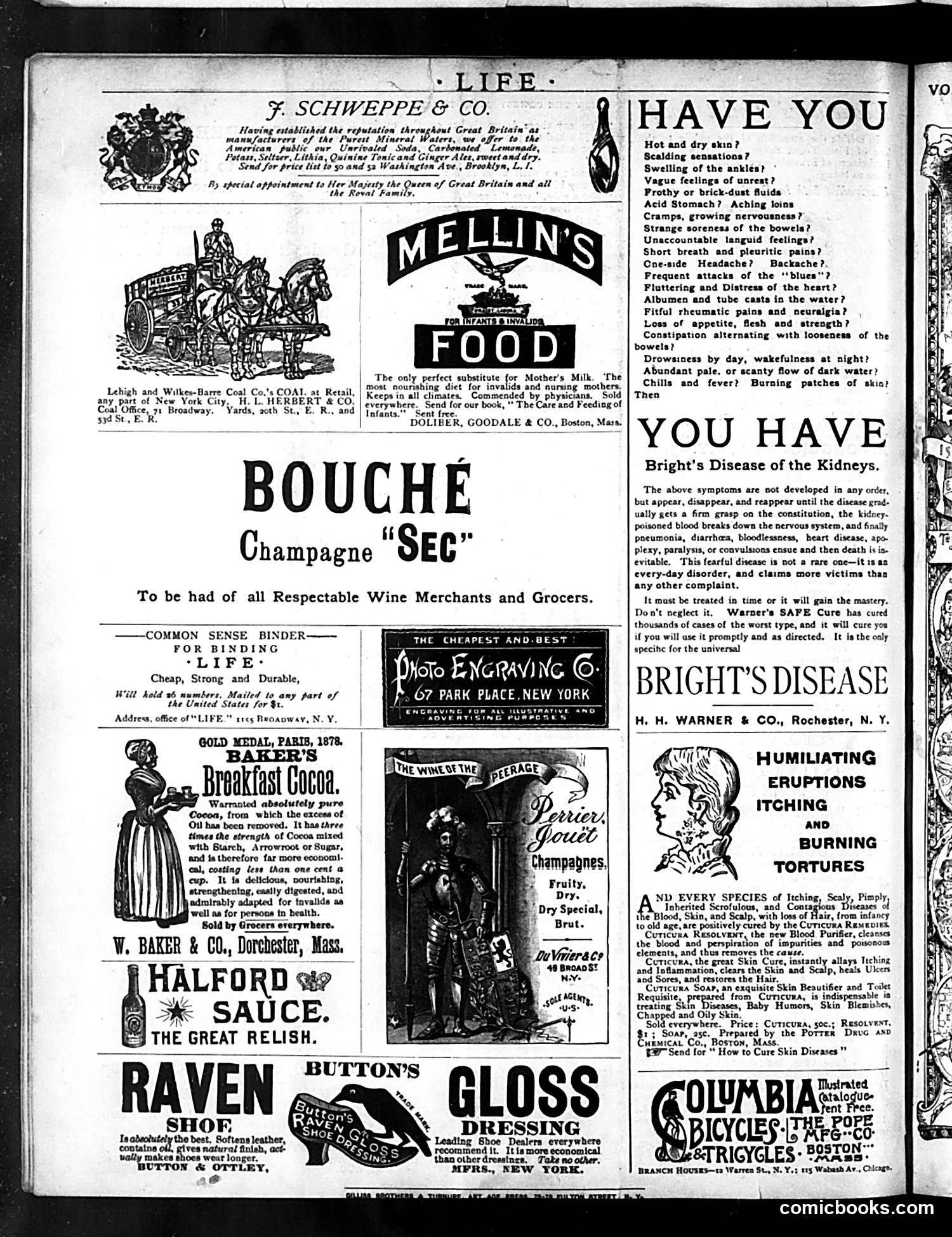
This is primarily an **advertising page**, not satirical content. It showcases patent medicines and consumer goods typical of late 19th-century American publications. The dominant feature is a large advertisement for **Warner's Safe Cure for Bright's Disease** (kidney ailment). The ad uses a manipulative marketing tactic common to the era: it lists dozens of vague, overlapping symptoms—fatigue, skin problems, digestive issues—that could apply to almost any illness, then claims they all indicate kidney disease treatable only by Warner's product. This exploits medical anxiety and ignorance before modern diagnostics existed. Other ads promote similarly dubious remedies: Baker's Cocoa, Cuticura soaps for skin conditions, and Mellin's Food as a "Mother's Milk substitute." **The satire, if any, is unintentional**: Life magazine published these ads alongside genuine editorial content. Modern readers would recognize this as predatory medical fraud, but contemporary audiences accepted such claims as normal commerce. The page documents how "patent medicines" exploited consumers before FDA regulation (established 1906).