
Life, 1885-10-08 · page 6 of 16
Life — October 8, 1885 — page 6: what you’re looking at
What you’re looking at
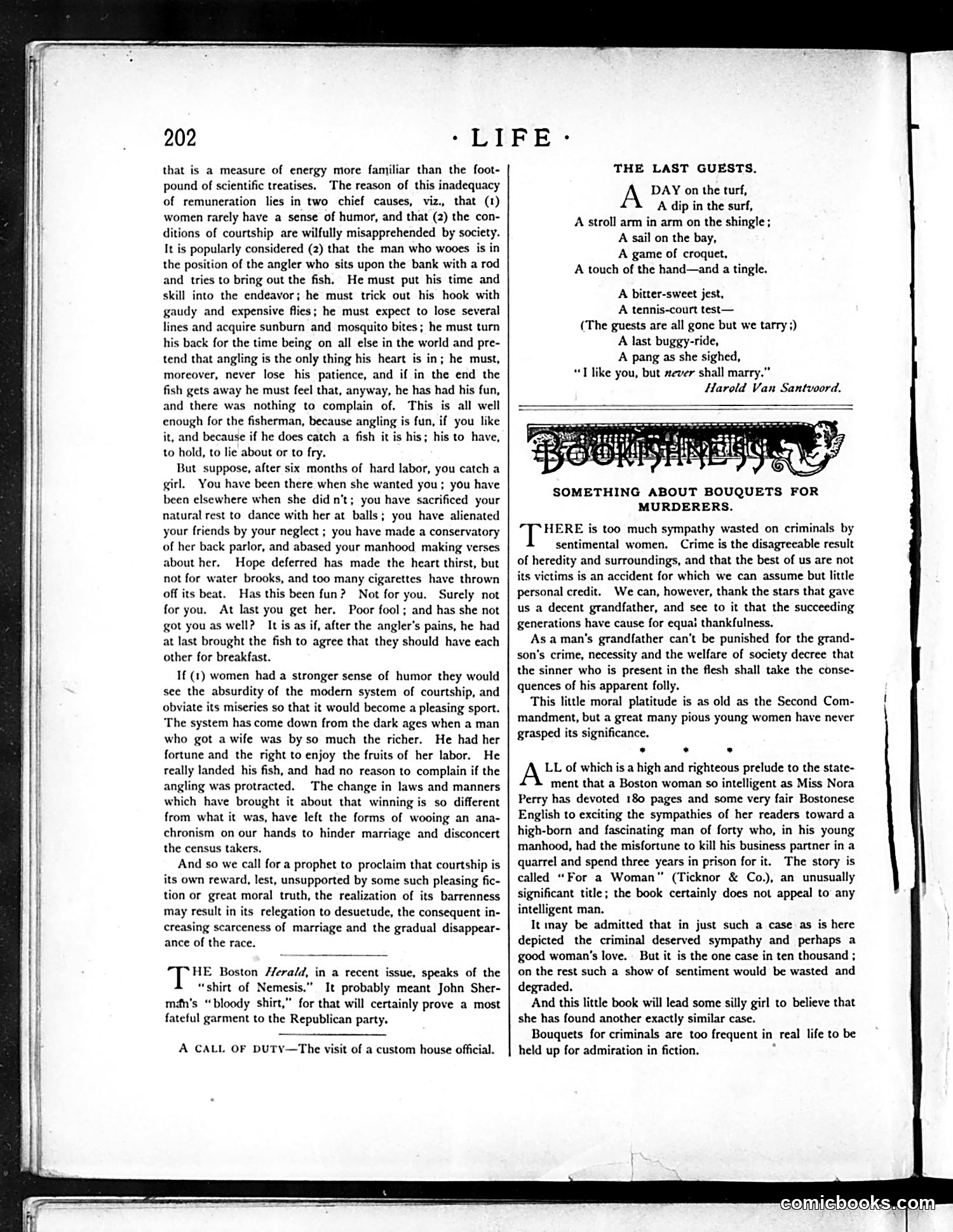
This page contains literary content rather than political cartoons. The left column continues an essay defending fishing as a worthwhile leisure activity, arguing that anglers shouldn't be criticized for their sport. The right side features "The Last Guests," a poem about seaside activities, followed by a decorative "Boulshevism" header (a pun on Bolshevism). Below that is an article titled "Something About Bouquets for Murderers," critiquing a Boston woman's novel "For a Woman" that sympathetically portrays a criminal. The piece argues such romanticization of crime is irresponsible, using this case to satirize sentimental literature that glorifies criminals. The page represents Life's typical approach: mixing humor, social commentary, and literary criticism to mock contemporary trends and attitudes.
📄 Transcribed text from this page (OCR, searchable)
Machine-transcribed from the original scan — historical spelling and the odd misread are preserved.
202 that is a measure of energy more familiar than the foot- pound of scientific treatises. The reason of this inadequacy of remuneration lies in two chief causes, viz., that (1) women rarely have a sense of humor, and that (2) the con- ditions of courtship are wilfully misapprehended by society. It is popularly considered (2) that the man who wooes is in the position of the angler who sits upon the bank with a rod and tries to bring out the fish. He must put his time and skill into the endeavor; he must trick out his hook with gaudy and expensive flies; he must expect to lose several lines and acquire sunburn and mosquito bites; he must turn his back for the time being on all else in the world and pre- tend that angling is the only thing his heart is in; he must, moreover, never lose his patience, and if in the end the fish gets away he must feel that, anyway, he has had his fun, and there was nothing to complain of. This is all well enough for the fisherman, because angling is fun, if you like it, and because if he does catch a fish it is his; his to have, to hold, to lie about or to fry. But suppose, after six months of hard labor, you catch a girl. You have been there when she wanted you ; you have been elsewhere when she didn't; you have sacrificed your natural rest to dance with her at balls; you have alienated your friends by your neglect ; you have made a conservatory of her back parlor, and abased your manhood making verses about her. Hope deferred has made the heart thirst, but not for water brooks, and too many cigarettes have thrown off its beat. Has this been fun? Not for you. Surely not for you. At last you get her. Poor fool; and has she not got you as well? It is as if, after the angler’s pains, he had at last brought the fish to agree that they should have each other for breakfast. If (1) women had a stronger sense of humor they would see the absurdity of the modern system of courtship, and obviate its miseries so that it would become a pleasing sport. The system has come down from the dark ages when a man who got a wife was byso much the richer. He had her fortune and the right to enjoy the fruits of her labor. He really landed his fish, and had no reason to complain if the angling was protracted. The change in laws and manners which have brought it about that winning is so different from what it was, have left the forms of wooing an ana- chronism on our hands to hinder marriage and disconcert the census takers. And so we call for a prophet to proclaim that courtship is its own reward, lest, unsupported by some such pleasing fic- tion or great moral truth, the realization of its barrenness may result in its relegation to desuetude, the consequent in- creasing scarceness of marriage and the gradual disappear- ance of the race. HE Boston /era/d, in a recent issue, speaks of the “shirt of Nemesis.” It probably meant John Sher- man's “bloody shirt,” for that will certainly prove a most fateful garment to the Republican party. A CALL OF DUTY—The visit of a custom house official. *LIFE: THE LAST GUESTS. DAY on the turf, A dip in the surf, A stroll arm in arm on the shingle; A sail on the bay, A game of croquet, A touch of the hand—and a tingle. A bitter-sweet jest, A tennis-court test— (The guests are all gone but we tarry ;) A last buggy-ride, A pang as she sighed, “T like you, but #ever shall marry.” Harold Van Santvoord. SOMETHING ABOUT BOUQUETS FOR MURDERERS. 0 Di is too much sympathy wasted on criminals by sentimental women. Crime is the disagreeable result of heredity and surroundings, and that the best of us are not its victims is an accident for which we can assume but little personal credit. We can, however, thank the stars that gave us a decent grandfather, and see to it that the succeeding generations have cause for equai thankfulness. As aman'’s grandfather can't be punished for the grand- son's crime, necessity and the welfare of society decree that the sinner who is present in the flesh shall take the conse- quences of his apparent folly. This little moral platitude is as old as the Second Com- mandment, but a great many pious young women have never grasped its significance. . . . LL of which is a high and righteous prelude to the state- ment that a Boston woman so intelligent as Miss Nora Perry has devoted 180 pages and some very fair Bostonese English to exciting the sympathies of her readers toward a high-born and fascinating man of forty who, in his young manhood, had the misfortune to kill his business partner in a quarrel and spend three years in prison for it. The story is called “For a Woman” (Ticknor & Co.), an unusually significant title; the book certainly does not appeal to any intelligent man. It may be admitted that in just such a case as is here depicted the criminal deserved sympathy and perhaps a good woman’s love. But it is the one case in ten thousand ; on the rest such a show of sentiment would be wasted and degraded. And this little book will lead some silly girl to believe that she has found another exactly similar case. Bouquets for criminals are too frequent in real life to be held up for admiration in fiction. .