
Life, 1885-10-08 · page 11 of 16
Life — October 8, 1885 — page 11: what you’re looking at
What you’re looking at
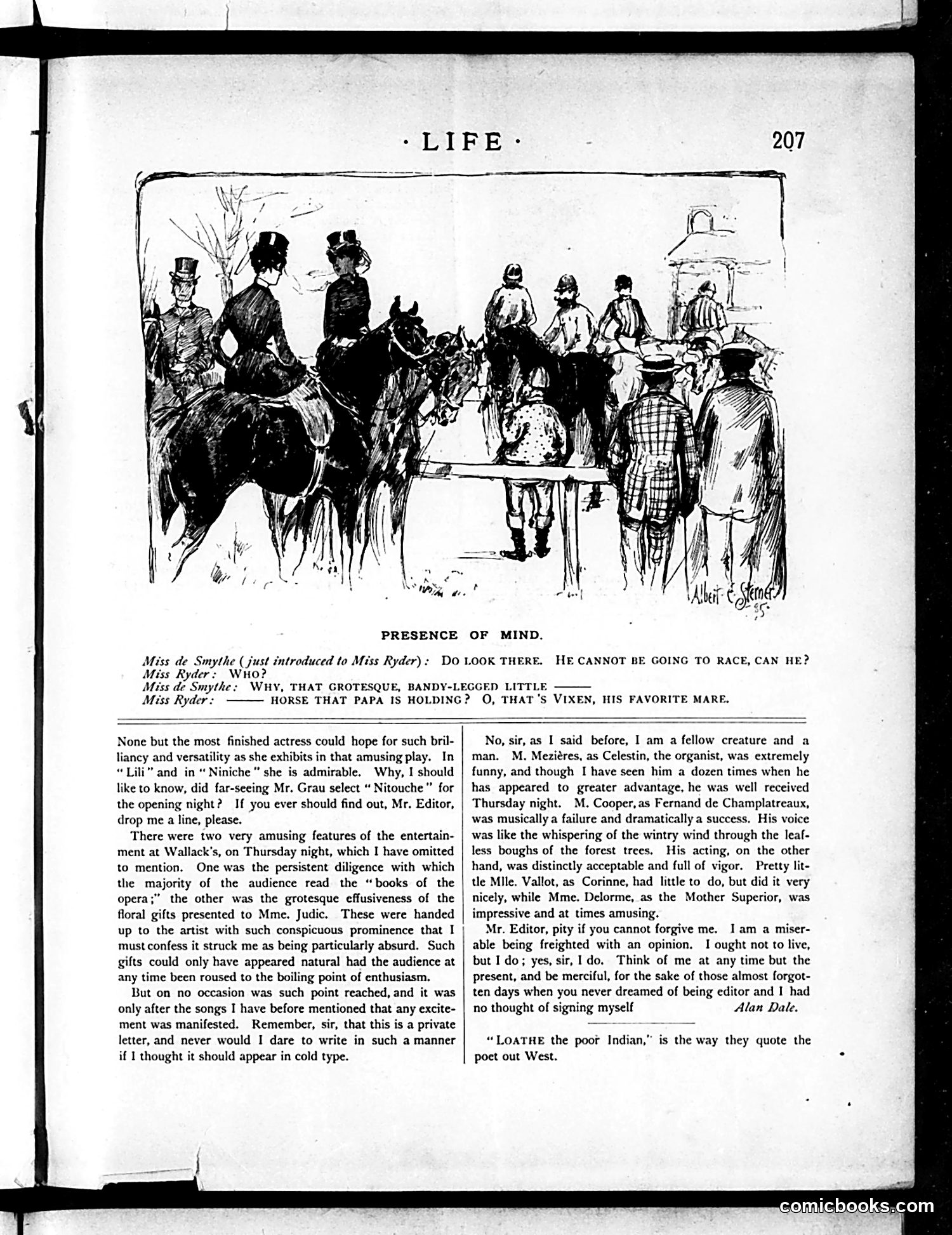
This cartoon depicts a social comedy of manners set at a horse race. Two women—Miss de Smythe and Miss Ryder—are introduced to each other. De Smythe, making conversation, points to a horse and begins insulting it as "grotesque" and "bandy-legged," unaware it belongs to Ryder's father and is his prized mare named Vixen. The joke is one of embarrassment and "presence of mind"—Ryder must quickly recover from the insult to her family's beloved animal. The satire targets upper-class social pretension: De Smythe's careless rudeness and assumption that any poorly-formed horse must be beneath notice, only to be humbled by the revelation of ownership. The cartoon exemplifies Victorian-era salon humor about navigating polite society's pitfalls—particularly women's social performance and the need for quick wit to escape awkward situations.
📄 Transcribed text from this page (OCR, searchable)
Machine-transcribed from the original scan — historical spelling and the odd misread are preserved.
PRESENCE OF MIND. Miss de Smythe (just introduced to Miss Ryder) : Miss Ryder: Wo? DO LOOK THERE. HE CANNOT BE GOING TO RACE, CAN HE? Miss de Smythe: WHY, THAT GROTESQUE, BANDY-LEGGED LITTLE Miss Ryder: HORSE THAT PAPA IS HOLDING? O, THAT'S VIXEN, HIS FAVORITE MARE, None but the most finished actress could hope for such bril- liancy and versatility as she exhibits in that amusing play. In “Lili” and in “ Niniche” she is admirable. Why, I should like to know, did far-seeing Mr. Grau select “ Nitouche” for the opening night? If you ever should find out, Mr. Editor, drop me a line, please. There were two very amusing features of the entertain- ment at Wallack’s, on Thursday night, which I have omitted to mention. One was the persistent diligence with which the majority of the audience read the “books of the opera;” the other was the grotesque effusiveness of the floral gifts presented to Mme. Judic. These were handed up to the artist with such conspicuous prominence that I must confess it struck me as being particularly absurd. Such gifts could only have appeared natural had the audience at any time been roused to the boiling point of enthusiasm. But on no occasion was such point reached, and it was only after the songs I have before mentioned that any excite- ment was manifested. Remember, sir, that this is a private letter, and never would I dare to write in such a manner if 1 thought it should appear in cold type. No, sir, as I said before, I am a fellow creature and a man. M. Meziéres, as Celestin, the organist, was extremely funny, and though I have seen him a dozen times when he has appeared to greater advantage, he was well received Thursday night. M. Cooper,as Fernand de Champlatreaux, was musically a failure and dramatically a success. His voice was like the whispering of the wintry wind through the leaf- less boughs of the forest trees. His acting, on the other hand, was distinctly acceptable and full of vigor. Pretty lit- tle Mile. Vallot, as Corinne, had little to do, but did it very nicely, while Mme. Delorme, as the Mother Superior, was impressive and at times amusing. Mr. Editor, pity if you cannot forgive me. I am a miser- able being freighted with an opinion. I ought not to live, but I do; yes, sir, Ido. Think of me at any time but the present, and be merciful, for the sake of those almost forgot- ten days when you never dreamed of being editor and I had no thought of signing myself Alan Dale. “LOATHE the poor Indian,” is the way they quote the poet out West.