
Life, 1885-10-08 · page 5 of 16
Life — October 8, 1885 — page 5: what you’re looking at
What you’re looking at
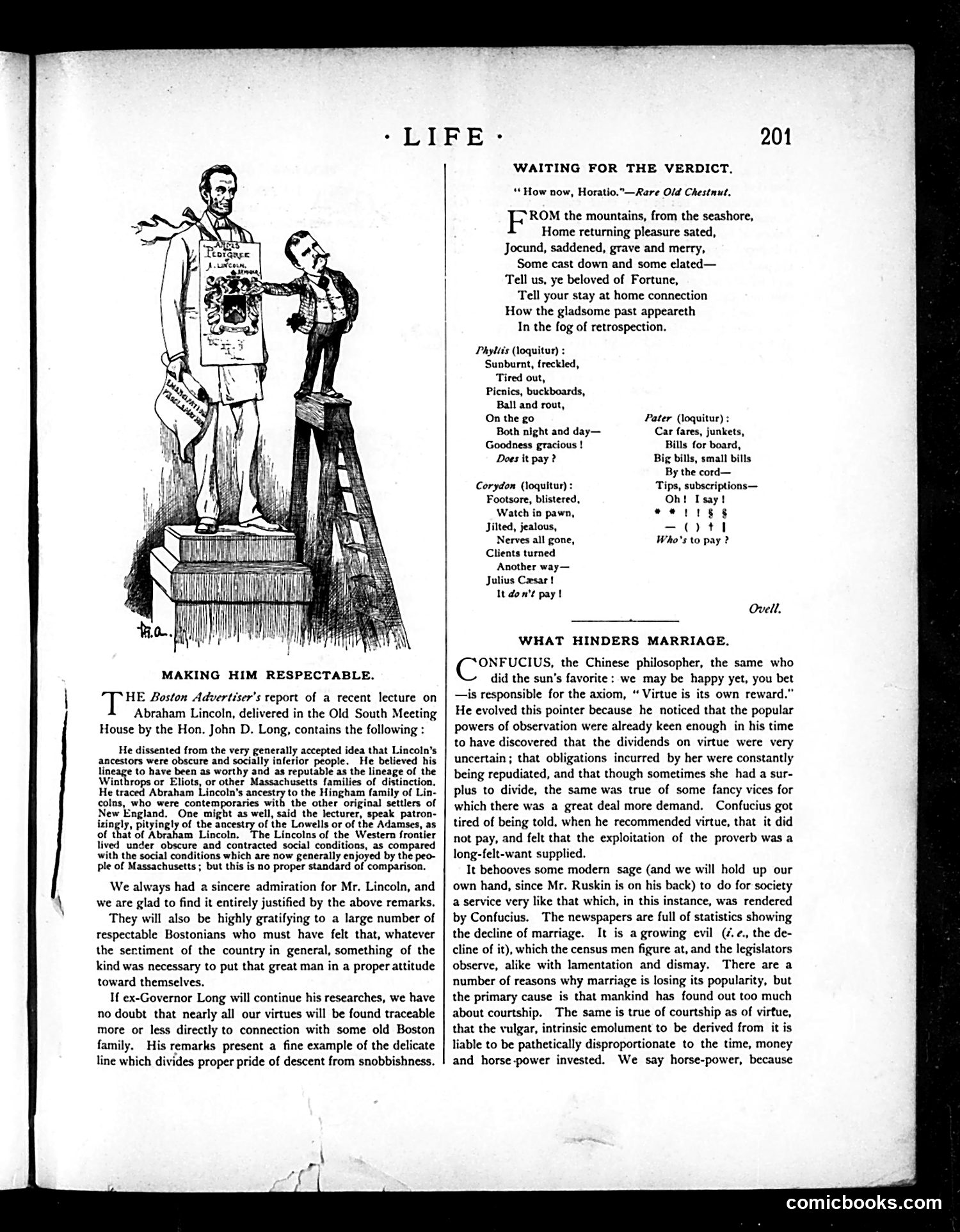
This cartoon satirizes efforts to rehabilitate Abraham Lincoln's ancestry and social standing. The image shows a tall figure (Lincoln) being elevated on a pedestal while someone below works to polish or "make respectable" his image—literally scrubbing away his humble origins. The accompanying text discusses a Boston lecture claiming Lincoln descended from the "respectable" Hingham family of Lincolns rather than from "obscure and socially inferior people." The article mocks this revisionism, arguing that Lincoln's virtue came from his own character, not his ancestry. It criticizes the impulse to retroactively elevate his family background to match his accomplishments, suggesting such efforts reveal snobbish attitudes about social class that undermine genuine pride in his humble beginnings and self-made success.
📄 Transcribed text from this page (OCR, searchable)
Machine-transcribed from the original scan — historical spelling and the odd misread are preserved.
> LIFE: MAKING HIM RESPECTABLE. HE Boston Advertiser's report of a recent lecture on Abraham Lincoln, delivered in the Old South Meeting House by the Hon. John D. Long, contains the following : He dissented from the very generally accepted idea that Lincoln’s ancestors were obscure and socially inferior people. He believed his lineage to have been as worthy and as reputable as the lineage of the Winthrops or Eliots, or other Massachusetts families of distinction. He traced Abraham Lincoln's ancestry to the Hingham family of Lin- colns, who were contemporaries with the other original settlers of New England. One might as well, said the lecturer, speak patron- izingly, pityingly of the ancestry of the Lowells or of the Adamses, as of that of Abraham Lincoln. e Lincolns of the Western frontier lived under obscure and contracted social conditions, as compared with the social conditions which are now generally enjoyed by the peo- ple of Massachusetts ; but this is no proper standard of comparison. We always had a sincere admiration for Mr. Lincoln, and we are glad to find it entirely justified by the above remarks. They will also be highly gratifying to a large number of respectable Bostonians who must have felt that, whatever the sertiment of the country in general, something of the kind was necessary to put that great man in a proper attitude toward themselves. If ex-Governor Long will continue his researches, we have no doubt that nearly all our virtues will be found traceable more or less directly to connection with some old Boston family. His remarks present a fine example of the delicate line which divides proper pride of descent from snobbishness. 201 WAITING FOR THE VERDICT, “* How now, Horatio."—Rare Old Chestnut, ROM the mountains, from the seashore, Home returning pleasure sated, Jocund, saddened, grave and merry, Some cast down and some elated— Tell us, ye beloved of Fortune, Tell your stay at home connection How the gladsome past appeareth In the fog of retrospection. Phyliis (loquitur) : Sunburnt, freckled, Tired out, Picnics, buckboards, Ball and rout, On the go Both night and day— Goodness gracious ! Does it pay? Pater (loquitur) : Car fares, junkets, Bills for board, Big bills, small bills By the cord— Tips, subscriptions— Oh! Isay! orig s -—()tl Who's to pay ? Corydon (loquitur) : Footsore, blistered, Watch in pawn, Jilted, jealous, Nerves all gone, Clients turned Another way— Julius Cxsar! It don't pay! WHAT HINDERS MARRIAGE. CoonEuelus: the Chinese philosopher, the same who did the sun’s favorite: we may be happy yet, you bet —is responsible for the axiom, “ Virtue is its own reward.” He evolved this pointer because he noticed that the popular powers of observation were already keen enough in his time to have discovered that the dividends on virtue were very uncertain ; that obligations incurred by her were constantly being repudiated, and that though sometimes she had a sur- plus to divide, the same was true of some fancy vices for which there was a great deal more demand. Confucius got tired of being told, when he recommended virtue, that it did not pay, and felt that the exploitation of the proverb was a long-felt-want supplied. It behooves some modern sage (and we will hold up our own hand, since Mr. Ruskin is on his back) to do for society a service very like that which, in this instance, was rendered by Confucius. The newspapers are full of statistics showing the decline of marriage. It is a growing evil (¢.¢., the de- cline of it), which the census men figure at, and the legislators observe, alike with lamentation and dismay. There are a number of reasons why marriage is losing its popularity, but the primary cause is that mankind has found out too much about courtship. The same is true of courtship as of virtue, that the vulgar, intrinsic emolument to be derived from it is liable to be pathetically disproportionate to the time, money and horse-power invested. We say horse-power, because comicbooks.com