
A complete issue · 16 pages · 1885
Life — October 1, 1885
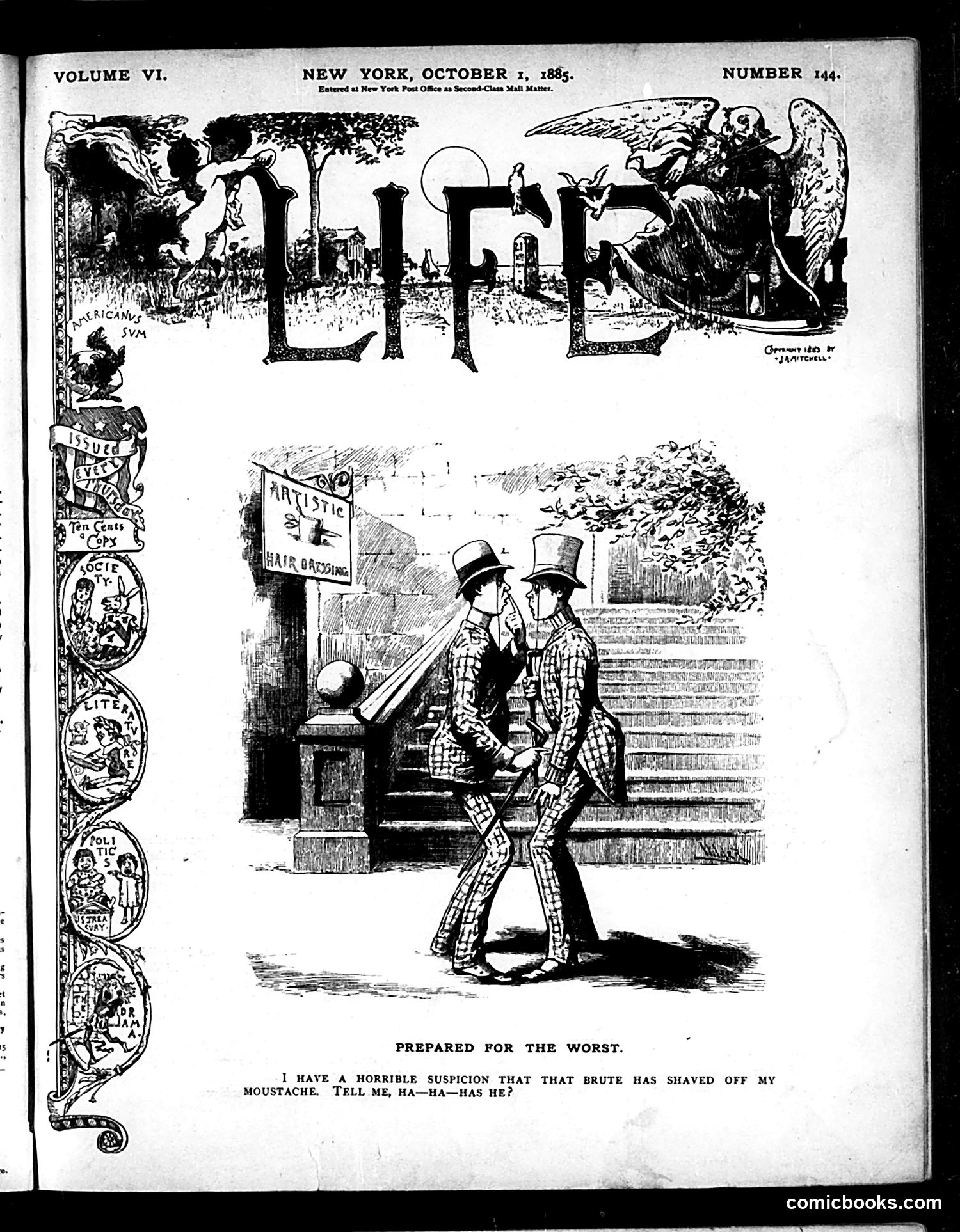
This page contains a single cartoon titled "Prepared for the Worst." The image shows two men in checkered suits standing outside a barber shop ("Artistic Hair Dressing" sign visible). One man, wearing a top hat, appears anxious or suspicious, saying: "I have a horrible suspicion that that brute has shaved off my moustache. Tell me, ha-ha-has he?" The satire appears to play on masculine vanity and anxiety about personal grooming. The joke hinges on the man's exaggerated worry that his barber has removed his distinctive moustache—a crucial marker of 19th-century masculinity and respectability. The caption "Prepared for the Worst" ironically suggests he's bracing himself for this cosmetic disaster. The humor derives from treating facial hair loss as a social catastrophe worthy of dramatic concern.
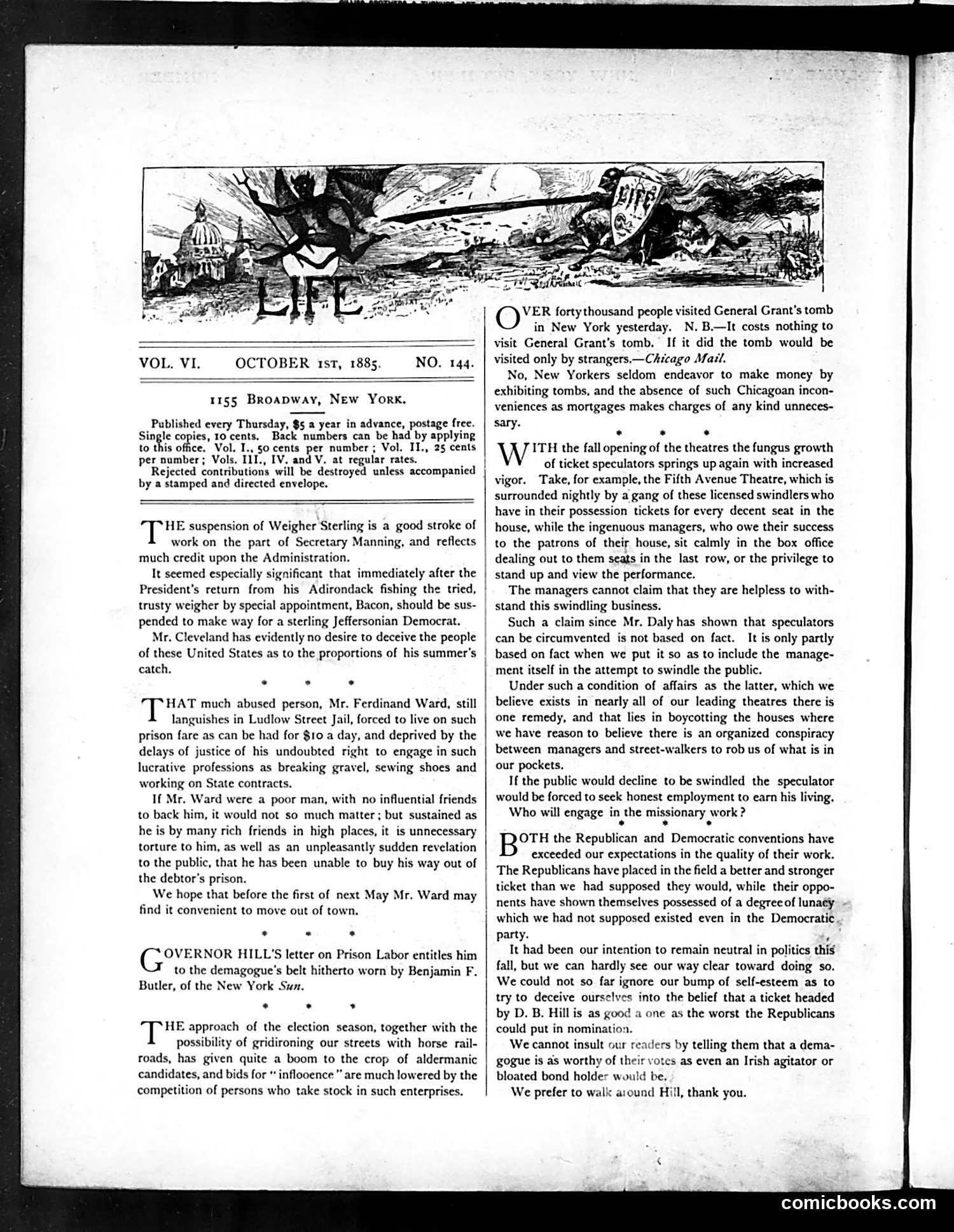
The page's masthead illustration depicts a chaotic scene with a large bird (possibly an eagle or raven) dominating a landscape of destruction and disorder—likely representing American political turmoil or social chaos of the 1880s. The article text references specific contemporary figures: Secretary Manning, President Cleveland, Weigher Sterling, and Ferdinand Ward (imprisoned for financial crimes). The editorial criticizes political appointments made for partisan advantage rather than merit, and discusses prison conditions and labor issues. The content suggests Life magazine's role as a satirical commentator on government corruption, patronage systems, and social injustice during the Gilded Age. The cartoon's anarchic imagery reinforces themes of mismanagement and disorder the text addresses throughout.
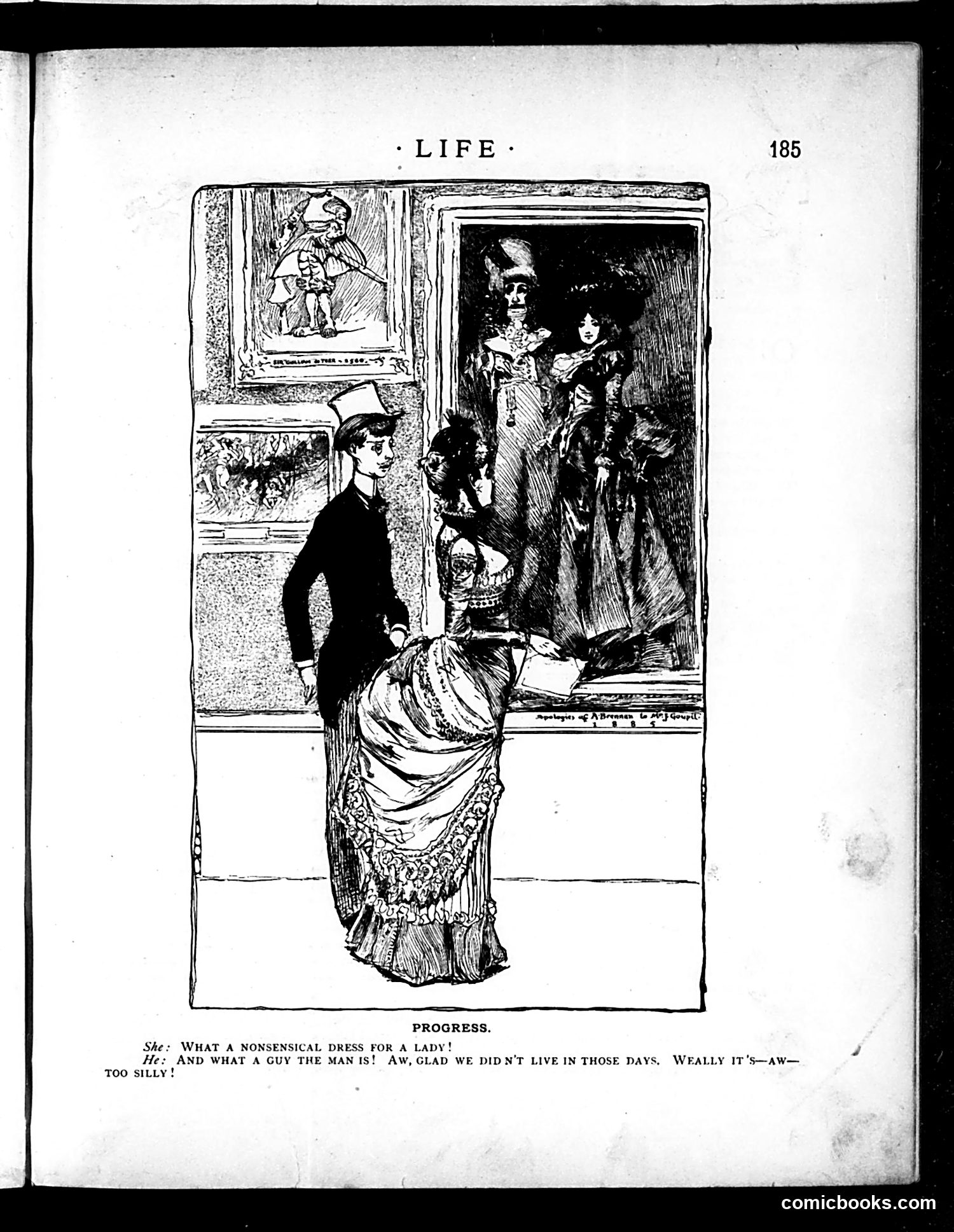
This cartoon satirizes changing fashion and social attitudes between generations. A woman in contemporary (early 20th century) dress—notably loose-fitting and revealing by Victorian standards—stands before a museum display of historical portraits. A man beside her comments on her "nonsensical dress," to which she responds by mocking old-fashioned clothing and expressing relief they don't live in "those days." The satire cuts both ways: the man appears old-fashioned and prudish, while the woman's confidence in modern dress suggests social progress. The artwork displayed behind them (appearing to show historical figures) emphasizes the contrast between past and present standards of propriety and fashion. The title "Progress" indicates the cartoonist views these changes—at least partially ironically—as inevitable social evolution.
This page contains satirical commentary rather than political cartoons. The "Notice Extraordinary" poem mocks Life magazine's own editorial decisions—specifically their practice of including minor figures in their "list" of notable people. The satire suggests that inclusion on their list has become meaningless, as they include virtually everyone while claiming these selections matter for circulation. The right column contains brief social commentary items typical of Life's format, referencing contemporary events: a Republican State Convention, naval matters (Brenton's Reef race), Canon Farrar's visit, and the Huguenot anniversary at Cape Town. These items mock current news rather than target specific individuals, representing the magazine's general satirical commentary on daily events and public figures of the period.
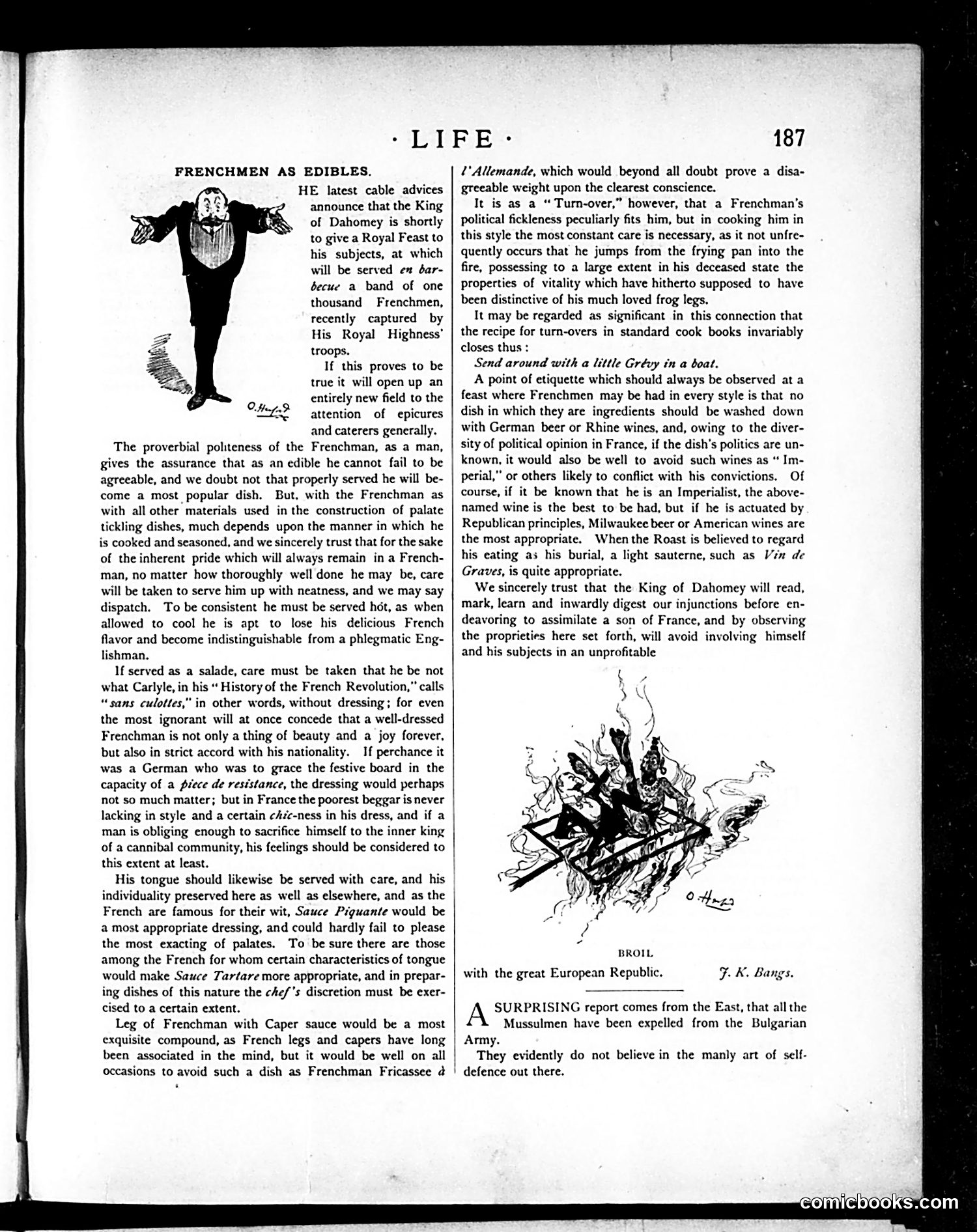
This satirical piece mocks the idea of serving Frenchmen as food at a royal feast in Dahomey (present-day Benin). The cartoon depicts a caricatured Frenchman with exaggerated features, presented as if he were a culinary dish. The article humorously provides "recipes" for preparing various French body parts—legs with caper sauce, tongue with Tartare sauce—playing on stereotypes about French cuisine and pretensions to sophistication. The satire targets both French cultural vanity and European colonial attitudes toward African nations, specifically mocking the notion that Dahomey's ruler would serve European guests in such a manner. The underlying joke appears to be about French arrogance meeting its comeuppance, presented through dark comedic inversion of French culinary superiority.
This page contains literary criticism and poetry rather than political cartoons. The main content includes: 1. **"A Modern Maiden"** — A satirical poem by C.C. Starkweather mocking a cosmopolitan woman ("Miss Maud") who is a famous polyglot, speaks multiple languages, and affects continental manners. The satire targets her affectation and pretension. 2. **Book reviews** discussing Julian Hawthorne's recent novel "Love; or, A Name," critiquing its characters and moral messaging about love and self-sacrifice. 3. **"Gumption"** section — Commentary on Blanche Willis Howard's observations about conversation and wisdom. The page reflects typical late-19th-century American satirical humor mocking cosmopolitan pretension and continental affectations among the upper classes.
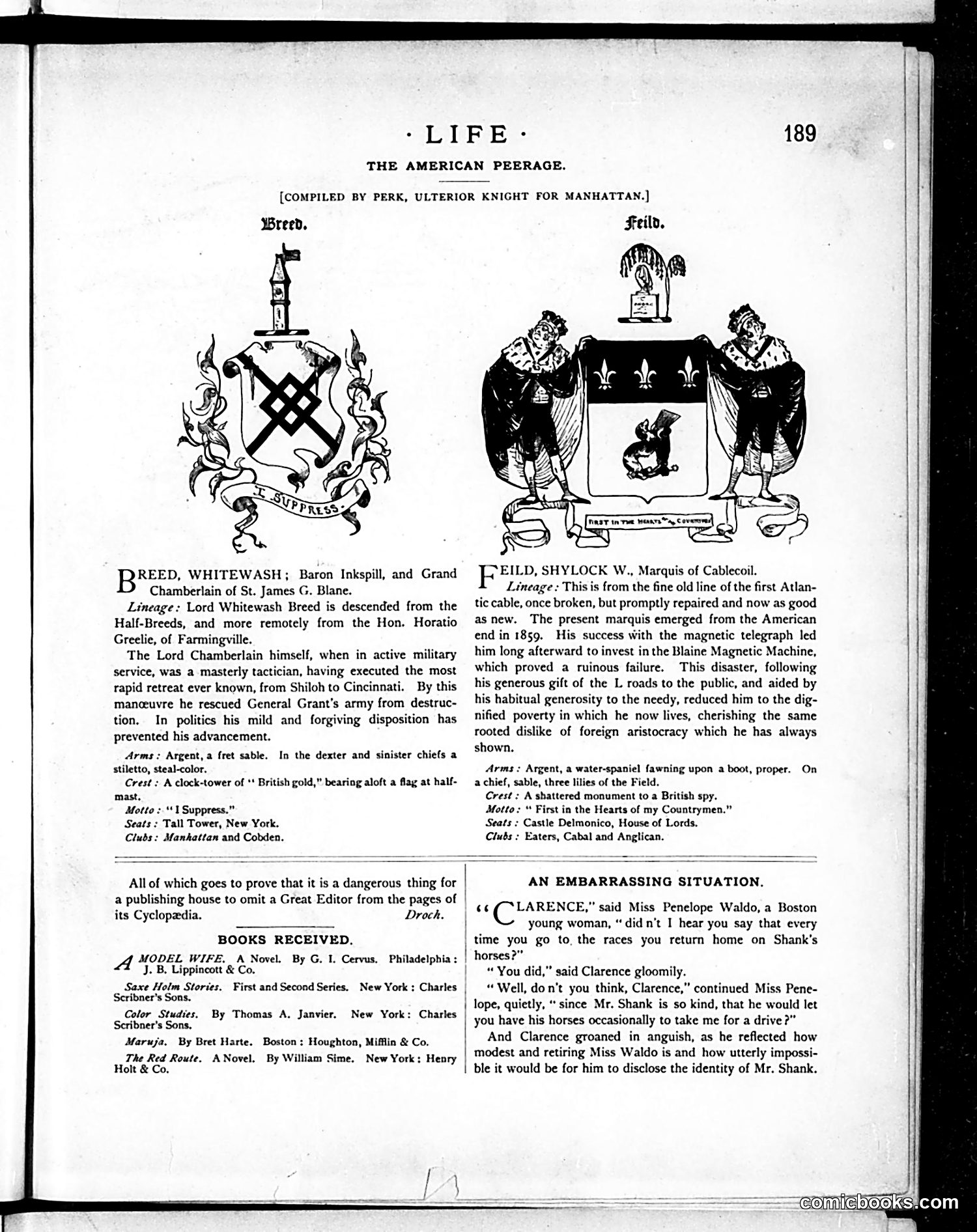
This page features heraldic coats of arms for two prominent American families: the Breed/Whitewash line and the Feild/Shylock line. The satirical intent appears to be genealogical mockery—the names themselves ("Whitewash," "Shylock") suggest moral or ethnic criticism thinly veiled as heraldry. The descriptive text uses elaborate language to document family histories while the chosen surnames undermine the subjects' dignity. The "Breed" entry references Civil War military service, while "Feild" discusses financial misfortune and losses. Below appears an unrelated story, "An Embarrassing Situation," about Miss Penelope Waldo and a character named Clarence regarding horses. The page demonstrates Life's use of satire through formal presentation of unflattering genealogical information.
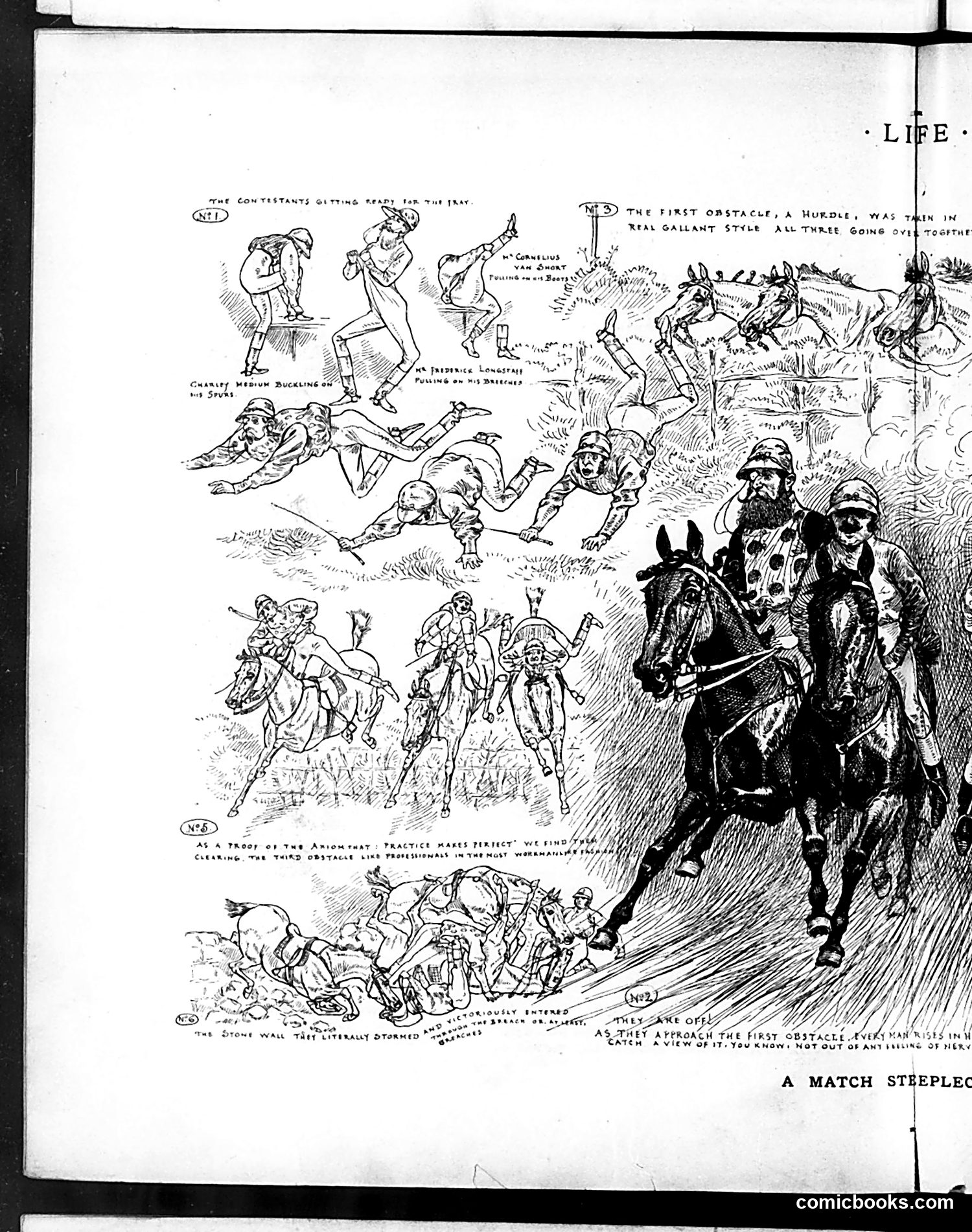
This satirical cartoon depicts a steeplechase (horse-racing competition) where the "horses" are actually political or social figures clearing various obstacles. The numbered panels show contestants navigating hurdles labeled with contemporary challenges. Key visible obstacles include references to "the first obstacle, a hurdle" and "the stone wall," suggesting this represents politicians or public figures tackling real-world problems of the era. The mounted riders on the right appear to be authority or establishment figures observing the competition. The satire mocks how political leaders approach difficult problems—treating serious governance like a sporting spectacle where success means merely jumping over obstacles rather than solving underlying issues. The elaborate setup and captions emphasize the performative nature of political action. Without clearer text or date identification, specifics about which politicians or events are referenced remain unclear from this image alone.
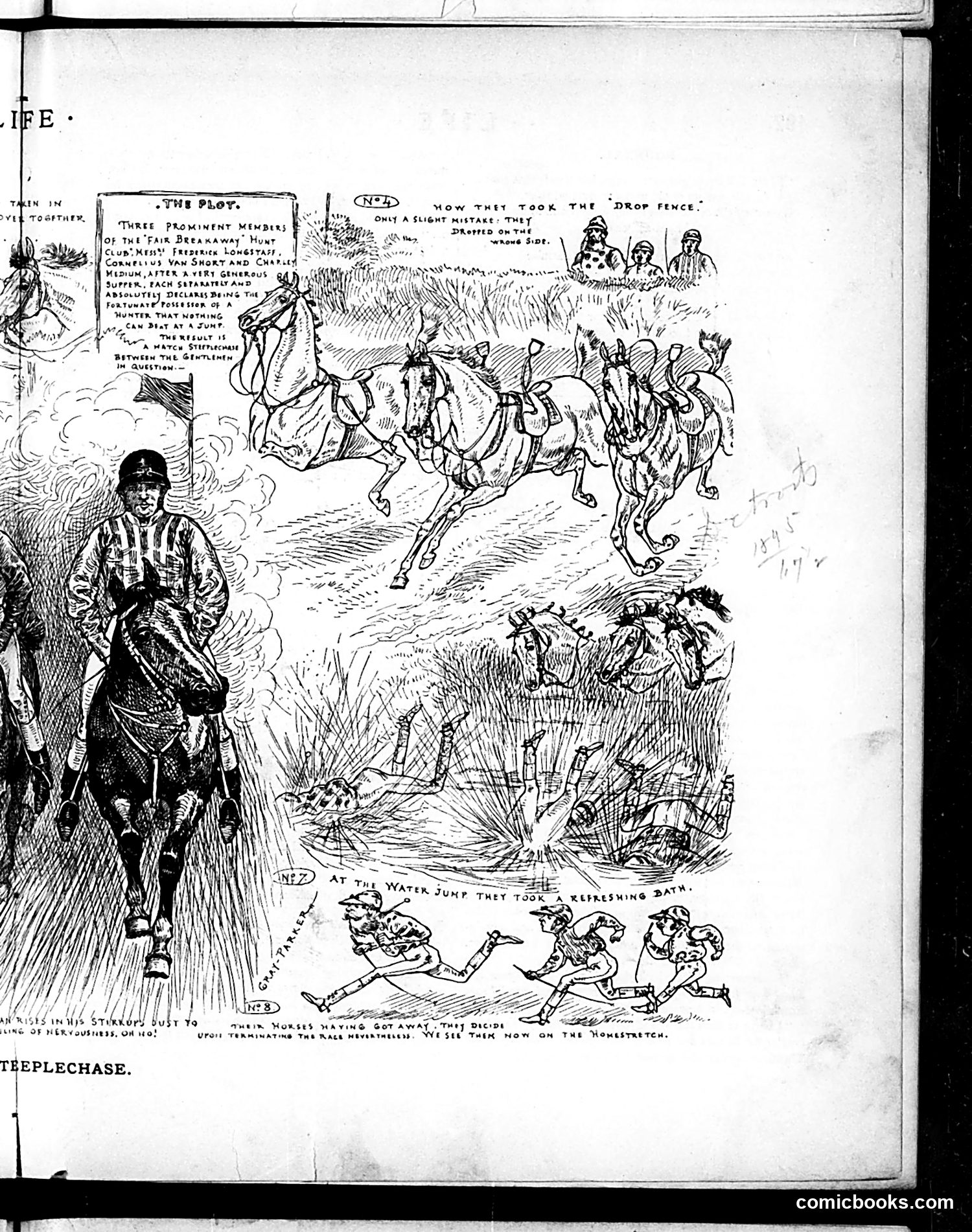
This multi-panel satirical comic depicts a steeplechase (horseback racing competition) as political allegory. Panel 1 introduces "three prominent members of the fair dealing party" who are "short and crafty" and engaged in questionable dealings. Panel 2 shows these figures on horseback jumping the "drop fence"—apparently surviving a minor mistake. Panel 3 depicts them at a water jump, taking a "refreshing bath." The final panel shows them on foot running, having "got away" while their horses are separated, with text suggesting they've "won on the homestretch." The cartoon satirizes corrupt political figures ("fair dealing party") as deceitful competitors who exploit rules, survive scandals ("refreshing bath"), and ultimately escape consequences through cunning—the steeplechase serving as metaphor for their evasive maneuvering.
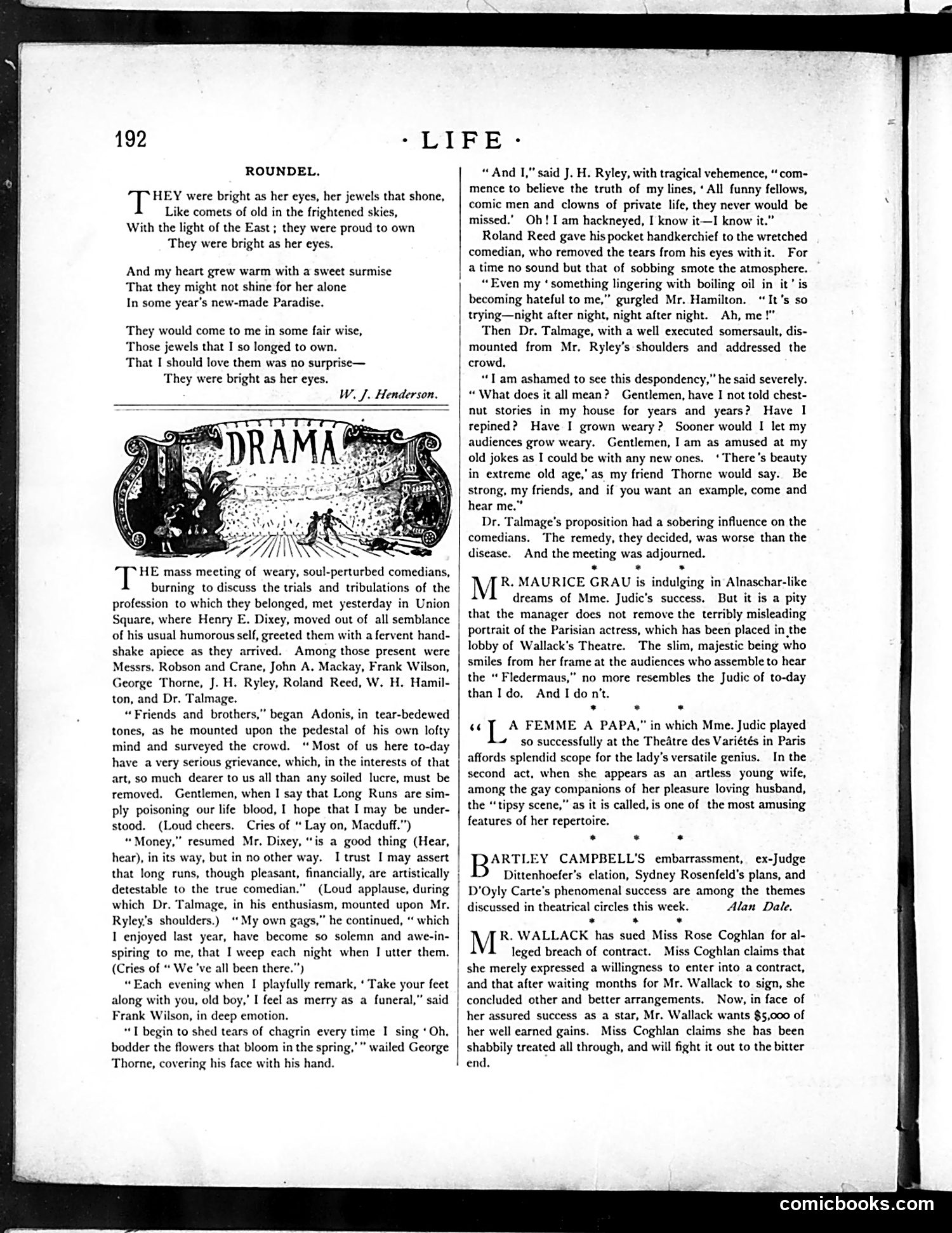
This page satirizes **comedians complaining about long theatrical runs**. The "DRAMA" section describes a mass meeting in Union Square featuring real performers of the era (Henry E. Dixey, Frank Wilson, George Thorne, J. H. Ryley, Roland Reed, and others). The joke: These comedians claim their repeated jokes have become artistically stale and emotionally draining—they weep performing the same gags nightly. They treat comedy as serious art being degraded by commercial repetition. The satire's sting: When Dr. Talmage (likely the famous preacher) offers his "solution"—claiming *he* never tires of his own old stories because he finds them perpetually amusing—the comedians realize **his remedy is worse than the problem**. The implication is cutting: Talmage's obliviousness and self-satisfaction are unbearable, making the meeting pointless. This mocks both theatrical pretension (comedians mourning worn-out material) and clerical smugness, ending with the perfectly cynical punchline that the meeting simply adjourned—nothing solved.
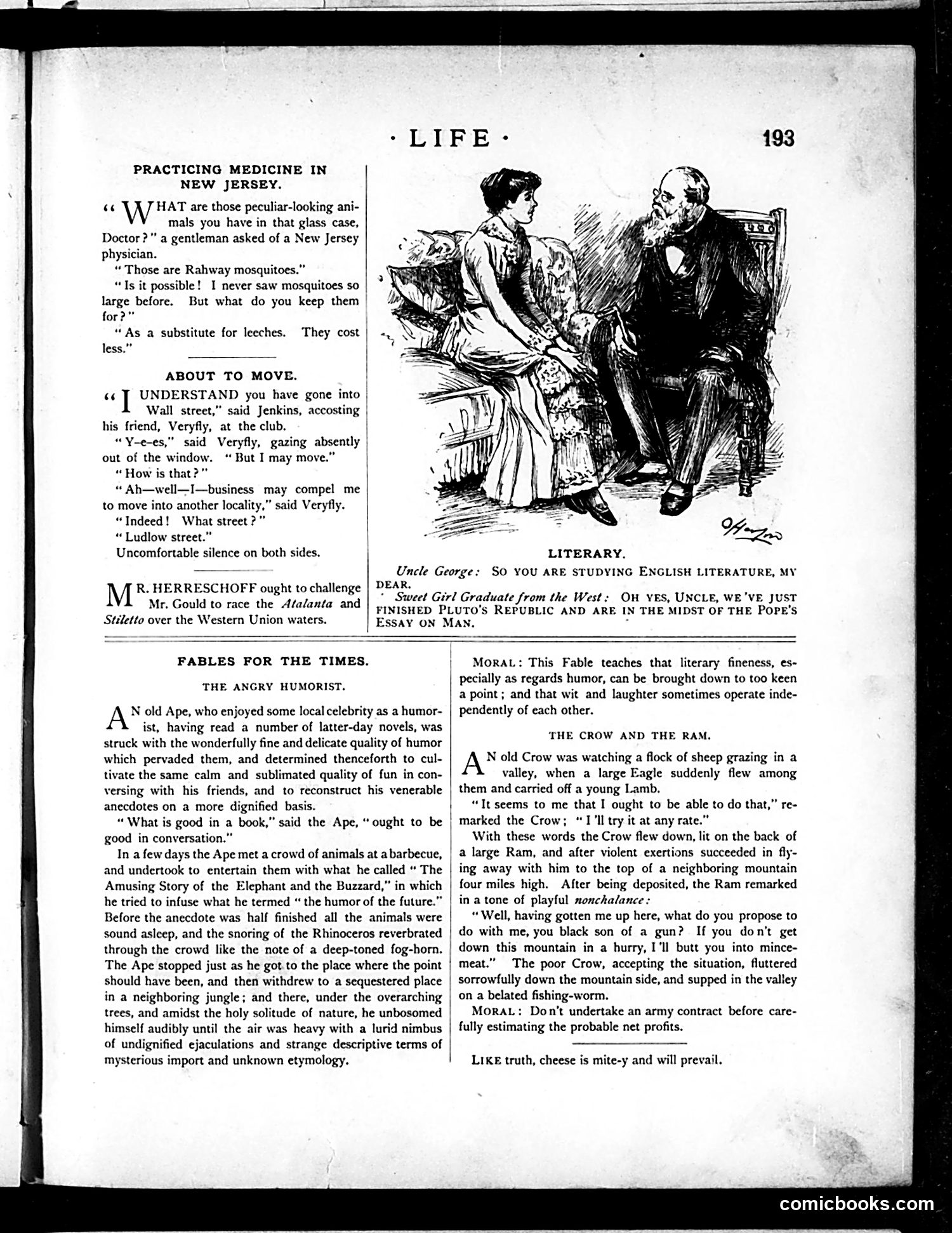
This page contains three satirical sections from *Life* magazine: 1. **"Practicing Medicine in New Jersey"**: A joke about New Jersey's Rahway mosquitoes being so large they substitute for leeches (bloodsuckers used in 19th-century medicine). It mocks New Jersey's reputation for oversized pests. 2. **"About to Move"**: Social satire about a Wall Street financier hinting he may move to "Ludlow street"—a euphemism for Ludlow Street Jail, suggesting financial ruin or criminal consequences from his business dealings. 3. **Two Fables**: Moral tales with contemporary twists. "The Angry Humorist" ridicules modern novelists' overly refined, tedious humor. "The Crow and the Ram" satirizes military contractors who underestimate costs—the crow overreaches trying to match the eagle's feat, then gets trapped, paralleling business failures from miscalculation. The cartoon shows two figures in conversation, likely illustrating one of these anecdotes.
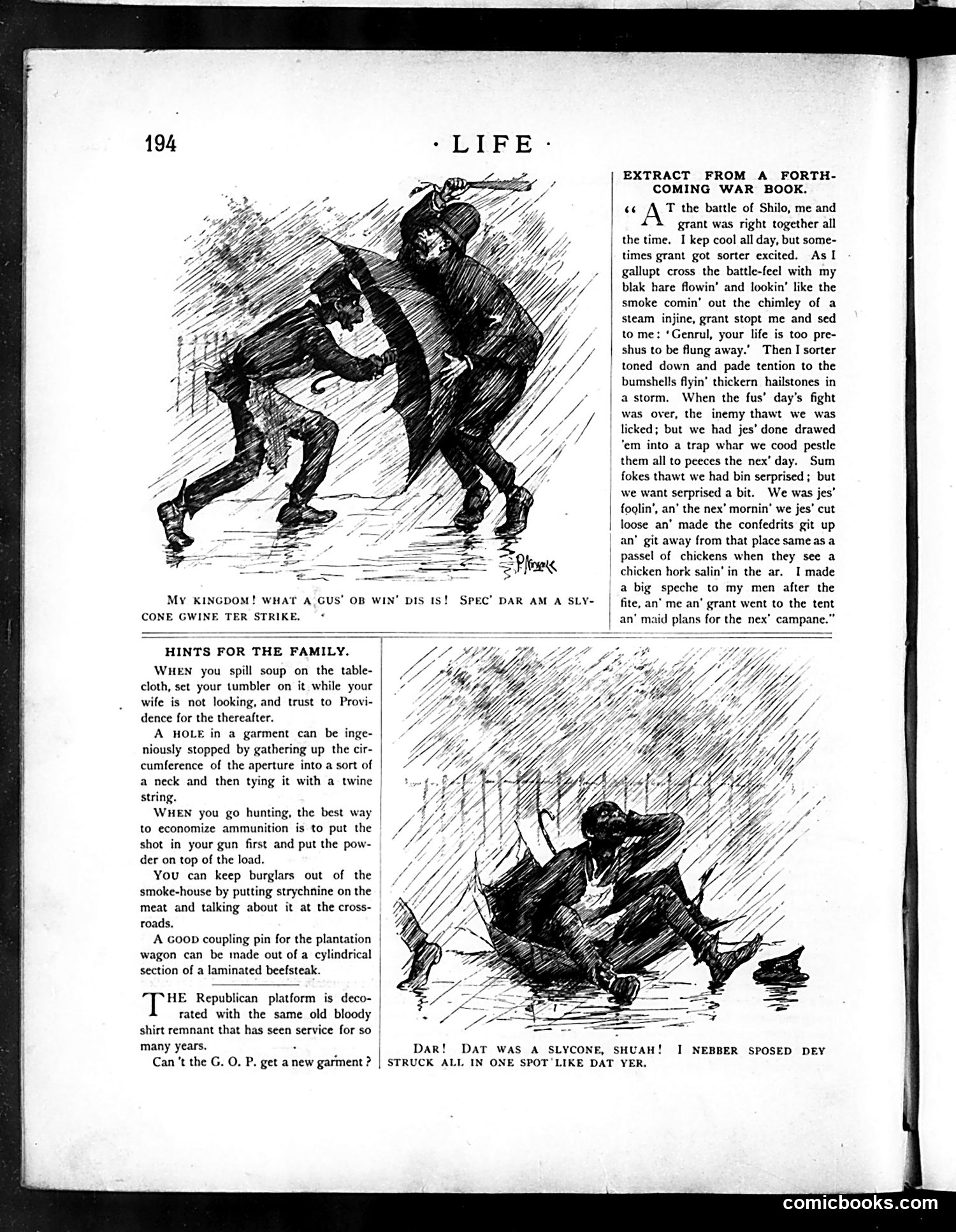
This page from *Life* magazine contains Civil War-era satire mocking Union General Ulysses S. Grant through the persona of a boastful, illiterate soldier claiming credit for victories Grant achieved. **Top cartoon**: A caricatured Black soldier (rendered in period racist stereotype) depicts himself as the real military genius at the Battle of Shiloh (1862), claiming Grant needed *his* guidance. The misspelled dialect—"fite," "speche," "campane"—is satirical mockery suggesting the speaker's actual ignorance while paradoxically crediting him with strategic brilliance. The joke undercuts Grant's reputation by attributing his success to an implausible source. **Bottom cartoon**: Shows another figure falling into mud or water, illustrating the absurdity of overconfidence. **"Hints for the Family"** section: Darkly comic advice (put powder *over* shot; use beefsteak as wagon hardware) parodies self-help columns. **Political note**: The final quip about Republicans' "bloody shirt" references the political tactic of invoking Civil War sacrifice—criticizing their reliance on worn-out war rhetoric rather than new ideas.
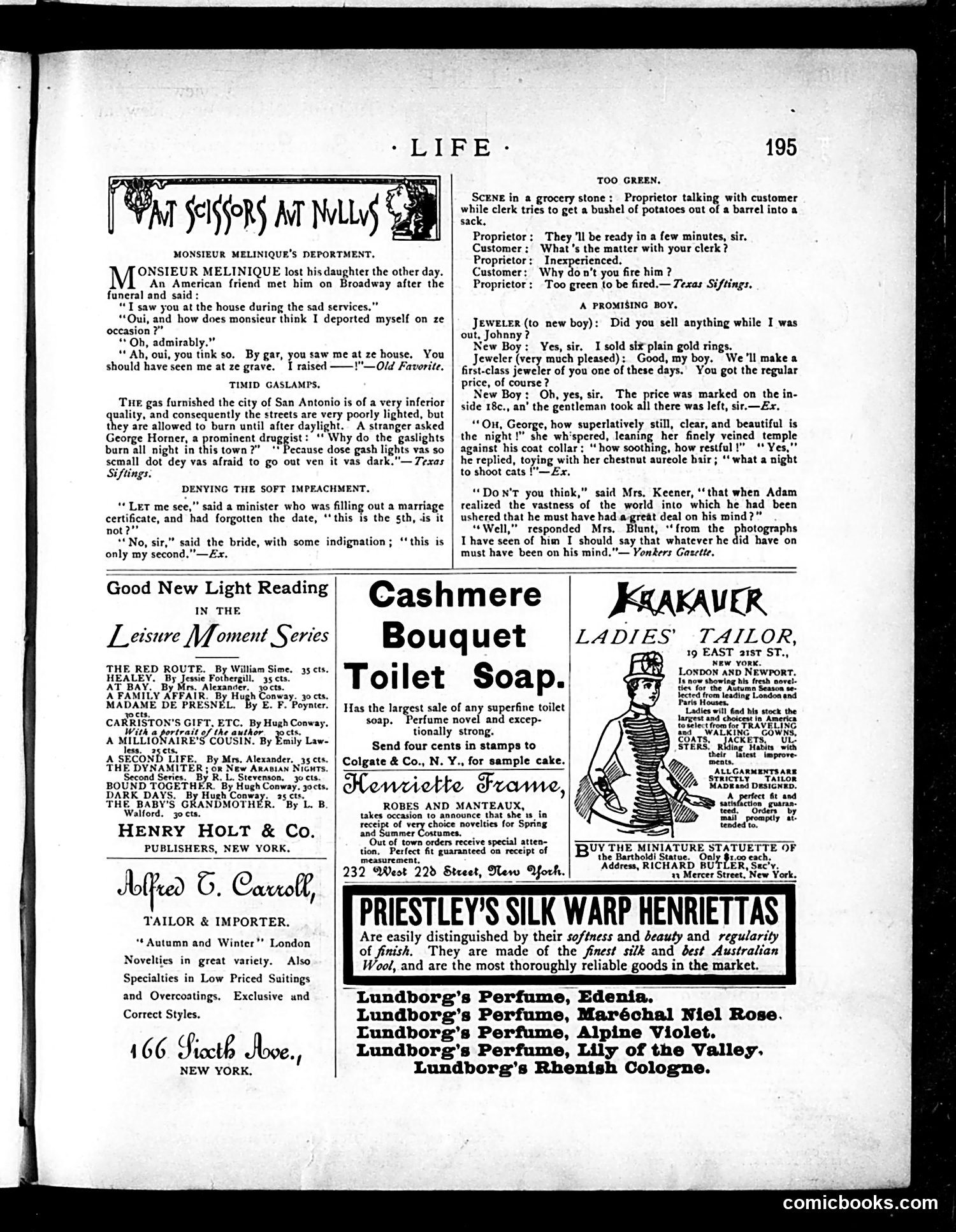
This page is primarily **advertising with comic anecdotes** rather than political cartoons. The humor consists of short jokes—mostly ethnic or dialect-based humor typical of 1880s-90s American magazines. The main comic pieces include: **"Monsieur Melinique's Deportment"**: A Frenchman's exaggerated pride in his dignified behavior at his daughter's funeral, told in stereotypical French-accented English ("Qui," "ze occasion"). **"Too Green"** and **"A Promising Boy"**: Jokes about an inexperienced clerk/boy employee, where "too green" (inexperienced) becomes a pun. **Other brief jokes** play on dialect humor and marital/romantic situations. The satire is gentle—poking fun at foreigners (particularly French), incompetence, and social pretension. There are no identifiable political figures or events referenced. The page reflects period conventions of humor based on ethnic stereotyping and slapstick situations. The bulk of space goes to advertisements for books, soap, tailoring, and perfume.
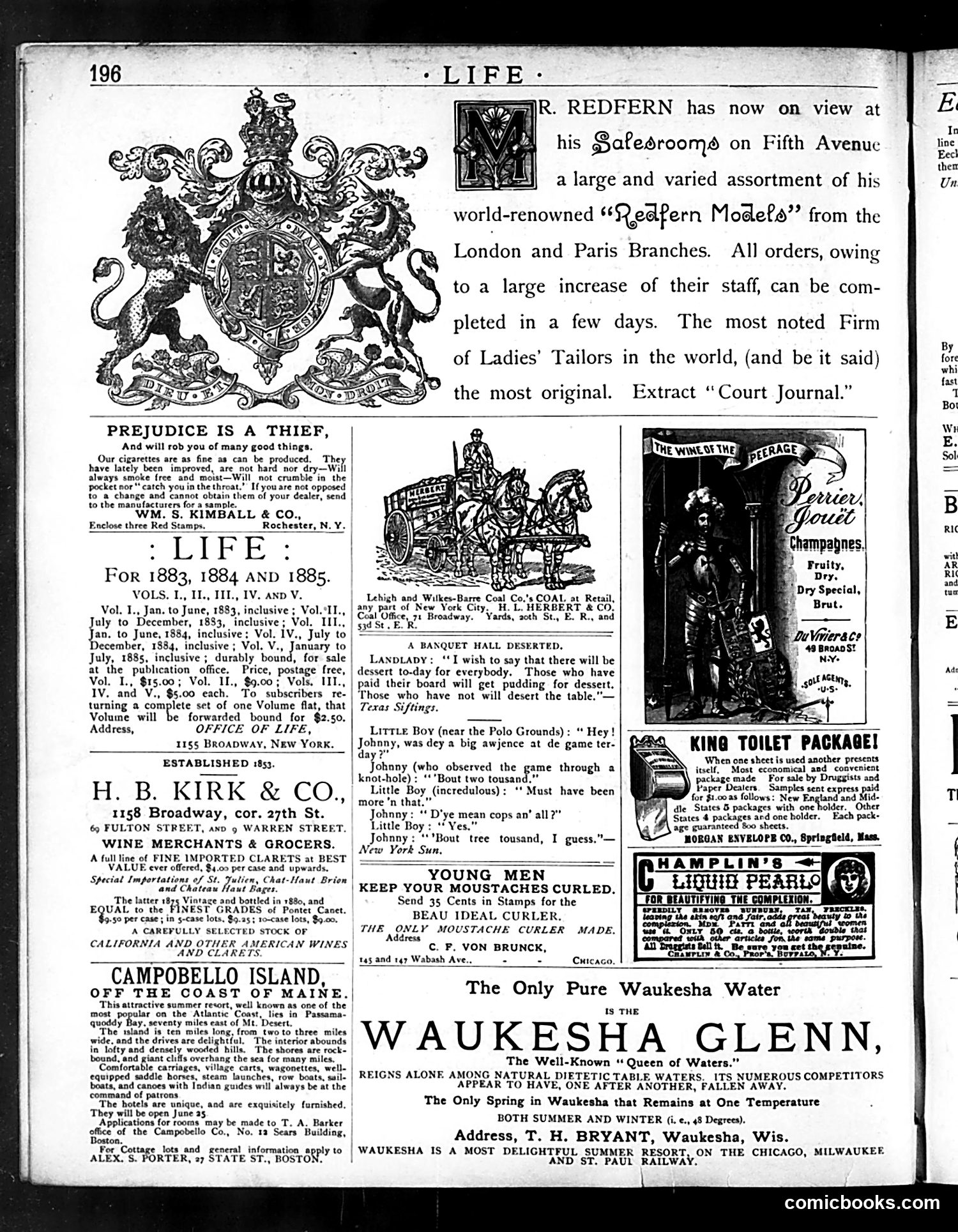
This page is primarily **advertisements and filler content** from an 1885 *Life* magazine, not political satire. The page contains: **Small humorous anecdotes** rather than political cartoons: - "A Banquet Hall Deserted" jokes about class distinction—a boarding house keeper distinguishes between paying and non-paying residents - "Little Boy" dialogue uses ethnic dialect humor (common then, offensive now) about attendance at a polo game **Extensive advertising** for luxury goods: women's tailoring (Redfern Models), cigarettes, wines, coal, summer resorts, and toiletries. These ads reflect Gilded Age consumer culture targeting wealthy readers. The page lacks substantive political commentary. The small illustrations are decorative or commercial rather than satirical. "Prejudice Is a Thief" is merely a cigarette advertisement using moralizing language as marketing.
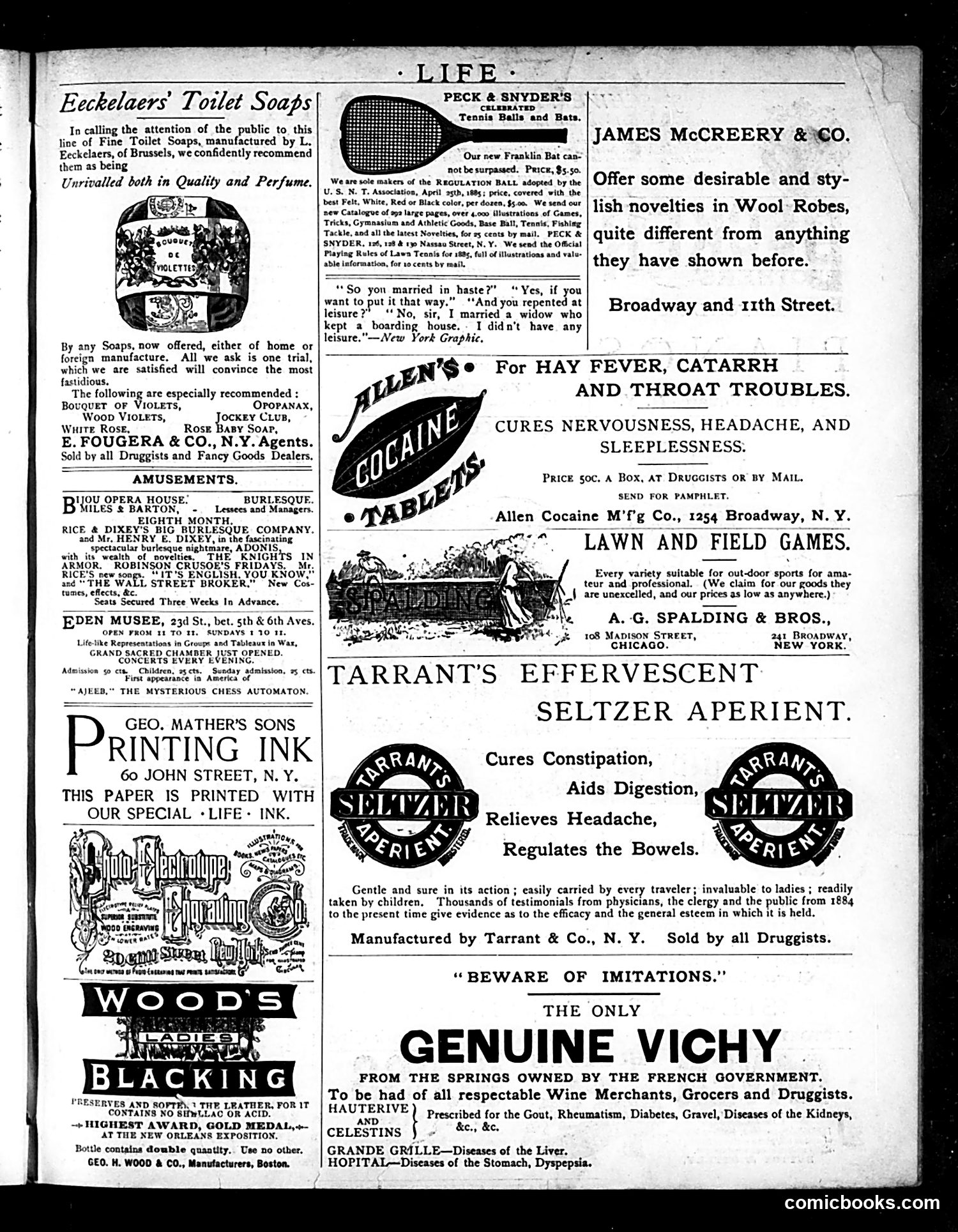
This page is **primarily advertising**, with one small joke/cartoon element embedded among the ads. The only satirical content is a brief dialogue joke (attributed to *New York Graphic*) positioned between two clothing advertisements. It's a mild marital humor piece: a man claims he married "in haste" but didn't repent "at leisure" because he married a widow who ran a boarding house—so he had no leisure time for regret. The joke plays on the common Victorian saying "marry in haste, repent in leisure." The rest of the page consists of period product advertisements for toilet soaps, printing ink, sporting goods, patent medicines (including cocaine tablets and seltzer), theater listings, and museum attractions. These ads are typical of 1880s-era *Life* magazine and reflect the medical and commercial practices of that era—notably the casual advertisement of cocaine as a remedy for hay fever and throat troubles, which would be shocking to modern readers. No political cartoons or significant satirical content appears on this page.
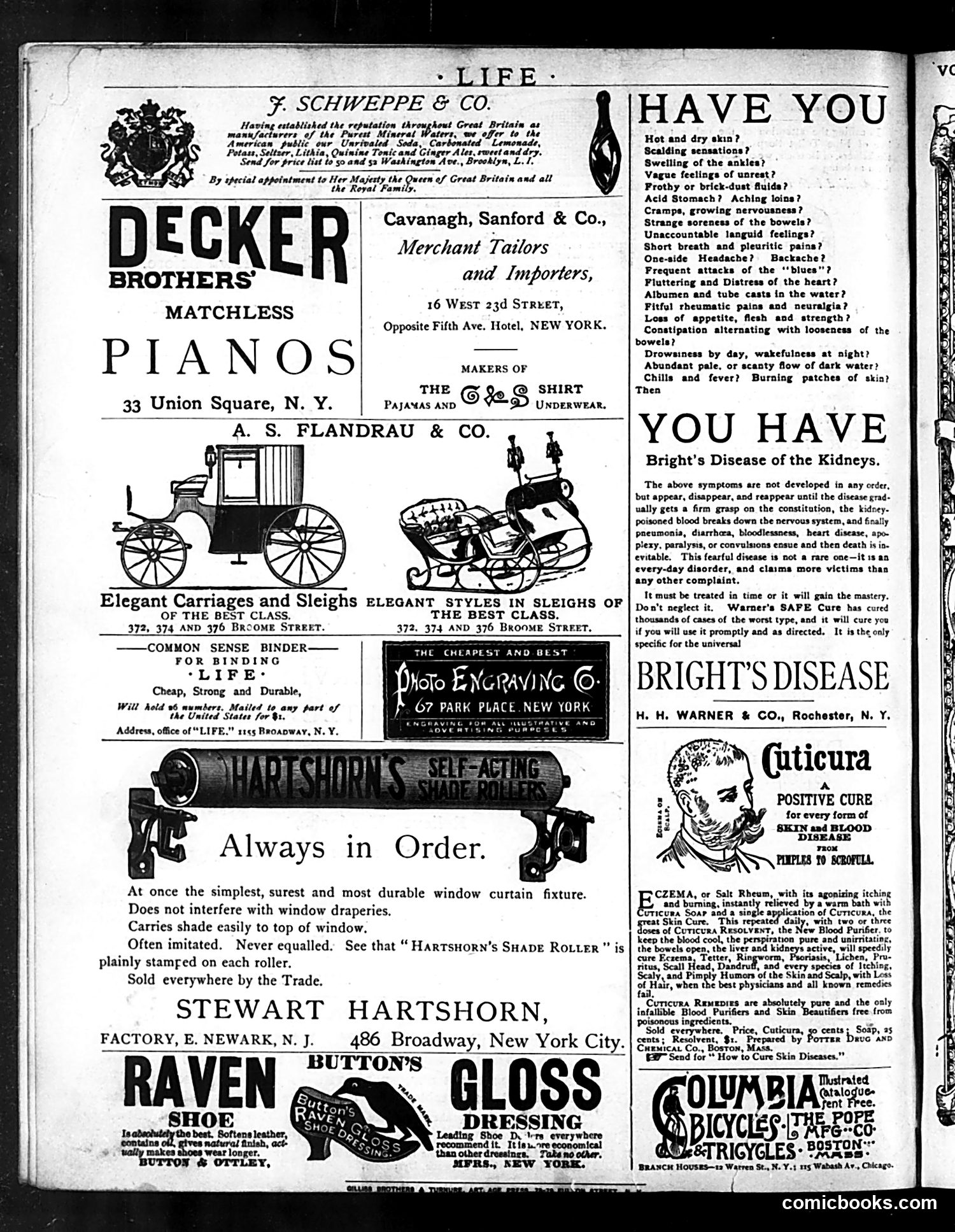
This is primarily a **commercial advertising page** rather than editorial content or political satire. It features various product advertisements typical of late 19th-century American magazines, including pianos, carriages, clothing, and patent medicines. The most notable content is a large advertisement for **Warner's Safe Cure for Bright's Disease** (a kidney ailment), which lists numerous symptoms—some real, others vague—to convince readers they suffer from this condition and need the cure. This exemplifies the era's **dubious medical advertising**: manufacturers made expansive disease claims and sold remedies of questionable efficacy to anxious consumers. Other ads promote mundane products: Decker Brothers pianos, Hartshorn's window shade rollers, Cuticura skin treatments, and Raven Shoe Gloss. The page reflects **Gilded Age consumerism** and the prevalence of unregulated patent medicine marketing that exploited public health anxieties before modern FDA oversight.