
Life, 1885-10-01 · page 6 of 16
Life — October 1, 1885 — page 6: what you’re looking at
What you’re looking at
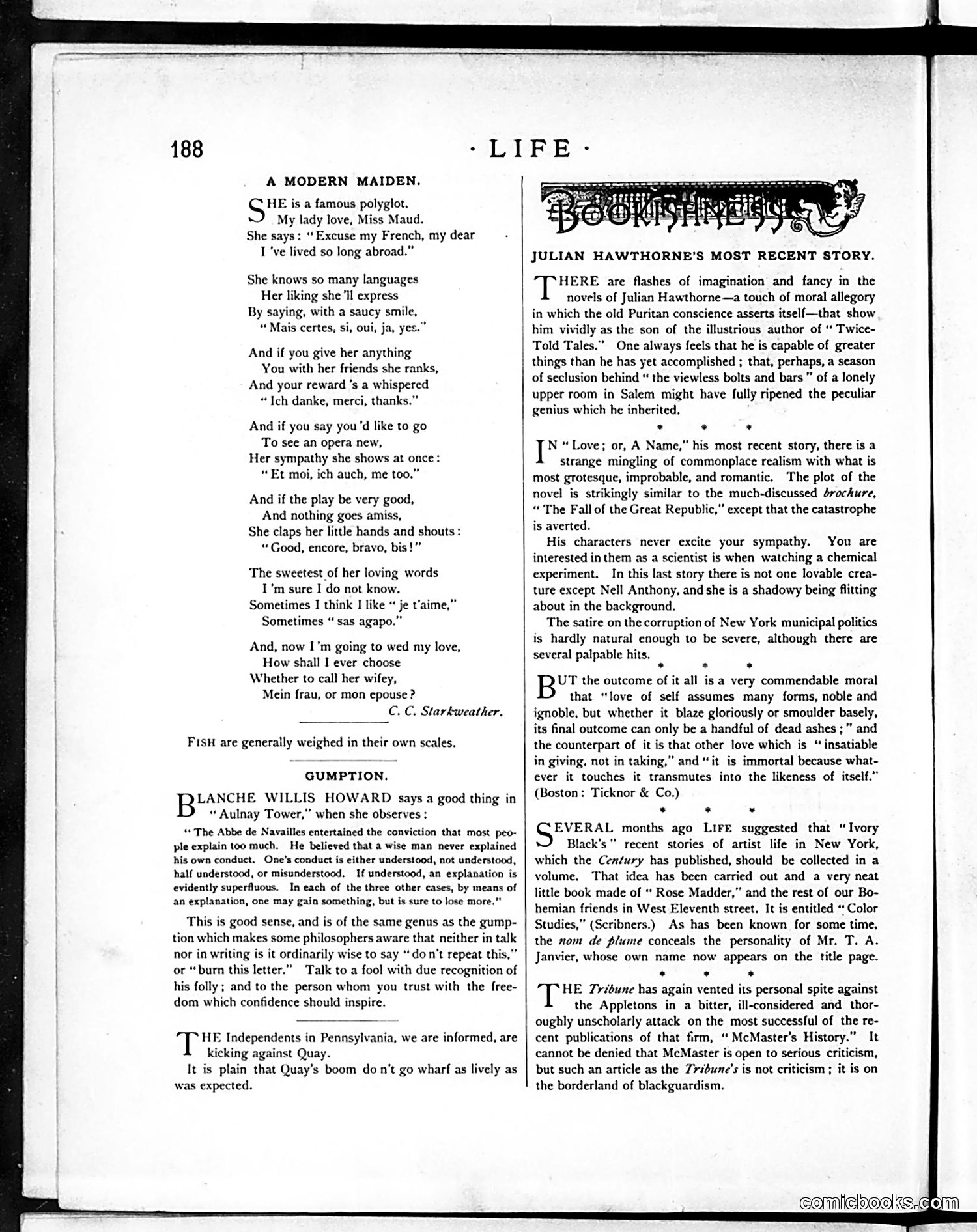
This page contains literary criticism and poetry rather than political cartoons. The main content includes: 1. **"A Modern Maiden"** — A satirical poem by C.C. Starkweather mocking a cosmopolitan woman ("Miss Maud") who is a famous polyglot, speaks multiple languages, and affects continental manners. The satire targets her affectation and pretension. 2. **Book reviews** discussing Julian Hawthorne's recent novel "Love; or, A Name," critiquing its characters and moral messaging about love and self-sacrifice. 3. **"Gumption"** section — Commentary on Blanche Willis Howard's observations about conversation and wisdom. The page reflects typical late-19th-century American satirical humor mocking cosmopolitan pretension and continental affectations among the upper classes.
📄 Transcribed text from this page (OCR, searchable)
Machine-transcribed from the original scan — historical spelling and the odd misread are preserved.
A MODERN MAIDEN. HE is a famous polyglot. My lady love, Miss Maud. She says: ‘*Excuse my French, my dear I ‘ve lived so long abroad.” She knows so many languages Her liking she'll express By saying, with a saucy smile, “ Mais certes, si, oui, ja, yes.” And if you give her anything You with her friends she ranks, And your reward 's a whispered “Ich danke, merci, thanks.” And if you say you'd like to go To see an opera new, Her sympathy she shows at once: “Et moi, ich auch, me too,” And if the play be very good, And nothing goes amiss, She claps her little hands and shouts : “Good, encore, bravo, bis!” The sweetest of her loving words I'm sure I do not know. Sometimes I think I like “ je t'aime,” Sometimes “ sas agapo.” And, now I'm going to wed my love, How shall I ever choose Whether to call her wifey, Mein frau, or mon epouse ? C. C. Starkweather. FISH are generally weighed in their own scales. GUMPTION. Bese WILLIS HOWARD says a good thing in “ Aulnay Tower,” when she observes : ** The Abbe de Navailles entertained the conviction that most peo- ple explain too much. He believed that a wise man never explained his own conduct. One's conduct is either understood, not understood, half understood, or misunderstood. If understood, an explanation is evidently superfluous. In each of the three other cases, by means of an explanation, one may gaia something, but is sure to lose more.” This is good sense, and is of the same genus as the gump- tion which makes some philosophers aware that neither in talk nor in writing is it ordinarily wise to say “don’t repeat this,” or “burn this letter.” Talk to a fool with due recognition of his folly ; and to the person whom you trust with the free- dom which confidence should inspire. HE Independents in Pennsylvania, we are informed, are kicking against Quay. It is plain that Quay’s boom do n't go wharf as lively as was expected. JULIAN HAWTHORNE'S MOST RECENT STORY. HERE are flashes of imagination and fancy in the novels of Julian Hawthorne—a touch of moral allegory | in which the old Puritan conscience asserts itself—that show him vividly as the son of the illustrious author of ‘ Twice- Told Tales.” One always feels that he is capable of greater things than he has yet accomplished ; that, perhaps, a season of seclusion behind “ the viewless bolts and bars” of a lonely upper room in Salem might have fully ripened the peculiar genius which he inherited. . . . [* “Love; or, A Name,” his most recent story, there is a strange mingling of commonplace realism with what is most grotesque, improbable, and romantic. The plot of the novel is strikingly similar to the much-discussed brochure, “ The Fall of the Great Republic,” except that the catastrophe is averted. His characters never excite your sympathy. You are interested in them as a scientist is when watching a chemical experiment. In this last story there is not one lovable crea- ture except Nell Anthony, and she is a shadowy being flitting about in the background. The satire on the corruption of New York municipal politics is hardly natural enough to be severe, although there are several palpable hits. . * . UT the outcome of it all is a very commendable moral that “love of self assumes many forms, noble and ignoble, but whether it blaze gloriously or smoulder basely, its final outcome can only be a handful of dead ashes ;" and the counterpart of it is that other love which is “ insatiable in giving, not in taking,” and “it is immortal because what- ever it touches it transmutes into the likeness of itself.” (Boston: Ticknor & Co.) . . . EVERAL months ago LIFE suggested that “Ivory Black’s” recent stories of artist life in New York, which the Century has published, should be collected in a volume. That idea has been carried out and a very neat little book made of “ Rose Madder,” and the rest of our Bo- hemian friends in West Eleventh street. It is entitled “Color Studies,” (Scribners.) As has been known for some time, the nom de plume conceals the personality of Mr. T. A. Janvier, whose own name now appears on the title page. . . * HE 7ribunc has again vented its personal spite against the Appletons in a bitter, ill-considered and thor- oughly unscholarly attack on the most successful of the re- cent publications of that firm, ‘‘ McMaster’s History.” It cannot be denied that McMaster is open to serious criticism, but such an article as the 7rzbune's is not criticism ; it is on the borderland of blackguardism. comichooks.gom