
Life, 1885-10-01 · page 10 of 16
Life — October 1, 1885 — page 10: what you’re looking at
What you’re looking at
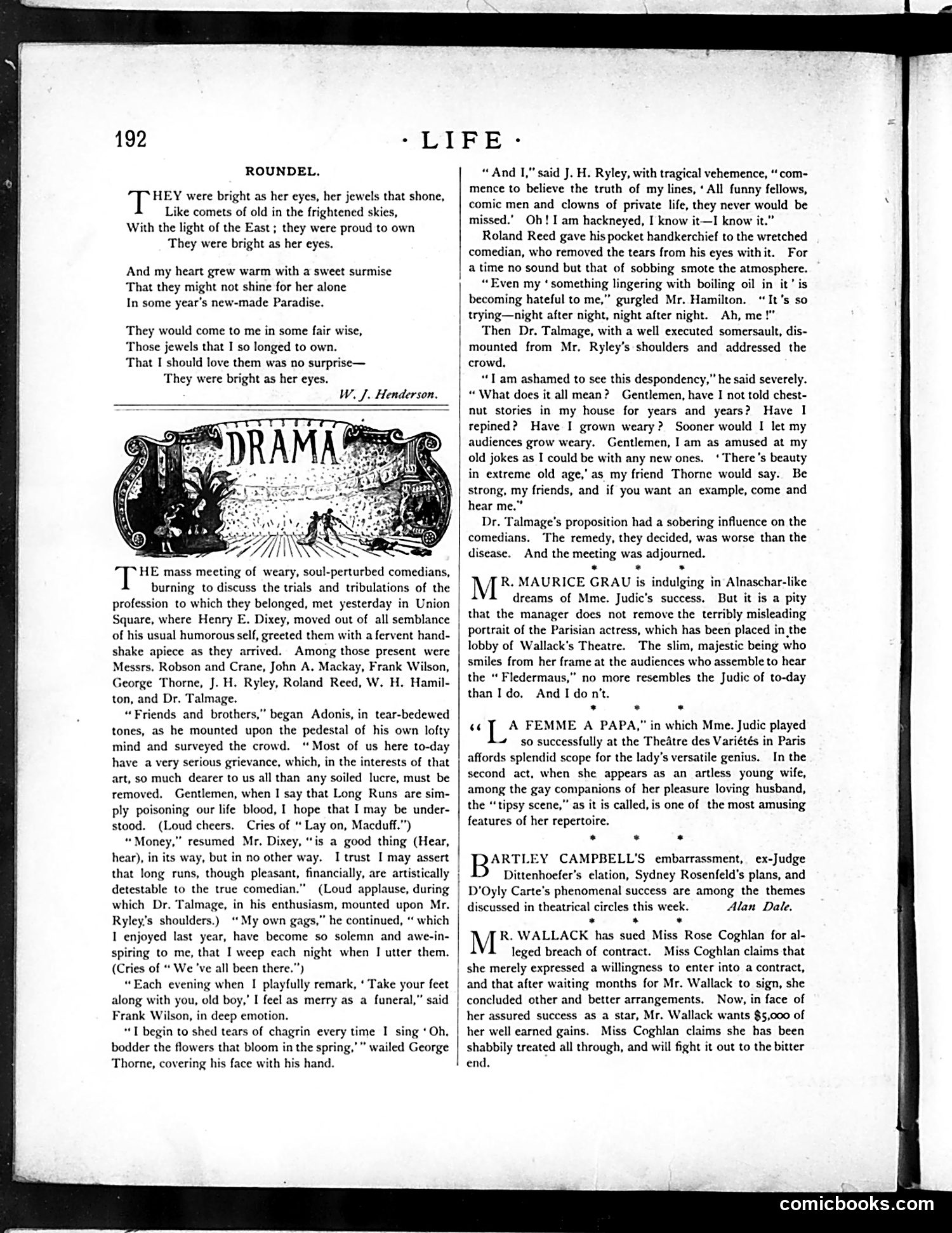
This page satirizes **comedians complaining about long theatrical runs**. The "DRAMA" section describes a mass meeting in Union Square featuring real performers of the era (Henry E. Dixey, Frank Wilson, George Thorne, J. H. Ryley, Roland Reed, and others). The joke: These comedians claim their repeated jokes have become artistically stale and emotionally draining—they weep performing the same gags nightly. They treat comedy as serious art being degraded by commercial repetition. The satire's sting: When Dr. Talmage (likely the famous preacher) offers his "solution"—claiming *he* never tires of his own old stories because he finds them perpetually amusing—the comedians realize **his remedy is worse than the problem**. The implication is cutting: Talmage's obliviousness and self-satisfaction are unbearable, making the meeting pointless. This mocks both theatrical pretension (comedians mourning worn-out material) and clerical smugness, ending with the perfectly cynical punchline that the meeting simply adjourned—nothing solved.
📄 Transcribed text from this page (OCR, searchable)
Machine-transcribed from the original scan — historical spelling and the odd misread are preserved.
192 ROUNDEL, HEY were bright as her eyes, her jewels that shone, Like comets of old in the frightened skies, With the light of the East ; they were proud to own They were bright as her eyes. And my heart grew warm with a sweet surmise That they might not shine for her alone In some year’s new-made Paradise. They would come to me in some fair wise, Those jewels that I so longed to own. That I should love them was no surprise— They were bright as her eyes. W. J. Henderson. HE mass meeting of weary, soul-perturbed comedians, burning to discuss the trials and tribulations of the profession to which they belonged, met yesterday in Union Square, where Henry E. Dixey, moved out of all semblance of his usual humorous self, greeted them with a fervent hand- shake apiece as they arrived. Among those present were Messrs. Robson and Crane, John A. Mackay, Frank Wilson, George Thorne, J. H. Ryley, Roland Reed, W. H. Hamil- ton, and Dr. Talmage. “Friends and brothers,” began Adonis, in tear-bedewed tones, as he mounted upon the pedestal of his own lofty mind and surveyed the crowd. “Most of us here to-day have a very serious grievance, which, in the interests of that art, so much dearer to us all than any soiled lucre, must be removed. Gentlemen, when I say that Long Runs are sim- ply poisoning our life blood, 1 hope that I may be under- stood. (Loud cheers. Cries of “ Lay on, Macduff.”) “Money,” resumed Mr. Dixey, a good thing (Hear, hear), in its way, but in no other way. I trust I may assert that long runs, though pleasant, financially, are artistically { detestable to the true comedian,” (Loud applause, during which Dr. Talmage, in his enthusiasm, mounted upon Mr. Ryley’s shoulders.) “My own gags,” he continued, “ which I enjoyed last year, have become so solemn and awe-in- spiring to me, that I weep each night when I utter them. (Cries of “ We 've all been there.”) “Each evening when I playfully remark, ‘ Take your feet along with you, old boy,’ I feel as merry as a funeral,” said Frank Wilson, in deep emotion. “IT begin to shed tears of chagrin every time I sing ‘Oh, bodder the flowers that bloom in the spring,’” wailed George Thorne, covering his face with his hand. | becoming hateful to me,” gurgled Mr. Hamilton. | trying—night after night, night after night. Ah, me!” > LIFE: “And I,” said J. H. Ryley, with tragical vehemence, “com- mence to believe the truth of my lines, ‘All funny fellows, comic men and clowns of private life, they never would be missed.’ Oh! I am hackneyed, I know it—I know it.” Roland Reed gave his pocket handkerchief to the wretched comedian, who removed the tears from his eyes withit. For a time no sound but that of sobbing smote the atmosphere. “Even my ‘something lingering with boiling oil in it’ is “It's so Then Dr. Talmage, with a well executed somersault, dis- mounted from Mr. Ryley’s shoulders and addressed the crowd. “I am ashamed to sce this despondency,” he said severely. “What does it all mean? Gentlemen, have I not told chest- nut stories in my house for years and years? Have I repined? Have I grown weary? Sooner would I let my audiences grow weary. Gentlemen, I am as amused at my old jokes as I could be with any new ones. ‘There's beauty in extreme old age,’ as my friend Thorne would say. Be strong, my friends, and if you want an example, come and hear me.” Dr. Talmage’s proposition had a sobering influence on the comedians. The remedy, they decided, was worse than the disease. And the meeting was adjourned. . * . R. MAURICE GRAU is indulging in Alnaschar-like dreams of Mme. Judic’s success, But it is a pity | that the manager does not remove the terribly misleading | portrait of the Parisian actress, which has been placed in the lobby of Wallack's Theatre. The slim, majestic being who smiles from her frame at the audiences who assemble to hear the “ Fledermaus,” no more resembles the Judic of to-day than I do. And I do n't. . . . “ A FEMME A PAPA,” in which Mme. Judic played ~ so successfully at the Theatre des Variétés in Paris affords splendid scope for the lady's versatile genius. In the second act, when she appears as an artless young wife, among the gay companions of her pleasure loving husband, the “tipsy scene,” as it is called, is one of the most amusing features of her repertoire. . * . ARTLEY CAMPBELL’S embarrassment, ex-Judge Dittenhoefer’s elation, Sydney Rosenfeld’s plans, and D'Oyly Carte’s phenomenal success are among the themes discussed in theatrical circles this week. Alan Dale. . * . R. WALLACK has sued Miss Rose Coghlan for al- leged breach of contract. Miss Coghlan claims that she merely expressed a willingness to enter into a contract, and that after waiting months for Mr. Wallack to sign, she concluded other and better arrangements. Now, in face of her assured success as a star, Mr. Wallack wants $5,000 of her well earned gains. Miss Coghlan claims she has been shabbily treated all through, and will fight it out to the bitter end. comicbooks.com