
Life, 1885-10-01 · page 2 of 16
Life — October 1, 1885 — page 2: what you’re looking at
What you’re looking at
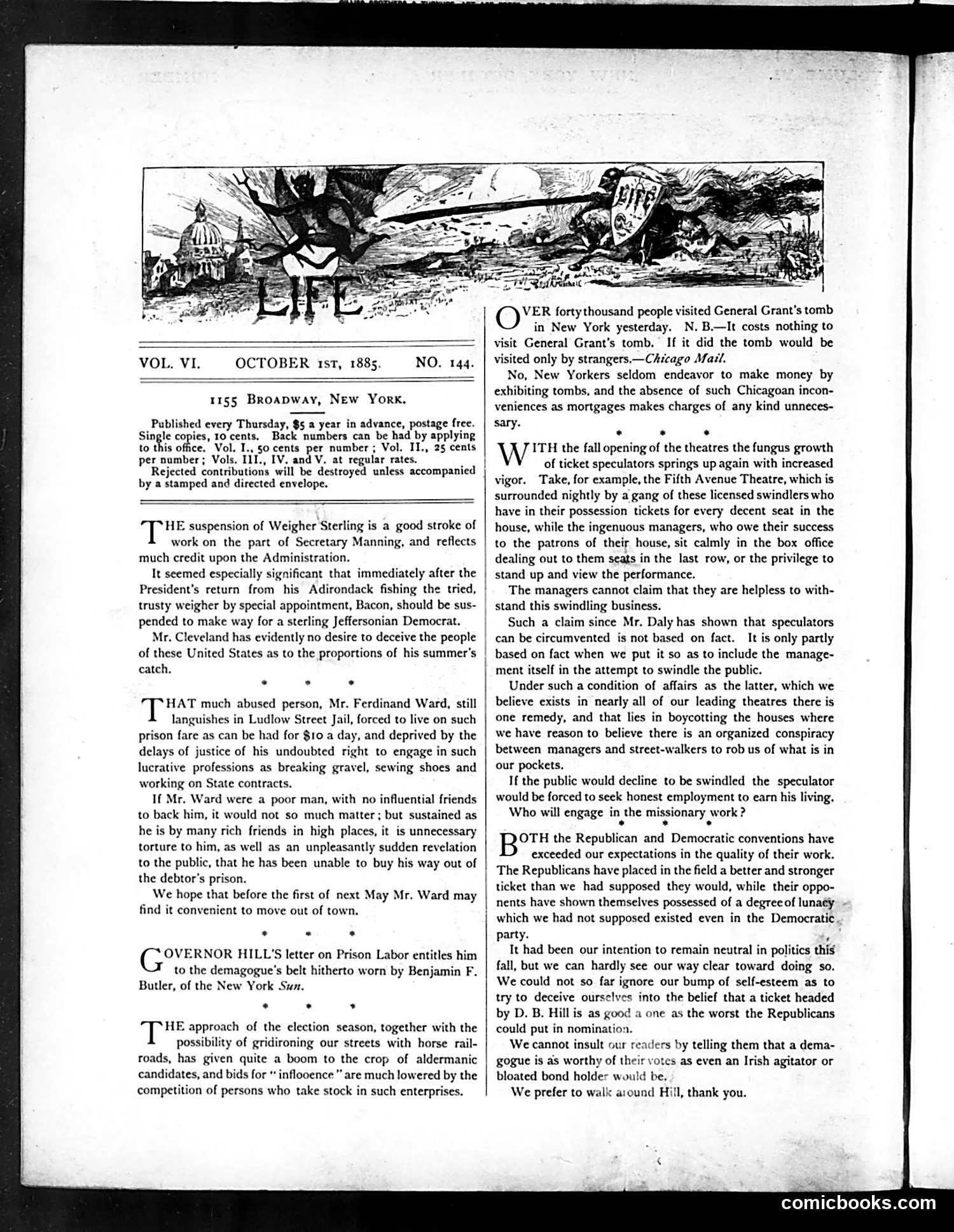
The page's masthead illustration depicts a chaotic scene with a large bird (possibly an eagle or raven) dominating a landscape of destruction and disorder—likely representing American political turmoil or social chaos of the 1880s. The article text references specific contemporary figures: Secretary Manning, President Cleveland, Weigher Sterling, and Ferdinand Ward (imprisoned for financial crimes). The editorial criticizes political appointments made for partisan advantage rather than merit, and discusses prison conditions and labor issues. The content suggests Life magazine's role as a satirical commentator on government corruption, patronage systems, and social injustice during the Gilded Age. The cartoon's anarchic imagery reinforces themes of mismanagement and disorder the text addresses throughout.
📄 Transcribed text from this page (OCR, searchable)
Machine-transcribed from the original scan — historical spelling and the odd misread are preserved.
VOL. VI. OCTOBER 1st, 1885. 1155 Broapway, New York. Published every Thursday, $s a year in advance, postage free. Single copies, 10 cents, Back numbers can be had by applying to this office. Vol. I., 50 cents per number ; Vol. II., 25 cents per number; Vols. I1I., IV. and V. at regular rates. Rejected contributions will be destroyed unless accompanied by a stamped and directed envelope. TH suspension of Weigher Sterling is a good stroke of work on the part of Secretary Manning, and reflects much credit upon the Administration. It seemed especially significant that immediately after the President's return from his Adirondack fishing the tried, | trusty weigher by special appointment, Bacon, should be sus- pended to make way for a sterling Jeffersonian Democrat. Mr. Cleveland has evidently no desire to deceive the people of these United States as to the proportions of his summer's catch. . . . HAT much abused person, Mr. Ferdinand Ward, still languishes in Ludlow Street Jail, forced to live on such prison fare as can be had for $10 a day, and deprived by the delays of justice of his undoubted right to engage in such lucrative professions as breaking gravel, sewing shoes and working on State contracts. If Mr. Ward were a poor man, with no influential friends to back him, it would not so much matter; but sustained as he is by many rich friends in high places, it is unnecessary torture to him, as well as an unpleasantly sudden revelation to the public, that he has been unable to buy his way out of the debtor's prison. We hope that before the first of next May Mr. Ward may | find it convenient to move out of town. . . . OVERNOR HILL'S letter on Prison Labor entitles him to the demagogue's belt hitherto worn by Benjamin F. Butler, of the New York Sux. * . * HE approach of the election season, together with the possibility of gridironing our streets with horse rail- roads, has given quite a boom to the crop of aldermanic candidates, and bids for “ inflooence ” are much lowered by the competition of persons who take stock in such enterprises. ER forty thousand people visited General Grant's tomb in New York yesterday. N.B.—It costs nothing to visit General Grant's tomb. If it did the tomb would be visited only by strangers.—Chicago Mail. No, New Yorkers seldom endeavor to make money by exhibiting tombs, and the absence of such Chicagoan incon- veniences as mortgages makes charges of any kind unneces- eat . . . ITH the fall opening of the theatres the fungus growth of ticket speculators springs up again with increased vigor. Take, for example, the Fifth Avenue Theatre, which is surrounded nightly by a gang of these licensed swindlers who have in their possession tickets for every decent seat in the house, while the ingenuous managers, who owe their success to the patrons of their house, sit calmly in the box office | dealing out to them seats in the last row, or the privilege to | stand up and view the performance. The managers cannot claim that they are helpless to with- stand this swindling business. Such a claim since Mr. Daly has shown that speculators can be circumvented is not based on fact. It is only partly | based on fact when we put it so as to include the manage- ment itself in the attempt to swindle the public. Under such a condition of affairs as the latter, which we believe exists in nearly all of our leading theatres there is one remedy, and that lies in boycotting the houses where we have reason to believe there is an organized conspiracy between managers and street-walkers to rob us of what is in our pockets. If the public would decline to be swindled the speculator would be forced to seek honest employment to earn his living. Who will engage in the missionary work ? OTH the Republican and Democratic conventions have exceeded our expectations in the quality of their work. The Republicans have placed in the field a better and stronger ticket than we had supposed they would, while their oppo- nents have shown themselves possessed of a degree of lunacy | which we had not supposed existed even in the Democratic. party. é It had been our intention to remain neutral in politics this fall, but we can hardly see our way clear toward doing so. We could not so far ignore our bump of self-esteem as to try to deceive ourselves into the belief that a ticket headed by D. B. Hill is as good a one as the worst the Republicans could put in nomination. We cannot insult our readers by telling them that a dema- gogue is as worthy of their votes as even an Irish agitator or bloated bond holder would be. We prefer to walk a:ound Hill, thank you. comicbooks.com