
A complete issue · 16 pages · 1885
Life — September 3, 1885
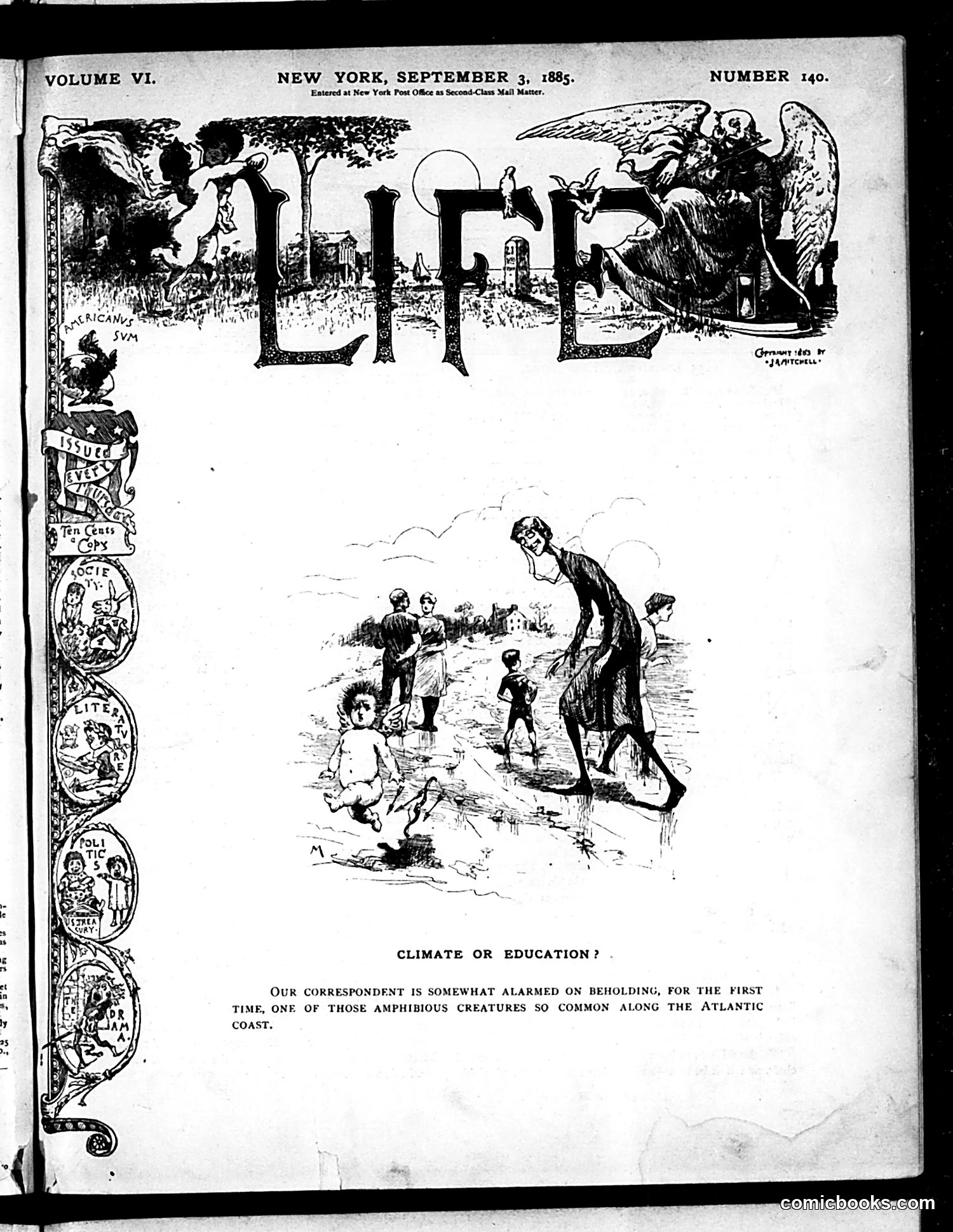
The cartoon illustrates a social debate about child development. The image shows an adult (likely representing a parent or educator) with several children at a beach or seaside. The caption asks whether children's behavior and development result from "climate or education"—a Victorian-era nature-versus-nurture question. The satire appears to critique the notion that coastal geography ("climate") naturally produces well-behaved children, versus the alternative that proper parental supervision and teaching ("education") matter more. The text references "amphibious creatures" common to the Atlantic Coast, humorously comparing undisciplined children to such animals. The joke suggests that without proper education, environment alone won't civilize children.
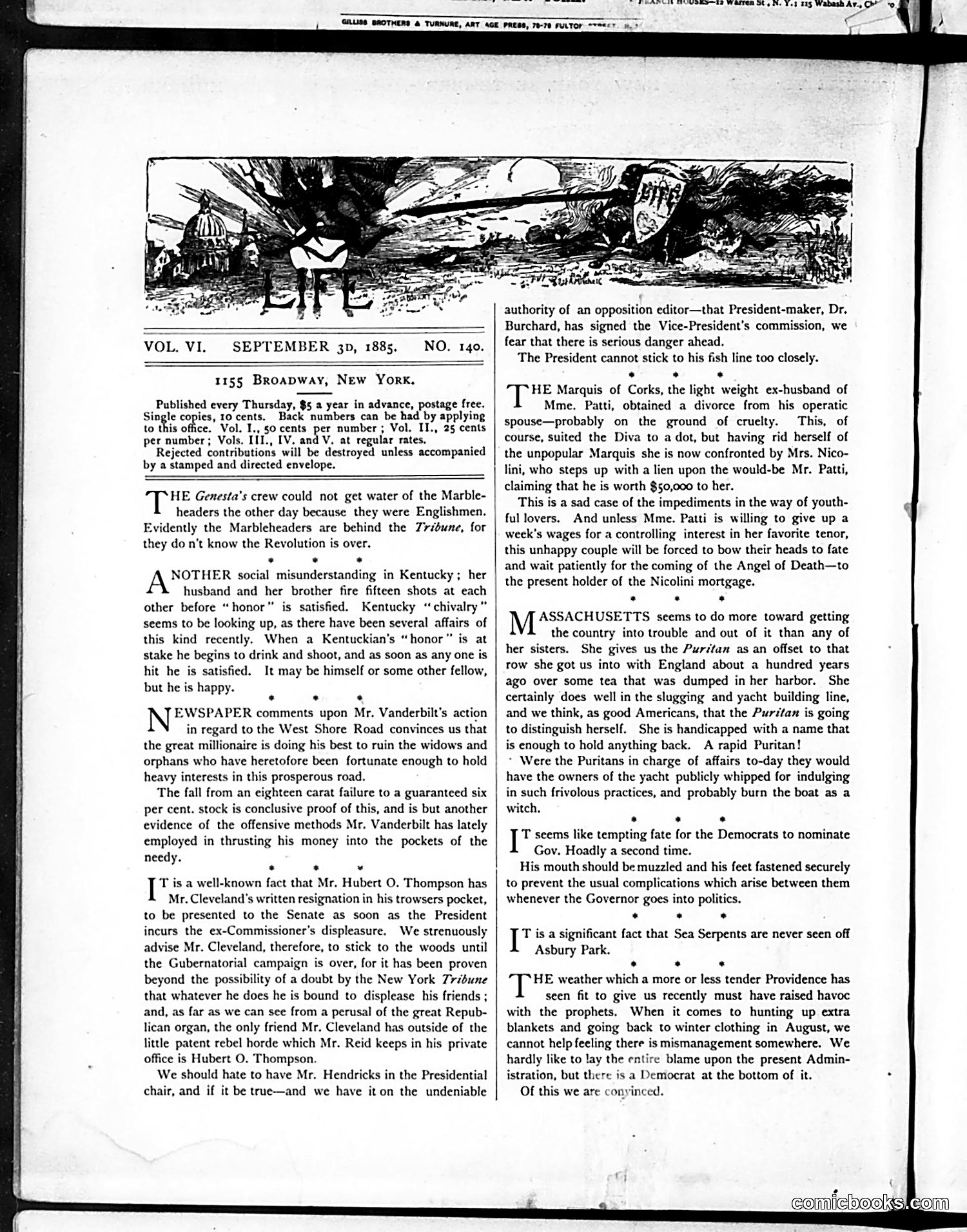
The masthead cartoon depicts a figure sitting at a desk, likely representing editorial authority or political power. The text discusses contemporary political scandals and social issues: - **Cleveland administration criticism**: References President Grover Cleveland and concerns about Dr. Burchard's influence, suggesting dangers ahead for the presidency. - **Social gossip items**: Comments on the Marquis of Corks' divorce, Massachusetts shipping disputes (the *Puritan*), and Kentucky "chivalry" (frontier violence). - **Political warnings**: Advises Mr. Cleveland to distance himself from the gubernatorial campaign and warns Democrats against nominating Gov. Hoadly again. The satirical tone criticizes both Republican and Democratic politics while mocking various social scandals of the era. The magazine functions as sharp political commentary on 1880s governance and elite society.
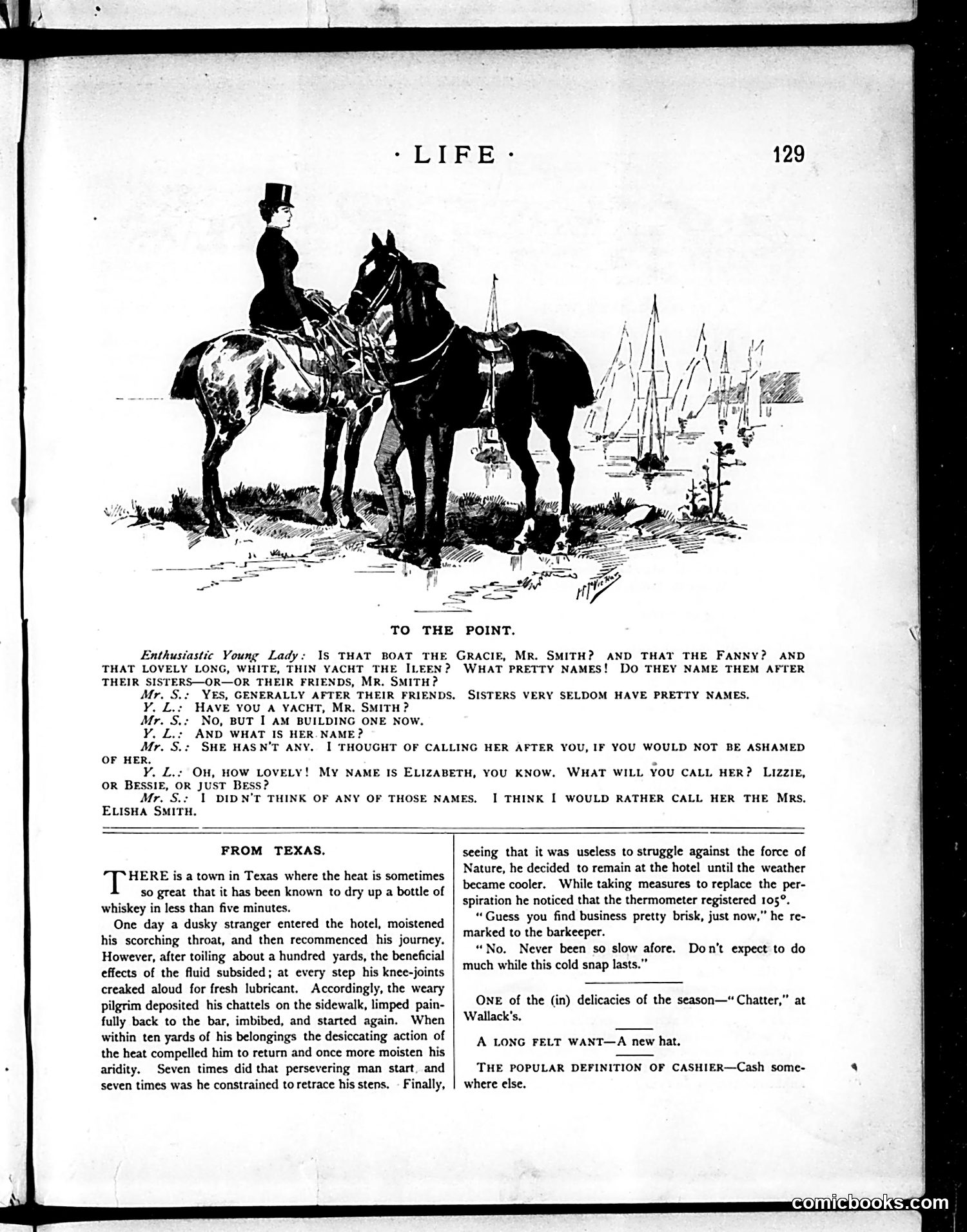
**The Cartoon "To the Point"** depicts a fashionably dressed woman on horseback near sailing boats, conversing with a man (Mr. Smith). The humor centers on naming conventions: the enthusiastic young lady asks what Mr. Smith will name his new yacht, assuming he owns boats named "Gracie" and "Fanny." Mr. Smith's deadpan response—that he'd name a new boat "Mrs. Elisha Smith" rather than adopt the common practice of giving ships feminine names—is the joke's punchline. The satire gently mocks upper-class conventions about boat-naming and the absurdity of defaulting to "pretty names" for vessels instead of meaningful personal references. The lower section contains humorous Texas anecdotes unrelated to the cartoon.
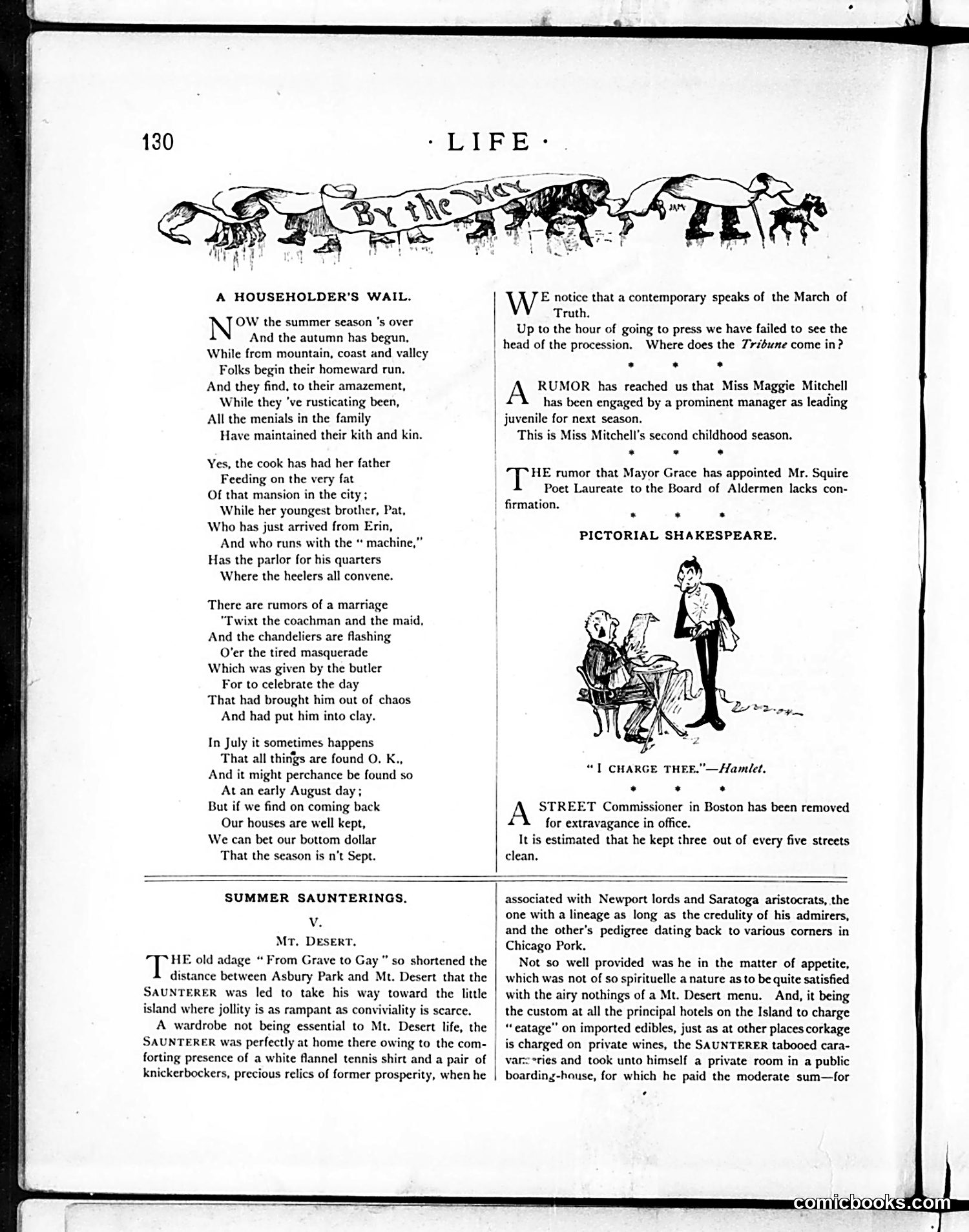
This page contains three distinct sections: 1. **"A Householder's Wail"** - A humorous poem about the end of summer, depicting domestic chaos as the family returns home. The satire targets the disorder of household management during transition seasons. 2. **"Pictorial Shakespeare"** - A sketch captioned "I CHARGE THEE" from Hamlet, appearing to be literary illustration rather than political satire. 3. **"Summer Saunterings"** - Social commentary about Mt. Desert and the "Saunterer" character. The text satirizes a wealthy tourist type frequenting fashionable resort locations, mocking his pretensions and eating habits at Island establishments. The overall page is **social satire** rather than political—it targets genteel American leisure culture, domestic management, and the affectations of the wealthy summer-resort crowd, which were recurring subjects in Life magazine's humor.
This page contains a short satirical dialogue titled "SATISFACTORY RESULTS" featuring a "Clerical-Looking Gentleman" asking a "Little Boy" for directions to a camp meeting. The humor relies on a misunderstanding: the gentleman expects a large attendance and "satisfactory results," but the boy reveals his father sold beer from a keg at the meeting site and profited significantly in just an hour. The satire targets the hypocrisy of temperance and religious gatherings—the implication being that alcohol sales at a "camp meeting" (a religious revival event) mocks both the piety of attendees and the effectiveness of temperance advocacy. The joke assumes readers understand early-20th-century American tensions between Prohibition movements and actual drinking culture.
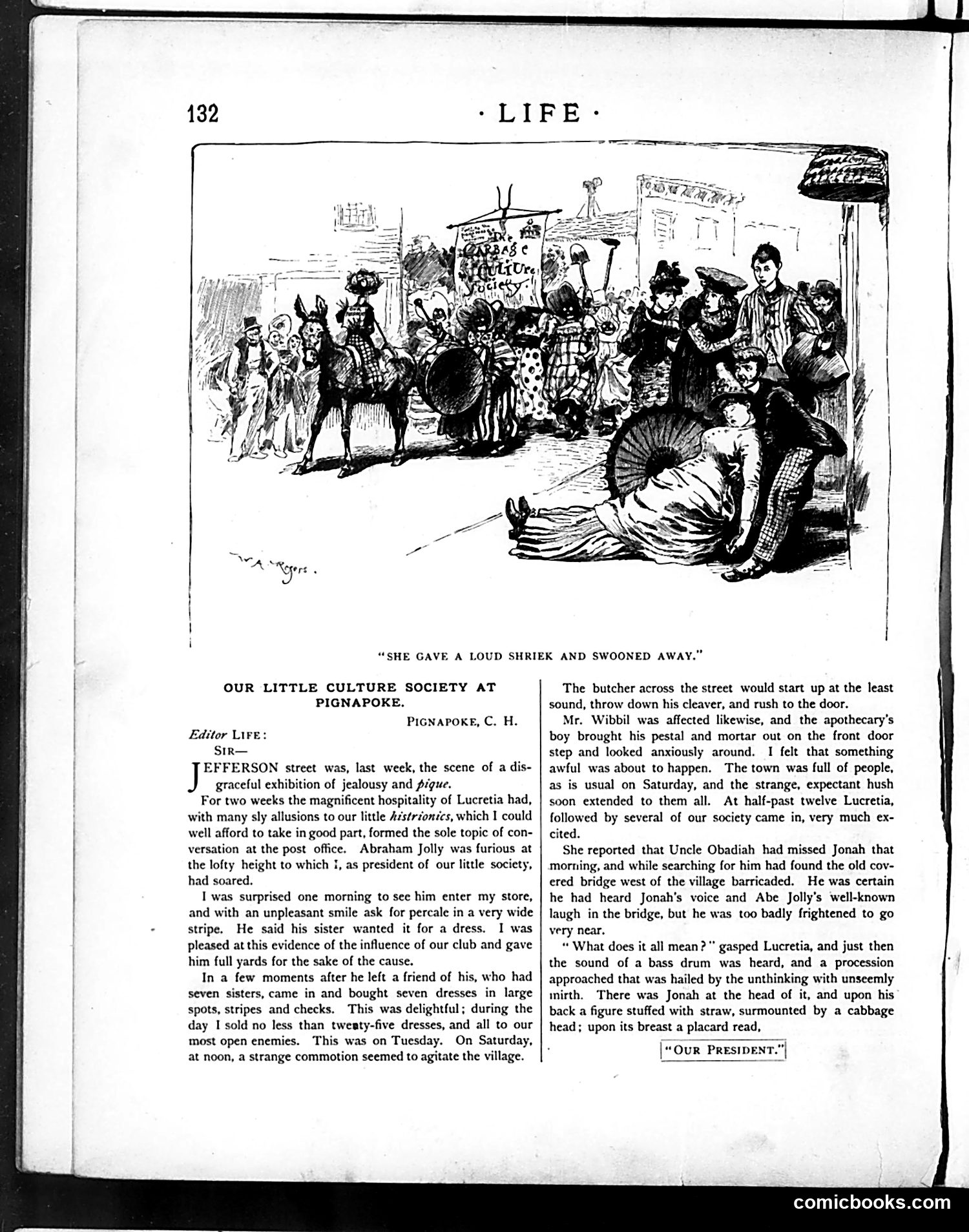
This satirical piece mocks pretentious small-town social climbers. The sketch shows a woman (Lucretia) fainting dramatically during a village procession, while townsfolk gather around in exaggerated concern. The text reveals the absurdity: Lucretia orchestrated an elaborate "culture society" exhibition featuring jealousy and social one-upmanship. She manipulated her brother into parading seven striped dresses through town to demonstrate the society's influence and superiority to local merchants (like the butcher). The procession includes a figure labeled "Our President"—apparently a stuffed effigy—suggesting the organization's pretension and artificiality. The satire targets rural communities' attempts at cultural sophistication through ostentatious display rather than genuine refinement.
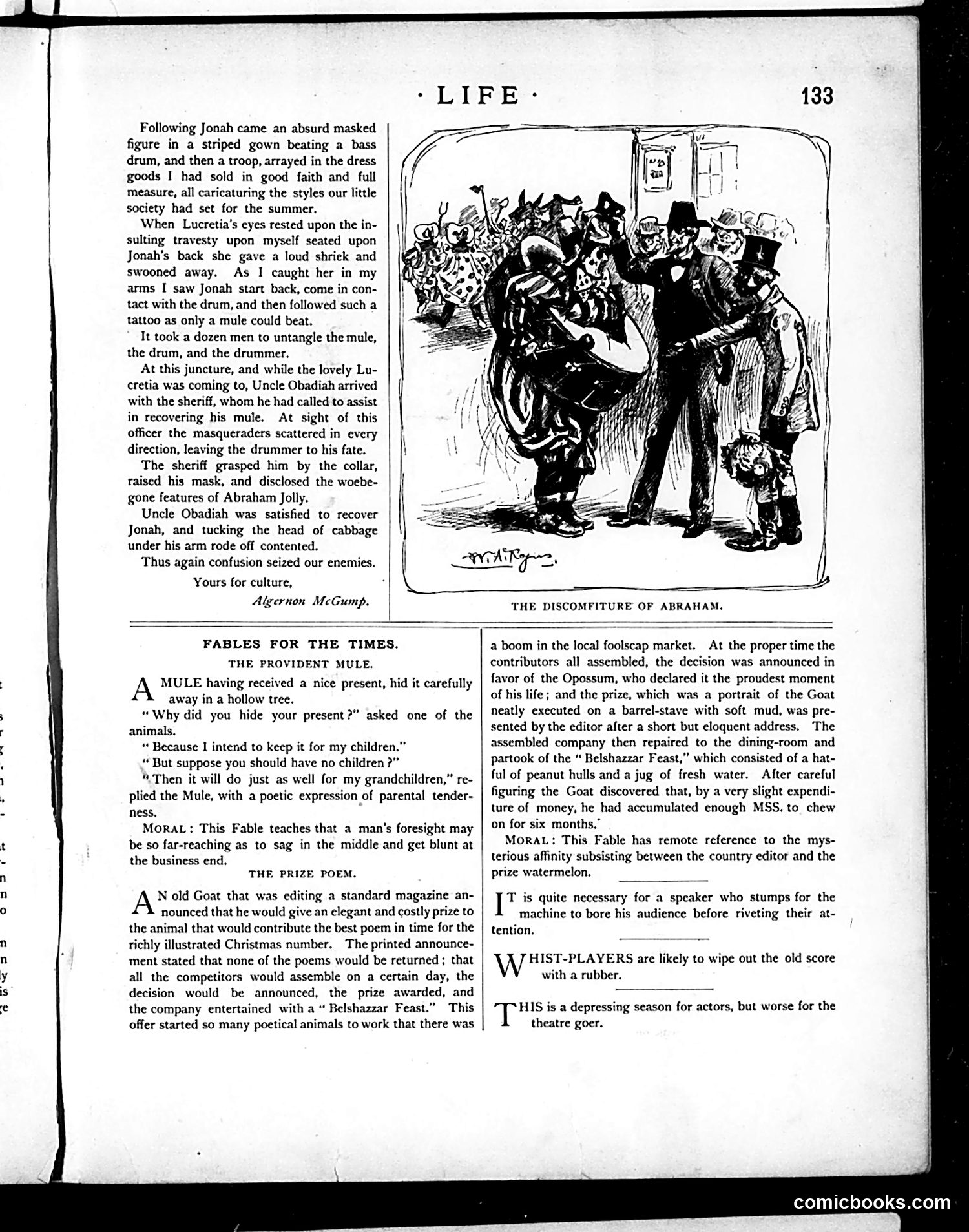
The main illustration titled "The Discomfiture of Abraham" depicts a chaotic scene where a masked figure in a striped gown beats a bass drum while riding a mule. The accompanying narrative describes confusion during a masquerade ball when this absurd performer arrives with goods, causing "lovely Lucretia" to shriek and faint. The satire appears to mock pretentious social climbers and the chaos of masquerade revelry among the upper class. "Uncle Obadiah" arrives with a sheriff to recover his mule, creating further pandemonium. Below, "Fables for the Times" includes brief satirical pieces mocking animals and human folly—standard fare for Life's social commentary. The tone is lighthearted rather than politically charged, targeting manners and vanity rather than specific current events.
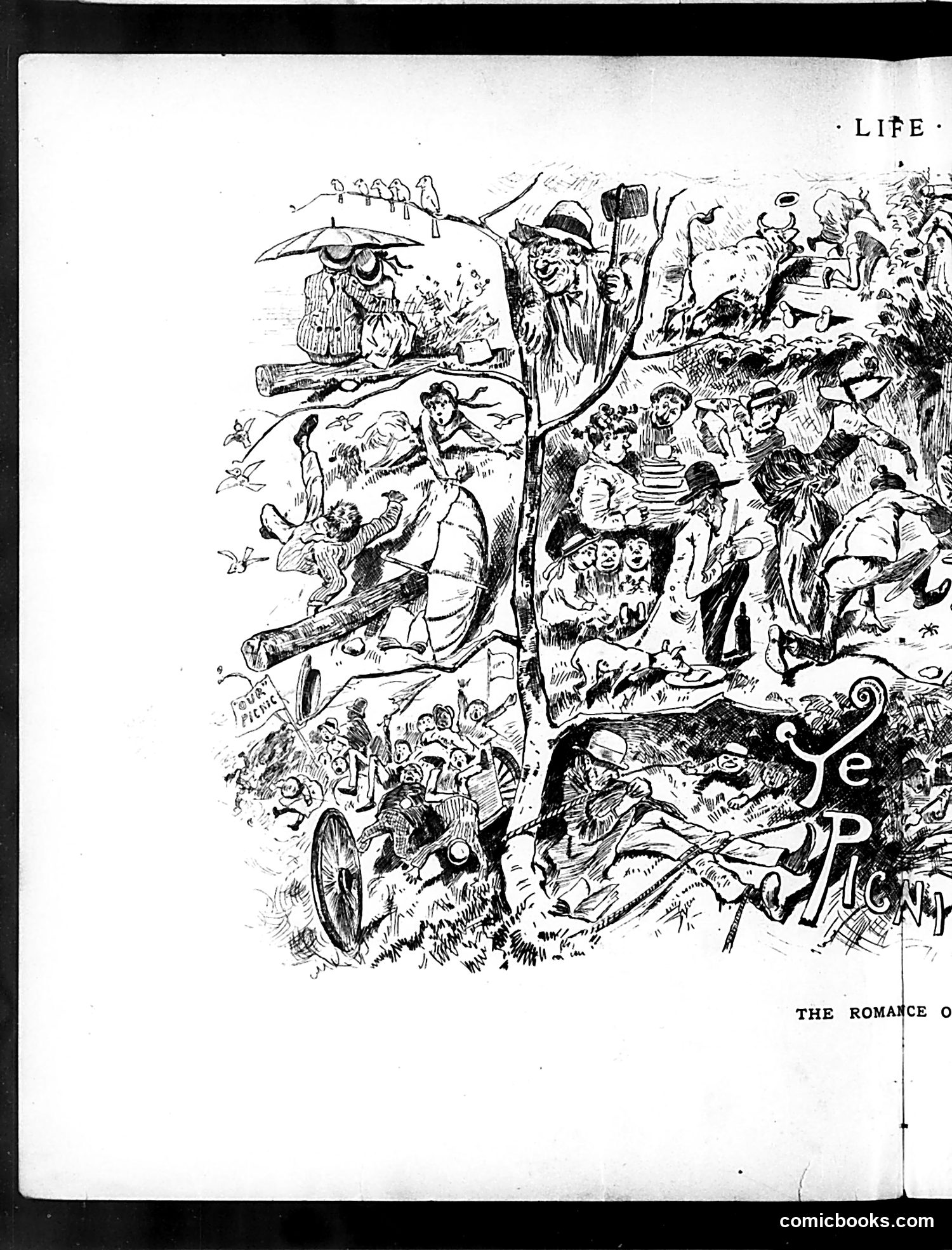
This is a satirical illustration from *Life* magazine showing a chaotic outdoor scene centered on a large tree. The drawing depicts numerous figures engaged in various activities—picnicking, playing, socializing—arranged around the tree's trunk and branches. The title appears to reference "The Romance of..." (text cut off), suggesting this is social commentary on leisure or recreational activities. The style and density of figures suggest satire about crowding, class mixing, or public behavior during what appears to be a leisure outing or holiday gathering. Without the complete caption or date, I cannot definitively identify the specific social or political target. The illustration's busy composition itself—showing disorder and congestion—may be the central joke about modern public life or tourism.
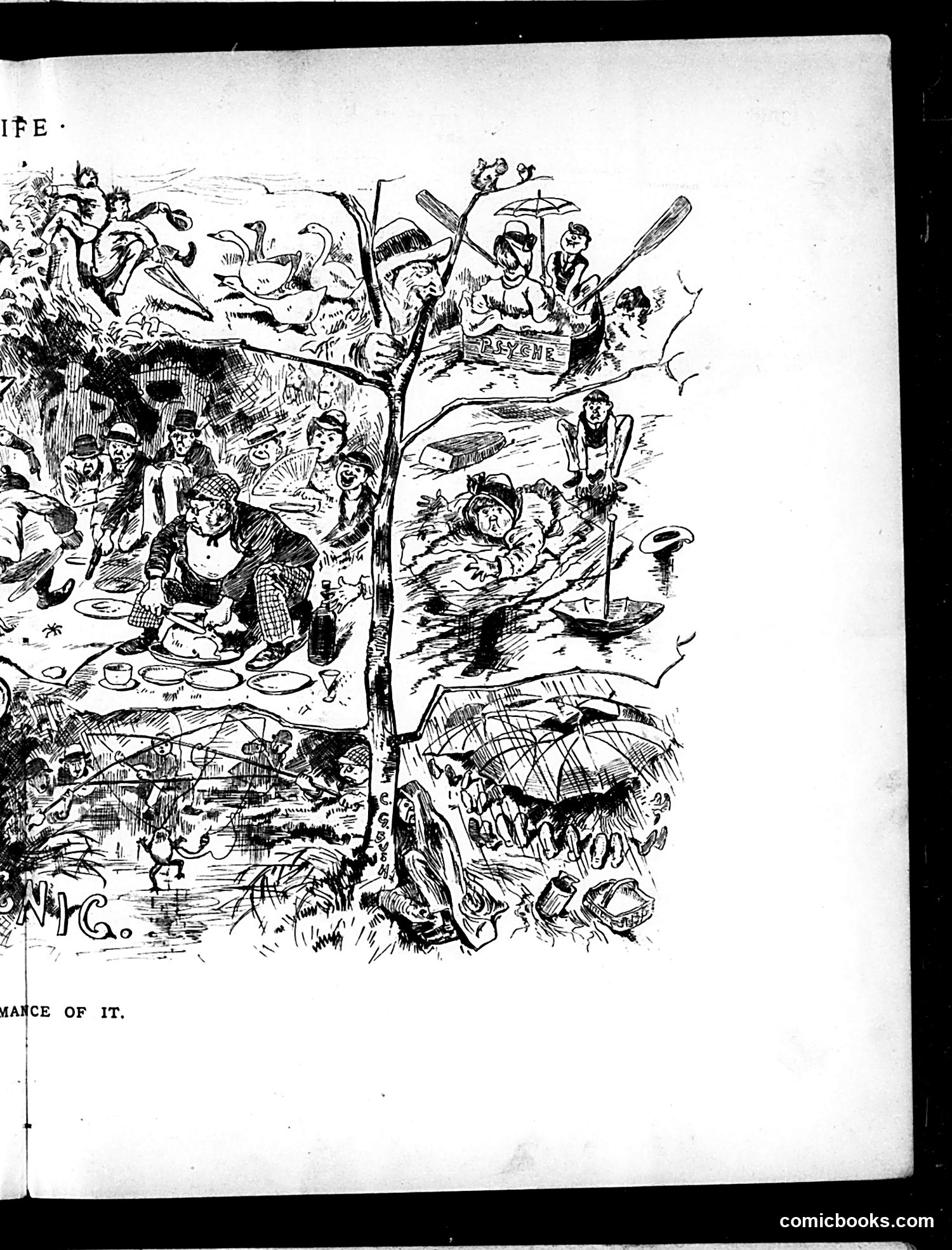
This page displays a single large satirical illustration titled "Life" (visible at top). The cartoon depicts a sprawling tree of life with numerous human figures engaged in various activities across different levels—from leisure activities (picnicking, boating, umbrella-holding) at the upper branches to more chaotic scenes below, including what appears to be water and struggling figures at the roots. The illustration appears to be a commentary on the hierarchy of human society and experience, using the tree metaphor to show different social classes or life conditions. The contrast between comfortable, leisured activities above and more turbulent or difficult conditions below suggests social commentary on inequality. The style and composition indicate this is likely a satirical social critique rather than simple humor, though the specific historical context and intended message remain unclear without additional publication information.
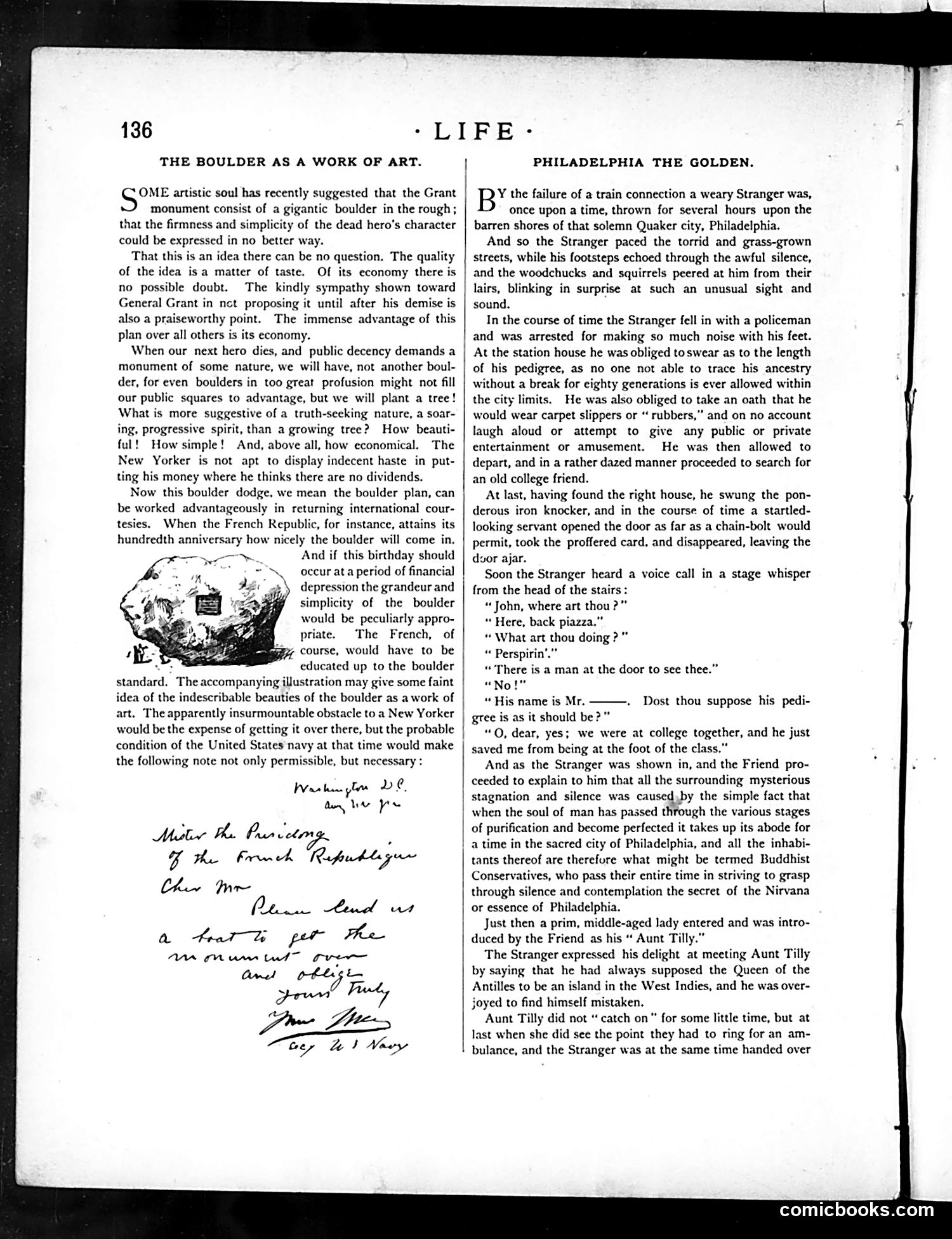
**The Boulder as a Work of Art** (left column): This is satire mocking proposals for a Grant monument. The piece ridicules the idea of a simple boulder as a memorial, sarcastically praising its "economy" and suggesting future heroes be honored with trees instead. The handwritten note at the bottom appears to be a mock diplomatic message to France, likely jesting about sending a boulder as a gift during financial depression—the final line references "the United States navy," implying the nation couldn't afford to transport it. **Philadelphia the Golden** (right column): A humorous short story satirizing Philadelphia's reputation for extreme Quaker restraint and solemnity. A visitor is arrested for making noise with his footsteps, forced to swear genealogical oaths, and required to wear carpet slippers—mocking the city's perceived stuffiness. The dialogue at the end between servant and master uses archaic "thee/thou" speech, further ridiculing Philadelphia's old-fashioned severity and silent, contemplative culture.
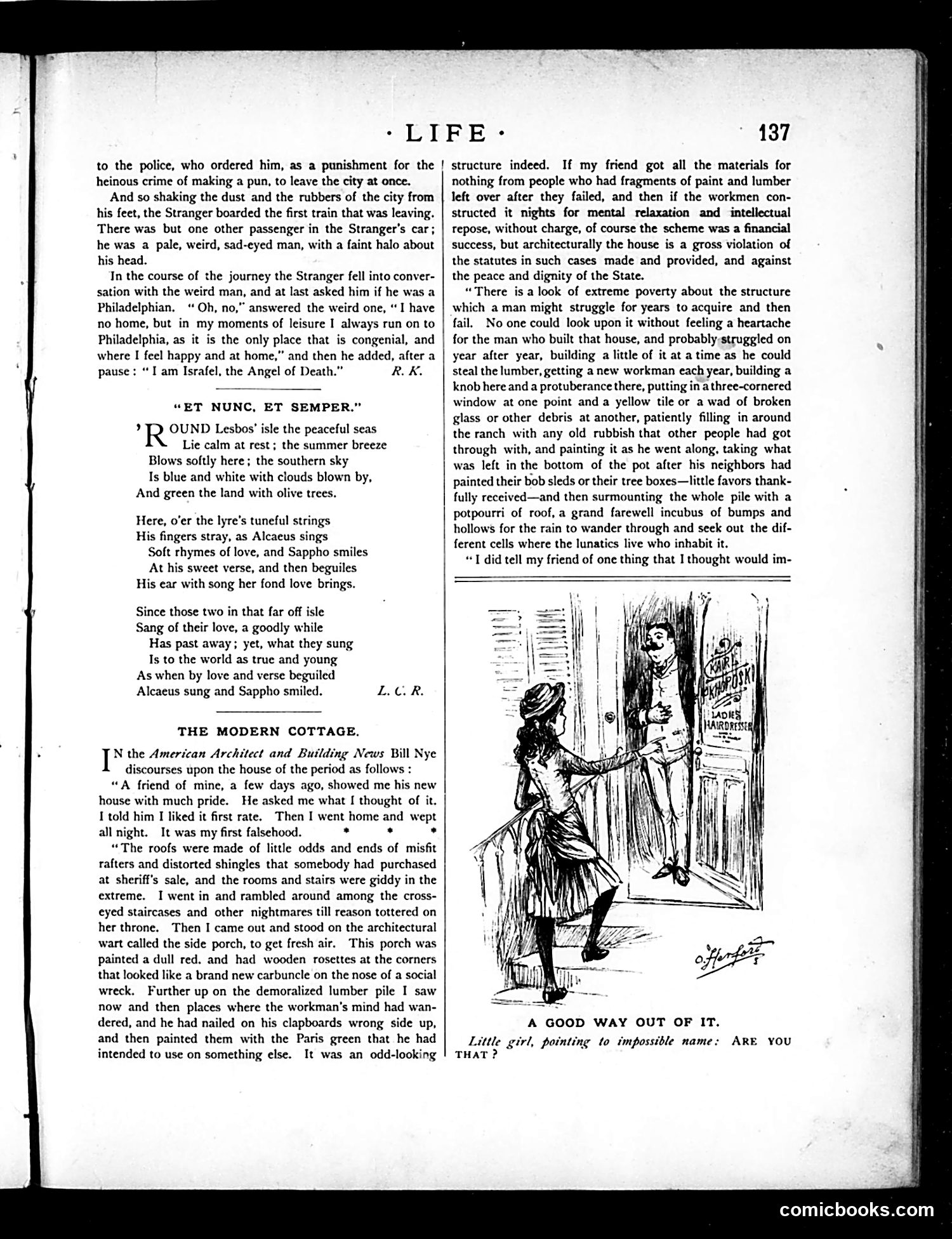
This page contains two distinct pieces of satirical content: **"Et Nunc, Et Semper"** — A sentimental poem about ancient Greek poets Alcaeus and Sappho, celebrating how their love verses remain eternally relevant. This appears to be serious literature rather than satire. **"The Modern Cottage"** — A humorous essay by Bill Nye (humorist and social critic) mocking poorly-constructed American houses. Nye satirizes shoddy construction: roofs made from mismatched materials bought at sheriff's sales, crooked staircases, garish paint jobs, and haphazardly nailed clapboards. The accompanying illustration shows a young girl pointing at an impossible storefront sign, captioned "A Good Way Out of It" — likely suggesting the house is so awful that escaping it is preferable. The satire targets both incompetent builders and working-class homeowners attempting self-construction with salvaged materials, critiquing the poor quality of hastily-built American housing during this period.
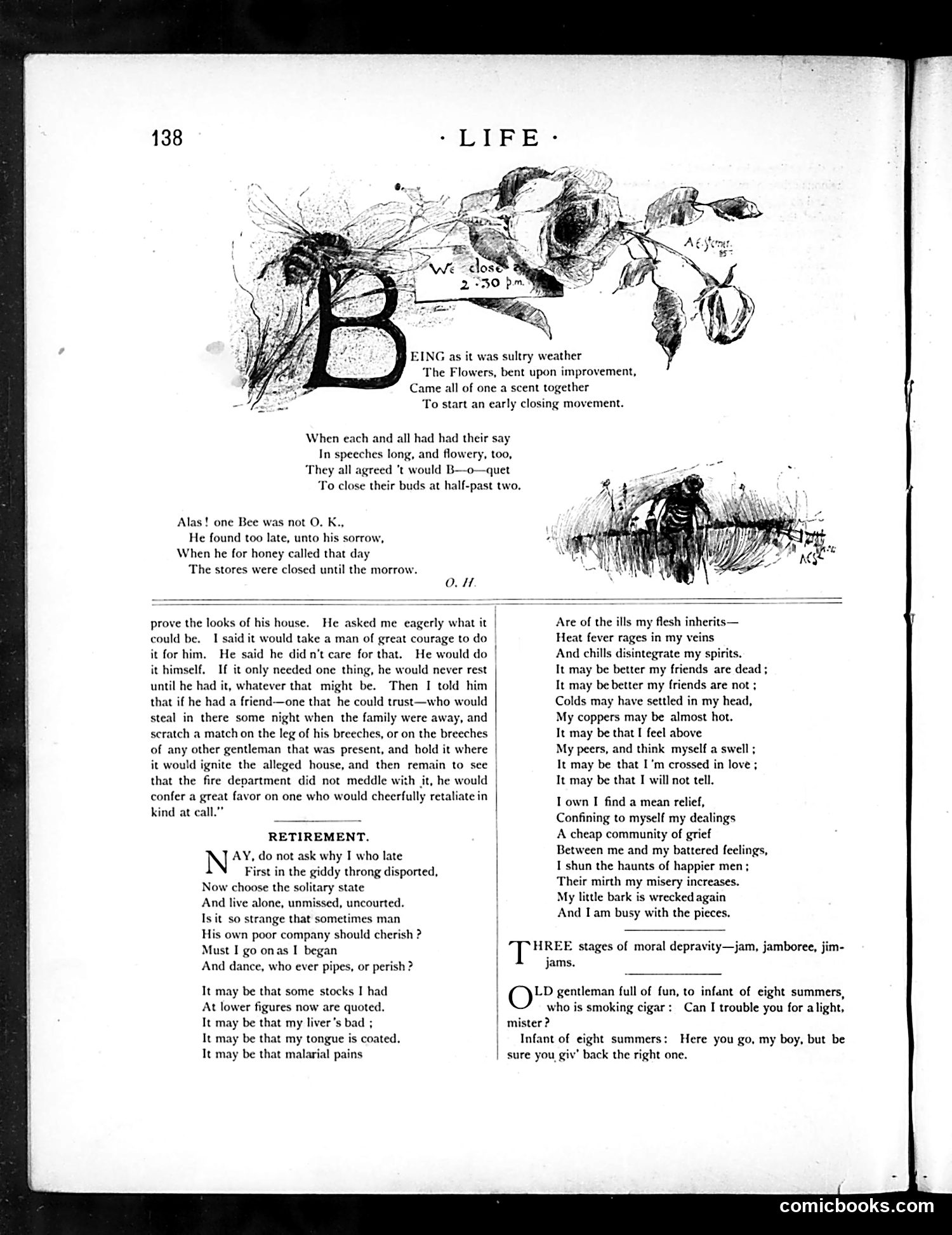
This page contains three distinct pieces of satirical content: **"The Bee and the Flowers"** (top): A whimsical poem with botanical illustrations mocking labor movements. Flowers hold speeches and agree to "close their buds at half-past two"—a clear parallel to factory workers organizing shorter hours. The bee, unaware of this "closing movement," arrives too late seeking honey, satirizing how strikes or labor actions can inconvenience others. **"Retirement"** (center): A melancholic poem about a man withdrawing from society, listing vague ailments (bad liver, malaria, unrequited love, financial losses) as justification. The satire targets upper-class men who manufacture excuses for social retreat rather than admitting genuine reasons. **"Three Stages of Moral Depravity"** and **"The Cigar"** (bottom): Brief humorous observations—one listing progressive slang terms, the other depicting an eight-year-old child smoking a cigar and prudently warning an old man to return "the right one," satirizing both child behavior and adult moral hypocrisy in the era.
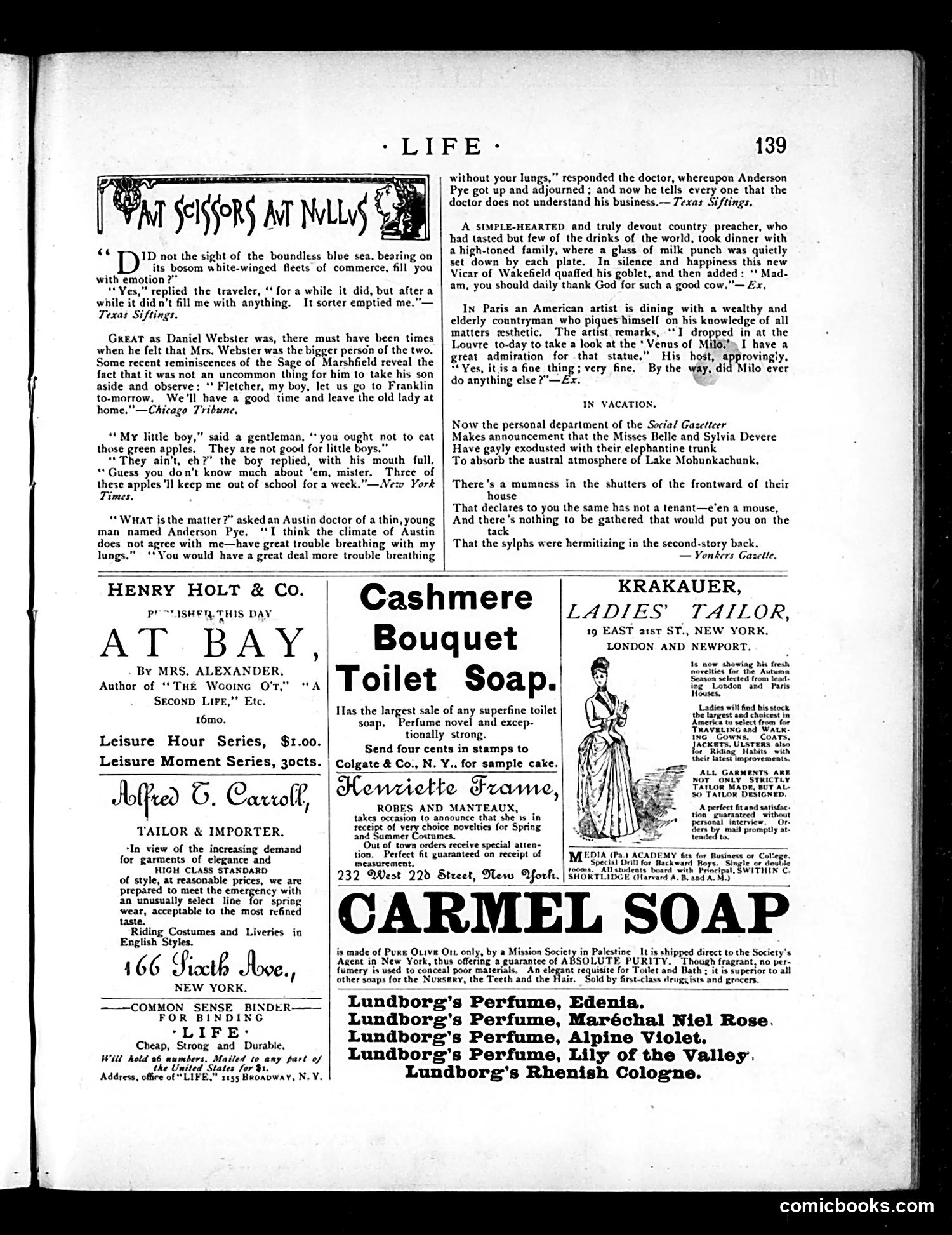
This page is primarily **advertisements and humorous anecdotes** rather than political cartoons. The brief humor pieces are gentle social satire typical of 1880s "Life" magazine. They mock: a pretentious traveler awed by the sea until boredom sets in; Daniel Webster's apparent desire to escape his dominating wife; a schoolboy cynically using green apples as a truancy strategy; and a naïve country preacher's sole takeaway from milk punch being praise of the cow. The final "In Vacation" section humorously describes wealthy families abandoning their homes seasonally, with shuttered houses so empty "not a tenant—e'en a mouse" remains. These are gentle, character-based jokes reflecting Victorian-era social pretensions and family dynamics—nothing overtly political. The remainder consists of advertisements for books, clothing, and patent soaps typical of period magazine content.
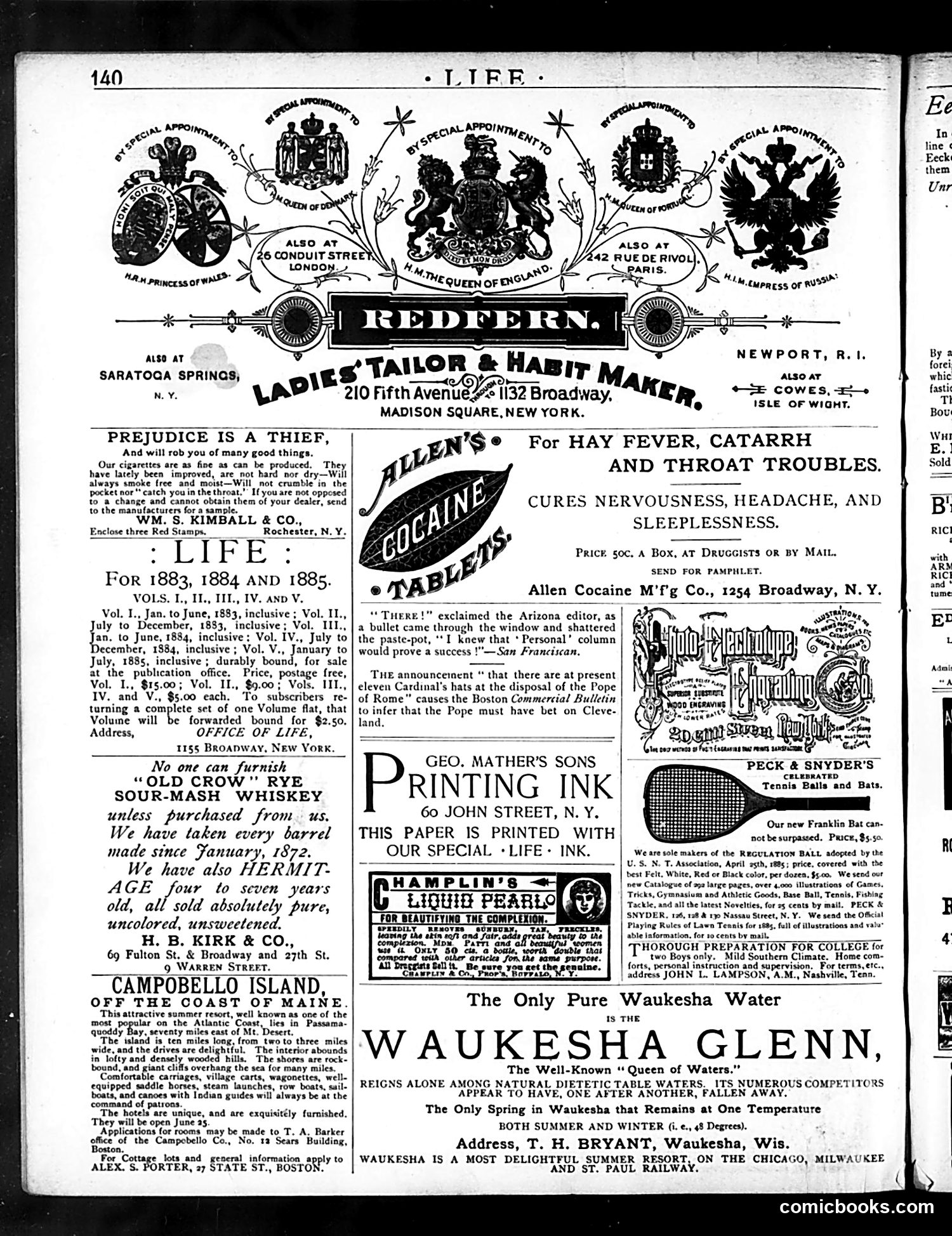
This page is primarily **advertisements and filler content** from Life magazine (1883-1885 era), with minimal political cartooning. The notable satirical content appears in two brief text jokes: 1. **The Arizona editor anecdote**: References a newspaper's "Personal" column attracting violent response—a jab at sensationalist journalism of the era. 2. **The Pope/Cleveland joke**: References Pope Leo XIII having eleven cardinal positions available, inferring the Pope "bet on Cleveland"—likely alluding to James Cleveland's 1884 presidential election. The joke's logic is unclear without deeper context, but appears to mock either the Pope's political involvement or Cleveland's odds of winning. The remainder consists of period advertisements: Redfern clothing, Allen's Cocaine tablets (for hay fever—then legal), whiskey, Life magazine back-issues, printing ink, and sporting goods. These ads reflect 1880s consumer culture and normalized cocaine marketing. **No significant political cartoons appear on this page.**
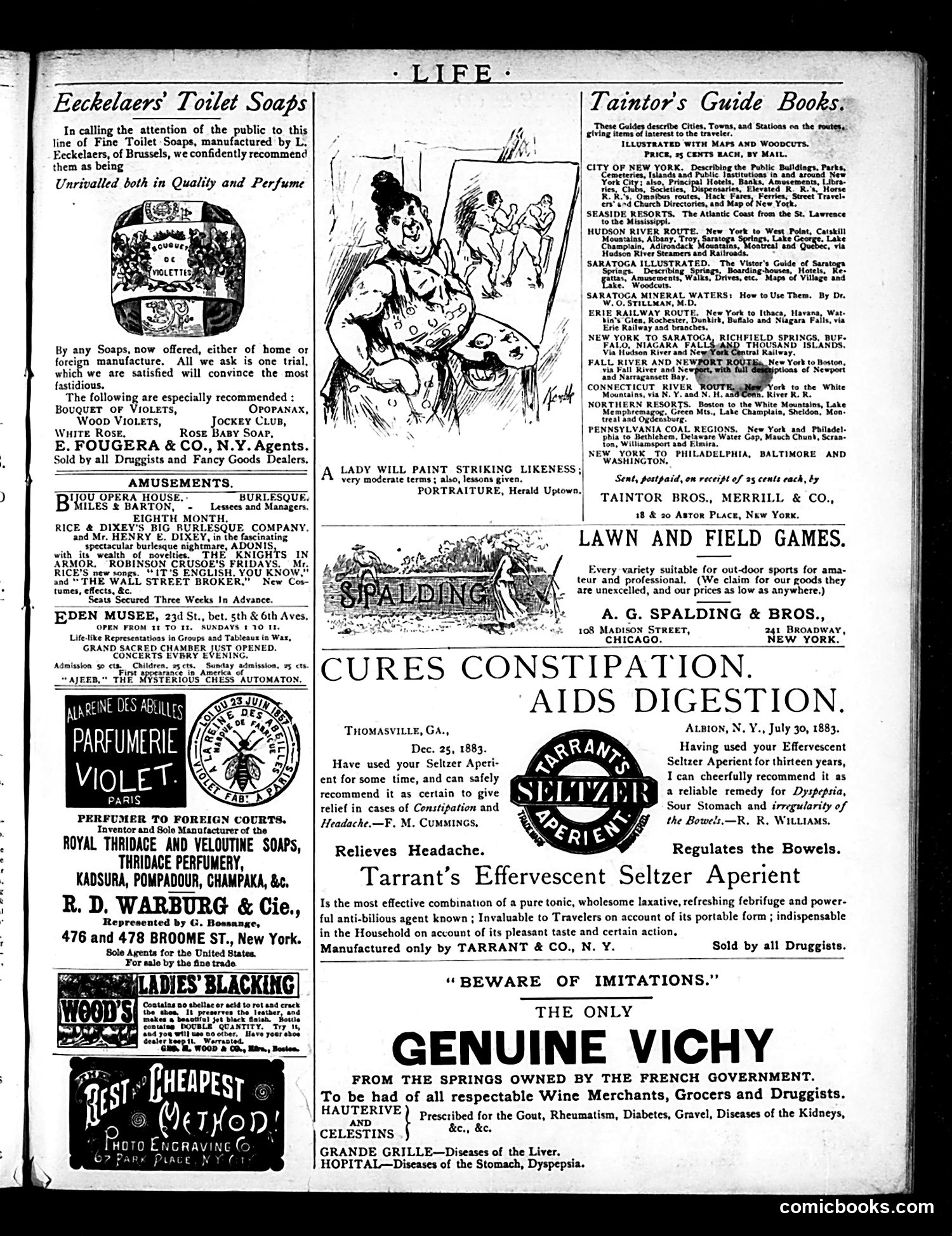
This page is primarily **advertisements and notices**, with one small cartoon illustration. The cartoon—labeled "A LADY WILL PAINT STRIKING LIKENESS"—shows a caricatured woman artist painting or sculpting a grotesque male face. The satire appears to mock either incompetent portrait painters or the vanity of subjects who commission unflattering likenesses. The exaggerated, ugly features suggest the joke is about the gap between how people wish to be portrayed versus reality. The page itself reflects 1880s consumer culture: soap advertisements (Eeckelaers, Wood's Blacking), theatrical promotions (burlesques, wax museums), patent medicines (Tarrant's Seltzer), and travel guides. The advertisements assume a prosperous urban readership interested in leisure activities, toiletries, and tourism—typical Life magazine fare from this period.
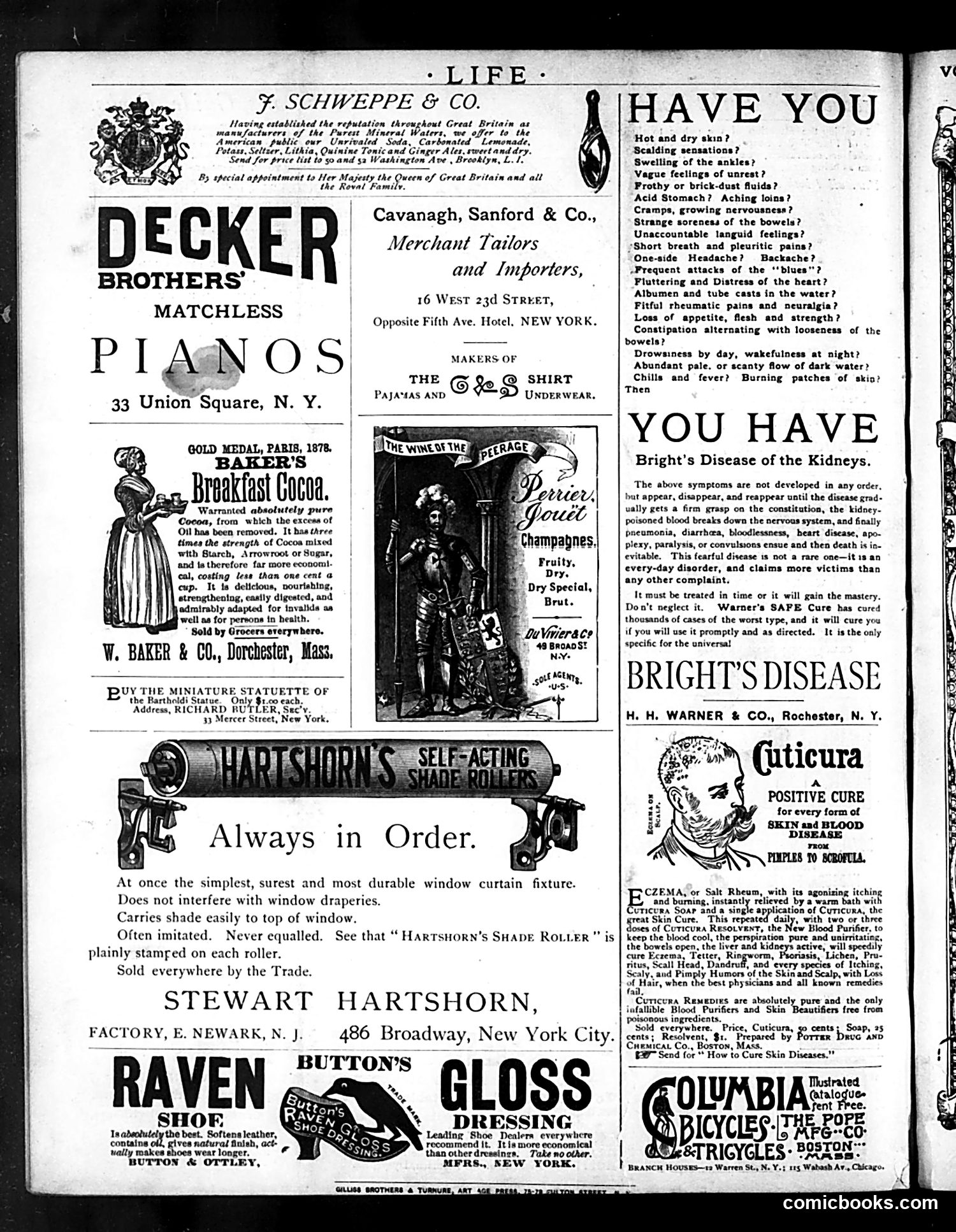
This is primarily a **page of advertisements** from *Life* magazine, not satirical content. The page features patent medicine and consumer product ads typical of the era. The most notable content is a large **medical advertisement for "Warner's Safe Cure"** (right column) claiming to treat Bright's Disease of the kidneys. It lists alarming symptoms—scalding sensations, swelling ankles, dark urine, heart palpitations—before announcing "Then YOU HAVE Bright's Disease" and promoting Warner's cure as the only effective treatment. This exemplifies **patent medicine fraud common in the 1800s**: unproven remedies made exaggerated claims to desperate patients. Such ads exploited medical ignorance and fear to sell ineffective treatments. The remaining ads promote legitimate consumer goods: pianos, cocoa, merchant tailors, shoe dressing, and window shade rollers—typical marketplace advertising of the period.