
Life, 1885-09-03 · page 12 of 16
Life — September 3, 1885 — page 12: what you’re looking at
What you’re looking at
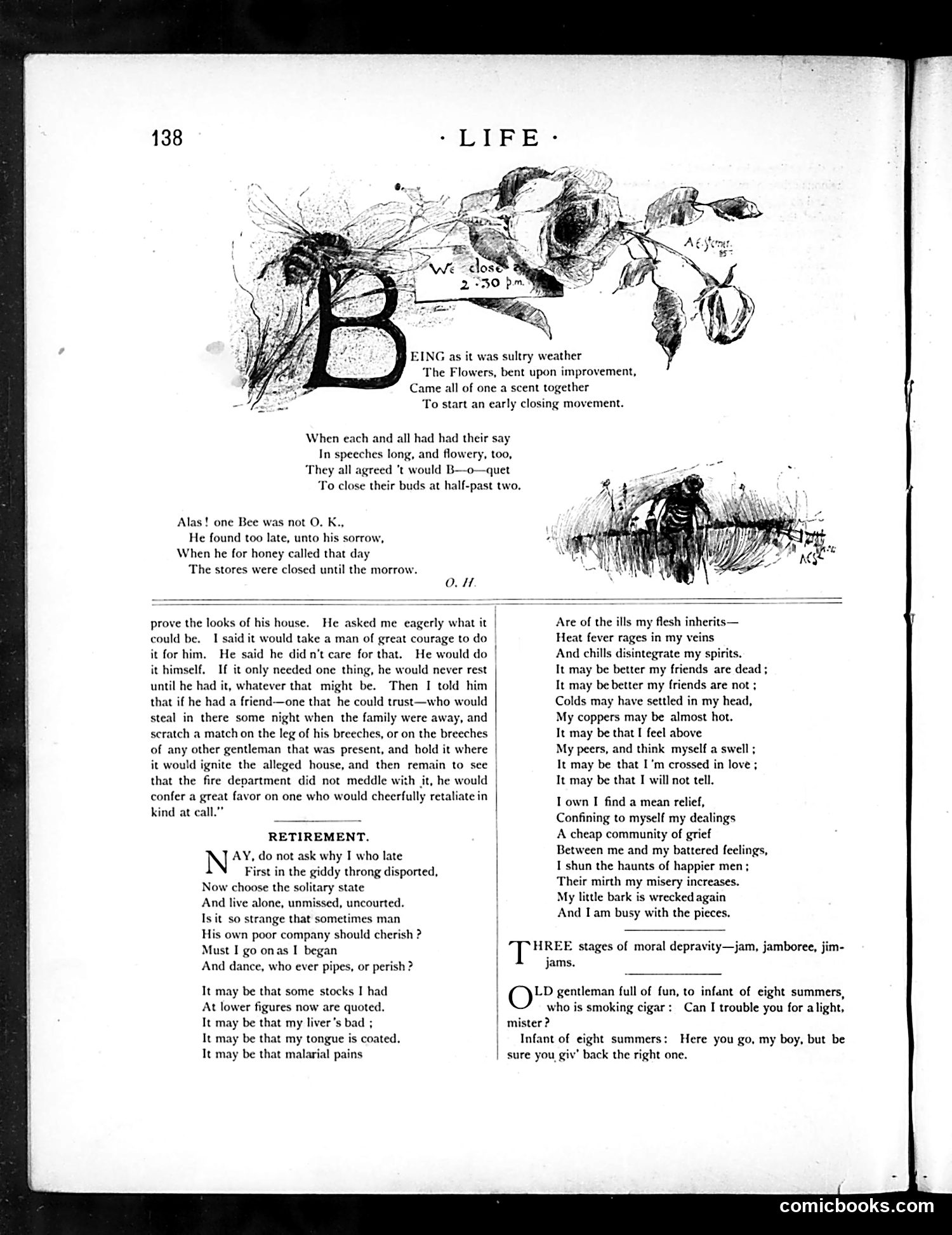
This page contains three distinct pieces of satirical content: **"The Bee and the Flowers"** (top): A whimsical poem with botanical illustrations mocking labor movements. Flowers hold speeches and agree to "close their buds at half-past two"—a clear parallel to factory workers organizing shorter hours. The bee, unaware of this "closing movement," arrives too late seeking honey, satirizing how strikes or labor actions can inconvenience others. **"Retirement"** (center): A melancholic poem about a man withdrawing from society, listing vague ailments (bad liver, malaria, unrequited love, financial losses) as justification. The satire targets upper-class men who manufacture excuses for social retreat rather than admitting genuine reasons. **"Three Stages of Moral Depravity"** and **"The Cigar"** (bottom): Brief humorous observations—one listing progressive slang terms, the other depicting an eight-year-old child smoking a cigar and prudently warning an old man to return "the right one," satirizing both child behavior and adult moral hypocrisy in the era.
📄 Transcribed text from this page (OCR, searchable)
Machine-transcribed from the original scan — historical spelling and the odd misread are preserved.
EING as it was sultry weather ‘The Flowers, bent upon improvement, Came all of one a scent together To start an early closing movement. When each and all had had their say In speeches long, and flowery, too, They all agreed 't would B—o—quet To close their buds at half-past two. Alas! one Bee was not O. K He found too late, unto his sorrow, When he for honey called that day The stores were closed until the morrow. prove the looks of his house. He asked me eagerly what it could be. I said it would take a man of great courage to do it for him. He said he did n't care for that. He would do | it himself. If it only needed one thing, he would never rest until he had it, whatever that might be. Then I told him that if he had a friend—one that he could trust—who would steal in there some night when the family were away, and scratch a match on the leg of his breeches, or on the breeches of any other gentleman that was present, and hold it where | it would ignite the alleged house, and then remain to see that the fire department did not meddle with jit, he would confer a great favor on one who would cheerfully retaliate in kind at call.” RETIREMENT. N AY, do not ask why I who late First in the giddy throng disported, Now choose the solitary state And live alone, unmissed, uncourted. Is it so strange that sometimes man His own poor company should cherish ? Must I go onas I began And dance, who ever pipes, or perish ? It may be that some stocks I had At lower figures now are quoted. It may be that my liver’s bad ; It may be that my tongue is coated. It may be that malarial pains Are of the ills my flesh inherits— Heat fever rages in my veins And chills disintegrate my spirits. It may be better my friends are dead ; It may be better my friends are not ; Colds may have settled in my head, My coppers may be almost hot. It may be that I feel above My peers, and think myself a swell ; It may be that I'm crossed in love ; It may be that I will not tell. T own I find a mean relief, Confining to myself my dealings A cheap community of grief Between me and my battered feelings, I shun the haunts of happier men; Their mirth my misery increases. My little bark is wrecked again And Iam busy with the pieces. HREE stages of moral depravity—jam, jamboree, jim- jams. LD gentleman full of fun, to infant of eight summers, who is smoking cigar: Can I trouble you for alight, Infant of eight summers: Here you go, my boy, but be | sure you giv’ back the right one. comicbooks.com