
Life, 1885-09-03 · page 11 of 16
Life — September 3, 1885 — page 11: what you’re looking at
What you’re looking at
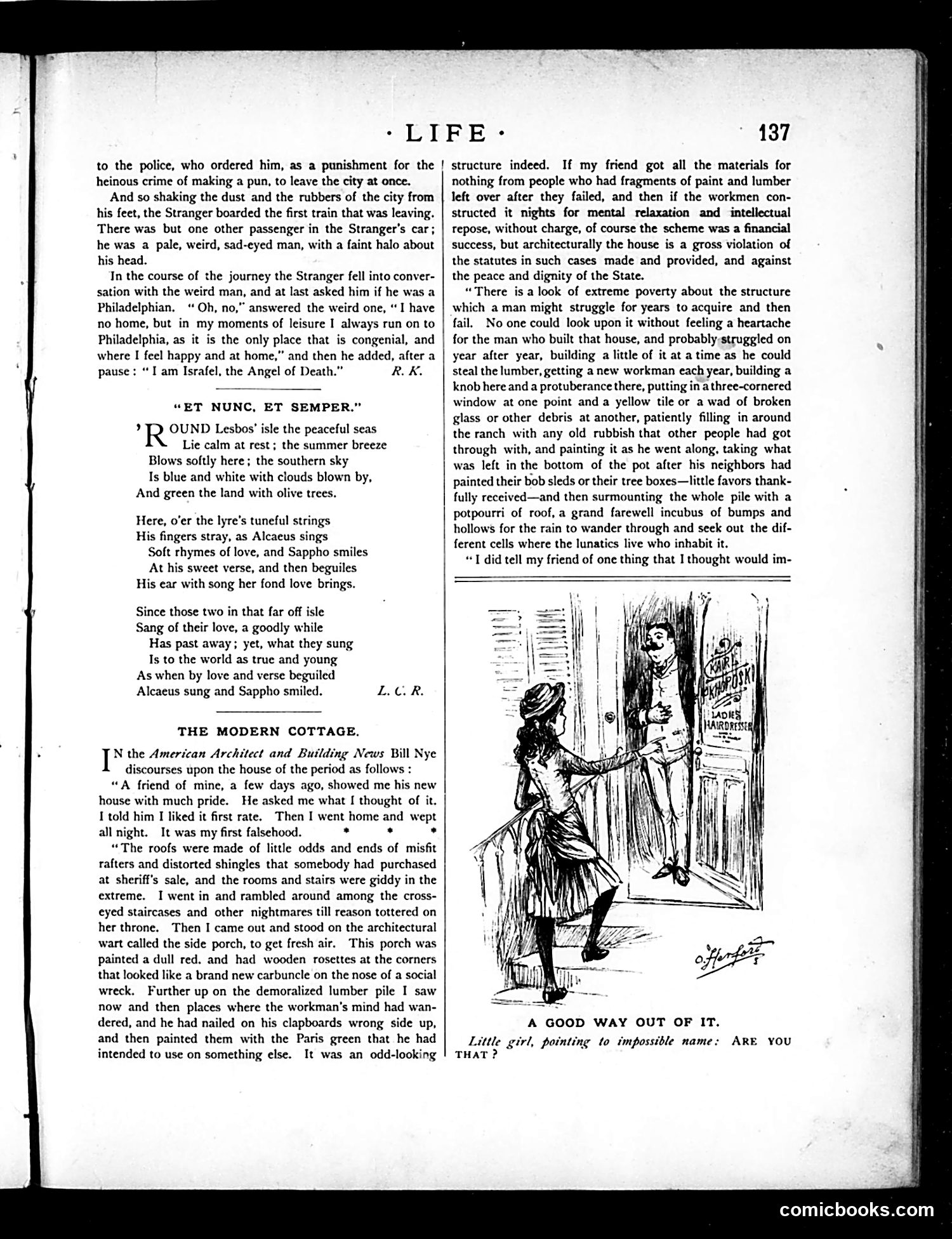
This page contains two distinct pieces of satirical content: **"Et Nunc, Et Semper"** — A sentimental poem about ancient Greek poets Alcaeus and Sappho, celebrating how their love verses remain eternally relevant. This appears to be serious literature rather than satire. **"The Modern Cottage"** — A humorous essay by Bill Nye (humorist and social critic) mocking poorly-constructed American houses. Nye satirizes shoddy construction: roofs made from mismatched materials bought at sheriff's sales, crooked staircases, garish paint jobs, and haphazardly nailed clapboards. The accompanying illustration shows a young girl pointing at an impossible storefront sign, captioned "A Good Way Out of It" — likely suggesting the house is so awful that escaping it is preferable. The satire targets both incompetent builders and working-class homeowners attempting self-construction with salvaged materials, critiquing the poor quality of hastily-built American housing during this period.
📄 Transcribed text from this page (OCR, searchable)
Machine-transcribed from the original scan — historical spelling and the odd misread are preserved.
> LIFE: to the police, who ordered him, as a punishment for the heinous crime of making a pun, to leave the city at once. And so shaking the dust and the rubbers of the city from his feet, the Stranger boarded the first train that was leaving. There was but one other passenger in the Stranger's car; he was a pale, weird, sad-eyed man, with a faint halo about his head. In the course of the journey the Stranger fell into conver- sation with the weird man, and at last asked him if he was a Philadelphian, ‘Oh, no,” answered the weird one, “I have no home, but in my moments of leisure I always run on to Philadelphia, as it is the only place that is congenial, and where I feel happy and at home,” and then he added, after a pause : “I am Israfel, the Angel of Death.” RK. “ET NUNC, ET SEMPER.” ’ OUND Lesbos’ isle the peaceful seas Lie calm at rest; the summer breeze Blows softly here; the southern sky Is blue and white with clouds blown by, And green the land with olive trees. Here, o'er the lyre’s tuneful strings His fingers stray, as Alcaeus sings Soft rhymes of love, and Sappho smiles At his sweet verse, and then beguiles His ear with song her fond love brings. Since those two in that far off isle Sang of their love, a goodly while Has past away ; yet, what they sung Is to the world as true and young As when by love and verse beguiled Alcaeus sung and Sappho smiled. THE MODERN COTTAGE. N the American Architect and Building News Bill Nye discourses upon the house of the period as follows : “A friend of mine, a few days ago, showed me his new house with much pride. He asked me what I thought of it. I told him I liked it first rate. Then I went home and wept all night. It was my first falsehood. . . . “The roofs were made of little odds and ends of misfit rafters and distorted shingles that somebody had purchased at sheriff's sale, and the rooms and stairs were giddy in the extreme. I went in and rambled around among the cross- eyed staircases and other nightmares till reason tottered on her throne. Then I came out and stood on the architectural wart called the side porch, to get fresh air. This porch was painted a dull red. and had wooden rosettes at the corners that looked like a brand new carbuncle on the nose of a social wreck. Further up on the demoralized lumber pile I saw now and then places where the workman's mind had wan- dered, and he had nailed on his clapboards wrong side up, and then painted them with the Paris green that he had intended to use on something else. It was an odd-looking 137 ! structure indeed. If my friend got all the materials for nothing from people who had fragments of paint and lumber left over after they failed, and then if the workmen con- structed it nights for mental relaxation and intellectual repose, without charge, of course the scheme was a financial success, but architecturally the house is a gross violation of the statutes in such cases made and provided, and against the peace and dignity of the State. “There is a look of extreme poverty about the structure which a man might struggle for years to acquire and then fail. No one could look upon it without feeling a heartache | for the man who built that house, and probably-struggled on year after year, building a little of it at atime as he could steal the lumber, getting a new workman each year, building a knob here and a protuberance there, putting in athree-cornered window at one point and a yellow tile or a wad of broken | glass or other debris at another, patiently filling in around the ranch with any old rubbish that other people had got through with, and painting it as he went along, taking what was left in the bottom of the pot after his neighbors had painted their bob sleds or their tree boxes—little favors thank- fully received—and then surmounting the whole pile with a potpourri of roof, a grand farewell incubus of bumps and hollows for the rain to wander through and seek out the dif- ferent cells where the lunatics live who inhabit it. “I did tell my friend of one thing that I thought would im- A GOOD WAY OUT OF IT. Little girl, pointing to impossible name: THAT ? ARE YOU comicbooks.com