
Life, 1885-09-03 · page 4 of 16
Life — September 3, 1885 — page 4: what you’re looking at
What you’re looking at
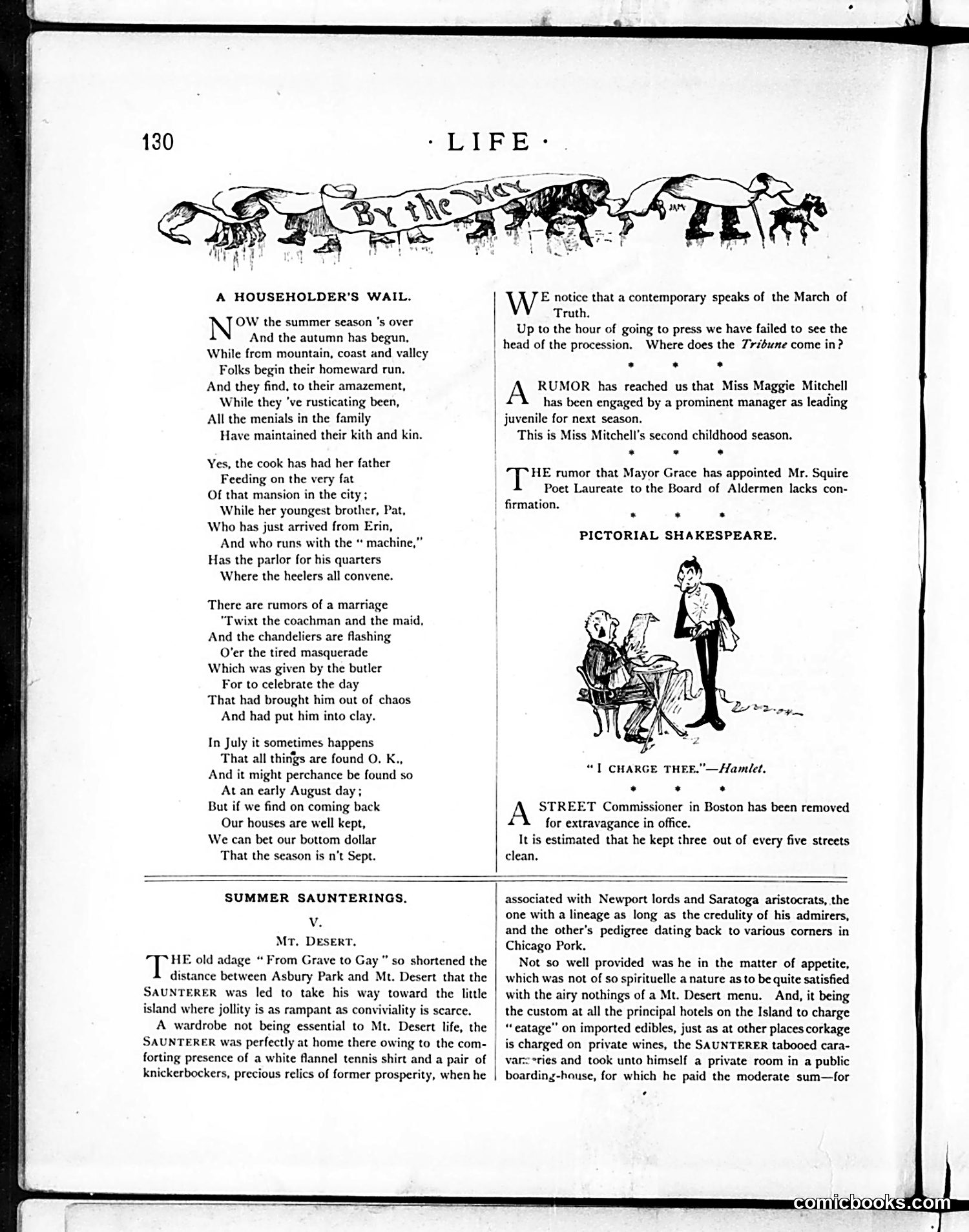
This page contains three distinct sections: 1. **"A Householder's Wail"** - A humorous poem about the end of summer, depicting domestic chaos as the family returns home. The satire targets the disorder of household management during transition seasons. 2. **"Pictorial Shakespeare"** - A sketch captioned "I CHARGE THEE" from Hamlet, appearing to be literary illustration rather than political satire. 3. **"Summer Saunterings"** - Social commentary about Mt. Desert and the "Saunterer" character. The text satirizes a wealthy tourist type frequenting fashionable resort locations, mocking his pretensions and eating habits at Island establishments. The overall page is **social satire** rather than political—it targets genteel American leisure culture, domestic management, and the affectations of the wealthy summer-resort crowd, which were recurring subjects in Life magazine's humor.
📄 Transcribed text from this page (OCR, searchable)
Machine-transcribed from the original scan — historical spelling and the odd misread are preserved.
A HOUSEHOLDER’S WAIL. OW the summer season 's over And the autumn has begun, While frem mountain, coast and valley Folks begin their homeward run, And they find, to their amazement, While they ‘ve rusticating been, All the menials in the family Have maintained their kith and kin. Yes, the cook has had her father Feeding on the very fat Of that mansion in the city ; While her youngest brother, Pat, Who has just arrived from Erin, And who runs with the “ machine,” Has the parlor for his quarters Where the heelers all convene. There are rumors of a marriage *Twixt the coachman and the maid, And the chandeliers are flashing O’er the tired masquerade Which was given by the butler For to celebrate the day That had brought him out of chaos And had put him into clay. In July it sometimes happens That all things are found O. K., And it might perchance be found so Atan early August day; But if we find on coming back Our houses are well kept, We can bet our bottom dollar That the season is n't Sept. E notice that a contemporary speaks of the March of Truth, | Up to the hour of going to press we have failed to see the head of the procession. Where does the 7rzbune come in? . * . RUMOR has reached us that Miss Maggie Mitchell has been engaged by a prominent manager as leading juvenile for next season. This is Miss Mitchell's second childhood season. . . . HE rumor that Mayor Grace has appointed Mr. Squire Poet Laureate to the Board of Aldermen lacks con- | firmation. . . * PICTORIAL SHAKESPEARE. “I CHARGE THEE.”—Hamlet, . . . STREET Commissioner in Boston has been removed for extravagance in office. It is estimated that he kept three out of every five streets clean. SUMMER SAUNTERINGS. Vv. Mr. DeserRT. HE old adage “ From Grave to Gay " so shortened the distance between Asbury Park and Mt. Desert that the SAUNTERER was led to take his way toward the little island where jollity is as rampant as conviviality is scarce. A wardrobe not being essential to Mt. Desert life, the | SAUNTERER was perfectly at home there owing to the com- forting presence of a white flannel tennis shirt and a pair of knickerbockers, precious relics of former prosperity, when he associated with Newport lords and Saratoga aristocrats, the | one with a lineage as long as the credulity of his admirers, | and the other's pedigree dating back to various corners in Chicago Pork. Not so well provided was he in the matter of appetite, which was not of so spirituelle a nature as to be quite satisfied with the airy nothings of a Mt. Desert menu. And, it being | the custom at all the principal hotels on the Island to charge “eatage” on imported edibles, just as at other places corkage is charged on private wines, the SAUNTERER tabooed cara- varz*ries and took unto himself a private room in a public boarding-haouse, for which he paid the moderate sum—for