
Life, 1885-09-03 · page 10 of 16
Life — September 3, 1885 — page 10: what you’re looking at
What you’re looking at
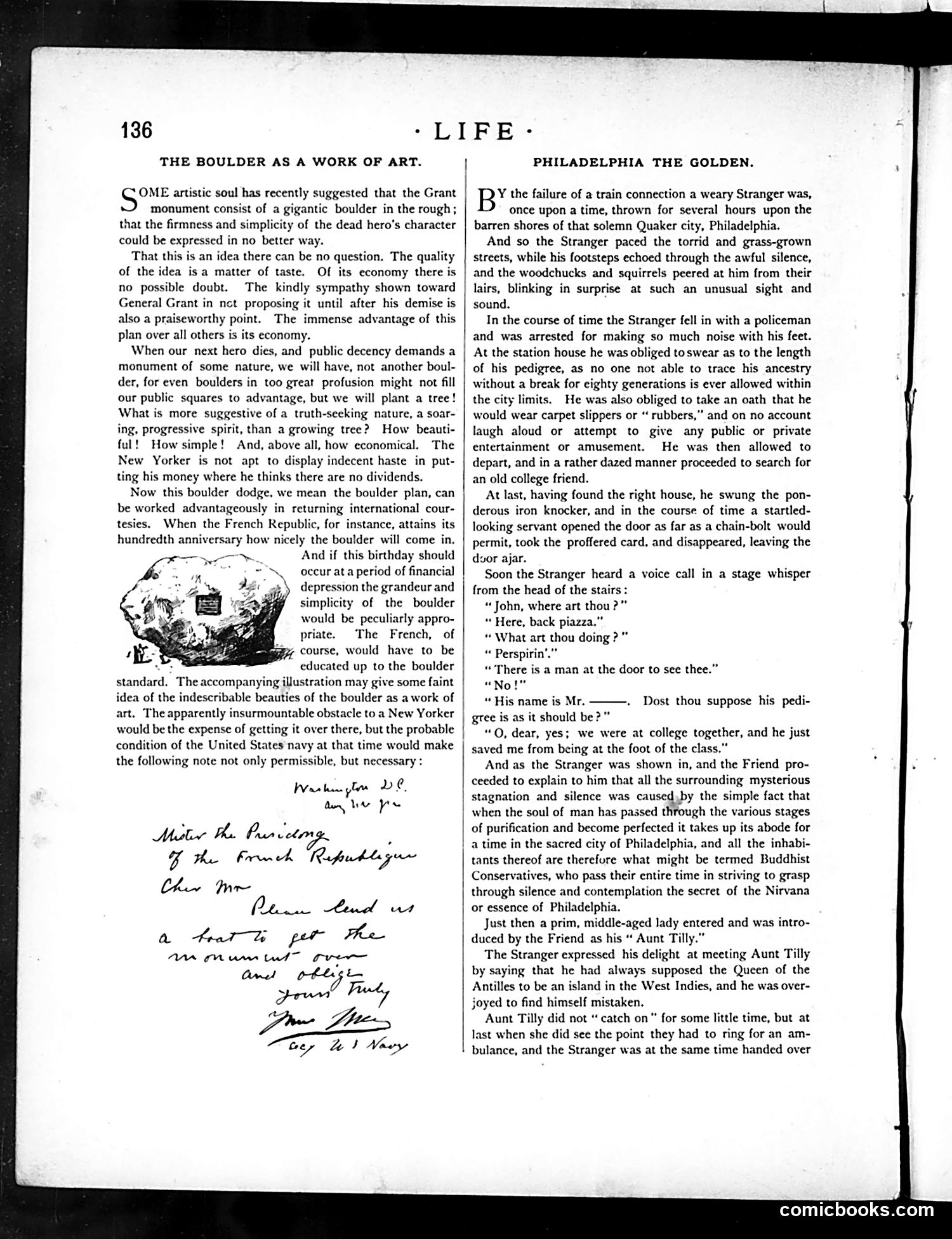
**The Boulder as a Work of Art** (left column): This is satire mocking proposals for a Grant monument. The piece ridicules the idea of a simple boulder as a memorial, sarcastically praising its "economy" and suggesting future heroes be honored with trees instead. The handwritten note at the bottom appears to be a mock diplomatic message to France, likely jesting about sending a boulder as a gift during financial depression—the final line references "the United States navy," implying the nation couldn't afford to transport it. **Philadelphia the Golden** (right column): A humorous short story satirizing Philadelphia's reputation for extreme Quaker restraint and solemnity. A visitor is arrested for making noise with his footsteps, forced to swear genealogical oaths, and required to wear carpet slippers—mocking the city's perceived stuffiness. The dialogue at the end between servant and master uses archaic "thee/thou" speech, further ridiculing Philadelphia's old-fashioned severity and silent, contemplative culture.
📄 Transcribed text from this page (OCR, searchable)
Machine-transcribed from the original scan — historical spelling and the odd misread are preserved.
136 THE BOULDER AS A WORK OF ART. OME artistic soul has recently suggested that the Grant monument consist of a gigantic boulder in the rough; that the firmness and simplicity of the dead hero's character could be expressed in no better way. That this is an idea there can be no question. The quality of the idea is a matter of taste. Of its economy there is no possible doubt. The kindly sympathy shown toward General Grant in nct proposing it until after his demise is also a praiseworthy point. The immense advantage of this plan over all others is its economy. When our next hero dies, and public decency demands a | monument of some nature, we will have, not another boul- der, for even boulders in too great profusion might not fill our public squares to advantage, but we will plant a tree! What is more suggestive of a truth-seeking nature, a soar- ing, progressive spirit, than a growing tree? How beauti- ful! How simple! And, above all, how economical. The New Yorker is not apt to display indecent haste in put- ting his money where he thinks there are no dividends. Now this boulder dodge, we mean the boulder plan, can be worked advantageously in returning international cour- tesies. When the French Republic, for instance, attai s hundredth anniversary how nicely the boulder will come in. And if this birthday should occur ata period of financial depression the grandeur and simplicity of the boulder would be peculiarly appro- priate. The French, of 7 course, would have to be wt educated up to the boulder standard. The accompanying illustration may give some faint idea of the indescribable beauties of the boulder as a work of art. The apparently insurmountable obstacle to a New Yorker would be the expense of getting it over there, but the probable condition of the United States navy at that time would make the following note not only permissible, but necessary : Eye, Werlin pin DE. dle pe G the Frrned Raputtigu Amel oberg i gine Pie ls Gey BI Navy Peety LIFE PHILADELPHIA THE GOLDEN. Y the failure of a train connection a weary Stranger was, once upon a time, thrown for several hours upon the barren shores of that solemn Quaker city, Philadelphia. And so the Stranger paced the torrid and grass-grown streets, while his footsteps echoed through the awful silence, | and the woodchucks and squirrels peered at him from their lairs, blinking in surprise at such an unusual sight and sound, In the course of time the Stranger fell in with a policeman and was arrested for making so much noise with his feet. At the station house he was obliged to swear as to the length of his pedigree, as no one not able to trace his ancestry without a break for eighty generations is ever allowed within the city limits. He was also obliged to take an oath that he would wear carpet slippers or “‘ rubbers,” and on no account laugh aloud or attempt to give any public or private entertainment or amusement. He was then allowed to depart, and in a rather dazed manner proceeded to search for an old college friend. At last, having found the right house, he swung the pon- derous iron knocker, and in the course of time a startled- looking servant opened the door as far as a chain-bolt would permit, took the proffered card, and disappeared, leaving the dyor ajar. Soon the Stranger heard a voice call in a stage whisper from the head of the stairs : “ John, where art thou?” “ Here, back piazza.” “ What art thou doing?” “ Perspirin’.” “There is a man at the door to see thee.” “No!” “ His name is Mr. gree is as it should be “O, dear, yes; we were at college together, and he just saved me from being at the foot of the class.” And as the Stranger was shown in, and the Friend pro- ceeded to explain to him that all the surrounding mysterious stagnation and silence was caused by the simple fact that when the soul of man has passed through the various stages of purification and become perfected it takes up its abode for a time in the sacred city of Philadelphia, and all the inhabi- tants thereof are therefore what might be termed Buddhist Conservatives, who pass their entire time in striving to grasp through silence and contemplation the secret of the Nirvana or essence of Philadelphia. Just then a prim, middle-aged lady entered and was intro- duced by the Friend as his “ Aunt Tilly.” The Stranger expressed his delight at meeting Aunt Tilly by saying that he had always supposed the Queen of the Antilles to be an island in the West Indies, and he was over- joyed to find himself mistaken. Aunt Tilly did not “ catch on” for some little time, but at last when she did see the point they had to ring for an am- bulance, and the Stranger was at the same time handed over Dost thou suppose his pedi- comicbooks.com